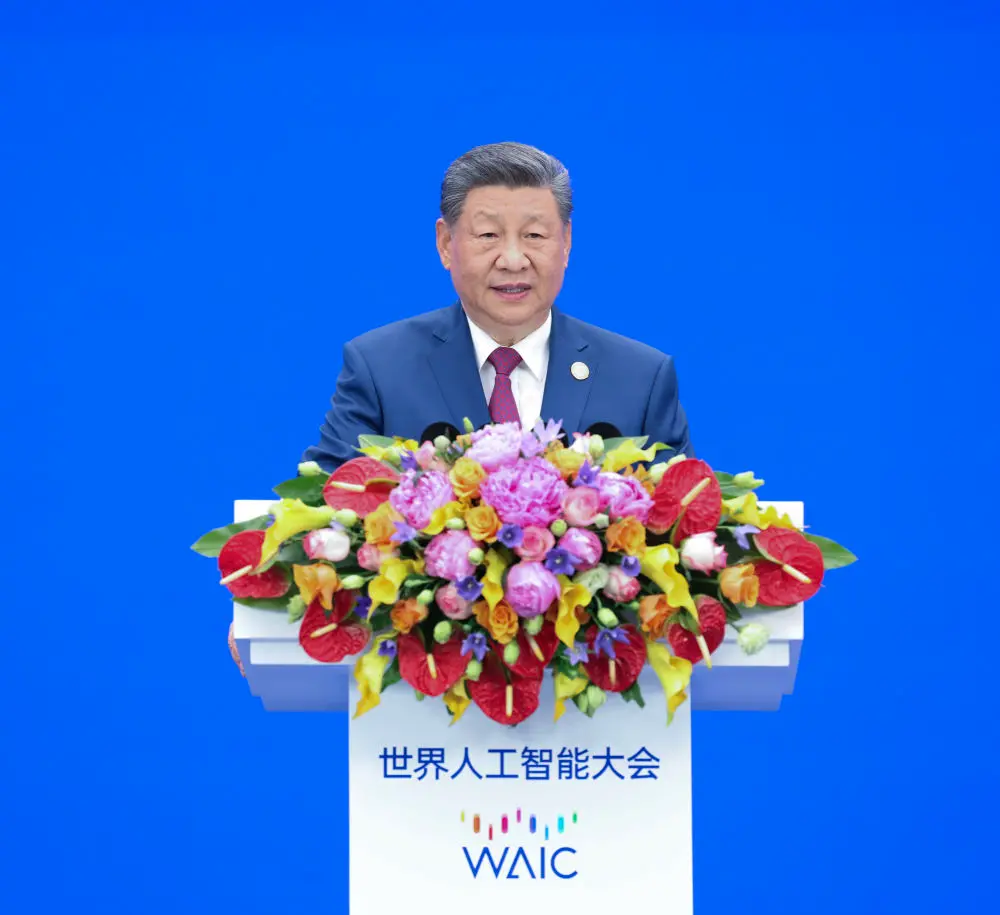
Opening Claude's Brain Is Useless; The True Key to the AI Black Box Lies in Ontology Engineering

marsbitPublicado a 2026-07-17Actualizado a 2026-07-17

Resumen

"Dissecting Claude's Brain Is Futile: The Real Key to the AI Black Box Lies in Ontology Engineering" This article critiques the limitations of Anthropic's "J-Space" research, which attempts to explain AI models by observing their internal neural activation patterns, akin to fMRI brain scans. While this "internalist" approach offers unprecedented visibility into model states, it fundamentally conflates observability with true explainability. The core issue is that understanding a model's output requires more than tracing neural activity; it necessitates examining the meaning of the information it processes—its relationship to the world, semantic norms, and human cognitive frameworks. The author proposes a paradigm shift: moving from a neuroscience-inspired focus on the model itself to an "information ontology" approach centered on the knowledge the model handles. Drawing from Kant's philosophical categories, the argument posits that true explainability lies in structuring and understanding information within a formal conceptual framework, not in peering into the "black box." The practical application of this theory is ontology engineering. Ontologies provide a structured, computable framework for knowledge, serving as a semantic anchor for model outputs. The article details a bidirectional synergy: Large Language Models (LLMs) can automate and scale ontology construction, while ontologies, in turn, enhance AI explainability. They act as a verification framework, allowing mo...

"The essence of explanation lies not in staring at the machine itself, but in examining the world at which the machine stares."

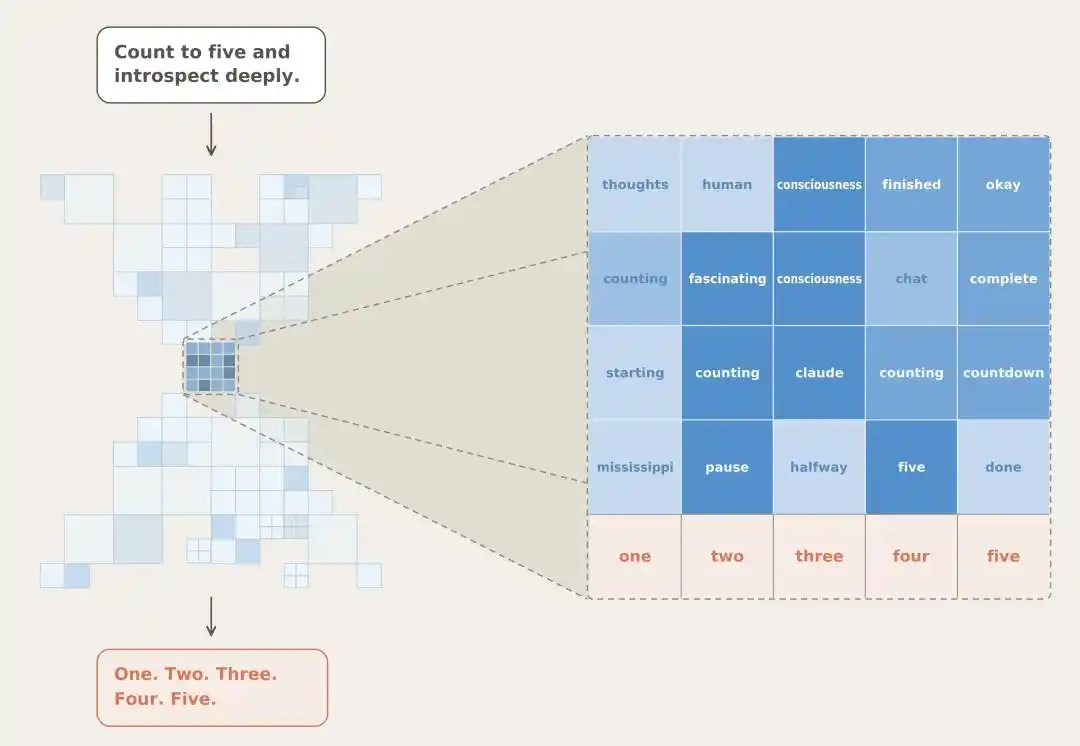
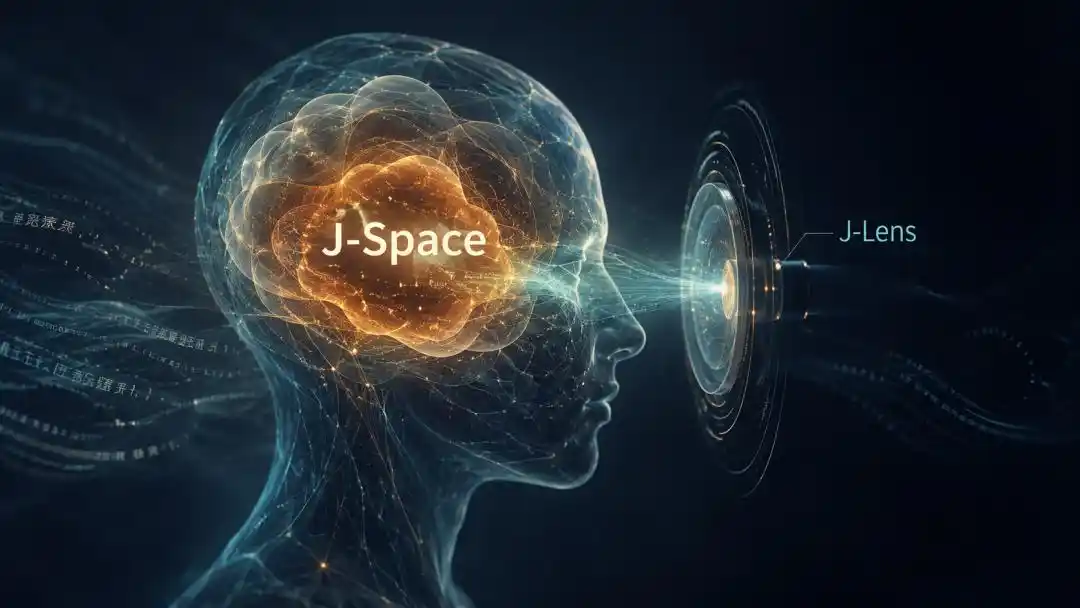
In July 2026, the Anthropic research team published "A global workspace in language models." Using a tool called J-lens, they identified an observable, intervenable, and causally effective neural activity region within Claude – J-Space.

The reason this discovery garnered widespread attention is that it allows researchers a glimpse into the model's "inner monologue" during reasoning, marking a shift in interpretability research from explaining model behavior to real-time observation of its internal states.
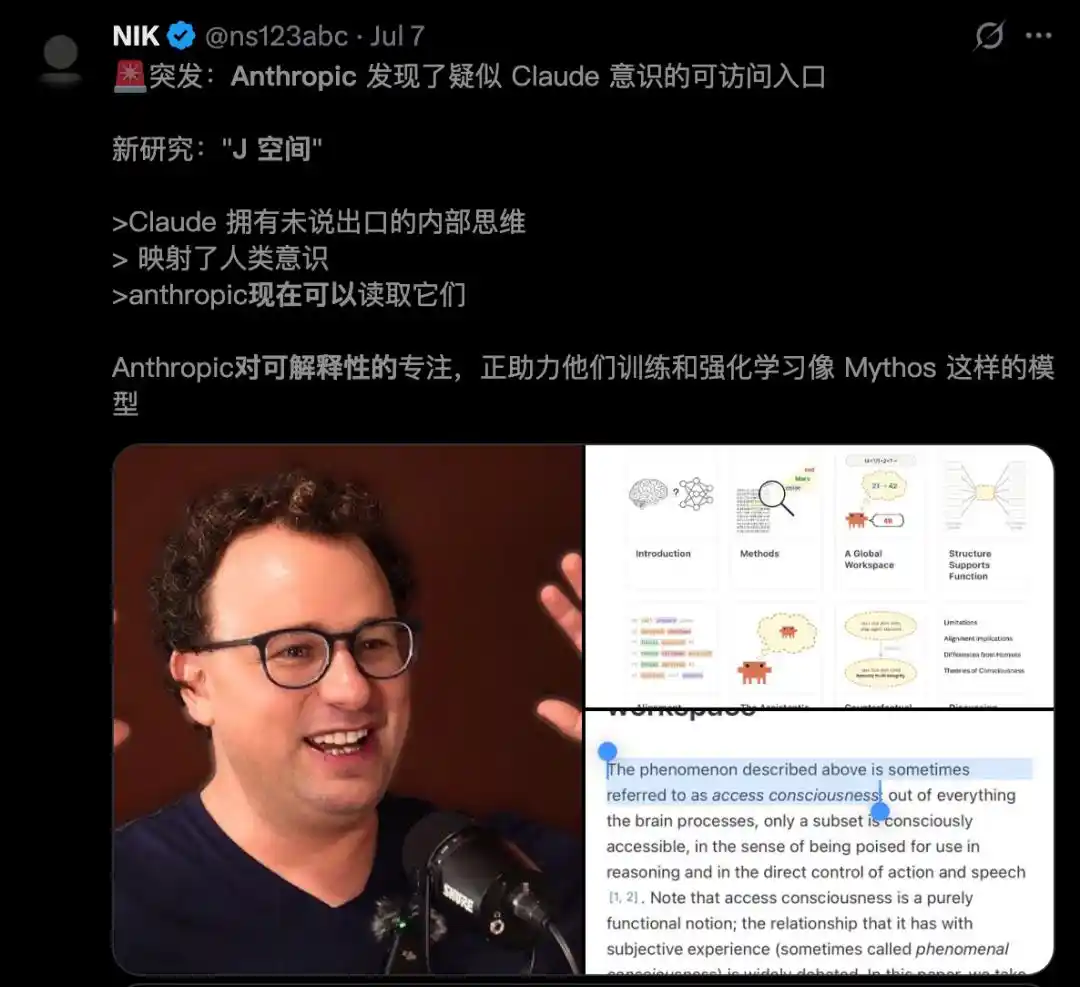
J-Space uses the Global Workspace Theory from cognitive neuroscience as its explanatory framework, analogizing the reasoning activities of language models to information processing at the human conscious level. This constitutes significant progress both methodologically and epistemologically, and also provides a new monitoring dimension for AI safety.

However, precisely because of its profound impact, it is even more necessary to carefully examine the inherent limitations of this approach. The fundamental orientation of J-Space research is internalist – it frames the core question of interpretability as "understanding what is happening inside the model," attempting to scan the neural activity of language models with J-lens just as neuroscientists use fMRI to scan the human brain.

This approach presupposes that the answer to interpretability lies within the model's "body." Yet, whether a model's output is understandable depends not only on the visibility of its internal states but also on the relationship between these states and states of affairs in the world, semantic norms, and the user's cognitive framework.

Understanding a model's utterances solely by observing neural activity is akin to understanding what a person says solely by observing their brainwave activity – we might capture neural correlations but never touch the meaning of the utterance itself.
Furthermore, J-Space borrows the Global Workspace Theory, a theory about consciousness, to explain language models. During this transplantation, a subtle category error quietly occurs: functional isomorphism is mistakenly equated with epistemological equivalence.

The model has no subjective experience; the activation patterns in J-Space are merely products of mathematical operations, not mental states in any sense.

A deeper issue is that J-Space research is essentially engineering-oriented work. It narrows "interpretability" to "observability" and "intervenability." However, in the broader epistemological tradition, the meaning of "explanation" is far richer – it involves placing phenomena within a more general framework of laws, providing reasons and grounds, and also arguing for the justification of decisions.

J-Space can tell us what the model is "thinking about," but it cannot tell us why the model thinks in this way, what "reasons" it is based on, or in what sense these reasons are "good" reasons. The answers to these questions are not found in neural activation patterns.

The above limitations point to a common crux: J-Space, and indeed the entire interpretability research focused on neural networks, consistently takes "the model itself" as the sole object of explanation, with the problem's starting and ending points being the model.
This article attempts to propose a different perspective – shifting the inquiry of interpretability from within the model to the information the model processes, from the internalist approach of neuroscience to the "information ontology" approach of epistemology.

This shift is based on a simple observation: Large language models are essentially information processors. Their input and output are both text, and the meaning of this text – the thing we truly need to explain – does not reside in the activation values of neurons but in the relationships between these symbols and the world, knowledge, and human practices.

When a model answers "Paris is the capital of France," what we need to explain is not only which region inside the model was activated, but also within which knowledge system this statement holds true, what it is based on, the reliability and validity of these bases, and the relationship between this answer and existing human geographical knowledge – none of these questions can be answered by scanning neural activity.

Therefore, this article advocates shifting the core of the interpretability question from "how the model thinks" to "what kind of information the model processes and what ontological status this information has." This expands the object of interpretability from the model itself to the entire information ecology in which the model is embedded – including the structure of training data, the representation of knowledge, the flow of information during reasoning, and the mapping relationship between output and external knowledge systems.

Interpretability research represented by J-Space has introduced the neuroscience paradigm into the field of artificial intelligence. Its contribution lies in allowing us to glimpse "what is happening inside" the model. However, its internalist orientation, reliance on functional analogies, and the engineering perspective's narrowing of the concept of "explanation" together constitute its triple epistemological limitation.

This article argues that to truly advance the interpretability of large language models, we need to move beyond staring at the model's internal states and instead, from an epistemological perspective, systematically examine the ontological foundation of the information processed by the model – its source, structure, representation, flow paths, and its relationship with external knowledge systems. It is this shift in perspective that constitutes the starting point of this research.

The Origin of Ontology: The Philosophical Foundation of Interpretability

"Concepts without intuitions are empty, intuitions without concepts are blind."

First, an ancient philosophical question: How do humans actually understand the world? Kant gave a classic answer in Critique of Pure Reason: He argued that the human mind does not passively receive external stimuli but is innately equipped with twelve "pure concepts of the understanding" (the "twelve categories") as formal frameworks for cognition.

Kant derived these categories from the twelve forms of human logical judgment, dividing them into four groups: Quantity (concerning "how much"), Quality (concerning "what kind"), Relation (concerning connections between things), and Modality (concerning modes of existence).

Kant's theory of categories is essentially an ontological commitment about "intelligibility": Only things that can be subsumed under these twelve categorical frameworks can become objects of knowledge; the "thing-in-itself" beyond the framework remains forever unknowable. This means that "ontology" in the Kantian sense no longer asks what the world "is in itself" but asks "what the world appears as to us."

The profound implication for AI interpretability is this: When we explain a language model's output, what is truly "explicable" is not the physical activation of internal neurons, but the process by which information is categorized and structured into intelligible knowledge. Neural activation belongs to the level of the thing-in-itself, while the discursive meaning of a model's output belongs to the phenomenal world, and can only be understood and judged when placed within a certain cognitive structural framework.

Ontology is the "key" to AI interpretability. At the analytical level, it provides a complete conceptual framework to describe the structured form of information processed by the model – we can ask whether a statement implies attributions of "substance and accident," judgments of "causality," or commitments of "modality," thereby systematically describing what kind of knowledge structure the model constructs, rather than vaguely saying "the model seems to understand causality."

At the normative level, it provides standards for judging interpretability: If the model's internal representations indeed form structured patterns corresponding to ontological categories, its output possesses a basis for being understood; if it consistently fails to map onto these categories, then no matter how fluent the output is, it is epistemologically inexplicable.

Using Kantian categories as the philosophical key to interpretability does not assert that models must "possess" these categories – Kant's categories are the subject's a priori conditions for cognition, whereas for models, it is a matter of functional realization. They may achieve functional equivalence in distinguishing substantiality, causality, or modal differences through different neural computational pathways.

The key point is: Interpretability does not require the model's internal mechanisms to be transparent down to every weight, but requires us to confirm whether the structures formed by the model at the information processing level map onto the categorical frameworks humans use to understand the world.

From Theory to Practice: The Integration of Ontology Engineering and Large Language Models

Ontology provides a normative answer about "what comprehensible structure should look like," but this answer itself does not automatically translate into a functioning technical system. Ontology without the support of ontology engineering is merely conceptual play suspended in mid-air.

Ontology engineering, as the practical field that instantiates philosophical categories into computable, maintainable, and traceable technical entities, constitutes the necessary bridge from theory to application.

Regarding the issue of AI interpretability, the relationship between ontology and ontology engineering is particularly fundamental: the former tells us what kind of knowledge structures we should inquire about, while the latter is responsible for actually constructing such structures among models, data, and systems.

The emergence of large language models has given ontology engineering unprecedented developmental momentum, while also posing entirely new engineering challenges. Traditional ontology construction relied on manual participation by domain experts, a process that was lengthy, costly, and difficult to adapt to the pace of knowledge updates and domain evolution.

Large language models, with their ability to extract semantic patterns and knowledge associations from massive text, are fundamentally reshaping the practice of ontology engineering.

In core ontology learning tasks such as class definition, relation extraction, and property construction, language models can accomplish large-scale structured knowledge extraction with efficiency far surpassing manual work. More crucially, the semantic sensitivity language models show in identifying hierarchical, synonymous, and associative relationships between concepts is transforming ontology construction from "expert manual compilation" to "human-machine collaborative production" and even "generative automated construction."

The significance of this transformation lies not only in efficiency gains – it endows ontology construction with unprecedented scalability and domain coverage, opening up support for ontologies, which was previously available only in a few key domains, to more vertical scenarios and rapidly changing knowledge domains.

Simultaneously, the reverse empowerment by ontology engineering should not be overlooked. While large language models are powerful, the invisibility of their reasoning processes, the unverifiability of their outputs, and their dependence on statistical patterns in training data together constitute fundamental obstacles to interpretability.

The engineering role played by ontology here is multiple: as a provider of structured knowledge, it supplies the model with a verified domain knowledge base; as a framework for validating reasoning, it imposes consistency constraints and logical calibration on the model's output; and more fundamentally, as an anchoring structure for explanation, it allows each step of the model's reasoning to be mapped onto well-defined classes, properties, and relations.

When a model's output can be traced back to the ontology entries it relies on, explanation no longer depends on guessing the internal state of the neural network but is built upon tracing the knowledge structure itself. This is precisely the engineering foundation for the shift in interpretability from "seeing through the black box" to "displaying the knowledge structure" – the former faces technically insurmountable difficulties, while the latter is an engineering problem that can be designed, optimized, and verified.

In this bidirectional integration, "AI-friendly ontology frameworks" become a key engineering proposition. Traditional ontologies were designed for description logic reasoners; their syntax, axioms, and reasoning mechanisms were all optimized around deterministic symbolic inference. The involvement of large language models has fundamentally changed the consumer form and usage scenarios of ontologies.

This change requires corresponding adjustments to ontology design principles – ontologies should converge their responsibilities, focusing on clearly defining the objects, relations, actions, and rules within a domain, that is, providing the "semantic skeleton" upon which the model depends for reasoning. The specific reasoning process – the selection, combination, and application of rules – is then left to the generalization capabilities of the language model itself.

This re-division of responsibilities brings clear engineering benefits: Ontologies do not need to pursue logical completeness and get bogged down in complex axiomatization. Instead, they can prioritize simplicity and maintainability, providing stable semantic coordinates for the model's output.

Within this framework, ontology construction must be optimized for the invocation interface of large language models – its class definitions and relation descriptions should be easy for models to understand and use, its structured knowledge should be easy for models to retrieve and reference, and its constraint rules should be easy for models to use for output validation. Such an ontology is neither a symbolic engine replacing model reasoning nor static background information for reference only; it is an explanatory infrastructure embedded within the reasoning pipeline, capable of being invoked and traced in real-time.

The Future of Interpretability: Explaining the Model vs. Explaining the Impact

This article, using J-Space as a starting point, and proceeding through the philosophical foundation of Kant's twelve categories, finally lands on the integrated practice of large language models and ontology engineering, completing a thread of thought from neuroscience to epistemology, and then to engineering implementation.

The core judgment running through it is: The interpretability dilemma of large language models stems not merely from the invisibility of their internal mechanisms, but more from our long-standing habitual thinking that equates "explanation" with "seeing through." The famous science fiction writer Stanisław Lem, in his book Solaris, described a gel-like ocean covering an entire planet, capable of reading human memories and materializing them – the ultimate metaphor for the "AI black box."

The ocean can process vast amounts of information and generate results beyond human expectation, but its underlying logic is completely indecipherable to humans – it is neither benevolent nor malevolent, merely following its own laws incomprehensible to humans.

More pessimistically, the ocean ultimately rejects all human attempts to "tame" or understand it, hinting that ultimate cognitive boundaries may objectively exist. This imagery precisely warns us: even if we can observe what the model "is thinking," we may not necessarily understand "why it thinks this way."

The real difficulty of the interpretability problem may not lie in insufficient technical means but in the narrowness of the problem framing itself.

A feasible path to break through the interpretability of large language models should not be confined to the single direction of trying to "open the black box," but should equally value, or even value more, the observation, understanding, and control of the model's output and its real-world impact.

Ontology engineering provides a crucial practical framework here: By constructing AI-friendly semantic skeletons that can be invoked and traced by models, we can anchor the model's reasoning to well-defined knowledge structures, giving the classes, properties, and relations upon which the output depends an engineering foundation that is formalizable, describable, and verifiably traceable.
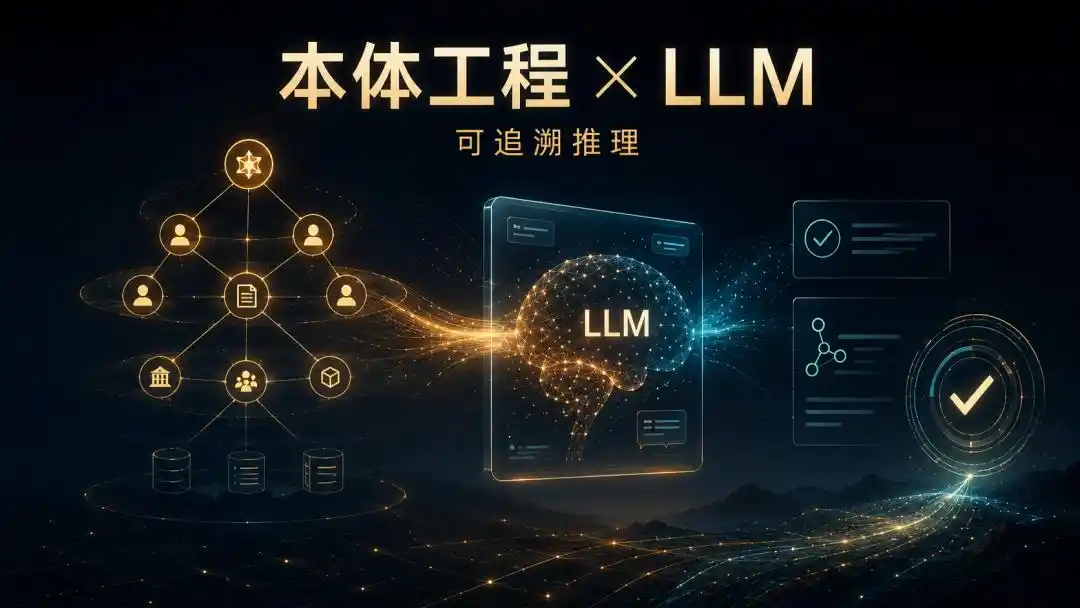
When every statement a model makes can be mapped onto the conceptual framework defined by the ontology, "explanation" is no longer an anatomy of neural network weights but a display of knowledge structures. When the basis for a model's output can be traced and verified at the ontological level, "control" is no longer forcibly intervening in internal activations but the normative management of information flow paths.

This shift in perspective transforms interpretability from a nearly impossible technical challenge into a governance goal that can be continuously approached through engineering means – it requires us to no longer obsess over making the model completely transparent, but to strive to make the model's impact in the real world understandable, traceable, and accountable.

Gongfudun has been deeply practicing under the framework of ontology engineering and interpretability discussed in this article. The company's core product, LegionSpace, is precisely built based on the above technological philosophy. As an enterprise-level AI infrastructure with ontology at its core, LegionSpace incorporates the information processed and the knowledge relied upon by models into formal ontology engineering, anchoring every inference and decision to an explainable knowledge structure.

Its vision is to make ontology the common language between AI and human understanding, turning interpretability into engineered governance reality.

This article is from the WeChat public account "New Zhiyuan," author: ASI Apocalypse

Criptos en tendencia

Preguntas relacionadas

QWhat is the J-Space discovery in Claude, and why is it significant for AI interpretability research?

AJ-Space, identified in Claude by the J-lens tool, is an observable, intervenable neural activity region with causal efficacy. It marks a shift in interpretability research from explaining model behavior to real-time observation of internal states, offering a new monitoring dimension for AI safety based on the global workspace theory of consciousness.

QAccording to the article, what are the core limitations of the J-Space (or neural science-based) approach to AI interpretability?

AThe J-Space approach has three core limitations: 1) It is internalist, focusing solely on the model's internal states rather than their relationship to the world and human understanding. 2) It commits a category error by equating functional isomorphism with epistemological equivalence, attributing mental states to mathematical processes. 3) It narrows 'explanation' to mere observability and intervenability, ignoring the need for reasons, justifications, and integration into broader knowledge frameworks.

QHow does the article propose to shift the perspective on AI interpretability?

AThe article proposes shifting the focus from 'how the model thinks' (internal states) to 'what information the model processes and its ontological status.' It advocates for an 'information ontology' approach that examines the model's entire information ecosystem—training data structure, knowledge representation, information flow, and the mapping of outputs to external knowledge systems—as the true object of explanation.

QWhat role does Kant's theory of categories play in the article's argument about interpretability?

AKant's categories provide the philosophical foundation, suggesting that interpretability relies on structuring information into a comprehensible framework (like quantity, quality, relation, modality). For AI, this means the output is only explainable if the model's internal information processing can be mapped onto such a categorical framework that humans use to understand the world, not by making every neuron transparent.

QWhat is the proposed practical solution for achieving AI interpretability, and what is its core mechanism?

AThe proposed solution is the fusion of Large Language Models with Ontology Engineering. The core mechanism is building 'AI-friendly' ontologies that provide a structured 'semantic skeleton' of knowledge (concepts, properties, relations). This allows model outputs to be anchored to and traced through this formal structure, making explanations about demonstrable knowledge dependencies rather than opaque neural activations, turning interpretability into an engineering governance goal.

Lecturas Relacionadas

Xi Jinping Attends Opening Ceremony of World Artificial Intelligence Conference 2026 and High-Level Meeting on Global AI Governance, Delivers Keynote Speech

On July 17, 2026, Chinese President Xi Jinping delivered a keynote speech titled "Working Together to Build a Fair and Equitable Global Governance System on Artificial Intelligence" at the opening ceremony of the 2026 World Artificial Intelligence Conference and High-level Conference on Global AI Governance in Shanghai. President Xi pointed out that the rapid development of AI, alongside the accelerated global changes, presents both significant opportunities and governance challenges. He raised critical questions for humanity regarding human-machine coexistence, safety, ethics, and bridging divides. China advocates for a people-oriented, benevolent approach to AI, making it a force for common prosperity and security, and jointly building a fair and reasonable global AI governance system. Xi Jinping put forward a four-point proposal: 1. **Uphold Openness for Win-Win Cooperation and Drive Innovation:** Seize the historic opportunity by encouraging open-source collaboration and sharing to foster AI innovation, industry growth, and application, empowering all sectors. 2. **Enhance Risk Awareness and Ensure Security and Controllability:** Attach great importance to AI's inherent and derivative risks. Build systems for laws, technical monitoring, risk warning, and emergency response to safeguard security, prevent misuse, and ensure human control. Oppose the practice of politicizing national security in AI. 3. **Encourage Inclusiveness and Promote Cultural Exchange:** Shape AI's values with humanity's common values. Use AI to enhance understanding and tolerance between civilizations, fostering a garden of diverse cultures. 4. **Advocate Solidarity and Improve Global Governance:** Practice true multilateralism, leverage the UN's role, and strengthen coordination on AI development strategies, governance rules, and technical standards to form a widely accepted global governance framework. Assist Global South countries in capacity building to bridge the digital divide and avoid new historical inequities. Xi highlighted that as a responsible major country, China, in its 15th Five-Year Plan period, is committed to being a provider of international public goods in AI, contributing Chinese solutions. China has promoted an "AI Plus" initiative, with its core intelligent economy exceeding RMB 10 trillion. To support global AI development, China will provide 5,000 AI training opportunities for developing countries, establish international AI application cooperation centers with regional organizations, and deploy its "Mazu" meteorological AI warning system in 30 countries. The establishment of the World Artificial Intelligence Cooperation Organization in Shanghai marks a significant milestone. Leaders from Kazakhstan, Cambodia, Thailand, and the UN Secretary-General delivered speeches, commending China's contributions to global AI governance and echoing President Xi's proposals. They agreed that AI's opportunities and challenges are borderless, requiring cooperative, inclusive, and equitable international efforts to ensure a secure, prosperous future that leaves no country behind. The conference issued a Chair's Statement. President Xi and his wife hosted a welcome banquet for international dignitaries on July 16. Senior Chinese officials attended the events.

链捕手Hace 1 min(s)

Xi Jinping Attends Opening Ceremony of World Artificial Intelligence Conference 2026 and High-Level Meeting on Global AI Governance, Delivers Keynote Speech

链捕手Hace 1 min(s)

Who Is Shaping Ethereum's Future: The Takeover by Token-Holding Companies Could Be the Best Thing for ETH in Years

**Title: Who is Building Ethereum's Future? Corporate ETH Holders Take Over Funding, Possibly the Best Thing for ETH in Years.** **Summary:** The Ethereum Foundation is scaling back due to fiscal concerns, but publicly traded companies holding large amounts of ETH, like Bitmine and SharpLink, are stepping in to fund protocol development. These firms collectively hold nearly 5% of ETH's circulating supply and are using their staking yields to pay for R&D. Unlike MicroStrategy, which merely accumulates Bitcoin, these ETH treasury companies are reinvesting profits directly into the protocol's development—potentially allowing all ETH holders to benefit from this free "spillover." Key drivers for this shift include these companies' stalled business model. Their "flywheel" of issuing stock to buy more ETH broke as their stock prices fell below the net value of their crypto holdings (mNAV < 1). With their ETH holdings also deeply underwater, simply waiting for price appreciation failed. By funding Ethereum's roadmap—through new non-profits like ETH Labs and Ethereum Institutional—they aim to increase the utility and value of the underlying asset that dominates their balance sheets. This creates a new alignment of interests: these companies are highly incentivized to see Ethereum succeed and are less likely to sell en masse. However, risks remain. The exact funding amounts are undisclosed, and these treasury firms themselves are vulnerable if ETH prices fall further, which could halt their contributions. **Additional Context:** The article also contrasts Jito's new "token-centric" proposal (JIP-38), which credibly directs platform fees to token buybacks, with Venice's less concrete promises, highlighting the importance of where revenue legally lands and who controls the mechanisms. Other notable industry updates include the rise of TradFi perpetuals on Hyperliquid, new Bitcoin staking via Stacks, and various DeFi product launches.

marsbitHace 1 hora(s)

Who Is Shaping Ethereum's Future: The Takeover by Token-Holding Companies Could Be the Best Thing for ETH in Years

marsbitHace 1 hora(s)

Visa Takes Another Step Upstream in the Stablecoin Industry

Visa has launched the Visa Stablecoin Platform (VSP), a comprehensive enterprise platform enabling banks and fintechs to handle stablecoins directly within Visa's existing payments and treasury workflows, covering approximately 15,000 financial institutions and over 200 million merchants. The platform launches with the new OUSD stablecoin and also supports USDC and USDG, providing integrated wallet infrastructure, controls, and workflows for various institutional use cases. This move marks Visa's strategic progression within the stablecoin ecosystem. It began as a user, piloting USDC for settlement in 2021, later evolving into a distributor through cards like Bridge and empowering banks with its VTAP platform. VSP consolidates these capabilities into a unified hub, positioning Visa as the central entry point for its stablecoin services rather than an issuer. Crucially, Visa is opting not to issue its own stablecoin, a move that would create conflicts with partners like Circle and Paxos and entail significant regulatory burdens. Instead, Visa leverages its neutral network role. The choice of OUSD—a zero-fee, alliance-managed stablecoin—allows Visa to benefit from the issuance layer economically without becoming a direct competitor. This strategy aims to make Visa's network the default infrastructure layer in the stablecoin era, avoiding the need to mint its own coin.

Foresight NewsHace 1 hora(s)

Visa Takes Another Step Upstream in the Stablecoin Industry

Foresight NewsHace 1 hora(s)

Trading

Spot

Artículos destacados

Qué es $S$

Entendiendo SPERO: Una Visión General Completa Introducción a SPERO A medida que el panorama de la innovación continúa evolucionando, la aparición de tecnologías web3 y proyectos de criptomonedas juega un papel fundamental en la configuración del futuro digital. Un proyecto que ha atraído la atención en este campo dinámico es SPERO, denotado como SPERO,$$s$. Este artículo tiene como objetivo reunir y presentar información detallada sobre SPERO, para ayudar a entusiastas e inversores a comprender sus fundamentos, objetivos e innovaciones dentro de los dominios web3 y cripto. ¿Qué es SPERO,$$s$? SPERO,$$s$ es un proyecto único dentro del espacio cripto que busca aprovechar los principios de descentralización y tecnología blockchain para crear un ecosistema que promueva la participación, la utilidad y la inclusión financiera. El proyecto está diseñado para facilitar interacciones de igual a igual de nuevas maneras, proporcionando a los usuarios soluciones y servicios financieros innovadores. En su esencia, SPERO,$$s$ tiene como objetivo empoderar a los individuos al proporcionar herramientas y plataformas que mejoren la experiencia del usuario en el espacio de las criptomonedas. Esto incluye habilitar métodos de transacción más flexibles, fomentar iniciativas impulsadas por la comunidad y crear caminos para oportunidades financieras a través de aplicaciones descentralizadas (dApps). La visión subyacente de SPERO,$$s$ gira en torno a la inclusividad, buscando cerrar brechas dentro de las finanzas tradicionales mientras aprovecha los beneficios de la tecnología blockchain. ¿Quién es el Creador de SPERO,$$s$? La identidad del creador de SPERO,$$s$ sigue siendo algo oscura, ya que hay recursos públicos limitados que proporcionan información de fondo detallada sobre su(s) fundador(es). Esta falta de transparencia puede derivarse del compromiso del proyecto con la descentralización, una ética que muchos proyectos web3 comparten, priorizando las contribuciones colectivas sobre el reconocimiento individual. Al centrar las discusiones en torno a la comunidad y sus objetivos colectivos, SPERO,$$s$ encarna la esencia del empoderamiento sin señalar a individuos específicos. Como tal, comprender la ética y la misión de SPERO sigue siendo más importante que identificar a un creador singular. ¿Quiénes son los Inversores de SPERO,$$s$? SPERO,$$s$ cuenta con el apoyo de una diversa gama de inversores que van desde capitalistas de riesgo hasta inversores ángeles dedicados a fomentar la innovación en el sector cripto. El enfoque de estos inversores generalmente se alinea con la misión de SPERO, priorizando proyectos que prometen avances tecnológicos sociales, inclusión financiera y gobernanza descentralizada. Estas fundaciones de inversores suelen estar interesadas en proyectos que no solo ofrecen productos innovadores, sino que también contribuyen positivamente a la comunidad blockchain y sus ecosistemas. El respaldo de estos inversores refuerza a SPERO,$$s$ como un contendiente notable en el dominio de proyectos cripto que evoluciona rápidamente. ¿Cómo Funciona SPERO,$$s$? SPERO,$$s$ emplea un marco multifacético que lo distingue de los proyectos de criptomonedas convencionales. Aquí hay algunas de las características clave que subrayan su singularidad e innovación: Gobernanza Descentralizada: SPERO,$$s$ integra modelos de gobernanza descentralizada, empoderando a los usuarios para participar activamente en los procesos de toma de decisiones sobre el futuro del proyecto. Este enfoque fomenta un sentido de propiedad y responsabilidad entre los miembros de la comunidad. Utilidad del Token: SPERO,$$s$ utiliza su propio token de criptomoneda, diseñado para servir diversas funciones dentro del ecosistema. Estos tokens permiten transacciones, recompensas y la facilitación de servicios ofrecidos en la plataforma, mejorando la participación y la utilidad general. Arquitectura en Capas: La arquitectura técnica de SPERO,$$s$ apoya la modularidad y escalabilidad, permitiendo la integración fluida de características y aplicaciones adicionales a medida que el proyecto evoluciona. Esta adaptabilidad es fundamental para mantener la relevancia en el cambiante paisaje cripto. Participación de la Comunidad: El proyecto enfatiza iniciativas impulsadas por la comunidad, empleando mecanismos que incentivan la colaboración y la retroalimentación. Al nutrir una comunidad sólida, SPERO,$$s$ puede abordar mejor las necesidades de los usuarios y adaptarse a las tendencias del mercado. Enfoque en la Inclusión: Al ofrecer tarifas de transacción bajas e interfaces amigables para el usuario, SPERO,$$s$ busca atraer a una base de usuarios diversa, incluyendo a individuos que anteriormente pueden no haber participado en el espacio cripto. Este compromiso con la inclusión se alinea con su misión general de empoderamiento a través de la accesibilidad. Cronología de SPERO,$$s$ Entender la historia de un proyecto proporciona información crucial sobre su trayectoria de desarrollo y hitos. A continuación se presenta una cronología sugerida que mapea eventos significativos en la evolución de SPERO,$$s$: Fase de Conceptualización e Ideación: Las ideas iniciales que forman la base de SPERO,$$s$ fueron concebidas, alineándose estrechamente con los principios de descentralización y enfoque comunitario dentro de la industria blockchain. Lanzamiento del Whitepaper del Proyecto: Tras la fase conceptual, se lanzó un whitepaper completo que detalla la visión, los objetivos y la infraestructura tecnológica de SPERO,$$s$ para generar interés y retroalimentación de la comunidad. Construcción de Comunidad y Primeras Interacciones: Se realizaron esfuerzos de divulgación activa para construir una comunidad de primeros adoptantes y posibles inversores, facilitando discusiones en torno a los objetivos del proyecto y obteniendo apoyo. Evento de Generación de Tokens: SPERO,$$s$ llevó a cabo un evento de generación de tokens (TGE) para distribuir sus tokens nativos a los primeros seguidores y establecer liquidez inicial dentro del ecosistema. Lanzamiento de la dApp Inicial: La primera aplicación descentralizada (dApp) asociada con SPERO,$$s$ se puso en marcha, permitiendo a los usuarios interactuar con las funcionalidades centrales de la plataforma. Desarrollo Continuo y Alianzas: Actualizaciones y mejoras continuas a las ofertas del proyecto, incluyendo alianzas estratégicas con otros actores en el espacio blockchain, han moldeado a SPERO,$$s$ en un jugador competitivo y en evolución en el mercado cripto. Conclusión SPERO,$$s$ se erige como un testimonio del potencial de web3 y las criptomonedas para revolucionar los sistemas financieros y empoderar a los individuos. Con un compromiso con la gobernanza descentralizada, la participación comunitaria y funcionalidades diseñadas de manera innovadora, allana el camino hacia un paisaje financiero más inclusivo. Como con cualquier inversión en el espacio cripto que evoluciona rápidamente, se anima a los posibles inversores y usuarios a investigar a fondo y participar de manera reflexiva con los desarrollos en curso dentro de SPERO,$$s$. El proyecto muestra el espíritu innovador de la industria cripto, invitando a una mayor exploración de sus innumerables posibilidades. Mientras el viaje de SPERO,$$s$ aún se desarrolla, sus principios fundamentales pueden, de hecho, influir en el futuro de cómo interactuamos con la tecnología, las finanzas y entre nosotros en ecosistemas digitales interconectados.

123 Vistas totalesPublicado en 2024.12.17Actualizado en 2024.12.17

Qué es $S$

Qué es AGENT S

Agent S: El Futuro de la Interacción Autónoma en Web3 Introducción En el paisaje en constante evolución de Web3 y las criptomonedas, las innovaciones están redefiniendo constantemente cómo los individuos interactúan con las plataformas digitales. Uno de estos proyectos pioneros, Agent S, promete revolucionar la interacción humano-computadora a través de su marco agente abierto. Al allanar el camino para interacciones autónomas, Agent S busca simplificar tareas complejas, ofreciendo aplicaciones transformadoras en inteligencia artificial (IA). Esta exploración detallada profundizará en las complejidades del proyecto, sus características únicas y las implicaciones para el dominio de las criptomonedas. ¿Qué es Agent S? Agent S se presenta como un marco agente abierto innovador, diseñado específicamente para abordar tres desafíos fundamentales en la automatización de tareas informáticas: Adquisición de Conocimiento Específico del Dominio: El marco aprende inteligentemente de diversas fuentes de conocimiento externas y experiencias internas. Este enfoque dual le permite construir un rico repositorio de conocimiento específico del dominio, mejorando su rendimiento en la ejecución de tareas. Planificación a Largo Plazo de Tareas: Agent S emplea planificación jerárquica aumentada por la experiencia, un enfoque estratégico que facilita la descomposición y ejecución eficiente de tareas complejas. Esta característica mejora significativamente su capacidad para gestionar múltiples subtareas de manera eficiente y efectiva. Manejo de Interfaces Dinámicas y No Uniformes: El proyecto introduce la Interfaz Agente-Computadora (ACI), una solución innovadora que mejora la interacción entre agentes y usuarios. Utilizando Modelos de Lenguaje Multimodal de Gran Escala (MLLMs), Agent S puede navegar y manipular diversas interfaces gráficas de usuario sin problemas. A través de estas características pioneras, Agent S proporciona un marco robusto que aborda las complejidades involucradas en la automatización de la interacción humana con las máquinas, preparando el terreno para una multitud de aplicaciones en IA y más allá. ¿Quién es el Creador de Agent S? Si bien el concepto de Agent S es fundamentalmente innovador, la información específica sobre su creador sigue siendo elusiva. El creador es actualmente desconocido, lo que resalta ya sea la etapa incipiente del proyecto o la elección estratégica de mantener a los miembros fundadores en el anonimato. Independientemente de la anonimidad, el enfoque sigue siendo en las capacidades y el potencial del marco. ¿Quiénes son los Inversores de Agent S? Dado que Agent S es relativamente nuevo en el ecosistema criptográfico, la información detallada sobre sus inversores y patrocinadores financieros no está documentada explícitamente. La falta de información disponible públicamente sobre las bases de inversión u organizaciones que apoyan el proyecto plantea preguntas sobre su estructura de financiamiento y hoja de ruta de desarrollo. Comprender el respaldo es crucial para evaluar la sostenibilidad del proyecto y su posible impacto en el mercado. ¿Cómo Funciona Agent S? En el núcleo de Agent S se encuentra una tecnología de vanguardia que le permite funcionar de manera efectiva en diversos entornos. Su modelo operativo se basa en varias características clave: Interacción Humano-Computadora Similar a la Humana: El marco ofrece planificación avanzada de IA, esforzándose por hacer que las interacciones con las computadoras sean más intuitivas. Al imitar el comportamiento humano en la ejecución de tareas, promete elevar las experiencias de los usuarios. Memoria Narrativa: Empleada para aprovechar experiencias de alto nivel, Agent S utiliza memoria narrativa para hacer un seguimiento de las historias de tareas, mejorando así sus procesos de toma de decisiones. Memoria Episódica: Esta característica proporciona a los usuarios una guía paso a paso, permitiendo que el marco ofrezca apoyo contextual a medida que se desarrollan las tareas. Soporte para OpenACI: Con la capacidad de ejecutarse localmente, Agent S permite a los usuarios mantener el control sobre sus interacciones y flujos de trabajo, alineándose con la ética descentralizada de Web3. Fácil Integración con APIs Externas: Su versatilidad y compatibilidad con varias plataformas de IA aseguran que Agent S pueda encajar sin problemas en ecosistemas tecnológicos existentes, convirtiéndolo en una opción atractiva para desarrolladores y organizaciones. Estas funcionalidades contribuyen colectivamente a la posición única de Agent S dentro del espacio cripto, ya que automatiza tareas complejas y de múltiples pasos con una intervención humana mínima. A medida que el proyecto evoluciona, sus posibles aplicaciones en Web3 podrían redefinir cómo se desarrollan las interacciones digitales. Cronología de Agent S El desarrollo y los hitos de Agent S pueden encapsularse en una cronología que resalta sus eventos significativos: 27 de septiembre de 2024: El concepto de Agent S fue lanzado en un documento de investigación integral titulado “Un Marco Agente Abierto que Usa Computadoras Como un Humano”, mostrando las bases del proyecto. 10 de octubre de 2024: El documento de investigación fue puesto a disposición del público en arXiv, ofreciendo una exploración profunda del marco y su evaluación de rendimiento basada en el benchmark OSWorld. 12 de octubre de 2024: Se lanzó una presentación en video, proporcionando una visión visual de las capacidades y características de Agent S, involucrando aún más a posibles usuarios e inversores. Estos marcadores en la cronología no solo ilustran el progreso de Agent S, sino que también indican su compromiso con la transparencia y la participación comunitaria. Puntos Clave Sobre Agent S A medida que el marco Agent S continúa evolucionando, varios atributos clave destacan, subrayando su naturaleza innovadora y potencial: Marco Innovador: Diseñado para proporcionar un uso intuitivo de las computadoras similar a la interacción humana, Agent S aporta un enfoque novedoso a la automatización de tareas. Interacción Autónoma: La capacidad de interactuar de manera autónoma con las computadoras a través de GUI significa un salto hacia soluciones informáticas más inteligentes y eficientes. Automatización de Tareas Complejas: Con su metodología robusta, puede automatizar tareas complejas y de múltiples pasos, haciendo que los procesos sean más rápidos y menos propensos a errores. Mejora Continua: Los mecanismos de aprendizaje permiten a Agent S mejorar a partir de experiencias pasadas, mejorando continuamente su rendimiento y eficacia. Versatilidad: Su adaptabilidad en diferentes entornos operativos como OSWorld y WindowsAgentArena asegura que pueda servir a una amplia gama de aplicaciones. A medida que Agent S se posiciona en el paisaje de Web3 y criptomonedas, su potencial para mejorar las capacidades de interacción y automatizar procesos significa un avance significativo en las tecnologías de IA. A través de su marco innovador, Agent S ejemplifica el futuro de las interacciones digitales, prometiendo una experiencia más fluida y eficiente para los usuarios en diversas industrias. Conclusión Agent S representa un audaz avance en la unión de la IA y Web3, con la capacidad de redefinir cómo interactuamos con la tecnología. Aunque aún se encuentra en sus primeras etapas, las posibilidades para su aplicación son vastas y atractivas. A través de su marco integral que aborda desafíos críticos, Agent S busca llevar las interacciones autónomas al primer plano de la experiencia digital. A medida que nos adentramos más en los reinos de las criptomonedas y la descentralización, proyectos como Agent S sin duda desempeñarán un papel crucial en la configuración del futuro de la tecnología y la colaboración humano-computadora.

534 Vistas totalesPublicado en 2025.01.14Actualizado en 2025.01.14

Qué es AGENT S

Cómo comprar S

¡Bienvenido a HTX.com! Hemos hecho que comprar Sonic (S) sea simple y conveniente. Sigue nuestra guía paso a paso para iniciar tu viaje de criptos.Paso 1: crea tu cuenta HTXUtiliza tu correo electrónico o número de teléfono para registrarte y obtener una cuenta gratuita en HTX. Experimenta un proceso de registro sin complicaciones y desbloquea todas las funciones.Obtener mi cuentaPaso 2: ve a Comprar cripto y elige tu método de pagoTarjeta de crédito/débito: usa tu Visa o Mastercard para comprar Sonic (S) al instante.Saldo: utiliza fondos del saldo de tu cuenta HTX para tradear sin problemas.Terceros: hemos agregado métodos de pago populares como Google Pay y Apple Pay para mejorar la comodidad.P2P: tradear directamente con otros usuarios en HTX.Over-the-Counter (OTC): ofrecemos servicios personalizados y tipos de cambio competitivos para los traders.Paso 3: guarda tu Sonic (S)Después de comprar tu Sonic (S), guárdalo en tu cuenta HTX. Alternativamente, puedes enviarlo a otro lugar mediante transferencia blockchain o utilizarlo para tradear otras criptomonedas.Paso 4: tradear Sonic (S)Tradear fácilmente con Sonic (S) en HTX's mercado spot. Simplemente accede a tu cuenta, selecciona tu par de trading, ejecuta tus trades y monitorea en tiempo real. Ofrecemos una experiencia fácil de usar tanto para principiantes como para traders experimentados.

1.1k Vistas totalesPublicado en 2025.01.15Actualizado en 2026.06.02

Cómo comprar S

Discusiones

Bienvenido a la comunidad de HTX. Aquí puedes mantenerte informado sobre los últimos desarrollos de la plataforma y acceder a análisis profesionales del mercado. A continuación se presentan las opiniones de los usuarios sobre el precio de S (S).

活动图片