SanDisk Reports Record Earnings, Why Did It Still Plunge 8% After Hours?

Odaily星球日报Publicado a 2026-08-06Actualizado a 2026-08-06

Resumen

SanDisk Reports Record Earnings, Yet Stock Plunges 8% After-Hours Despite announcing record-breaking Q4 and full-year fiscal 2026 results, SanDisk's stock fell sharply. Key figures were stellar: Q4 revenue surged 372% YoY to $8.97B, beating estimates, with adjusted EPS skyrocketing to $39.25. Full-year revenue hit $20.25B, with a dramatic swing from a $1.64B loss in FY2025 to an $11.43B GAAP profit, highlighting a powerful recovery driven by the NAND cycle and AI demand. The market's negative reaction stemmed from future guidance failing to meet elevated expectations. SanDisk's Q1 FY2027 revenue guidance of $10.3B-$10.8B (midpoint $10.55B) fell short of the $11.16B consensus, creating a roughly 5.5% gap. Investors are concerned not with past performance but with whether growth can accelerate further. Business segment analysis revealed a strategic shift. Data Center revenue was the standout, soaring nearly 13x YoY to $2.98B and becoming a key growth pillar at 33% of revenue. The larger Edge Computing segment also grew robustly by 392%. However, Consumer revenue declined 5% YoY, reflecting weak traditional electronics demand. Management highlighted strategic moves, including securing five new or expanded long-term supply agreements under its "New Business Model," aiming to lock in over half of FY2027 supply to smooth cyclical volatility. A new $14B stock buyback authorization signaled confidence but couldn't offset short-term guidance disappointment. The core issue is that...

Original | Odaily Planet Daily (@OdailyChina)

Author | Azuma (@azuma_eth)
After the U.S. market closed on Wednesday, storage chip giant SanDisk announced its fourth fiscal quarter and full fiscal year results for the period ended July 3.

The financial report data shows that SanDisk's revenue for this fiscal quarter was $8.97 billion (market expectation $8.48 billion), a surge of 372% year-on-year and an increase of 51% quarter-on-quarter; the adjusted earnings per share (EPS) under the non-GAAP measure was $39.25, 135 times the level of a year ago ($0.29), also an increase of 68% quarter-on-quarter, nearly 10% higher than market expectations; the adjusted gross profit margin reached 84.6%, a significant increase of 58.2 percentage points year-on-year.

From a full-year perspective, SanDisk's fiscal year 2026 was also stunning. Full-year revenue reached $20.25 billion, a year-on-year increase of 175%; net profit under the GAAP measure was $11.43 billion, and the full-year Non-GAAP EPS was as high as $70.88. It is worth noting that in fiscal year 2025, SanDisk was still in a loss position of $1.64 billion. Completing such a reversal in one year itself illustrates the combined power of the NAND storage cycle and AI demand.

However, the capital market did not give positive feedback to this earnings report. Before the earnings release, SanDisk's closing price had already fallen by 5.4%; after the earnings release, it plummeted nearly 8% in after-hours trading, temporarily reporting at $1,243 as of 11:00.
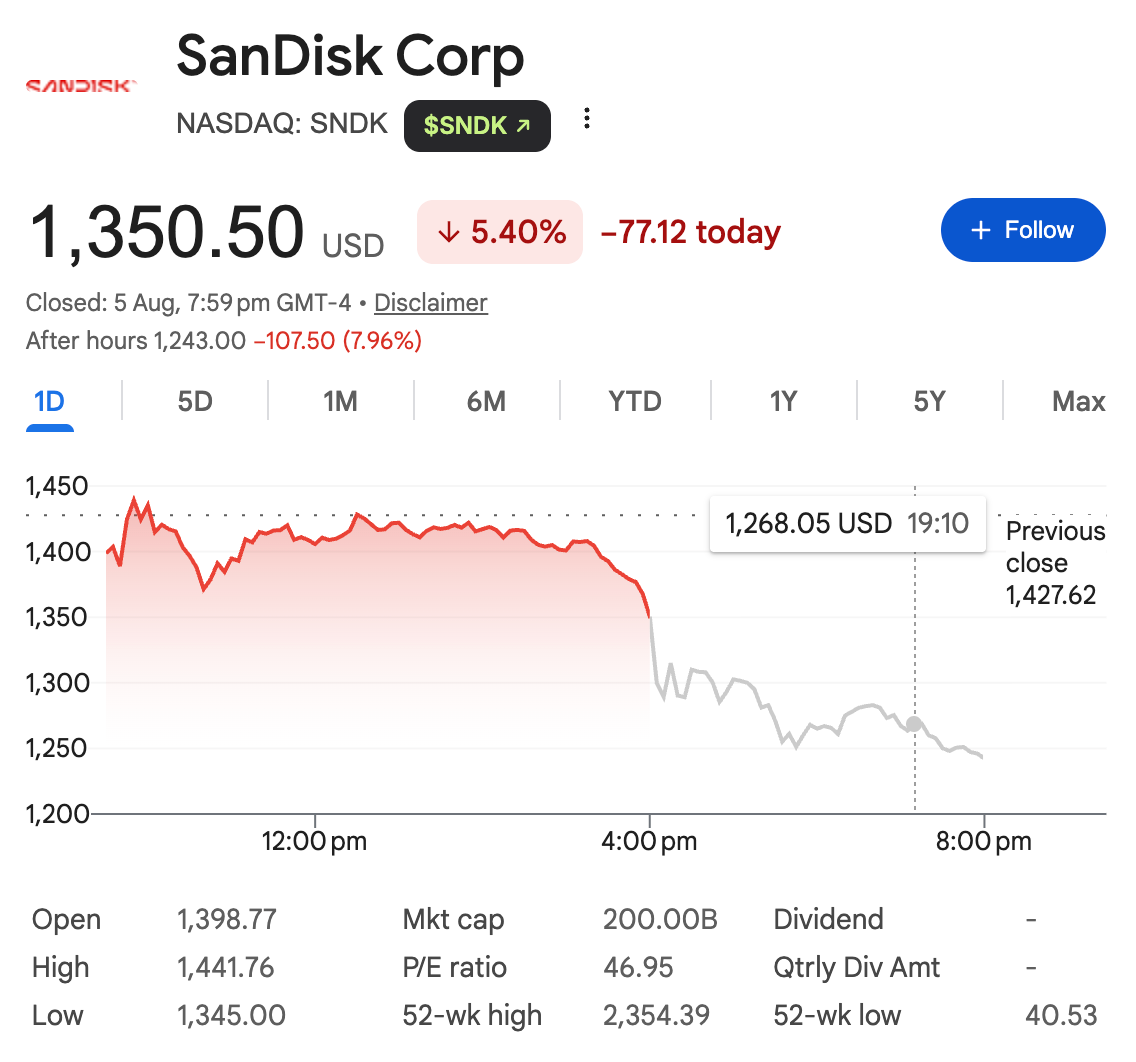
Why didn't the market reward such a "record-breaking" earnings report? The underlying logic is similar to what we wrote about SK Hynix's earnings this quarter (refer to "SK Hynix's Most Profitable Quarter Ever, Why Still 'Missed Expectations'?"). For such major storage manufacturers, investors are no longer just concerned about whether performance can grow, but whether growth can continue to exceed already significantly elevated expectations.

There is another issue, different from SK Hynix, related to unfinished guidance. SanDisk's revenue guidance range for the next fiscal quarter is $10.3 billion to $10.8 billion, with a midpoint of $10.55 billion, while the market previously expected $11.16 billion, a gap of about 5.5% — in summary, the market is not denying the performance SanDisk has already delivered, but is worried about whether its future growth rate can continue to meet even higher expectations.

Core Business Breakdown: What Changes in Revenue Structure?

By breaking down SanDisk's revenue structure for this fiscal quarter, we can see more clearly the qualitative transformation this company is undergoing.

As SanDisk CEO David Goeckeler emphasized, the data center business has become SanDisk's undisputed growth engine. Fourth-quarter data center revenue was $2.98 billion, a nearly 13-fold (1298%) year-on-year increase, doubling (103%) quarter-on-quarter, with its share of revenue rising from about 11% a year ago to 33%. For the entire fiscal year 2026, data center revenue skyrocketed 437%, and management has clearly established it as a "key growth pillar." Against the backdrop of exploding demand for AI servers and high-performance computing storage, SanDisk is clearly benefiting from this wave of infrastructure investment.

The Edge Computing business remains SanDisk's largest source of revenue currently, with quarterly revenue of $5.43 billion, a 392% year-on-year increase and 48% quarter-on-quarter growth. This part mainly serves the enterprise and terminal equipment markets, with a large scale and steady growth rate, forming SanDisk's foundation.

The only relative weakness appears in the Consumer segment. This quarter's consumer business revenue was only $556 million, a slight year-on-year decrease of 5%, and a sharp quarter-on-quarter decline of 32%, far below the market expectation of $874 million. Weak demand in traditional consumer electronics and lengthening PC and smartphone replacement cycles have made this business the most obvious drag in the earnings report. However, from a strategic perspective, SanDisk is actively optimizing its customer structure, tilting towards the high value-added data center and enterprise markets. The contraction of the consumer business is, to some extent, a growing pain during the transition period.

Biggest Highlights: Long-Term Agreements + Buyback

It is worth noting that SanDisk management spent a significant portion of the earnings call explaining the strategic significance of its "New Business Model" (NBM) long-term agreements.

In the history of the NAND industry, supply and prices have typically been negotiated quarterly, resulting in severe cyclical fluctuations. SanDisk disclosed that after announcing 5 NBM long-term agreements during the April earnings season, this quarter's earnings report revealed another 5 NBM agreements, including 3 new agreements and expansions/upgrades to 2 existing agreements. Related orders will cover supply for many years into the future, with over half of the supply for fiscal year 2027 already locked in advance, and about two-thirds of the supply for fiscal year 2028 also arranged.

David Goeckeler bluntly stated the hope to "enhance business predictability and cyclical resilience through long-term agreements, breaking free from the industry's past cycle of booms and busts." From an industrial logic perspective, this is undoubtedly the correct long-term strategy — using long-term agreements to lock in capacity, smooth price volatility, and deepen ties with major customers; but in short-term trading, long-term agreements also mean that some price elasticity is locked in. When the market is at the peak of a price increase cycle, investors may worry whether the company "sold too cheaply" by locking in orders in advance.

The $14 billion stock buyback plan announced concurrently with the earnings is another noteworthy signal. Combined with the existing amount, SanDisk's total remaining repurchase authorization has reached $15.5 billion. For a company that experienced a 47% stock price plunge in July and lost over $150 billion in market value, such a large-scale buyback is not only a demonstration of management's confidence in cash flow but also a signal to the market that "the current stock price is attractive."

However, buybacks generally belong to medium-to-long-term variables and are difficult to counteract the selling pressure caused by guidance disappointment in the short term. Especially during the earnings release event window, trading logic will still prioritize the core proposition of "whether revenue guidance is revised upward."

Where Exactly is the "Gap" in Guidance?

Returning to the forward guidance most concerning to the market. SanDisk expects first fiscal quarter 2027 revenue of $10.3 billion to $10.8 billion, with a midpoint of $10.55 billion, corresponding to a year-on-year growth of approximately 359%. This number itself is not bad — still showing quarter-on-quarter growth, with year-on-year growth rate remaining high — but the market had already priced in this expectation too fully.
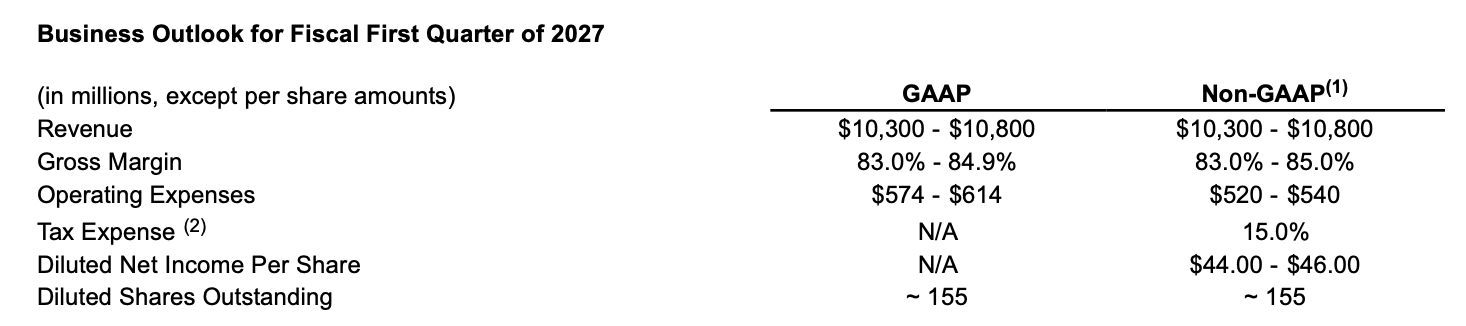
A more subtle signal comes from gross margin. SanDisk's adjusted gross margin reached a historical high of 84.6% in the fourth quarter, but the company's gross margin guidance range for the next quarter is 83% to 85%, with a midpoint of about 84%. Although still at an extremely high level, there is no sign of further expansion, instead giving a sense of "peaking at a high level, entering a plateau phase." For investors accustomed to SanDisk continuously breaking through gross margin ceilings over the past few quarters, this mentality of "unchanged is negative news" is further amplified in the current market environment.

The EPS guidance range is $44 to $46, with a midpoint of $45, basically falling near market expectations,谈不上惊喜。 Following a "record-breaking" earnings report, the market was waiting for guidance that was "even more record-breaking," but what SanDisk provided was just "normally good."

The Market Focuses Not on Growth, But on the Acceleration of Growth

Yesterday, while compiling Arthur Hayes' new article, I saw this sentence: "What investment really trades is not growth itself, but the acceleration of growth."

In other words, the market is actually focused on the second derivative — whether growth is accelerating or decelerating.

Judging from this earnings report, SanDisk's fundamentals have not shown obvious weakening. Whether it's record quarterly revenue, high gross margin maintenance, or the data center business becoming a new growth pillar, the company is benefiting from the NAND cycle recovery and the structural changes brought by AI infrastructure investment. However, the capital market's focus has long shifted from "whether performance is excellent" to "how can it grow further."

Over the past year, the storage sector has undergone a significant revaluation of expectations. On one hand, AI data center construction has driven demand growth for high-performance storage; on the other hand, NAND industry supply contraction and price recovery have also propelled soaring profit margins for related companies.

Against this backdrop, the valuation given to SanDisk by the market has long reflected not only the current profit level but also priced in expectations for continued accelerated growth in future quarters. Therefore, when the company's guidance for the next quarter only maintains high growth without further upward revision, the market reaction becomes even more sensitive.

This is also the core contradiction of SanDisk's earnings report this time — fundamentals remain strong, but expectations have already run ahead of performance.

Preguntas relacionadas

QWhy did Sandisk's stock price drop significantly after-hours despite reporting record-breaking quarterly earnings?

AThe stock dropped because the company's revenue guidance for the next quarter (a range of $10.3B to $10.8B) fell short of market expectations (which were around $11.16B). While the reported earnings were excellent, investors were disappointed that future growth might not accelerate as much as the already-high expectations had priced in.

QWhat were the key highlights of Sandisk's Q4 FY2026 financial performance?

AKey highlights included: revenue of $8.97B (beating expectations), non-GAAP EPS of $39.25 (135x YoY), and an adjusted gross margin of 84.6%. For the full FY2026, revenue was $20.25B with GAAP net income of $11.43B, marking a dramatic turnaround from a $1.64B loss the previous year.

QHow has Sandisk's revenue structure changed, and which business segment is now the key growth driver?

ASandisk's revenue structure has shifted significantly towards the Data Center segment. In Q4, Data Center revenue was $2.98B, up nearly 13x year-over-year, and now constitutes 33% of total revenue, up from ~11% a year ago. Management has identified this as the key growth pillar, driven by AI server and high-performance computing storage demand.

QWhat strategic initiatives did Sandisk's management highlight during the earnings call?

AManagement highlighted two main initiatives: 1) The 'New Business Model' (NBM) involving long-term supply agreements, which have now locked in over half of the supply for FY2027 and about two-thirds for FY2028 to enhance predictability. 2) A new $14B stock repurchase authorization, bringing the total remaining authorization to $15.5B, signaling confidence and that the stock is undervalued.

QAccording to the article, what is the underlying logic behind the market's negative reaction to Sandisk's earnings?

AThe market's logic is that it is not just trading on growth, but on the acceleration of growth (the 'second derivative'). Sandisk's reported results were strong, but the guidance for the next quarter, while still showing high growth, did not show further acceleration beyond the already-elevated expectations. The market had priced in even faster growth, so the 'merely' high guidance was seen as a disappointment.

Lecturas Relacionadas

South Korean Stocks Plunge Again, Latest Response from the Blue House

Korean Stock Market Plummets Amid Global Sell-Off, Presidential Office Responds South Korea's stock market experienced a sharp decline on Thursday. The benchmark KOSPI index fell over 4%, with major components SK Hynix and Samsung Electronics dropping over 8% and 5%, respectively. The sell-off quickly spread to related Hong Kong ETFs. The trigger was weak forward guidance from U.S. memory chip giants SanDisk and Western Digital, whose revenue forecasts fell short of lofty market expectations despite strong prior-quarter results. Their subsequent stock plunge led to a sell-off in Asian semiconductor stocks, highlighting the region's dependence on U.S. market sentiment. Since hitting a record high in mid-June, the KOSPI has fallen over 21% in about a month. In response to market volatility, the South Korean government has implemented measures, including raising cash margin requirements for single-stock leveraged ETFs. This led to a significant drop in their trading volume. A senior presidential official stated the focus is on closely monitoring the situation and formulating appropriate countermeasures. Analyst views on the market outlook diverge: while Morgan Stanley sees the sell-off as a buying opportunity due to low valuations, others like China Securities warn of continued high volatility as leverage unwinds. Looking ahead, analysts expect the global memory chip sector to remain in a high-sensitivity phase. However, Goldman Sachs maintains a long-term bullish target of 12,000 for the KOSPI, citing unmet AI-driven demand, with JPMorgan also viewing the pullback as a chance to accumulate positions.

marsbitHace 14 min(s)

South Korean Stocks Plunge Again, Latest Response from the Blue House

marsbitHace 14 min(s)

CryptoQuant: Large Investors Are Buying Bitcoin, Ethereum, and XRP, the Bear Market May Be Approaching Its Final Stage!

Data analysis platform CryptoQuant reports that large-scale investors, or "whales," holding significant amounts of Bitcoin (BTC), Ethereum (ETH), and XRP have recently increased their positions. The company suggests this trend may indicate the prolonged crypto bear market is nearing its final stage. Historically, periods of sustained price decline where large investors are buying rather than selling have been a significant indicator. Similar activity was observed in past market cycles when long-term investors deemed prices attractive. However, CryptoQuant emphasizes that current data is insufficient to confirm a market bottom has been reached. While whale accumulation is seen as a positive signal, prices for BTC, ETH, and XRP could still fall further before a definitive bottom forms, warranting investor caution regarding short-term volatility. Experts note this accumulation is often part of a long-term strategy, with large investors buying during panic while retail investors remain cautious—a common characteristic of past cycle endings. CryptoQuant also states that macroeconomic events and global liquidity conditions will remain crucial for price direction. Key factors include central bank monetary policy, regulatory changes, and institutional investor sentiment toward the market. *This is not investment advice.

cryptonews.ruHace 28 min(s)

CryptoQuant: Large Investors Are Buying Bitcoin, Ethereum, and XRP, the Bear Market May Be Approaching Its Final Stage!

cryptonews.ruHace 28 min(s)

Tiger Research: What Will the Crypto World Look Like in 2036?

Tiger Research envisions the crypto world of 2036 through four narrative vignettes. In a fictional nation with a hyperinflating currency, the local "Bucks" are nearly obsolete. Citizens and eventually the government itself—for taxes, bonds, and salaries—adopt dollar-pegged stablecoins like USDT and USDC, marking a fundamental shift in monetary sovereignty. In Singapore, a young trader named Lia operates in a borderless, 24/7 market. She trades tokenized versions of everything from NVIDIA stock to Korean real estate indices on decentralized platforms, representing a generation for whom constant, global asset exposure is the norm. An infrastructure engineer, Do-hyun, reflects on the consolidation of blockchain networks. The hundreds of independent chains and Layer 2 solutions that boomed in the 2020s, fueled by incentives, have largely collapsed under their own weight. By 2036, only a few major, efficient infrastructures remain, having absorbed liquidity and users. Finally, media entrepreneur Jae-hoon witnesses the end of the traditional web advertising model. With AI agents generating over half of web traffic by 2029, banner ads become irrelevant. The industry pivots to a new machine-to-machine economy, using protocols like the x402 standard to charge AI models micropayments for direct data access, creating a more reliable revenue stream than human eyeballs ever did. The article paints a picture of 2036 defined by stablecoin adoption as sound money, perpetual global trading of all assets, consolidation into few dominant blockchain infrastructures, and the restructuring of digital commerce around AI agents.

marsbitHace 37 min(s)

Tiger Research: What Will the Crypto World Look Like in 2036?

marsbitHace 37 min(s)

IOSG: How Can Blockchains Keep Secrets? Three Answers to On-Chain Privacy

**Title: IOSG: How Does Blockchain Keep Secrets? Three Answers to On-Chain Privacy** **Summary:** Public blockchains expose every transaction. To protect sensitive data like institutional balances or trade sizes, three main approaches have emerged: 1. **Native Privacy Networks:** Projects like Zcash (with optional privacy) and Monero (with mandatory privacy) build secrecy directly into their own blockchains. However, they exist as isolated "islands," limiting interaction with mainstream DeFi applications. Canton, a permissioned network, offers privacy by restricting data sharing only to transaction participants, which appealed to JPMorgan for its deposit token. 2. **Privacy as an Add-On Layer:** This approach adds privacy to existing chains like Ethereum. Tornado Cash was an early "mixer" but was sanctioned. Railgun provides private balances and payments via zero-knowledge proofs on Ethereum. Zama uses Fully Homomorphic Encryption (FHE) to encrypt balances and amounts on-chain, enabling confidential DeFi activities like private yield vaults and over-the-counter trading while keeping transaction graphs public. 3. **The Core Trade-off:** All solutions sacrifice some privacy for functionality. Truly private chains (Zcash, Monero) lack smart contract versatility. Add-on layers (Zama, Railgun) reveal some metadata to enable computation. "Perfect" privacy that hides everything while allowing full functionality remains elusive. **Market Reality:** Demand is validated, with institutions moving trades off-screen to avoid slippage. However, the sector's revenue (est. $6-7M/year across all protocols) is minuscule compared to the ~$25B market cap of privacy assets. Protocols like Zama charge minimal, usage-based fees, while others like Railgun take a small percentage. The key gap is a sustainable pricing model. The conclusion is bullish on the underlying demand but suggests value will accrue to the applications (trading venues, wallets) that successfully monetize privacy, not necessarily the foundational privacy layers themselves.

marsbitHace 40 min(s)

IOSG: How Can Blockchains Keep Secrets? Three Answers to On-Chain Privacy

marsbitHace 40 min(s)

Trading

Spot
活动图片