Artículos Relacionados con Costs

El Centro de Noticias de HTX ofrece los artículos más recientes y un análisis profundo sobre "Costs", cubriendo tendencias del mercado, actualizaciones de proyectos, desarrollos tecnológicos y políticas regulatorias en la industria de cripto.

AI is Killing 'Poor People's Entertainment'

AI Is Eliminating 'Entertainment for the Poor' This article discusses the rising cost of video gaming, arguing that AI is making digital entertainment increasingly expensive. It follows the example of a frugal gamer who, accustomed to waiting for discounts and buying second-hand games, now faces a new reality. Video game consoles like the PS5 Pro and Switch 2 are increasing in price post-launch, breaking the traditional pattern of降价 over time. Game prices are also rising, with major titles like GTA 6 launching at $80. Furthermore, the industry is moving towards eliminating physical media, exemplified by Sony's plan to stop PS disc production by 2028. This shift blocks the二手 market, a key cost-saving avenue for players. Even Valve's anticipated affordable Steam Machine launched with a high price and disappointing specs. Manufacturers cite inflation, supply chain issues, and rising development costs, but a core driver is the AI boom. AI data centers now consume semiconductor and memory resources once prioritized for consumer electronics like game consoles. This competition from a more profitable sector drives up hardware costs. Additionally, developing modern AAA games with massive teams over many years is astronomically expensive, pushing publishers towards digital-only distribution and subscription models to secure recurring revenue. The article suggests this trend extends beyond gaming. Video streaming, music platforms, cloud storage, and AI tools are increasingly locked behind complex subscription tiers. While AI promises future benefits, it is currently making digital entertainment and services more costly. The era of progressively cheaper, accessible online entertainment is ending, forcing consumers to pay more upfront for future technological promises.

marsbitAyer 04:17

AI is Killing 'Poor People's Entertainment'

marsbitAyer 04:17

Forbes Feature: Stablecoin Cross-Border Payments Are Faster, But Not Yet Cheaper

A Forbes feature delves into the state of stablecoin-based cross-border payments, noting rapid growth but a key shortfall: while faster and more accessible, they are not yet cheaper. At a recent industry conference in Mexico City, optimism about technology, regulation, and volume was tempered by discussions with practitioners. The core issue is liquidity. Traditional FX brokers charge 60-70 basis points, and stablecoins promise to slash this to 2-5 basis points. However, this theoretical cost advantage cannot be realized until deep liquidity pools are established at scale, requiring significant institutional capital inflow. A major adoption barrier is trust. Businesses often rely on long-standing relationships with traditional brokers, valuing reliability over marginal cost savings. This shift will be gradual. Furthermore, successful companies in the space are not positioning themselves as replacements for legacy systems like SWIFT, but as complements. They leverage stablecoins for speed while using traditional rails for their standardization and reliability in ensuring accurate payment details—a critical factor for supplier payments to avoid customs issues. Companies like Caliza, experiencing high monthly growth, exemplify this hybrid approach. The industry anticipates consolidation, as long-term viability will depend on securing the essential trifecta: proper licensing, robust fiat on/off-ramps, and deep liquidity. Without these, firms risk being mere intermediaries rather than building sustainable businesses.

marsbit07/05 09:23

Forbes Feature: Stablecoin Cross-Border Payments Are Faster, But Not Yet Cheaper

marsbit07/05 09:23

How Much of the Subscription Fee You Pay to Claude Can Optical Module Companies Get?

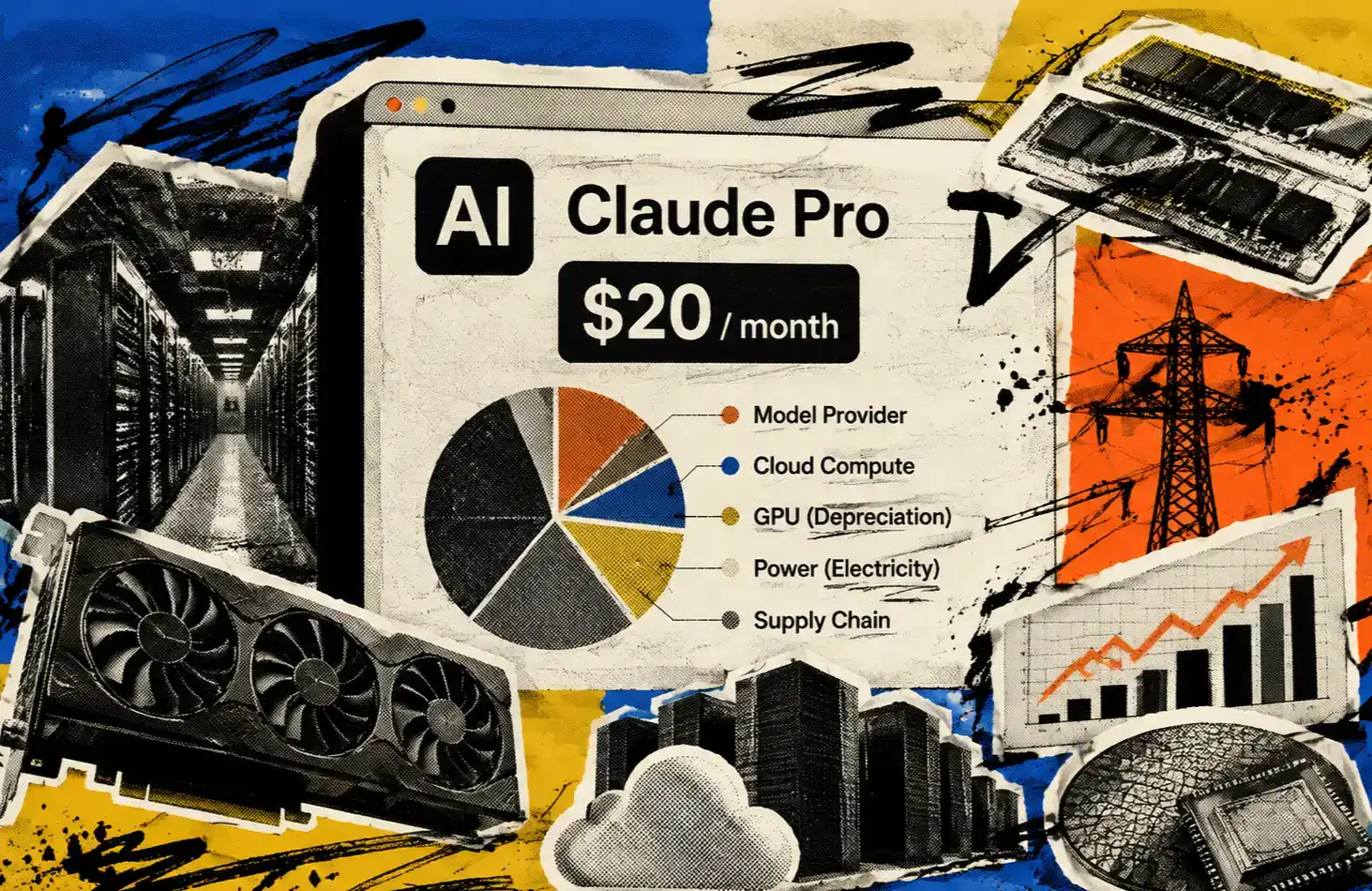
How much of your $20 Claude Pro subscription actually goes to AI model companies like Anthropic? A viral breakdown image highlights the fundamental valuation challenge for AI applications versus traditional SaaS. Unlike SaaS with high software margins, AI subscriptions face variable "inference costs": every user query consumes GPU time, power, and cloud resources. This creates a tension between fixed subscription fees and usage-driven expenses. While the specific dollar splits are illustrative, the core question is whether AI revenue can achieve SaaS-like margins as usage scales. Currently, infrastructure providers (cloud platforms, GPU makers like Nvidia, HBM suppliers, power/data centers) capture more certain revenue from growing AI usage. Their financials reflect pricing power and faster earnings validation. The bullish case hinges on efficiency improvements: model optimization, caching, smaller models, and custom chips could lower per-token costs over time. The key debate is whether cost declines can outpace increases in user workload complexity and volume. Ultimately, for AI companies to command high SaaS-like valuations, they must demonstrate not just user growth but also improving gross margins after accounting for inference costs. Investors will scrutinize not just subscriber numbers, but usage patterns, enterprise pricing tiers, and real efficiency gains.

marsbit06/17 03:43

How Much of the Subscription Fee You Pay to Claude Can Optical Module Companies Get?

marsbit06/17 03:43

From Subsidies to Token-Based Pricing to Price Cuts: Is OpenAI Sparking a Price War? Is the Inflection Point for Token Economics Nearing?

The commercialization of generative AI is facing a critical inflection point as a potential price war looms. According to The Wall Street Journal, OpenAI is considering a significant cut to its token fees to compete with rival Anthropic, signaling a shift from a growth-at-all-costs model focused on token consumption. This move comes as both companies, reportedly losing billions on compute, prepare for IPOs, and as enterprise customers face "bill shock" from switching to usage-based token billing. Reports indicate poor ROI, with one analysis finding only 18 cents of every dollar spent on AI tokens generates user-facing value. The industry's initial phases—from flat-rate subscriptions to aggressive subsidies—have given way to a reckoning with real costs. Analysts debate the future: some predict a bifurcation between premium, high-cost models for complex tasks and cheaper alternatives for routine work, while others believe overall spending will still rise as agentic AI increases tokens per task. Notably, Chinese model DeepSeek's low-cost API is gaining traction with U.S. enterprises, adding competitive pressure. The core challenge is redefining value beyond token volume ("tokenmaxxing") toward measurable productivity ("valuemaxxing"), as the entire AI value chain, from cloud providers to chipmakers, feels the ripple effects of unsustainable pricing.

marsbit06/11 23:50

From Subsidies to Token-Based Pricing to Price Cuts: Is OpenAI Sparking a Price War? Is the Inflection Point for Token Economics Nearing?

marsbit06/11 23:50

Token Budget Wars: Enterprise AI Enters the 'Accounting Era'

Token Budget Wars: Enterprise AI Enters the "Accounting Era" Enterprise AI is shifting from the question of "whether to adopt" to "how to account for it." As AI inference costs evolve from experimental budgets into ongoing operational expenses, CEOs and CFOs are demanding proof of value: what tangible results does each dollar spent on tokens deliver? The core of "Token Budget Wars" is not simply about reducing AI bills, but about intelligently allocating compute resources. It involves determining which business processes warrant more computational power, which tasks can use cheaper models, which can be outsourced or handled manually, and which are merely inefficient consumption. A key insight is that AI usage (token consumption) does not equal value. While SaaS usage indicated software adoption, AI token usage only indicates the "meter is running." The same workflow can cost vastly different amounts due to factors like prompt quality, context, model choice, and retries. The critical metric for scaling is "marginal token utility"—the business value created per additional dollar of inference cost. However, this is difficult to measure due to challenges like the long tail of retries, context inflation (where costs can scale quadratically with context length), and inefficient model routing (defaulting to the most powerful model for all tasks). The competition for token allocation is intensifying because, in the AI era, influence is tied to how much intelligence one can command, not just team size. AI spending is essentially competing with labor costs, whether for replacing external BPOs, internal staff, or generating new revenue. BPO contracts provide a clearer benchmark as they are priced per completed unit. The missing layer is attribution from tokens to business outcomes. Companies need a system that connects inference spending to completed work and results, capturing the agent's decision trajectory—what it saw, retrieved, tried, and why it succeeded or failed. This recorded rationale becomes a valuable asset. Ultimately, those who master token-to-outcome attribution will control the allocation of AI resources within enterprises, deciding which workflows get more compute, which are capped, or which revert to humans. The first phase of enterprise AI proved models could do the work. The next phase will determine how much of that work is worth paying for.

marsbit05/28 12:13

Token Budget Wars: Enterprise AI Enters the 'Accounting Era'

marsbit05/28 12:13

a16z Charts of the Week: AI Costs Halved and Usage Doubled This Year, Major Life Milestones for 30-Year-Olds in the US Delayed Across the Board

a16z's Charts of the Week explores four key trends. First, while a "DExit" (Delaware Exodus) narrative exists due to high-profile companies leaving over legal concerns, data shows a more complex reality. Delaware's overall share of U.S. businesses has actually grown, though Wyoming has seen a surge in LLC registrations. Second, AI demonstrates the Jevons Paradox: as the cost to process AI tokens halved this year, usage doubled. Demand for older GPU rentals (H100, A100) is also rising, contradicting predictions of a compute glut. Historical parallels suggest the full economic impact of AI may take time to materialize. Third, AI capital expenditure is massive, comparable to annual U.S. bank lending and significantly larger than U.S. corporate tax income or the military budget of any non-U.S. G7 nation. Fourth, the prediction market Kalshi is outperforming professional forecasters and futures markets in predicting the Federal Funds Rate, providing a valuable high-frequency, probabilistic benchmark. Finally, data shows a stark delay in life milestones for 30-year-olds in the U.S. Since the 1980s, far fewer are living independently, married, living with children, or owning a home. The only exception is college attainment, which has nearly doubled since 1995, though the value of a degree is increasingly questioned.

marsbit03/01 02:49

a16z Charts of the Week: AI Costs Halved and Usage Doubled This Year, Major Life Milestones for 30-Year-Olds in the US Delayed Across the Board

marsbit03/01 02:49

活动图片