Welcome to the New Crypto World: Only This Time, The Place Where You Lose Money Is Called the Stock Market

marsbitPublicado a 2026-07-30Actualizado a 2026-07-30

Resumen

Welcome to the New Crypto World: Only This Time, the Place to Lose Money is Called the Stock Market. The article depicts a future (2026) where global stock markets, particularly tech stocks, are exhibiting behaviors and risks reminiscent of the cryptocurrency world. The narrative centers on a sharp crash in South Korea's KOSPI index and leading stocks like SK Hynix, highlighting widespread retail losses, leverage-induced liquidations, and extreme volatility. It argues that a significant shift in market dynamics is underway: pricing is increasingly driven by narratives (like the AI boom) over fundamental valuation, amplified by high leverage and the rapid, emotion-fueled consensus formed on social media. Former crypto traders, seeking new opportunities, brought their high-risk strategies—chasing narratives, using leverage—into equity markets, focusing on sectors like AI and semiconductors. Ironically, data suggests some major tech stocks have recently shown greater volatility and faster crashes than Bitcoin, which is becoming relatively more stable and "stock-like" through institutional adoption. The piece details how leveraged ETFs in Korea, particularly those tied to single stocks, created a vicious cycle of forced selling that exacerbated the market plunge. It concludes that while stocks retain underlying fundamentals, the *trading* of them has undergone a "de-rationalization": markets now prioritize themes, social media sentiment, and leveraged bets over traditional ana...

Author: Dou Wanle

July 13, 2026, Seoul.

South Korea's benchmark KOSPI index plummeted 8.95% in a single day, triggering its 7th circuit breaker of the year. SK Hynix, the 'national destiny stock' in the eyes of Koreans, plunged 15.37%, a decline not seen in nearly two decades. Samsung Electronics also fell over 10%.

Margin calls were issued for over 1.2 million leveraged accounts. Brokerage systems automatically liquidated between 320,000 and 460,000 accounts. More heartbreaking is that 62% of those liquidated were young people aged 20 to 30. Some lost their down payment for a wedding apartment, others were trading on margin...

A young man in his 20s in Busan, who lost money following a recommendation from a stock YouTuber, went and stabbed the influencer.

In the past, these phrases would most likely have been used to describe scenes after a crypto market crash. Today, they are recurring in the South Korean, American, and Japanese markets as the tech stock tide recedes.

Sharp rallies and sell-offs are just the surface. What's truly changed is the method of valuation—narrative outweighs fundamentals, leverage amplifies emotions, and social media drives consensus to extremes with unprecedented speed.

Global stock markets, especially tech stocks, are becoming increasingly like the crypto world.

Returning to the Family Home

"Welcome back to the family home."

After the crash, crypto traders who had switched to stocks shared numerous loss stories online. Comments like the one above were ubiquitous.
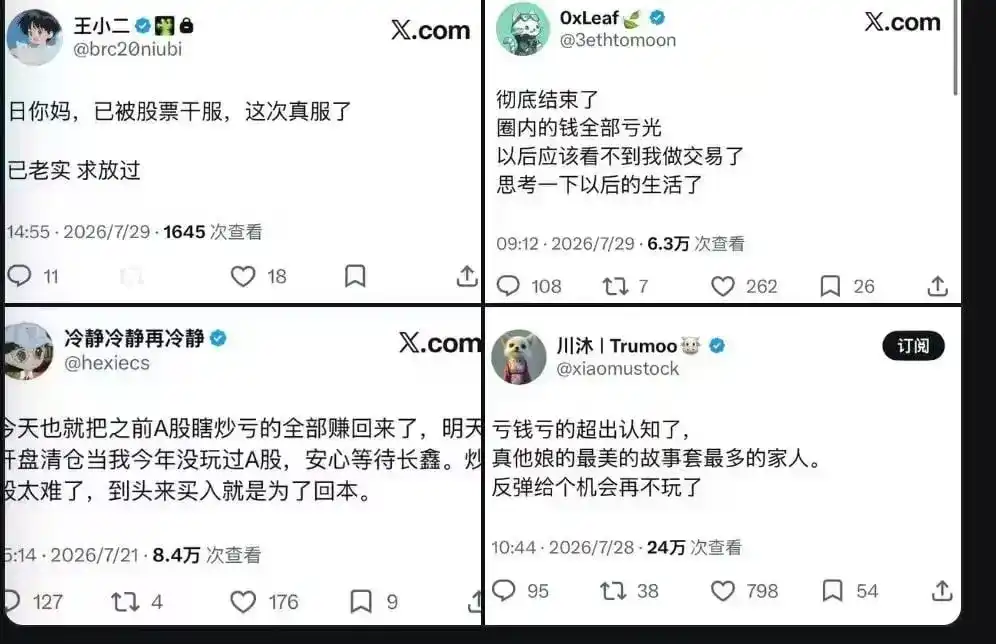
The so-called "family home" refers to the cryptocurrency world. From the second half of 2025 to early 2026, a major drama of "leaving the family home" unfolded in the crypto space.

A number of KOLs and veteran players who had been in the cryptocurrency market for years began to lose faith. Bitcoin was range-bound with tepid trading volume, meme coins kept getting shaved. Many felt "this circle is boring" and started turning their attention to US stocks.

This choice seemed very reasonable.

Stocks have revenue, profits, financial reports, and SEC oversight. Compared to crypto projects lacking cash flow and priced purely on consensus, US stocks at least appeared to be more mature and safer assets.

The crypto traders didn't just take their liquidity; they brought their trading methods along too.

In the crypto market, they were accustomed to chasing new narratives, hunting for high-volatility targets, using leverage, and swiftly switching positions based on social media sentiment. Upon entering the stock market, this approach barely changed—only the trading objects shifted from tokens to AI, memory chips, and leveraged ETFs, repeatedly achieving significant gains.

Memory stocks soon became the new collective consensus.

The logic was not complicated: AI servers require more high-bandwidth memory (HBM), leading to supply shortages and rising memory prices. Micron, Samsung Electronics, and SK Hynix naturally became the most direct 'shovel sellers.' The phrase "you can never have enough memory" became deeply ingrained.
Numerous crypto KOLs reinvented themselves, starting to talk about US stocks, memory cycles, and AI capital expenditure. Products like the 2x leveraged SK Hynix ETF were also regarded as more 'efficient' betting tools than regular stocks.

Until the market reversed in July.

Bitcoin Becomes the "Low Volatility Asset"

How long does it take to fall from the peak?

Bitcoin took 268 days to halve its value, and silver took 169 days for a similar magnitude of retracement.

In contrast, SanDisk took only 36 days to fall about 55%, and SK Hynix took only 34 days to drop about 53%.

While both experienced a 'halving,' Bitcoin took nearly nine months, while memory stocks took just over one month.
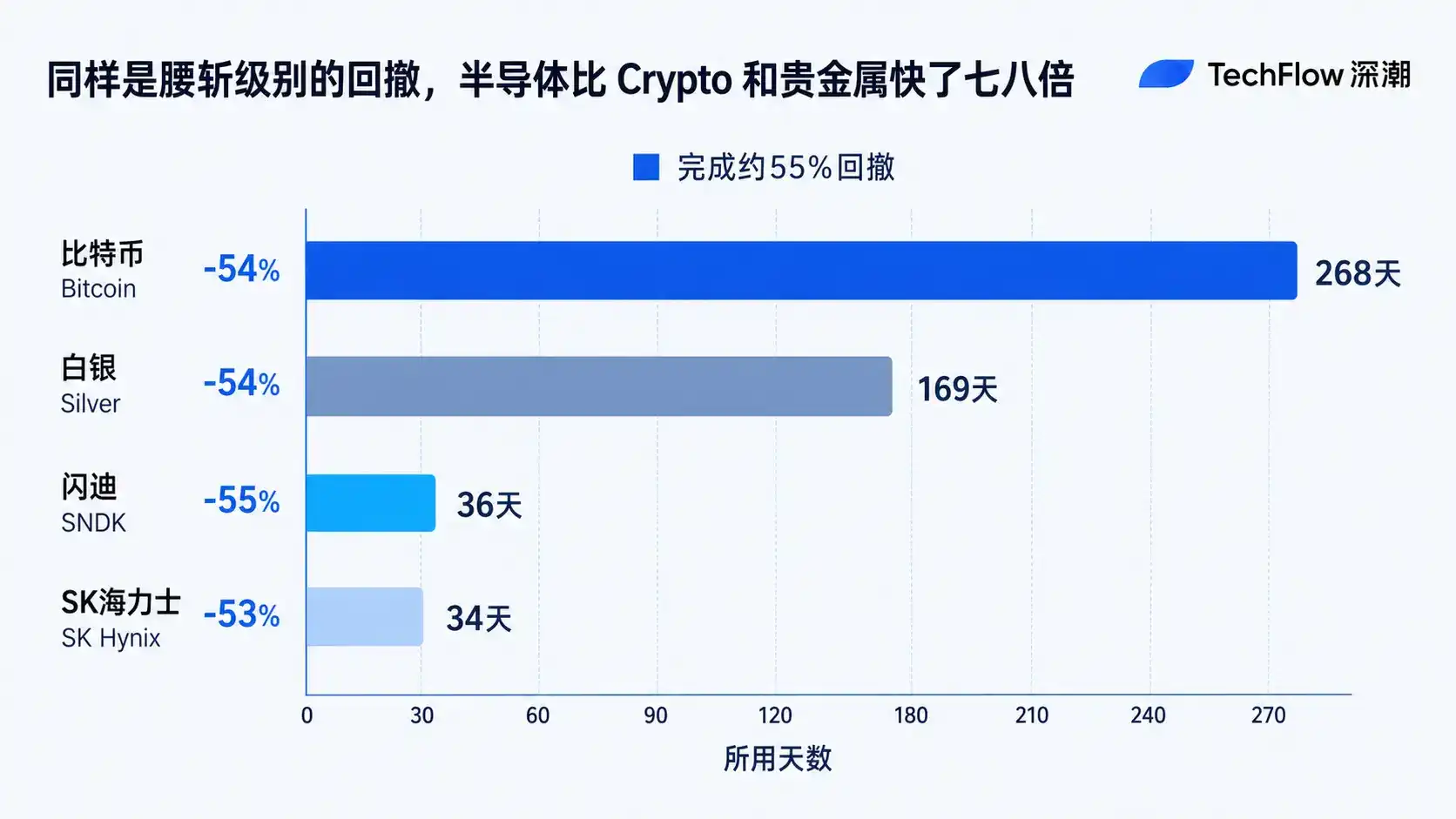
This is the ironic twist of this round of market movements. In the past, investors worried Bitcoin could surge or crash within days, while stocks adjusted slowly based on earnings and valuations. Now, some tech stocks are completing an entire bubble burst in a shorter time frame than cryptocurrencies.

It's very counter-intuitive. Compared to some tech stocks, Bitcoin is becoming relatively stable.

According to Schwab statistics, Bitcoin's historical volatility in 2025 was about 42%, with a maximum drawdown of around 32%. During the same period, Tesla's volatility was about 63% with a max drawdown of 48%, and Nvidia's volatility was about 50% with a max drawdown of 37%.

Bitcoin remains a high-risk asset, but the volatility of some major tech stocks is even greater.

Bitwise even predicted in its 2026 outlook that Bitcoin's overall volatility might continue to be lower than Nvidia's.

So the current situation is quite absurd: Bitcoin is becoming more like tech stocks, while tech stocks are becoming more like Bitcoin.

When Narrative Becomes the Valuation Anchor

There's an old saying in crypto: trading crypto is trading narratives.

In 2026, global tech stocks are turning this saying into reality.

AI is certainly not vaporware. Nvidia, Microsoft, Google, and large cloud computing companies have real revenue and are investing real capital to build data centers.

But there's a long road between "AI will indeed create value" and "any company touching AI is worth buying at any price."

At the height of the frenzy, the market simply skipped that road.

AI servers, optical modules, memory chips, data centers, power equipment, even nuclear energy companies—as long as they could be placed within the AI industrial chain, their stock prices could surge. Businesses were still in the planning stage, orders not yet secured, but the market would price them based on the best possible outcome years in advance.

The story in South Korea was "AI semiconductors are tied to national destiny." As KOSPI kept hitting new highs, more and more families began opening stock accounts for their underage children, gifting popular stocks like Samsung Electronics and SK Hynix as long-term presents.

A similar concentration occurred in the A-share market. In the first half of 2026, the TMT sector's market cap reached 41.78 trillion yuan, accounting for about 31.45% of the total A-share market value. On some trading days, turnover in the tech sector approached half of the entire market's.

The US market has long been priced around a handful of large tech companies. As index gains relied increasingly on just a few firms, and as funds, options, and retail investors flooded into the same stocks, seemingly diversified portfolios were essentially betting on the same AI story.

This is reminiscent of the old crypto world. Dogecoin's surge in 2021 wasn't due to a technological breakthrough, but because Elon Musk tweeted. The surge in tech stocks in 2026 wasn't because all companies experienced explosive earnings growth, but because ChatGPT convinced everyone that "AI will rewrite everything."

That narratives could dominate the market so rapidly is also inseparable from changes in dissemination methods.

In the past, stock information primarily came from financial reports, research notes, and institutional roadshows. Today, more and more people's investment decisions come from YouTube, X, short videos, and paid communities.

Complex company research is compressed into a few sentences: Time will prove compute and optical modules, AI compute will always be insufficient...

Social media algorithms don't reward caution either. Overnight riches are always the traffic magnet: someone doubled their money overnight with options, an office worker achieved financial freedom by heavily investing in memory stocks, someone used leveraged ETFs to earn years' worth of salary in a few months.

Charts are the best advertisement. A large number of housewives and middle-aged women began investing their private savings, and some even sold properties to buy stocks, reminiscent of students dropping out of school to all-in on Web3 a few years ago...

The Leverage Carnival

The scariest thing in crypto isn't volatility; it's the lethal combination of leverage and volatility. In 2026, global stock markets are perfectly replicating it.

On May 27, 2026, the Korea Exchange approved the listing of 16 single-stock leveraged ETFs with 2x leverage, tracking stocks like Samsung Electronics and SK Hynix.

Retail investors went wild. From approval to mid-July, Korean retail investors accumulated a net purchase of 14 trillion won (approx. 64 billion RMB) worth of single-stock leveraged ETFs. During the same period, foreign investors bought only about 2 trillion won.

These ETFs had several fatal design flaws.

These products rebalance their positions daily. The more severe the volatility, the more significant the decay in net asset value. Assume a stock falls 10%, then rises 11.1%—it returns to its original price. The corresponding 2x leveraged product would first fall 20%, then rise 22.2%, ultimately still losing about 2.2%.

The problem is even worse during rapid declines.

To maintain target leverage, the products need to passively reduce risk exposure after a decline. Selling further depresses the underlying price, triggering more position reductions, stop-losses, and margin pressure.

Goldman Sachs later pointed out that the "rapid deleveraging" of these products was the main cause of abnormal intraday volatility in KOSPI, with 62% of institutional net selling stemming from ETF-related liquidations.

Two months later, South Korean regulators urgently halted all new listings of single-stock leveraged ETFs. The minimum margin requirement was drastically raised from 10 million won to 30 million won, and only cash was recognized.

But it was too late. 2.3 trillion won in forced liquidation amounts, and the wealth of hundreds of thousands of families vanished into thin air.

Even the US stock market, the deepest in the world, is experiencing the backlash of leverage.

JPMorgan analysts recently noted that US stocks still have "deleveraging room," needing three months to return to pre-April levels.

The ratio of memory chip stock leveraged ETF assets to underlying market cap is three times the average for all stock ETFs. Even for broad leveraged stock index ETFs, the ratio is high relative to its own history.

A Regression

"Stock markets becoming like crypto" doesn't mean stocks have become completely identical to cryptocurrencies.

Stocks still have companies, assets, revenue, and cash flow behind them. They also have financial disclosures, audits, and regulation. Even when market sentiment fades, a truly profitable company still possesses a calculable value.

What's truly changed is at the trading layer.

In the past, people bought a company's future profits. Now, more and more people are trading the heat of a theme.

The crypto-fication of stock markets is essentially a revolution of de-rationalization.

Traditional stock markets look at P/E, cash flow; crypto-fied markets look at narratives, imagination. Traditional stock markets consider 20% volatility high; crypto-fied markets see individual stocks fluctuating 10-15% daily as the norm.

Traditional markets use leverage via margin trading; crypto-fied markets use ETFs, derivatives, quantitative strategies. Traditional market info comes from research reports, financial statements; crypto-fied market info comes from Twitter, YouTubers, online communities. Traditional markets have institutions rationally pricing; crypto-fied markets have institutions becoming retail-like, quant funds chasing momentum...

What's even more laughable is, now Bitcoin is striving to become like a stock, gaining mainstream financial acceptance through ETFs, institutionalization, and declining volatility.

This is an absurd point of intersection.

Those who transitioned from crypto to stocks ultimately found they hadn't left the "family home." It's the same repeating mechanism: grand narratives, crowded positions, easily accessible leverage, and everyone believing they can exit before everyone else.

The words written by a Korean retail investor on a trading forum are worth everyone remembering: I want to go back to the days before I traded stocks, and get my money back.

But the market never issues refunds.

Criptos en tendencia

Preguntas relacionadas

QAccording to the article, why are global stock markets, especially tech stocks, becoming more like the cryptocurrency market?

AThe article argues that stock markets, particularly tech stocks, are becoming more like the cryptocurrency market due to several converging factors. Firstly, pricing is increasingly driven by narrative and hype (like AI) rather than traditional valuation metrics like earnings. Secondly, the widespread use of leverage, especially through products like single-stock leveraged ETFs, magnifies volatility and emotions, similar to crypto trading. Finally, social media and online influencers rapidly form and spread consensus, pushing market sentiment to extremes and encouraging herd behavior among retail investors.

QWhat role did single-stock leveraged ETFs play in the South Korean market crash described in the article?

AIn South Korea, the approval of single-stock 2x leveraged ETFs (tracking stocks like Samsung and SK Hynix) in May 2026 played a catastrophic role. A massive influx of retail money into these products created concentrated, highly leveraged positions. Their daily rebalancing mechanism caused significant 'volatility decay' during swings. Most critically, during the sharp July decline, these ETFs were forced to automatically sell underlying stocks to maintain their target leverage. This created a vicious cycle of forced selling, further driving down stock prices, triggering more margin calls, and leading to a market crash. High estimated that 62% of institutional net selling during the crash was related to ETF liquidations.

QWhat paradoxical comparison does the article make between Bitcoin and certain technology stocks in 2026?

AThe article presents a paradoxical and counterintuitive comparison: while Bitcoin is notorious for its volatility, data from 2025 showed that its historical volatility (~42%) and maximum drawdown (~32%) were actually lower than those of major tech stocks like Tesla (~63% volatility, ~48% drawdown) and Nvidia (~50% volatility, ~37% drawdown). Furthermore, it took stocks like SK Hynix only about 34 days to fall roughly 53% from their peak, whereas a similar 'halving' for Bitcoin historically took about 268 days. Thus, compared to some hyper-volatile tech stocks, Bitcoin was ironically becoming a relatively 'low-volatility asset'.

QHow does the article characterize the change in information sources and decision-making for stock investors?

AThe article characterizes a fundamental shift in how stock investment information is sourced and decisions are made. Traditionally, investors relied on financial reports, analyst research, and institutional roadshows. Now, decisions are increasingly influenced by content from social media platforms like YouTube, X (Twitter), short video apps, and paid online communities. Complex company analysis is reduced to simple, viral slogans or narratives (e.g., 'AI compute will always be scarce'). Social media algorithms favor sensational, get-rich-quick stories over cautious analysis, accelerating the spread of consensus and FOMO (fear of missing out) among retail investors.

QWhat is the core irony or 'crossroads' highlighted at the end of the article regarding Bitcoin and stocks?

AThe article highlights a profound irony at the current crossroads of finance. On one hand, Bitcoin and the crypto market, originally the 'wild west' of finance, are striving to become more like traditional stocks—seeking legitimacy through ETFs, institutional adoption, and reduced volatility to gain mainstream acceptance. On the other hand, segments of the traditional stock market, especially tech stocks, are regressing to behave more like the speculative, narrative-driven, high-leverage crypto market of the past. The 'crypto natives' who moved to stocks found they never left their '原生家庭' (native home)—the same mechanisms of hype, leverage, and the greater fool theory were now dominant in equities.

Lecturas Relacionadas

Coinbase Vice President: The Wars Over Cryptocurrency Regulation Are Over

Coinbase's new Vice President, Ryan VanGrak, declared that regulatory wars in the cryptocurrency sector are over. Since taking office on July 9, 2026, he has shifted the company's approach from litigation and sanctions to focusing on growth and innovation. The industry can now concentrate on development rather than fighting for its right to exist. He highlighted that the Digital Asset Market Clarity Act (CLARITY Act), which aims to establish a clear federal regulatory framework dividing oversight between the SEC and CFTC, has gained significant momentum. This framework is intended to provide proper supervision, investor protection, and maintain U.S. leadership in digital assets. VanGrak's appointment marks a strategic shift from a "wartime" to a "peacetime" advisor, replacing former Chief Legal Officer Paul Grewal, who oversaw major litigation, including a dismissed 2023 SEC lawsuit. With his background at Citadel Securities and the SEC, VanGrak brings deep regulatory and institutional finance expertise as Coinbase expands beyond a simple exchange into a broader financial services provider, offering stocks, futures, prediction markets, and AI tools. For investors, bipartisan support for crypto legislation like the CLARITY Act represents a major shift from the enforcement-focused environment of 2023-2024. Lawmakers are now focused on *how* to regulate crypto, not *if* it should exist. However, risks remain, as the bill's passage is not yet guaranteed.

cryptonews.ruHace 20 min(s)

Coinbase Vice President: The Wars Over Cryptocurrency Regulation Are Over

cryptonews.ruHace 20 min(s)

Deep Dive into FWA: An Intriguing Experiment Turning NFTs into "On-Chain Gachapon"

A Deep Dive into FWA: The “On-Chain Gacha” Experiment for NFTs Fake World Assets (FWA), created by TokenWorks, introduces an innovative “NFT gacha machine” fully operating on-chain. Users can deposit eligible NFTs paired with ETH (called Backing) to create a Position, acting as a prize pool. Others can then pay a uniform Acquisition Price for a chance to win a random NFT from the pool. The core mechanism features a reverse probability system: Positions with lower Backing have a higher chance of being selected, serving as common prizes, while high-Backing Positions are rare “jackpots.” The acquisition price is calculated based on the harmonic mean of all Backings, keeping entry costs low. When a Position is won, the purchaser must choose: keep the NFT or accept the Standing Bid (85% of the Backing, claimable in ETH or $FWA tokens), returning the NFT to the original depositor. The protocol involves two main roles. Depositors provide liquidity (NFT + ETH), earning a share of fees from each draw, distributed equally per active Position, plus potential $FWA rewards. Purchasers pay to spin the gacha, receiving $FWA rewards for participation. A special “Crown” reward goes to the Position with the highest Backing. The $FWA token has a fixed supply and is initially obtainable only through protocol participation (depositing or purchasing), with external buying disabled early on to reduce sell pressure. Its value is supported by a built-in buy pressure: when purchasers opt for the $FWA settlement on a Standing Bid, the protocol uses the backing ETH to buy $FWA from the market. Revenue for the protocol comes from a 1% fee on each draw, a 1% settlement fee when an NFT is kept, and the 15% discount from Standing Bid settlements (currently allocated to the protocol). The design cleverly blends Uniswap-style liquidity provision, gacha mechanics, and tokenomics to create a novel, self-regulating marketplace for NFT liquidity and engagement.

marsbitHace 34 min(s)

Deep Dive into FWA: An Intriguing Experiment Turning NFTs into "On-Chain Gachapon"

marsbitHace 34 min(s)

10,000 Scientists Get 1 Year of Free Access: OpenAI Brings the Scientific Research Pipeline into ChatGPT

OpenAI has launched the "ChatGPT for Academic Researchers" program, offering free one-year access to its flagship models for 100,000 university researchers globally, with 10,000 spots available this summer. Selected institutions include prestigious centers like ENS Paris and the IAS at Princeton. The initiative provides an integrated research workspace within ChatGPT, bundling tools like ChatGPT, ChatGPT Work, and Codex, along with expanded Deep Research capabilities, higher usage limits, and specialized tools for life sciences. The suite connects to platforms like Zotero and GitHub, aiming to streamline the entire research workflow from literature review and coding to data analysis and manuscript drafting. OpenAI notes that about 1.3 million people already use ChatGPT weekly for advanced science and math. The program targets building long-term user dependency by embedding these tools into daily research habits. However, access comes with limitations: it does not include API credits or model weights, and eligibility is restricted to verified academic researchers from supported countries. This approach contrasts with Anthropic's "AI for Science" program, which offers API credits but not an integrated workspace. Both companies emphasize preventing misuse by withholding model weights, a point of contention for AI researchers seeking transparency. The core strategy remains clear: provide a powerful, integrated environment to foster user reliance ahead of the post-free period.

marsbitHace 39 min(s)

10,000 Scientists Get 1 Year of Free Access: OpenAI Brings the Scientific Research Pipeline into ChatGPT

marsbitHace 39 min(s)

What's Going On with Gigadevice? Major Shareholder Cashes Out 44 Billion, Then Announces 20 Billion Buyback

Gigadevice Innovation, a leading Chinese memory chip company, has executed a controversial financial maneuver. The company's controlling shareholder and chairman, Zhu Yiming, sold approximately 44 billion RMB worth of his shares between early May and mid-June 2026, capitalizing on a soaring stock price that peaked at 846.66 RMB on June 29th. Following a subsequent stock crash—plummeting to around 350 RMB in 22 trading days and erasing over 330 billion RMB in market value—Zhu announced a combined "market rescue" plan on July 29th. This plan includes his personal commitment to buy back at least 1 billion RMB in shares and a company proposal to repurchase 1 to 2 billion RMB worth of stock. This sequence of high-selling followed by a low-buying plan has confused and unsettled many of the company's 240,000 retail investors. The stock's dramatic decline was attributed to several factors: the successful IPO of its sister company, Changxin Technologies, which ended Gigadevice's status as a primary investment proxy for the domestic memory sector; a Morgan Stanley report warning of a potential peak in the memory chip cycle; and a severe loss of market confidence triggered by the chairman's massive sell-off. While the sell-off was procedurally compliant, its timing has been criticized. The company's fundamentals appear strong, with preliminary H1 2026 results showing revenue up 177% year-on-year to 11.5 billion RMB and net profit skyrocketing 1099% to 6.9 billion RMB, driven by a boom in memory chips and MCU demand. However, a significant portion (2.05 billion RMB) of this profit came from non-recurring gains like securities investment, and the memory industry is notoriously cyclical. Analysts highlight the company's role in the domestic substitution of niche DRAM and NOR Flash memory, with some maintaining bullish price targets. Yet, the recent events underscore key risks: its fabless model creates dependency on foundries like Changxin, and the chairman's actions have raised serious questions about management's alignment with minority shareholders. The promised buybacks cannot commence until December 13th due to a mandatory six-month cooling-off period following an insider sale, leaving the stock vulnerable in the interim.

marsbitHace 39 min(s)

What's Going On with Gigadevice? Major Shareholder Cashes Out 44 Billion, Then Announces 20 Billion Buyback

marsbitHace 39 min(s)

Trading

Spot

Artículos destacados

Qué es $S$

Entendiendo SPERO: Una Visión General Completa Introducción a SPERO A medida que el panorama de la innovación continúa evolucionando, la aparición de tecnologías web3 y proyectos de criptomonedas juega un papel fundamental en la configuración del futuro digital. Un proyecto que ha atraído la atención en este campo dinámico es SPERO, denotado como SPERO,$$s$. Este artículo tiene como objetivo reunir y presentar información detallada sobre SPERO, para ayudar a entusiastas e inversores a comprender sus fundamentos, objetivos e innovaciones dentro de los dominios web3 y cripto. ¿Qué es SPERO,$$s$? SPERO,$$s$ es un proyecto único dentro del espacio cripto que busca aprovechar los principios de descentralización y tecnología blockchain para crear un ecosistema que promueva la participación, la utilidad y la inclusión financiera. El proyecto está diseñado para facilitar interacciones de igual a igual de nuevas maneras, proporcionando a los usuarios soluciones y servicios financieros innovadores. En su esencia, SPERO,$$s$ tiene como objetivo empoderar a los individuos al proporcionar herramientas y plataformas que mejoren la experiencia del usuario en el espacio de las criptomonedas. Esto incluye habilitar métodos de transacción más flexibles, fomentar iniciativas impulsadas por la comunidad y crear caminos para oportunidades financieras a través de aplicaciones descentralizadas (dApps). La visión subyacente de SPERO,$$s$ gira en torno a la inclusividad, buscando cerrar brechas dentro de las finanzas tradicionales mientras aprovecha los beneficios de la tecnología blockchain. ¿Quién es el Creador de SPERO,$$s$? La identidad del creador de SPERO,$$s$ sigue siendo algo oscura, ya que hay recursos públicos limitados que proporcionan información de fondo detallada sobre su(s) fundador(es). Esta falta de transparencia puede derivarse del compromiso del proyecto con la descentralización, una ética que muchos proyectos web3 comparten, priorizando las contribuciones colectivas sobre el reconocimiento individual. Al centrar las discusiones en torno a la comunidad y sus objetivos colectivos, SPERO,$$s$ encarna la esencia del empoderamiento sin señalar a individuos específicos. Como tal, comprender la ética y la misión de SPERO sigue siendo más importante que identificar a un creador singular. ¿Quiénes son los Inversores de SPERO,$$s$? SPERO,$$s$ cuenta con el apoyo de una diversa gama de inversores que van desde capitalistas de riesgo hasta inversores ángeles dedicados a fomentar la innovación en el sector cripto. El enfoque de estos inversores generalmente se alinea con la misión de SPERO, priorizando proyectos que prometen avances tecnológicos sociales, inclusión financiera y gobernanza descentralizada. Estas fundaciones de inversores suelen estar interesadas en proyectos que no solo ofrecen productos innovadores, sino que también contribuyen positivamente a la comunidad blockchain y sus ecosistemas. El respaldo de estos inversores refuerza a SPERO,$$s$ como un contendiente notable en el dominio de proyectos cripto que evoluciona rápidamente. ¿Cómo Funciona SPERO,$$s$? SPERO,$$s$ emplea un marco multifacético que lo distingue de los proyectos de criptomonedas convencionales. Aquí hay algunas de las características clave que subrayan su singularidad e innovación: Gobernanza Descentralizada: SPERO,$$s$ integra modelos de gobernanza descentralizada, empoderando a los usuarios para participar activamente en los procesos de toma de decisiones sobre el futuro del proyecto. Este enfoque fomenta un sentido de propiedad y responsabilidad entre los miembros de la comunidad. Utilidad del Token: SPERO,$$s$ utiliza su propio token de criptomoneda, diseñado para servir diversas funciones dentro del ecosistema. Estos tokens permiten transacciones, recompensas y la facilitación de servicios ofrecidos en la plataforma, mejorando la participación y la utilidad general. Arquitectura en Capas: La arquitectura técnica de SPERO,$$s$ apoya la modularidad y escalabilidad, permitiendo la integración fluida de características y aplicaciones adicionales a medida que el proyecto evoluciona. Esta adaptabilidad es fundamental para mantener la relevancia en el cambiante paisaje cripto. Participación de la Comunidad: El proyecto enfatiza iniciativas impulsadas por la comunidad, empleando mecanismos que incentivan la colaboración y la retroalimentación. Al nutrir una comunidad sólida, SPERO,$$s$ puede abordar mejor las necesidades de los usuarios y adaptarse a las tendencias del mercado. Enfoque en la Inclusión: Al ofrecer tarifas de transacción bajas e interfaces amigables para el usuario, SPERO,$$s$ busca atraer a una base de usuarios diversa, incluyendo a individuos que anteriormente pueden no haber participado en el espacio cripto. Este compromiso con la inclusión se alinea con su misión general de empoderamiento a través de la accesibilidad. Cronología de SPERO,$$s$ Entender la historia de un proyecto proporciona información crucial sobre su trayectoria de desarrollo y hitos. A continuación se presenta una cronología sugerida que mapea eventos significativos en la evolución de SPERO,$$s$: Fase de Conceptualización e Ideación: Las ideas iniciales que forman la base de SPERO,$$s$ fueron concebidas, alineándose estrechamente con los principios de descentralización y enfoque comunitario dentro de la industria blockchain. Lanzamiento del Whitepaper del Proyecto: Tras la fase conceptual, se lanzó un whitepaper completo que detalla la visión, los objetivos y la infraestructura tecnológica de SPERO,$$s$ para generar interés y retroalimentación de la comunidad. Construcción de Comunidad y Primeras Interacciones: Se realizaron esfuerzos de divulgación activa para construir una comunidad de primeros adoptantes y posibles inversores, facilitando discusiones en torno a los objetivos del proyecto y obteniendo apoyo. Evento de Generación de Tokens: SPERO,$$s$ llevó a cabo un evento de generación de tokens (TGE) para distribuir sus tokens nativos a los primeros seguidores y establecer liquidez inicial dentro del ecosistema. Lanzamiento de la dApp Inicial: La primera aplicación descentralizada (dApp) asociada con SPERO,$$s$ se puso en marcha, permitiendo a los usuarios interactuar con las funcionalidades centrales de la plataforma. Desarrollo Continuo y Alianzas: Actualizaciones y mejoras continuas a las ofertas del proyecto, incluyendo alianzas estratégicas con otros actores en el espacio blockchain, han moldeado a SPERO,$$s$ en un jugador competitivo y en evolución en el mercado cripto. Conclusión SPERO,$$s$ se erige como un testimonio del potencial de web3 y las criptomonedas para revolucionar los sistemas financieros y empoderar a los individuos. Con un compromiso con la gobernanza descentralizada, la participación comunitaria y funcionalidades diseñadas de manera innovadora, allana el camino hacia un paisaje financiero más inclusivo. Como con cualquier inversión en el espacio cripto que evoluciona rápidamente, se anima a los posibles inversores y usuarios a investigar a fondo y participar de manera reflexiva con los desarrollos en curso dentro de SPERO,$$s$. El proyecto muestra el espíritu innovador de la industria cripto, invitando a una mayor exploración de sus innumerables posibilidades. Mientras el viaje de SPERO,$$s$ aún se desarrolla, sus principios fundamentales pueden, de hecho, influir en el futuro de cómo interactuamos con la tecnología, las finanzas y entre nosotros en ecosistemas digitales interconectados.

159 Vistas totalesPublicado en 2024.12.17Actualizado en 2024.12.17

Qué es $S$

Qué es AGENT S

Agent S: El Futuro de la Interacción Autónoma en Web3 Introducción En el paisaje en constante evolución de Web3 y las criptomonedas, las innovaciones están redefiniendo constantemente cómo los individuos interactúan con las plataformas digitales. Uno de estos proyectos pioneros, Agent S, promete revolucionar la interacción humano-computadora a través de su marco agente abierto. Al allanar el camino para interacciones autónomas, Agent S busca simplificar tareas complejas, ofreciendo aplicaciones transformadoras en inteligencia artificial (IA). Esta exploración detallada profundizará en las complejidades del proyecto, sus características únicas y las implicaciones para el dominio de las criptomonedas. ¿Qué es Agent S? Agent S se presenta como un marco agente abierto innovador, diseñado específicamente para abordar tres desafíos fundamentales en la automatización de tareas informáticas: Adquisición de Conocimiento Específico del Dominio: El marco aprende inteligentemente de diversas fuentes de conocimiento externas y experiencias internas. Este enfoque dual le permite construir un rico repositorio de conocimiento específico del dominio, mejorando su rendimiento en la ejecución de tareas. Planificación a Largo Plazo de Tareas: Agent S emplea planificación jerárquica aumentada por la experiencia, un enfoque estratégico que facilita la descomposición y ejecución eficiente de tareas complejas. Esta característica mejora significativamente su capacidad para gestionar múltiples subtareas de manera eficiente y efectiva. Manejo de Interfaces Dinámicas y No Uniformes: El proyecto introduce la Interfaz Agente-Computadora (ACI), una solución innovadora que mejora la interacción entre agentes y usuarios. Utilizando Modelos de Lenguaje Multimodal de Gran Escala (MLLMs), Agent S puede navegar y manipular diversas interfaces gráficas de usuario sin problemas. A través de estas características pioneras, Agent S proporciona un marco robusto que aborda las complejidades involucradas en la automatización de la interacción humana con las máquinas, preparando el terreno para una multitud de aplicaciones en IA y más allá. ¿Quién es el Creador de Agent S? Si bien el concepto de Agent S es fundamentalmente innovador, la información específica sobre su creador sigue siendo elusiva. El creador es actualmente desconocido, lo que resalta ya sea la etapa incipiente del proyecto o la elección estratégica de mantener a los miembros fundadores en el anonimato. Independientemente de la anonimidad, el enfoque sigue siendo en las capacidades y el potencial del marco. ¿Quiénes son los Inversores de Agent S? Dado que Agent S es relativamente nuevo en el ecosistema criptográfico, la información detallada sobre sus inversores y patrocinadores financieros no está documentada explícitamente. La falta de información disponible públicamente sobre las bases de inversión u organizaciones que apoyan el proyecto plantea preguntas sobre su estructura de financiamiento y hoja de ruta de desarrollo. Comprender el respaldo es crucial para evaluar la sostenibilidad del proyecto y su posible impacto en el mercado. ¿Cómo Funciona Agent S? En el núcleo de Agent S se encuentra una tecnología de vanguardia que le permite funcionar de manera efectiva en diversos entornos. Su modelo operativo se basa en varias características clave: Interacción Humano-Computadora Similar a la Humana: El marco ofrece planificación avanzada de IA, esforzándose por hacer que las interacciones con las computadoras sean más intuitivas. Al imitar el comportamiento humano en la ejecución de tareas, promete elevar las experiencias de los usuarios. Memoria Narrativa: Empleada para aprovechar experiencias de alto nivel, Agent S utiliza memoria narrativa para hacer un seguimiento de las historias de tareas, mejorando así sus procesos de toma de decisiones. Memoria Episódica: Esta característica proporciona a los usuarios una guía paso a paso, permitiendo que el marco ofrezca apoyo contextual a medida que se desarrollan las tareas. Soporte para OpenACI: Con la capacidad de ejecutarse localmente, Agent S permite a los usuarios mantener el control sobre sus interacciones y flujos de trabajo, alineándose con la ética descentralizada de Web3. Fácil Integración con APIs Externas: Su versatilidad y compatibilidad con varias plataformas de IA aseguran que Agent S pueda encajar sin problemas en ecosistemas tecnológicos existentes, convirtiéndolo en una opción atractiva para desarrolladores y organizaciones. Estas funcionalidades contribuyen colectivamente a la posición única de Agent S dentro del espacio cripto, ya que automatiza tareas complejas y de múltiples pasos con una intervención humana mínima. A medida que el proyecto evoluciona, sus posibles aplicaciones en Web3 podrían redefinir cómo se desarrollan las interacciones digitales. Cronología de Agent S El desarrollo y los hitos de Agent S pueden encapsularse en una cronología que resalta sus eventos significativos: 27 de septiembre de 2024: El concepto de Agent S fue lanzado en un documento de investigación integral titulado “Un Marco Agente Abierto que Usa Computadoras Como un Humano”, mostrando las bases del proyecto. 10 de octubre de 2024: El documento de investigación fue puesto a disposición del público en arXiv, ofreciendo una exploración profunda del marco y su evaluación de rendimiento basada en el benchmark OSWorld. 12 de octubre de 2024: Se lanzó una presentación en video, proporcionando una visión visual de las capacidades y características de Agent S, involucrando aún más a posibles usuarios e inversores. Estos marcadores en la cronología no solo ilustran el progreso de Agent S, sino que también indican su compromiso con la transparencia y la participación comunitaria. Puntos Clave Sobre Agent S A medida que el marco Agent S continúa evolucionando, varios atributos clave destacan, subrayando su naturaleza innovadora y potencial: Marco Innovador: Diseñado para proporcionar un uso intuitivo de las computadoras similar a la interacción humana, Agent S aporta un enfoque novedoso a la automatización de tareas. Interacción Autónoma: La capacidad de interactuar de manera autónoma con las computadoras a través de GUI significa un salto hacia soluciones informáticas más inteligentes y eficientes. Automatización de Tareas Complejas: Con su metodología robusta, puede automatizar tareas complejas y de múltiples pasos, haciendo que los procesos sean más rápidos y menos propensos a errores. Mejora Continua: Los mecanismos de aprendizaje permiten a Agent S mejorar a partir de experiencias pasadas, mejorando continuamente su rendimiento y eficacia. Versatilidad: Su adaptabilidad en diferentes entornos operativos como OSWorld y WindowsAgentArena asegura que pueda servir a una amplia gama de aplicaciones. A medida que Agent S se posiciona en el paisaje de Web3 y criptomonedas, su potencial para mejorar las capacidades de interacción y automatizar procesos significa un avance significativo en las tecnologías de IA. A través de su marco innovador, Agent S ejemplifica el futuro de las interacciones digitales, prometiendo una experiencia más fluida y eficiente para los usuarios en diversas industrias. Conclusión Agent S representa un audaz avance en la unión de la IA y Web3, con la capacidad de redefinir cómo interactuamos con la tecnología. Aunque aún se encuentra en sus primeras etapas, las posibilidades para su aplicación son vastas y atractivas. A través de su marco integral que aborda desafíos críticos, Agent S busca llevar las interacciones autónomas al primer plano de la experiencia digital. A medida que nos adentramos más en los reinos de las criptomonedas y la descentralización, proyectos como Agent S sin duda desempeñarán un papel crucial en la configuración del futuro de la tecnología y la colaboración humano-computadora.

567 Vistas totalesPublicado en 2025.01.14Actualizado en 2025.01.14

Qué es AGENT S

Cómo comprar S

¡Bienvenido a HTX.com! Hemos hecho que comprar Sonic (S) sea simple y conveniente. Sigue nuestra guía paso a paso para iniciar tu viaje de criptos.Paso 1: crea tu cuenta HTXUtiliza tu correo electrónico o número de teléfono para registrarte y obtener una cuenta gratuita en HTX. Experimenta un proceso de registro sin complicaciones y desbloquea todas las funciones.Obtener mi cuentaPaso 2: ve a Comprar cripto y elige tu método de pagoTarjeta de crédito/débito: usa tu Visa o Mastercard para comprar Sonic (S) al instante.Saldo: utiliza fondos del saldo de tu cuenta HTX para tradear sin problemas.Terceros: hemos agregado métodos de pago populares como Google Pay y Apple Pay para mejorar la comodidad.P2P: tradear directamente con otros usuarios en HTX.Over-the-Counter (OTC): ofrecemos servicios personalizados y tipos de cambio competitivos para los traders.Paso 3: guarda tu Sonic (S)Después de comprar tu Sonic (S), guárdalo en tu cuenta HTX. Alternativamente, puedes enviarlo a otro lugar mediante transferencia blockchain o utilizarlo para tradear otras criptomonedas.Paso 4: tradear Sonic (S)Tradear fácilmente con Sonic (S) en HTX's mercado spot. Simplemente accede a tu cuenta, selecciona tu par de trading, ejecuta tus trades y monitorea en tiempo real. Ofrecemos una experiencia fácil de usar tanto para principiantes como para traders experimentados.

1.1k Vistas totalesPublicado en 2025.01.15Actualizado en 2026.06.02

Cómo comprar S

Discusiones

Bienvenido a la comunidad de HTX. Aquí puedes mantenerte informado sobre los últimos desarrollos de la plataforma y acceder a análisis profesionales del mercado. A continuación se presentan las opiniones de los usuarios sobre el precio de S (S).

活动图片