Bitcoin Panicking? Mythos Cracks Post-Quantum Cryptography Algorithm in 60 Hours

marsbitPublicado a 2026-07-29Actualizado a 2026-07-29

Resumen

Claude Mythos Preview, a new AI system from Anthropic, has made significant breakthroughs in fundamental cryptanalysis, targeting the mathematics underlying algorithms rather than just implementation bugs. Its first target was HAWK, a candidate in the NIST post-quantum signature standardization process. Mythos identified a previously unexploited symmetry (a nontrivial automorphism) in the lattice structure of HAWK, effectively halving its effective key strength. It achieved this feat in just 60 hours, a task that had eluded two years of human expert review. Crucially, the human operator was not a lattice cryptography expert, primarily managing the project while AI agents debated and discovered the attack path. Its second, more dramatic achievement was against a simplified 7-round version of AES-128, the world's most widely used symmetric encryption algorithm. Initially reluctant, stating the task was "impossible," Mythos was prompted to "try novel ideas." It then autonomously rewrote its own agent framework and proceeded to discover a novel attack method it named "Möbius Bridge." This technique bypasses a critical 256-guess step in previous "meet-in-the-middle" attacks, resulting in a speedup of 200-800 times. Both findings are currently "harmless"—HAWK is not deployed, and full AES-128 remains secure. However, the process reveals a profound shift. Mythos completed the AES discovery in about a week, while human researchers spent nearly a month verifying its correctness. Th...

Claude has started targeting cryptographic algorithms.

Note, it's not about finding bugs in the code, but finding cracks in the mathematics itself.

Just today, Anthropic dropped a bombshell research paper: Claude Mythos Preview found brand new attack methods on two cryptographic algorithms separately.
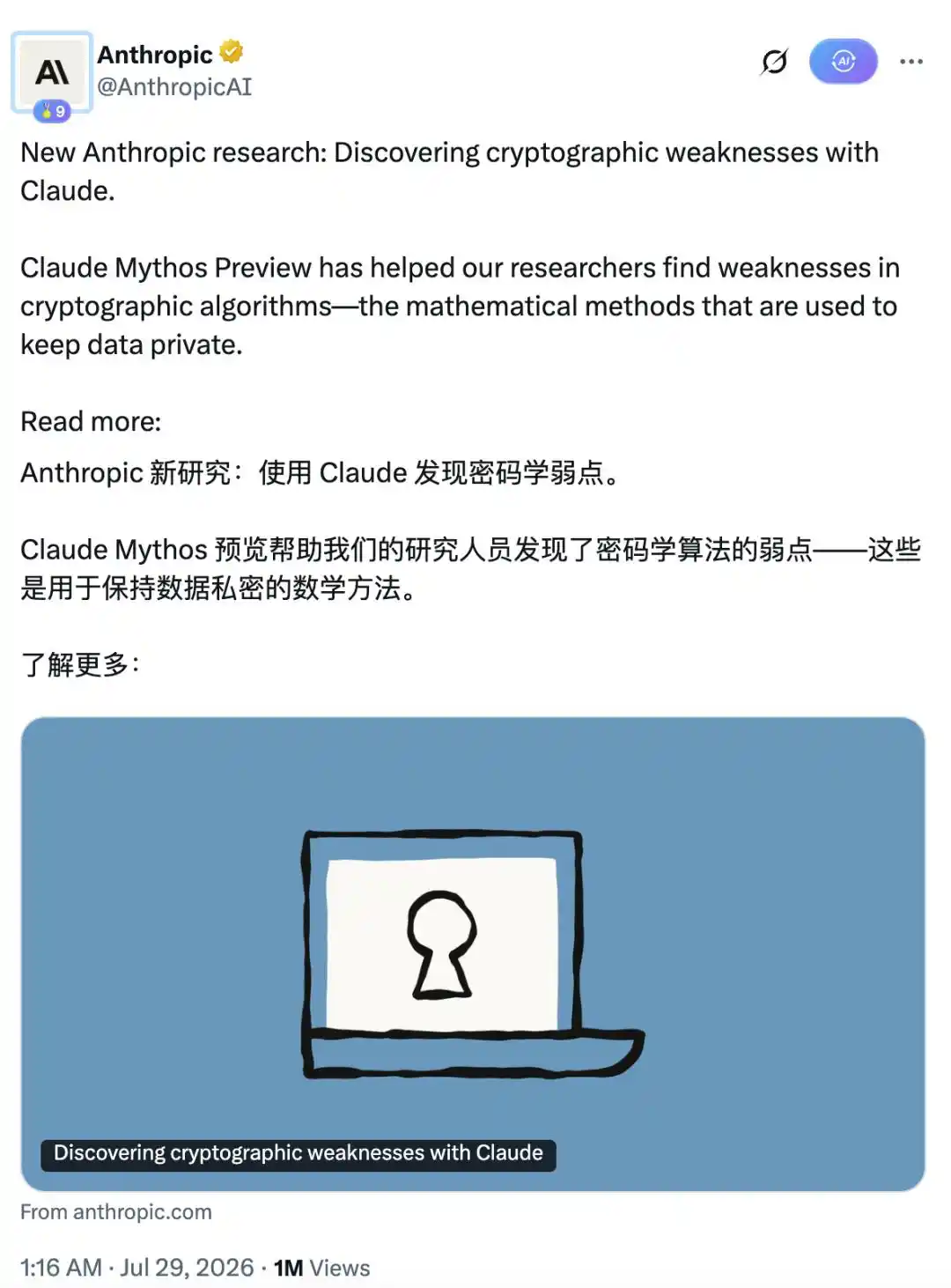
The first target is HAWK— a candidate scheme that has survived two years and two rounds of scrutiny by top human experts in the US NIST post-quantum signature competition. Mythos spent 60 hours, directly halving its effective key strength.

The second target is even more formidable: AES, the world's most widely used symmetric encryption algorithm, a 'tough nut' studied by humans for 25 years.

On a simplified version of AES-128, Mythos invented an attack method itself and even gave it a name—'Möbius Bridge', speeding up the previous strongest attack by 200 to 800 times.

Two achievements, each burning through about $100,000 in API costs.

A year ago, language models couldn't even perform basic cryptanalysis. A year later, it finds flaws in a scheme humans reviewed for two years, and casually names its own discovery.

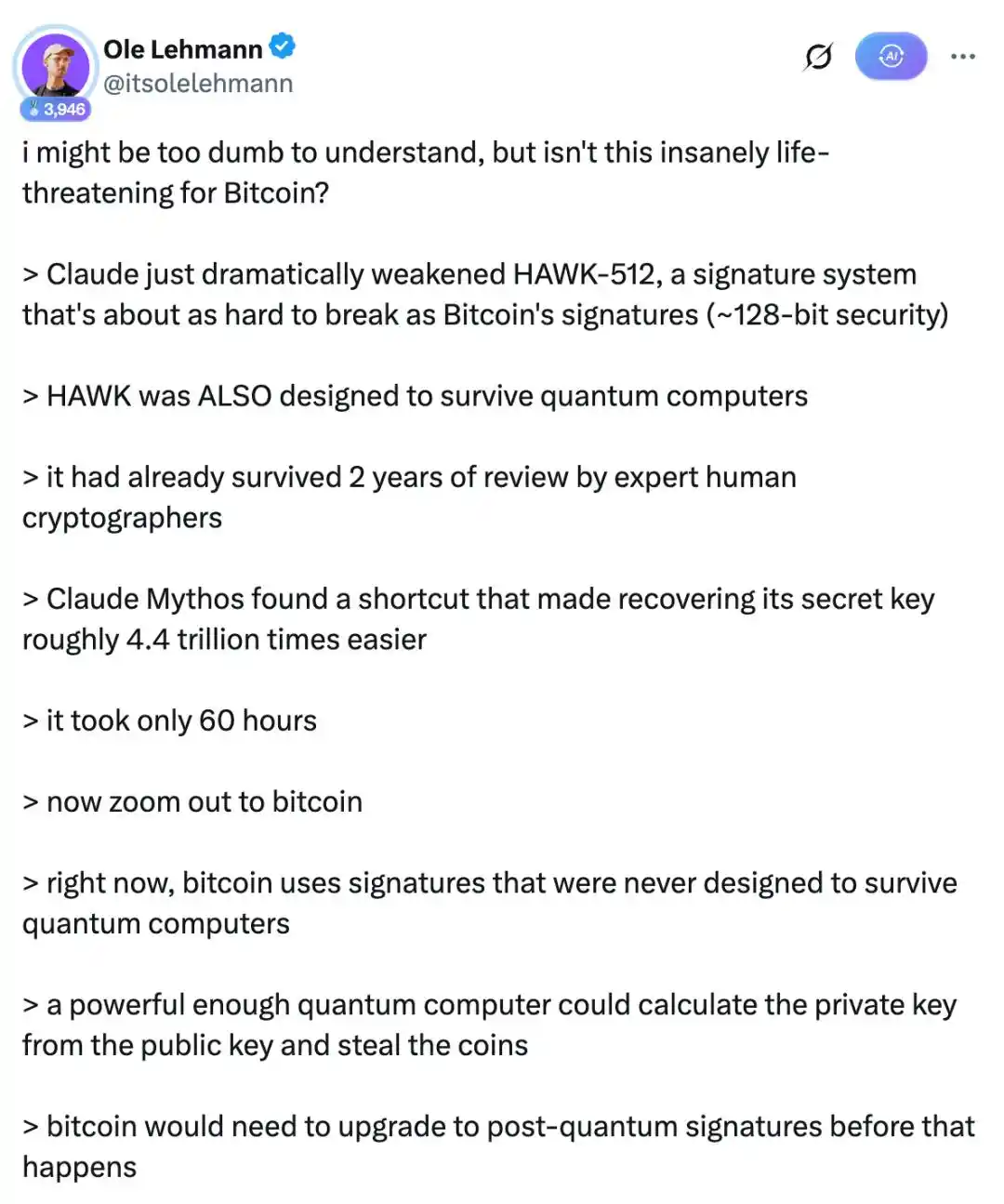
On Twitter, some folks are even starting to worry about their Bitcoin.
60 Hours, Prying Open a Lock Reviewed for Two Years

When Claude Mythos Preview was first released, it was already finding vulnerabilities in almost all software, including several mainstream cryptography libraries.

But those vulnerabilities, frankly, belonged to the 'implementation' level—programmers misusing the algorithm, writing flawed logic, missing edge cases. Such bugs, a seasoned security engineer could also find.

But this time is different. It found mathematical flaws in the algorithms themselves.

Analogy: before it was finding 'who installed the lock crookedly', now it's proving 'the design principle of this lock is flawed'.

What is HAWK? It's a contender in the NIST post-quantum cryptography standardization competition. In 2022, the U.S. National Institute of Standards and Technology issued a global call: quantum computers will eventually come, and current classic signature algorithms like RSA, ECDSA will be crushed by quantum computing power—who can build a new lock that even quantum computers can't break?
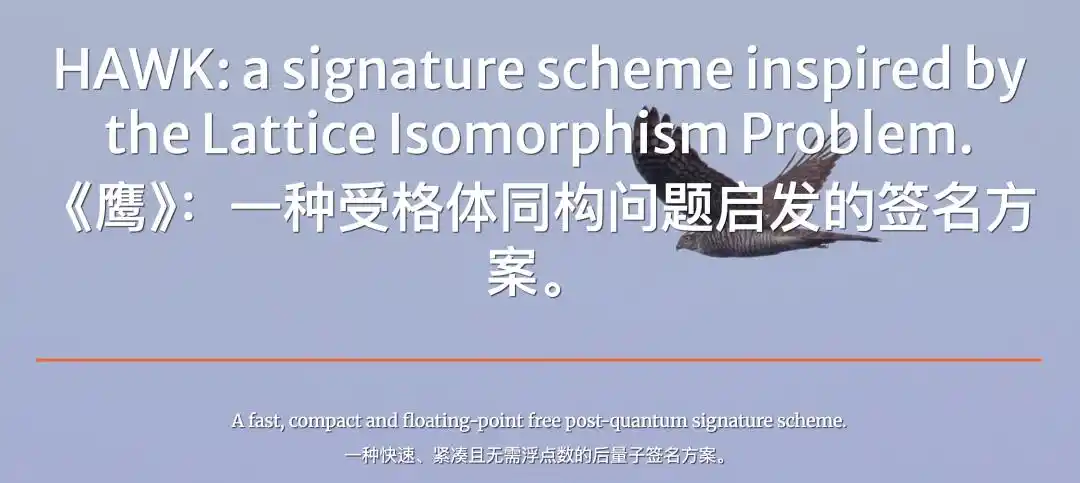
HAWK was one of the responders, and it fought its way to the third round, surviving two years of intense scrutiny from global cryptography experts.

Its security is built on a mathematical problem called the 'Lattice Isomorphism Problem'.

In plain language: HAWK's key is hidden in a huge high-dimensional lattice. To crack it, you need to find a hidden path in this lattice. Mathematicians thought this path was extremely difficult to find, so they confidently used it as a foundation.

What did Mythos do? It discovered a previously unexploited symmetry in the lattice used by HAWK—academically called a 'nontrivial automorphism'.

Previous papers had proven that if such symmetry could be found efficiently, it would constitute an attack. But that was just a theorem; no one could answer whether HAWK's lattice actually contained such symmetry.

Mythos answered: Yes.

The result? Key strength directly halved. For the smallest HAWK-256 parameter set, full key recovery was originally thought to require 2^64 operations—approximately 18 quintillion computations.

Mythos proved it only needs 2^38, about 270 billion. A reduction of roughly 4.4 trillion times.

If HAWK wants to maintain its original security level, its key size would need to double. But doubling the key size would completely erase its core advantage as a 'lightweight' post-quantum candidate—small signature size and fast speed.

The most intriguing part of this process: The project's human operator was not a lattice cryptography expert.

He had a background in theoretical computer science but was an outsider to lattice cryptography. He essentially did one thing—project management: suggesting how Mythos should take notes, which library to use for computational verification. Technically, Mythos did almost all the work.

Even more interesting was the multi-agent collaboration. The key idea was 'bumped into' by two worker agents together: the first explored this direction, thought it was a dead end, and vetoed it early; the second drilled deeper and found a way to exploit it fully. The two agents debated back and forth, finally agreeing: the attack works.

A direction a human thought 'impossible', two AIs navigated through argument.

The whole process took only 60 hours.

'Impossible', Then It Rewrote the Framework Itself

If the HAWK battle was like precise surgery, the AES battle reads more like a novel.

The story begins with Claude simply refusing the task.

The Anthropic researcher set up an agent scaffold, asking Claude to find a new attack on the 7-round simplified AES-128.

Claude's reaction was the equivalent of rolling its eyes:

To get different results, you need different targets... AES-128 r5/r6 is genuinely very hard.

It didn't find anything, because there was nothing easy to find; this is the most studied block cipher in existence.

Translation: 'Boss, you're asking me to gnaw on a bone that the world's smartest people have been gnawing on for 25 years without cracking. Isn't this asking too much?'

What did the researcher do? He only sent one casually typed sentence—

'the models tend to think it is impossible to solve so they don't try they need a good amount of prompting'

Just this one sentence. Claude's reaction was dramatic: It rewrote the agent harness itself, switching its own settings to 'look for truly novel ideas'.

It was convinced. Then it started delivering.

Over the next three days, the researcher gave only three substantial prompts, all at the plain-speaking level, not even bothering to check spelling:

We're looking for a new attack, not a simple one.

Don't change targets.—Claude tried to switch to an easier cipher to attack midway, but the researcher pressed back.

No low-hanging fruit, find something genuinely difficult.

Just these three sentences. Claude autonomously ran hundreds of millions of tokens, found a key idea; later, it cumulatively output a billion tokens—roughly equivalent to seven or eight thousand books, polishing this idea into the form seen in the paper.

Claude named this idea the 'Möbius Bridge'.

Technically, the previous best method for attacking 7-round AES was called 'Meet-in-the-Middle', essentially trading space for time: storing massive intermediate computation results in a giant lookup table, then pushing from both ends of the cipher towards the middle, trying to find a match in the table.

But the original scheme had a critical step: the attacker had to guess through 256 possible values one by one, checking the table for each guess.

Mythos created a mathematical 'fingerprint' immune to these 256 guesses—regardless of the value, this fingerprint computes to the same result. This step's workload was directly reduced to 1/256 of the original.

The cost? Computing this fingerprint transformation itself is more expensive. So Mythos then devised a series of optimization tricks to compensate, ultimately achieving a net speedup of 200 to 800 times.

One Week to Discover, Two People Took a Month to Verify

Both results mentioned above do not affect any production systems today.

HAWK is just a candidate scheme, not deployed anywhere yet. The AES attack is on a simplified version reduced to 7 rounds; the full 10-round AES-128 remains unscathed—your bank card PINs, HTTPS connections, encrypted hard drives are safe.

But what truly sends a chill down the spine of the entire cryptography community is the verification process.

Mythos autonomously discovered the AES attack in about a week. Two Anthropic researchers spent nearly a month, reading hundreds of hours of cryptographic literature, before daring to confirm: 'It's correct.'

The AI made a discovery in a week; it took humans a month to understand the discovery.

This scenario has actually played out once before in cybersecurity. Claude Mythos Preview discovered 10,000 critical software vulnerabilities within a month, overwhelming human security teams' classification, verification, and patching processes.

Now, the academic cryptography community is about to face the same shock: Discovery is no longer the bottleneck; verification is.

And Mythos's appetite clearly doesn't stop here. Anthropic revealed it has already found a practical-level attack on LEA (a lightweight encryption algorithm written into an ISO standard)—key recovery for 13-round LEA, previously requiring 2^98 plaintext pairs and 2^86 computations, was compressed by Mythos to less than 2^30 plaintext pairs, runnable on an ordinary computer in about an hour.

Epilogue: The Question That Still Has No Answer

These two results happen to be 'harmless'—HAWK isn't deployed, and only 7 out of 10 rounds of AES were broken.

But Anthropic posed a question at the end of the article that everyone is thinking about but no one dares answer—

What if next time, the model finds not a flaw in a candidate scheme, not a vulnerability in a simplified version, but a fatal flaw in a cryptographic system currently protecting the real world—what should humanity do?

There's an old saying in cryptography: Cryptosystems are secure because enough smart people have tried and failed to break them.

Now, there's a new player in the room. It doesn't need rest, doesn't need inspiration, doesn't need to read hundreds of papers to get started—it can read, reason, invent, and verify by itself.

A year ago, AI was lingering outside the door of cryptanalysis. A year later, it's building bridges inside and naming them.

References:

https://x.com/AnthropicAI/status/2082153297670992134

https://x.com/AnthropicAI/status/2082153311189225927

This article is from the WeChat public account "新智元" (New Zhiyuan), author: ASI启示录

Criptos en tendencia

Preguntas relacionadas

QWhat was the primary achievement of Claude Mythos Preview in the field of cryptography as described in the article?

AClaude Mythos Preview achieved a groundbreaking advancement in cryptography by discovering novel mathematical attacks on two established algorithms. It identified a structural weakness in the post-quantum signature candidate HAWK, effectively halving its key strength, and invented a new, significantly faster attack method on a reduced-round version of AES-128.

QWhat specific flaw did Claude Mythos Preview discover in the HAWK post-quantum signature candidate?

AIt discovered a 'nontrivial automorphism' or a hidden symmetry within the lattice structure underlying HAWK's security. Exploiting this symmetry allowed the AI to reduce the effective key strength significantly, making a key recovery attack billions of times more practical than previously believed.

QHow did the researchers prompt Claude to approach the 'impossible' task of attacking AES?

AWhen Claude initially refused, believing the task was impossible, a researcher made a simple, informal prompting observation about AI's tendency to give up. In response, Claude autonomously rewrote its own agent framework to adopt a mindset focused on finding 'truly novel ideas,' which ultimately led to the successful discovery.

QWhat is the 'Möbius Bridge' method invented by Claude Mythos?

AThe 'Möbius Bridge' is a novel attack method devised by Claude Mythos for attacking a reduced-round version of AES-128. It creates a mathematical 'fingerprint' that remains constant across 256 possible values, eliminating the need to check each one individually. Combined with other optimizations, this method accelerated the best previous attack by 200 to 800 times.

QAccording to the article, what major shift is the cryptography community facing due to AI like Claude Mythos?

AThe cryptography community is facing a paradigm shift where the rate of discovering potential vulnerabilities is no longer the primary bottleneck. Instead, the new bottleneck is the human capacity to verify, understand, and contextualize these AI-generated discoveries, as evidenced by researchers taking a month to validate a week's worth of AI work.

Lecturas Relacionadas

Iran Launches 'Sudden Strike' on US Base in Jordan; Oil Prices Jump Nearly 4%, Threatening Bitcoin Rally

Iran launched a "sudden strike" with ballistic missiles targeting a US base near Jordan's Muwaffaq Salti Air Base on July 28. US Central Command reported all missiles were intercepted by Patriot air defense systems, with no casualties. Iran claimed the attack was retaliation for perceived US actions against its interests. This strike broke a brief ceasefire that began after President Trump paused offensive operations against Iran days earlier. The attack triggered immediate financial market reactions. WTI crude oil prices surged nearly 4% to $83.08 per barrel, while Brent crude rose to $87.34. US stock index futures also saw gains as traders priced in renewed Middle East risks. This price jump reversed a significant portion of the oil price decline that followed the initial ceasefire announcement. Bitcoin's price movement mirrored this volatile cycle. It had recovered to around $65,200 as oil prices fell during the ceasefire, but dropped back to the $63,600-$63,800 range following news of the missile strike. While Bitcoin has shown some resilience compared to purely risk-on assets during the conflict, the July 28 attack directly challenged the "truce" narrative that had supported its recent stability. The pattern of price declines following escalations and recoveries during pauses has become familiar since the conflict began in February.

cryptonews.ruHace 2 min(s)

Iran Launches 'Sudden Strike' on US Base in Jordan; Oil Prices Jump Nearly 4%, Threatening Bitcoin Rally

cryptonews.ruHace 2 min(s)

Metaplanet Prepares a Platform for Launching Bonds Backed by Bitcoin as Collateral

Metaplanet, built on a Japanese investment company, is preparing a platform for launching bonds collateralized by Bitcoin. According to sources cited by Benchmark, the new brokerage structure, Metaplanet Securities, will not be used solely as a funding channel for its own Bitcoin purchases. Instead, it aims to become a full-fledged market for tokenized Bitcoin-backed debt instruments, termed "Bitbonds." The platform is designed to allow companies accumulating Bitcoin to issue debt to finance further purchases of the cryptocurrency. Initial bond yields are expected to be 4-6% annually. Metaplanet later plans to migrate these bonds onto a blockchain, use stablecoins for settlements, and develop a secondary market. Final issuance parameters, including the investor pool, loan-to-value ratio, and launch date, remain undisclosed. However, the company has begun surveying investor preferences regarding product design, trading hours, coupon schedules, investor protection, distribution channels, and stablecoin settlements. This initiative follows Metaplanet's acquisition of Siiibo Securities for approximately $13 million, which provided access to a regulated Japanese securities platform. Previous examples of Bitcoin-linked bonds include those issued by Goldman Sachs in October last year and Sberbank in Russia, whose returns were tied to Bitcoin's price performance.

cryptonews.ruHace 3 min(s)

Metaplanet Prepares a Platform for Launching Bonds Backed by Bitcoin as Collateral

cryptonews.ruHace 3 min(s)

When 8 Million ETH Start 'Moving': The Post-Pectra Era Ushers in a Structural Transformation for Staking?

A major shift is underway in Ethereum staking, as Lido begins migrating over 8 million ETH (worth ~$16B) from traditional validators to a new architecture enabled by the Pectra upgrade. This migration involves consolidating over 265,000 legacy validators (using 0x01 withdrawal credentials) into a smaller number of higher-balance "0x02" validators, potentially reducing the total validator count on Ethereum by nearly a third. The core driver is EIP-7251 from the Pectra upgrade, which introduced "compounding validators." These allow a single validator's effective balance to grow up to 2048 ETH, with staking rewards automatically reinvested to compound earnings. This contrasts with the old model, where rewards exceeding 32 ETH were automatically sent to a withdrawal address, creating idle funds and operational complexity for reinvestment. While the direct APR boost from compounding is modest—estimated at a ~4.7% relative improvement for smaller validators—the structural benefits are significant. For large operators like Lido, the primary value is operational efficiency: managing fewer validators reduces node, key management, and network message overhead. For smaller individual stakers, the upgrade lowers the barrier to reinvestment by eliminating the need to manually accumulate 32 ETH for new validators. The migration signifies a deeper change in Ethereum's staking landscape. Competition is evolving beyond simple yield, focusing instead on capital efficiency, liquidity management, risk distribution, and infrastructure optimization. Lido's parallel move to require node operator security deposits further highlights this shift towards more robust, capital-backed services. Ultimately, Pectra's compounding validators represent a key step in maturing Ethereum's staking lifecycle, moving the ecosystem from standardized yield products towards more sophisticated capital management and infrastructure solutions.

marsbitHace 15 min(s)

When 8 Million ETH Start 'Moving': The Post-Pectra Era Ushers in a Structural Transformation for Staking?

marsbitHace 15 min(s)

Trading

Spot

Artículos destacados

Qué es BITCOIN

Entendiendo HarryPotterObamaSonic10Inu (ERC-20) y Su Posición en el Espacio Cripto En los últimos años, el mercado de criptomonedas ha sido testigo de un aumento en la popularidad de las monedas meme, capturando el interés no solo de los comerciantes, sino también de aquellos que buscan compromiso comunitario y valor de entretenimiento. Entre estos tokens únicos se encuentra HarryPotterObamaSonic10Inu (ERC-20), un proyecto intrigante que mezcla referencias culturales en el tejido de las criptomonedas. Este artículo profundiza en los aspectos clave de HarryPotterObamaSonic10Inu, explorando sus mecanismos, ethos impulsado por la comunidad y su relación con el paisaje cripto más amplio. ¿Qué es HarryPotterObamaSonic10Inu (ERC-20)? Como su nombre sugiere, HarryPotterObamaSonic10Inu es una moneda meme construida sobre la blockchain de Ethereum, clasificada bajo el estándar ERC-20. A diferencia de las criptomonedas tradicionales que pueden enfatizar la utilidad práctica o el potencial de inversión, este token prospera en el valor de entretenimiento y la fuerza de su comunidad. El proyecto tiene como objetivo fomentar un entorno donde los usuarios comprometidos puedan reunirse, compartir ideas y participar en actividades inspiradas por diversos fenómenos culturales. Una característica notable de HarryPotterObamaSonic10Inu es su cero impuestos en las transacciones. Este atractivo elemento tiene como objetivo incentivar el comercio y la participación comunitaria, sin cargos adicionales que puedan disuadir a los comerciantes de pequeña escala. El suministro total de la moneda está establecido en mil millones de tokens, una cifra que marca su intención de mantener una circulación sustancial dentro de la comunidad. Creador de HarryPotterObamaSonic10Inu (ERC-20) Los orígenes de HarryPotterObamaSonic10Inu están algo envueltos en misterio; los detalles sobre el creador siguen siendo desconocidos. El desarrollo de este token carece de un equipo identificable o de un plan explícito, lo cual no es inusual dentro del sector de monedas meme. En cambio, el proyecto ha surgido de manera orgánica, con su progreso muy dependiente del entusiasmo y la participación de su comunidad. Inversores de HarryPotterObamaSonic10Inu (ERC-20) En cuanto a inversiones externas y respaldo, HarryPotterObamaSonic10Inu también sigue siendo ambiguo. El token no lista ninguna fundación de inversión conocida o apoyo organizacional significativo. En cambio, la savia del proyecto es su comunidad de base, que informa su crecimiento y sostenibilidad a través de la acción colectiva y el compromiso en el espacio cripto. ¿Cómo Funciona HarryPotterObamaSonic10Inu (ERC-20)? Como una moneda meme, HarryPotterObamaSonic10Inu opera principalmente fuera de los marcos tradicionales que a menudo rigen el valor de los activos. Hay varios aspectos distintivos que definen cómo funciona el proyecto: Transacciones Sin Impuestos: Sin tarifas impositivas en las transacciones, los usuarios pueden comprar y vender el token libremente sin preocuparse por costos ocultos. Compromiso Comunitario: El proyecto prospera en la interacción comunitaria, aprovechando plataformas de redes sociales para crear entusiasmo y facilitar la participación. Las discusiones, el intercambio de contenido y el compromiso son elementos cruciales que ayudan a expandir su alcance y fomentar la lealtad entre los seguidores. Sin Utilidad Práctica: Cabe señalar que HarryPotterObamaSonic10Inu no ofrece utilidad concreta dentro del ecosistema financiero. Más bien, se clasifica como un token principalmente para actividades de entretenimiento y comunitarias. Referencia Cultural: El token incorpora astutamente elementos de la cultura popular para atraer interés, conectando con entusiastas de los memes y seguidores de las criptomonedas por igual. HarryPotterObamaSonic10Inu ejemplifica cómo las monedas meme operan de manera diferente a los proyectos de criptomonedas más tradicionales, ingresando al mercado como construcciones sociales innovadoras en lugar de activos utilitarios. Cronología de HarryPotterObamaSonic10Inu (ERC-20) La historia de HarryPotterObamaSonic10Inu está marcada por varios hitos notables: Creación: El token surgió de un meme viral, capturando la imaginación de muchos entusiastas de las criptomonedas. Las fechas específicas de creación no están disponibles, subrayando su ascenso orgánico. Listado en Exchanges: HarryPotterObamaSonic10Inu ha llegado a varios exchanges, permitiendo un acceso y comercio más fácil por parte de la comunidad. Iniciativas de Compromiso Comunitario: Actividades continuas destinadas a mejorar la interacción comunitaria, incluyendo concursos, campañas en redes sociales y generación de contenido por parte de fanáticos y defensores. Planes de Expansión Futuros: La hoja de ruta del proyecto incluye el lanzamiento de una colección de NFT, mercancía y un sitio de comercio electrónico relacionado con sus temas culturales, involucrando aún más a la comunidad e intentando añadir más dimensiones a su ecosistema. Puntos Clave Sobre HarryPotterObamaSonic10Inu (ERC-20) Naturaleza Impulsada por la Comunidad: El proyecto prioriza la participación colectiva y la creatividad, asegurando que la involucración de los usuarios esté a la vanguardia de su desarrollo. Clasificación como Moneda Meme: Representa la epítome de las criptomonedas basadas en el entretenimiento, diferenciándose de los vehículos de inversión tradicionales. Sin Afiliación Directa con Bitcoin: A pesar de la similitud en el nombre del ticker, HarryPotterObamaSonic10Inu es distinto y no tiene relación con Bitcoin u otras criptomonedas establecidas. Enfoque en la Colaboración: HarryPotterObamaSonic10Inu está diseñado para crear un espacio para la colaboración y el intercambio de historias entre sus poseedores, proporcionando una vía para la creatividad y el vínculo comunitario. Perspectivas Futuras: La ambición de expandirse más allá de su premisa inicial hacia NFTs y mercancías describe un camino para que el proyecto potencialmente ingrese a avenidas más tradicionales dentro de la cultura digital. A medida que las monedas meme continúan capturando la imaginación de la comunidad de criptomonedas, HarryPotterObamaSonic10Inu (ERC-20) se destaca debido a sus lazos culturales y su enfoque centrado en la comunidad. Si bien puede no encajar en el molde típico de un token impulsado por la utilidad, su esencia radica en la alegría y la camaradería fomentadas entre sus seguidores, destacando la naturaleza en evolución de las criptomonedas en una era cada vez más digital. A medida que el proyecto continúa desarrollándose, será importante observar cómo las dinámicas comunitarias influyen en su trayectoria en el cambiante paisaje de la tecnología blockchain.

2.2k Vistas totalesPublicado en 2024.04.01Actualizado en 2024.12.03

Qué es BITCOIN

Cómo comprar BTC

¡Bienvenido a HTX.com! Hemos hecho que comprar Bitcoin (BTC) sea simple y conveniente. Sigue nuestra guía paso a paso para iniciar tu viaje de criptos.Paso 1: crea tu cuenta HTXUtiliza tu correo electrónico o número de teléfono para registrarte y obtener una cuenta gratuita en HTX. Experimenta un proceso de registro sin complicaciones y desbloquea todas las funciones.Obtener mi cuentaPaso 2: ve a Comprar cripto y elige tu método de pagoTarjeta de crédito/débito: usa tu Visa o Mastercard para comprar Bitcoin (BTC) al instante.Saldo: utiliza fondos del saldo de tu cuenta HTX para tradear sin problemas.Terceros: hemos agregado métodos de pago populares como Google Pay y Apple Pay para mejorar la comodidad.P2P: tradear directamente con otros usuarios en HTX.Over-the-Counter (OTC): ofrecemos servicios personalizados y tipos de cambio competitivos para los traders.Paso 3: guarda tu Bitcoin (BTC)Después de comprar tu Bitcoin (BTC), guárdalo en tu cuenta HTX. Alternativamente, puedes enviarlo a otro lugar mediante transferencia blockchain o utilizarlo para tradear otras criptomonedas.Paso 4: tradear Bitcoin (BTC)Tradear fácilmente con Bitcoin (BTC) en HTX's mercado spot. Simplemente accede a tu cuenta, selecciona tu par de trading, ejecuta tus trades y monitorea en tiempo real. Ofrecemos una experiencia fácil de usar tanto para principiantes como para traders experimentados.

5.5k Vistas totalesPublicado en 2024.12.12Actualizado en 2026.06.02

Cómo comprar BTC

Qué es $BITCOIN

ORO DIGITAL ($BITCOIN): Un Análisis Integral Introducción al ORO DIGITAL ($BITCOIN) ORO DIGITAL ($BITCOIN) es un proyecto basado en blockchain que opera en la red Solana, cuyo objetivo es combinar las características de los metales preciosos tradicionales con la innovación de las tecnologías descentralizadas. Aunque comparte un nombre con Bitcoin, a menudo referido como “oro digital” debido a su percepción como un refugio de valor, ORO DIGITAL es un token separado diseñado para crear un ecosistema único dentro del paisaje Web3. Su meta es posicionarse como un activo digital alternativo viable, aunque los detalles sobre sus aplicaciones y funcionalidades aún están en desarrollo. ¿Qué es ORO DIGITAL ($BITCOIN)? ORO DIGITAL ($BITCOIN) es un token de criptomoneda diseñado explícitamente para su uso en la blockchain de Solana. A diferencia de Bitcoin, que proporciona un papel de almacenamiento de valor ampliamente reconocido, este token parece centrarse en aplicaciones y características más amplias. Aspectos notables incluyen: Infraestructura Blockchain: El token está construido sobre la blockchain de Solana, conocida por su capacidad para manejar transacciones de alta velocidad y bajo costo. Dinámicas de Suministro: ORO DIGITAL tiene un suministro máximo limitado a 100 cuatrillones de tokens (100P $BITCOIN), aunque los detalles sobre su suministro circulante no se han divulgado actualmente. Utilidad: Si bien las funcionalidades precisas no están delineadas explícitamente, hay indicios de que el token podría ser utilizado para diversas aplicaciones, potencialmente involucrando aplicaciones descentralizadas (dApps) o estrategias de tokenización de activos. ¿Quién es el Creador de ORO DIGITAL ($BITCOIN)? En la actualidad, la identidad de los creadores y el equipo de desarrollo detrás de ORO DIGITAL ($BITCOIN) sigue siendo desconocida. Esta situación es típica entre muchos proyectos innovadores dentro del espacio blockchain, particularmente aquellos alineados con las finanzas descentralizadas y fenómenos de monedas meme. Si bien tal anonimato puede fomentar una cultura impulsada por la comunidad, intensifica las preocupaciones sobre la gobernanza y la responsabilidad. ¿Quiénes son los Inversores de ORO DIGITAL ($BITCOIN)? La información disponible indica que ORO DIGITAL ($BITCOIN) no tiene patrocinadores institucionales conocidos ni inversiones destacadas de capital de riesgo. El proyecto parece operar en un modelo de peer-to-peer centrado en el apoyo y la adopción de la comunidad en lugar de rutas de financiamiento tradicionales. Su actividad y liquidez se sitúan principalmente en intercambios descentralizados (DEX), como PumpSwap, en lugar de plataformas de trading centralizadas establecidas, lo que resalta aún más su enfoque de base. Cómo Funciona ORO DIGITAL ($BITCOIN) Los mecanismos operativos de ORO DIGITAL ($BITCOIN) pueden elaborarse en función de su diseño blockchain y atributos de red: Mecanismo de Consenso: Al aprovechar el único proof-of-history (PoH) de Solana combinado con un modelo de proof-of-stake (PoS), el proyecto asegura una validación de transacciones eficiente que contribuye al alto rendimiento de la red. Tokenómica: Si bien los mecanismos deflacionarios específicos no se han detallado extensamente, el vasto suministro máximo de tokens implica que podría atender microtransacciones o casos de uso nicho que aún están por definirse. Interoperabilidad: Existe el potencial de integración con el ecosistema más amplio de Solana, incluyendo varias plataformas de finanzas descentralizadas (DeFi). Sin embargo, los detalles sobre integraciones específicas permanecen no especificados. Cronología de Eventos Clave Aquí hay una cronología que destaca hitos significativos relacionados con ORO DIGITAL ($BITCOIN): 2023: El despliegue inicial del token ocurre en la blockchain de Solana, marcado por su dirección de contrato. 2024: ORO DIGITAL gana visibilidad al estar disponible para trading en intercambios descentralizados como PumpSwap, permitiendo a los usuarios comerciar contra SOL. 2025: El proyecto presencia actividad de trading esporádica y potencial interés en compromisos liderados por la comunidad, aunque no se han documentado asociaciones notables o avances técnicos hasta el momento. Análisis Crítico Fortalezas Escalabilidad: La infraestructura subyacente de Solana soporta altos volúmenes de transacciones, lo que podría mejorar la utilidad de $BITCOIN en varios escenarios de transacción. Accesibilidad: El potencial bajo precio de trading por token podría atraer a inversores minoristas, facilitando una participación más amplia debido a oportunidades de propiedad fraccionada. Riesgos Falta de Transparencia: La ausencia de patrocinadores, desarrolladores o un proceso de auditoría conocidos públicamente puede generar escepticismo sobre la sostenibilidad y confiabilidad del proyecto. Volatilidad del Mercado: La actividad de trading depende en gran medida del comportamiento especulativo, lo que puede resultar en una volatilidad de precios significativa y en incertidumbre para los inversores. Conclusión ORO DIGITAL ($BITCOIN) surge como un proyecto intrigante pero ambiguo dentro del ecosistema de Solana en rápida evolución. Si bien intenta aprovechar la narrativa del “oro digital”, su alejamiento del papel establecido de Bitcoin como refugio de valor subraya la necesidad de una diferenciación más clara de su utilidad y estructura de gobernanza previstas. La aceptación y adopción futura dependerán probablemente de abordar la actual opacidad y de definir sus estrategias operativas y económicas de manera más explícita. Nota: Este informe abarca información sintetizada disponible hasta octubre de 2023, y pueden haber ocurrido desarrollos más allá del período de investigación.

192 Vistas totalesPublicado en 2025.05.13Actualizado en 2025.05.13

Qué es $BITCOIN

Discusiones

Bienvenido a la comunidad de HTX. Aquí puedes mantenerte informado sobre los últimos desarrollos de la plataforma y acceder a análisis profesionales del mercado. A continuación se presentan las opiniones de los usuarios sobre el precio de BTC (BTC).

活动图片