Bitcoin Giants Shrink: Whales Quietly Hand Off Billions To Institutions

bitcoinistPublicado a 2025-07-06Actualizado a 2025-07-06

Resumen

Bitcoin’s price has held steady around $108,100 as of Saturday afternoon after big holders shipped out a massive load of...

Trusted Editorial content, reviewed by leading industry experts and seasoned editors. Ad Disclosure

Bitcoin’s price has held steady around $108,100 as of Saturday afternoon after big holders shipped out a massive load of coins.

Based on reports, whales—those early adopters and big miners—sold over 500,000 BTC in the past 12 months. At today’s rates, that stash is worth north of $50 billion. Institutions grabbed almost every coin they let go. It’s a huge shift in who really owns Bitcoin.

Whales Pass The Torch

According to Bloomberg’s review of 10x Research data, wallets holding between 1,000–10,000 BTC saw their balances slip from over 4.5 million coins in January 2023 to about 4.47 million in July 2025.

At the same time, addresses with 100–1,000 BTC jumped from nearly 4 million to 4.77 million. That shift shows big players trimming back while medium‑size holders, often funds or wealthy clients, build their stacks. It’s happening quietly through in‑kind transfers and private deals that skip public exchanges.
Source: Bitcoin Treasuries

Institutions Ramp Up Their Stakes

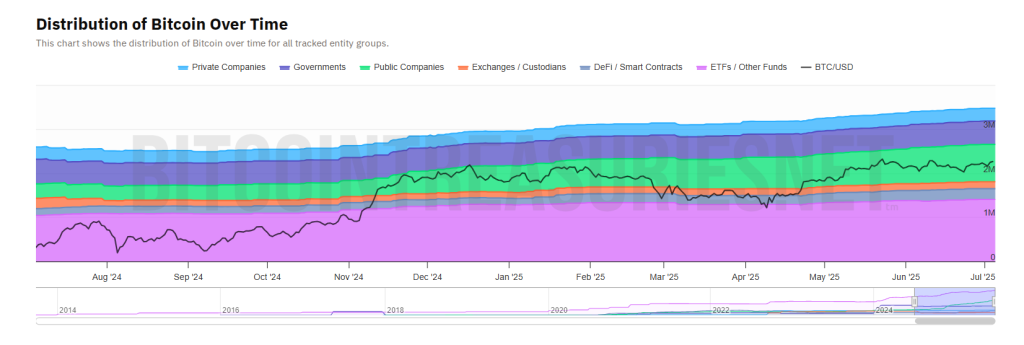
Funds, ETFs and corporate treasuries have scooped up almost every coin dropped by whales. Data from Bitcoin Treasuries shows private companies boosted their holdings from 279,374 BTC in July 2024 to 290,883 BTC today.

Public firms climbed from 325,400 BTC to 848,600 BTC. ETFs led the charge, raising their balance from 1,039,000 BTC to 1,405,480 BTC. In total, these groups added 899,198 BTC—about $96 billion—over the past year. That buying power has helped keep the market in balance as whales step back.

BTCUSD currently trading at $108,227. Chart: TradingView

Shift In On-Chain Holdings

Medium-sized wallets are growing while the largest ones shrink. That trend suggests new types of investors are moving in.

Edward Chin, co‑founder of Parataxis Capital, said in‑kind transfers let coins move from anonymous holders to regulated firms without public trades. This quiet pipeline boosts on‑chain activity and brings more oversight to big Bitcoin trades.

Volatility Hits Two-Year Low

As institutional flows rise, price swings have dulled. The Deribit 30‑day volatility gauge sits at its lowest level in two years. Jeff Dorman, CIO at Arca, compared today’s Bitcoin to a steady dividend payer that might deliver annual gains in the 10–20% range.

That’s a far cry from the 1,400% surge seen in 2017. For long‑term savers, steadier returns look more attractive than wild rallies.

Meanwhile, Fred Thiel, CEO of miner MARA Holdings, said his company still holds every coin it mines. But he warned that if whale selling picks up again and institutional appetite fades, prices could lurch lower.

Featured image from Meta, chart from TradingView

Editorial Process for bitcoinist is centered on delivering thoroughly researched, accurate, and unbiased content. We uphold strict sourcing standards, and each page undergoes diligent review by our team of top technology experts and seasoned editors. This process ensures the integrity, relevance, and value of our content for our readers.

Christian, a journalist and editor with leadership roles in Philippine and Canadian media, is fueled by his love for writing and cryptocurrency. Off-screen, he's a cook and cinephile who's constantly intrigued by the size of the universe.

Lecturas Relacionadas

Cryptocurrency Asset Recovery: A Lucrative, Low-Profile Business

Summary: The article explores the growing business of cryptocurrency asset recovery, highlighting it as a quiet but profitable niche. While many assume recovery involves dramatic hacking or theft cases, the most common issues are everyday operational errors: sending crypto to the wrong blockchain network, forgetting transaction memos/Tags, hardware wallet failures, incorrect seed phrase backups, and frozen centralized exchange accounts. As cryptocurrency adoption expands to less technical users, the volume of such costly mistakes increases. This creates a genuine, recurring demand for professional recovery services. The article notes a paradox: while the technology emphasizes user-controlled assets, the complexity often necessitates expert intermediaries, similar to traditional financial services. However, the field is fraught with risks, including middlemen and secondary scammers who prey on desperate users. Truly professional teams avoid promising guaranteed results, instead focusing on diagnosing the specific problem—whether it's a technical wallet issue, an exchange compliance matter, or an unsolvable private key loss. The author concludes by noting the professionalization of this market and announces a partnership with a specialized recovery team, offering readers a preliminary assessment for issues like wrong-chain deposits, lost access, or frozen accounts, while emphasizing ethical practices and realistic expectations.

marsbitHace 23 min(s)

Cryptocurrency Asset Recovery: A Lucrative, Low-Profile Business

marsbitHace 23 min(s)

Cryptocurrency Asset Recovery: A Lucrative, Under-the-Radar Business

Cryptocurrency Asset Recovery: A Lucrative, Low-Key Business The article discusses the burgeoning business of cryptocurrency asset recovery, driven by common yet often crippling user errors rather than sensational hacking incidents. Key problem areas include selecting the wrong blockchain for a deposit, omitting required memos/tags when sending to exchanges, physical wallet device failures, errors in backing up or modifying seed phrases, and issues with frozen accounts or withdrawals on centralized exchanges. As cryptocurrency adoption grows among mainstream users—including retail investors and businesses—these operational mistakes increase. The decentralized nature of crypto places full responsibility for asset security on users, who may lack the technical expertise to navigate complex chains, wallets, and protocols. Even centralized exchanges, while offering some support, often present users with cumbersome, non-intuitive processes for resolving issues. This creates a persistent and growing demand for professional recovery services. However, the field is rife with risks, including middlemen without real expertise and outright scammers who promise guaranteed recovery, request sensitive information like private keys, or charge advance "fees." Legitimate service providers typically avoid absolute guarantees, as recovery feasibility depends heavily on the specific technical or administrative circumstances of each case. The business is evolving from an informal market into a professional one requiring a combination of technical analysis, exchange/platform communication, and legal/compliance knowledge. The article concludes by noting the author's partnership with a professional recovery team, offering preliminary assessments for issues like incorrect deposits, wallet access problems, or exchange account freezes, with an emphasis on realistic evaluation over promises.

链捕手Hace 29 min(s)

Cryptocurrency Asset Recovery: A Lucrative, Under-the-Radar Business

链捕手Hace 29 min(s)

YC Partner: How to Build a Self-Evolving AI-Native Company

YC Partner Tom Blomfield argues that the future lies in building AI-native companies designed as self-evolving systems, not just applying AI to traditional, hierarchical "Roman legion" structures. The core idea is to extract and codify all organizational knowledge—scattered across emails, Slack, documents, and human minds—into a central, AI-readable "company brain." This enables the creation of recursive AI loops that sense changes (from emails, support tickets, data), make decisions, execute via tools, and learn from feedback, all with minimal human intervention. YC exemplifies this with an agent that monitors failed queries, autonomously diagnoses the issue (e.g., needing a new database or index), writes code, submits it for review, and deploys fixes—optimizing the company while founders sleep. This shift redefines organizational structure: the bottleneck becomes token usage and context quality, not headcount. Middle management for coordination is largely obsolete. The critical human roles are individual contributors (ICs) and those handling high-risk, real-world judgments at the system's edge. Key steps include recording all organizational activity for AI, creating self-improving artifacts (like an AI-generated, living handbook), and treating internal software as temporary and disposable, while preserving valuable business context and data. The fundamental question for founders is whether to build their company as this new type of intelligent, self-optimizing system from the start.

marsbitHace 34 min(s)

YC Partner: How to Build a Self-Evolving AI-Native Company

marsbitHace 34 min(s)

Trading

Spot
Futuros
活动图片