Ripple Just Moved This $2 Billion Industry Onto The XRP Ledger

bitcoinistPublicado a 2026-05-20Actualizado a 2026-05-20

Resumen

The XRP Ledger is now hosting a significant tokenized asset: electricity. A token called JMWH, issued by blockchain infrastructure company Justoken and backed by Latin American energy producers, represents real megawatt-hours of power on-chain. With a total asset value of approximately $2.229 billion, it is a major component of the Ledger's real-world asset (RWA) market. The tokenization process allows electricity to be transparently tracked from production to consumption, with tokens being burned once the energy is used. This move expands the XRP Ledger's use beyond payments and financial instruments into the commodity sector, specifically energy. The growing RWA market on the XRP Ledger, now valued at over $3.57 billion, demonstrates rapid expansion as more issuers tokenize real-world assets.

The XRP Ledger is hosting tokenized US Treasuries, money market funds, and real estate instruments, but it is also hosting something far more fundamental than these.

Electricity has become one of the largest real-world assets now represented on the XRP Ledger. Data from RWA.xyz shows JMWH, an energy-linked token issued through Justoken, with a total asset value of about $2.229 billion, putting tokenized power production directly on the Ledger infrastructure.

$2 Billion Tokenized Electricity On The XRP Ledger

Data from RWA.xyz shows over $2 billion worth of electricity tokens are currently tokenized on the XRP Ledger. This development is centered on JMWH, a digital token that represents real electricity on-chain.

JMWH is listed on RWA.xyz as a commodity-backed represented asset issued through Justoken. The asset description on RWA.xyz says each JMWH token represents one real megawatt-hour of energy backed by energy companies, with the total token amount reflecting contractual commitments covered by generation capacity assigned to clients.

The token is issued by Buenos Aires-based blockchain infrastructure company Justoken, backed by energy producers in Latin America.
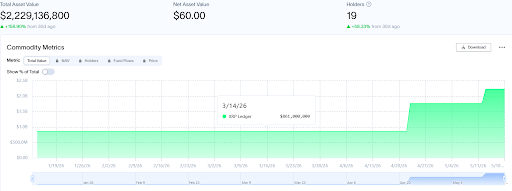
Source: Chart from RWA.xyz

Energy contracts are converted into blockchain-based tokens, allowing electricity to be tracked from production to consumption with full transparency. Once electricity is used, the corresponding tokens are burned, permanently removing them from circulation.

According to data from RWA.xyz, reflected in the image below, JMWH’s total asset value has now reached $2.229 billion, up 158.90% from 30 days ago, with 19 holders recorded on-chain.

Industrial Tokenization On The Ledger

JMWH is important because it changes the type of asset associated with the XRP Ledger. The network is often discussed through cross-border payments, stablecoins, tokenized Treasuries, and institutional settlement. Tokenized electricity adds another category entirely of energy as a recorded commodity on the Ledger.

This is more than a simple token listing. As noted by an enthusiast that goes by the name X Finance Bull, this is physical energy flowing through power grids being represented, traded, and settled on the same blockchain that powers XRP. $2 billion in tokenized electricity generates constant transactional demand. Every new account on the Ledger requires XRP reserves. More companies, more brokers, more settlement accounts, more wallets holding tokenized energy. Each one locks the altcoin just to exist on the ledger.

At the time of writing, the XRP Ledger has $3.57 billion in represented asset value, up by 71.47% from 30 days ago. This growth shows how quickly the Ledger’s real-world asset market is expanding, especially as more issuers begin using the network to represent commodities, stablecoins, financial contracts, and other real-world assets with links to the real-world economy.

XRP trading at $1.37 on the 1D chart | Source: XRPUSDT on Tradingview.com

Criptos en tendencia

Preguntas relacionadas

QWhat is the name and estimated value of the tokenized electricity asset being hosted on the XRP Ledger?

AThe tokenized electricity asset is called JMWH, and its total asset value is approximately $2.229 billion.

QWhat does a single JMWH token represent, and how is its lifecycle managed on the blockchain?

AA single JMWH token represents one real megawatt-hour of energy. The tokens are burned, or permanently removed from circulation, once the electricity they represent is consumed.

QWhich company is responsible for issuing the JMWH token, and where is it based?

AThe JMWH token is issued by Justoken, a Buenos Aires-based blockchain infrastructure company.

QAccording to the article, why is the tokenization of electricity on the XRP Ledger significant beyond just adding a new asset type?

AIt's significant because it creates constant transactional demand and requires new accounts (for companies, brokers, settlement accounts, etc.) to hold the tokens. Each new account must lock up XRP reserves, increasing utility and demand for XRP itself.

QWhat is the total value of all represented assets on the XRP Ledger, and what is its growth over the last 30 days as mentioned in the article?

AThe total represented asset value on the XRP Ledger is $3.57 billion, which represents a growth of 71.47% from 30 days ago.

Lecturas Relacionadas

When Traditional Finance Fails People in Crisis, Bitcoin Succeeds

When traditional finance fails to reach people in crisis, Bitcoin succeeds. This article highlights how fundraising platforms like GoFundMe face severe limitations in delivering aid to conflict zones like Gaza due to banking regulations, sanctions, and compliance rules. For instance, Sami Jamal Al-Shannat raised over £55,000 for his family but couldn't receive the funds directly; instead, money had to be routed through a beneficiary in another country, leading to disputes and loss of access. The piece explores how compliance requirements often force reliance on intermediaries, shifting risk and responsibility away from platforms and onto individuals. In contrast, Bitcoin and blockchain-based platforms like Geyser and Agora enable direct, peer-to-peer transactions, bypassing traditional financial bottlenecks. These platforms shift trust from centralized institutions to verifiers—local partners or trusted organizations—who validate projects, allowing donors to send funds directly to recipients' wallets. While not a panacea, Bitcoin offers a way to circumvent "transnational financial repression," where sanctions and AML rules inadvertently harm legitimate aid recipients, activists, and dissidents. The conclusion emphasizes that open payment networks and decentralized trust models represent a systemic shift, empowering beneficiaries and providing more resilient humanitarian fundraising in crisis situations. However, challenges around verification, accountability, and fraud prevention remain.

marsbitHace 15 min(s)

When Traditional Finance Fails People in Crisis, Bitcoin Succeeds

marsbitHace 15 min(s)

Bitcoin Shifts Towards Consolidation, Long-Term Holder Selling Pressure Significantly Eases

Bitcoin's Bottoming Process Shows Signs of Shifting Dynamics Bitcoin's bottom formation is ongoing, but key characteristics are changing. The capitulation selling by long-term holders (LTHs), a primary source of selling pressure this cycle, has begun to cool from its recent peak. Buyers successfully absorbed the selling at the June lows, and price is now recovering to challenge overhead resistance. The market is testing higher resistance levels. Bitcoin reacted more strongly to soft inflation data than major equity indices, signaling sellers may be exhausted and buyers are waiting for a catalyst. Its correlation with stocks is weakening while its inverse relationship with the USD is deepening, suggesting liquidity dynamics are now more influential than risk sentiment. On-chain, price sits between the network's Realized Price (a historical bear market floor) and the Short-Term Holder (STH) cost basis near $69k, a key resistance level where recent buyers break even. LTH profit-taking has largely dried up, and losses now dominate realized on-chain volume—a typical late bear market signal. Crucially, the pace of LTH capitulation has started to decline. Derivatives markets show bearish positions are being unwound, with put/call ratios falling and crash protection costs moderating. However, this derisking hasn't been accompanied by significant spot buying, a missing link for sustained recovery. US spot ETF outflows have slowed but not reversed. In conclusion, foundational elements for a bottom are forming: LTH selling is easing, low-point selling was absorbed, and the market is responding to positive macro cues. The next critical test is whether spot-driven buying can push price through and hold above the STH cost basis near $69k. The follow-through is not yet confirmed.

marsbitHace 33 min(s)

Bitcoin Shifts Towards Consolidation, Long-Term Holder Selling Pressure Significantly Eases

marsbitHace 33 min(s)

Defending Champions or New Kings? World Cup Final Sees All AIs Backing the Same Side

Will the 2026 World Cup final see Argentina successfully defend their title or a new champion crowned? AI models from various platforms have made their prediction. The final in Buenos Aires pits defending champions Argentina against a resilient Spanish side that has reached this stage with a record of exceptional defensive solidity, conceding only one goal in seven matches. Argentina's path was dramatically different, filled with late comebacks and narrow victories, including a semi-final win over England secured by late goals assisted by the 39-year-old Lionel Messi. A poignant subplot adds narrative weight: a nearly 20-year-old photo shows a young Messi bathing an infant Lamine Yamal, who is now a 19-year-old key player for Spain, symbolizing a potential passing of the torch. In the semi-finals, most AI models incorrectly predicted a French victory over Spain, with only Google's Gemini correctly picking Spain's advancement and also accurately forecasting Argentina's win over England. For the final, however, all six surveyed AIs—ChatGPT, Claude, Gemini, Grok, DeepSeek, and Qwen—unanimously predict a Spanish victory. Their reasoning centers on Spain's superior defense, midfield control, and better physical preparedness after a less strenuous knockout stage journey. While consensus favors Spain as champions, five of the six AIs believe the match will be tightly contested, predicting a draw (1-1 or 0-0) within regular time, with Spain's advantage potentially telling in extra time or even a penalty shootout. Only DeepSeek forecasts a clear Spanish victory within 90 minutes. The stage is set for a clash between Argentina's legendary fighting spirit and Spain's machine-like consistency, with artificial intelligence firmly backing the latter to lift the trophy.

Odaily星球日报Hace 50 min(s)

Defending Champions or New Kings? World Cup Final Sees All AIs Backing the Same Side

Odaily星球日报Hace 50 min(s)

From a Loss of 19.2 Billion to a Profit of 7.1 Billion, ChangXin Technology States 'Downturn Cycle Remains a Concern'

Changxin Technology, China's leading domestic DRAM manufacturer, is nearing its IPO on the STAR Market. After reporting significant net losses of -192.25 billion yuan and -90.51 billion yuan in 2023 and 2024 respectively, the company achieved a net profit of 71.44 billion yuan in 2025. This turnaround is attributed to an AI-driven surge in DRAM demand and tight industry supply, leading to a 33.69% increase in average selling prices alongside reduced unit costs. Despite the improved profitability, with gross margins rising from -1.93% in 2023 to 40.99% in 2025, Chairman Zhu Yiming cautions that the strongly cyclical DRAM industry remains vulnerable. Risks include potential macroeconomic shifts, uncertain AI demand, and new capacity expansions that could trigger another downturn. The company still faces high fixed costs, with depreciation reaching 246.8 billion yuan in 2025. Changxin plans to raise 29.5 billion yuan through its IPO to fund technology upgrades, DRAM advancement, and R&D. While its capacity ranks fourth globally, its 7.67% Q4 2025 market share lags behind leaders Samsung, SK Hynix, and Micron. Analysts note the company must now prove its ability to achieve stable mass production with high yields and low cost-per-bit, especially for advanced products. Its growth currently relies on transitioning from DDR4/LPDDR4X to DDR5/LPDDR5X and increasing domestic substitution. Successfully developing and commercializing high-value AI products like HBM is seen as crucial for future competitiveness and closing the gap with international giants.

marsbitHace 1 hora(s)

From a Loss of 19.2 Billion to a Profit of 7.1 Billion, ChangXin Technology States 'Downturn Cycle Remains a Concern'

marsbitHace 1 hora(s)

Trading

Spot

Artículos destacados

Qué es XRP 2.0

XRP 2.0: Una Nueva Frontera en el Panorama de las Criptomonedas Introducción a XRP 2.0 En el siempre cambiante ámbito de las criptomonedas, nuevos proyectos surgen continuamente, compitiendo por atención y adopción. Una de estas iniciativas prometedoras es XRP 2.0, un nuevo proyecto de criptomoneda diseñado para aprovechar la tecnología blockchain avanzada y metodologías de encriptación robustas. Aunque el nombre establece paralelismos con el XRP de Ripple, es crucial señalar que XRP 2.0 opera de manera independiente, enfocándose en mejorar la seguridad de las transacciones, la privacidad y la escalabilidad. A medida que el panorama financiero digital abraza cada vez más soluciones descentralizadas, XRP 2.0 busca contribuir de manera significativa a web3 y a la expansión general de los proyectos de criptomonedas. ¿Qué es XRP 2.0? En esencia, XRP 2.0 es un proyecto de criptomoneda que busca crear un ecosistema de moneda digital seguro y descentralizado. Su tecnología fundamental integra principios avanzados de blockchain con técnicas de encriptación de vanguardia. El objetivo principal de XRP 2.0 es establecerse como una plataforma confiable y eficiente que permita la ejecución rápida de transacciones mientras prioriza la protección de la privacidad de sus usuarios. El proyecto se promociona como una solución a muchas limitaciones enfrentadas por las criptomonedas existentes, proponiendo un sistema que puede manejar un mayor volumen de transacciones con mejor velocidad y privacidad. Esta versatilidad posiciona a XRP 2.0 como un competidor significativo en un mercado plagado de diversas monedas digitales. ¿Quién es el Creador de XRP 2.0? La identidad del creador detrás de XRP 2.0 ha sido señalada como 'Wilbur.' Sin embargo, los detalles completos sobre Wilbur o su entidad asociada siguen siendo elusivos. La anonimidad de muchos creadores de criptomonedas no es un fenómeno poco común en la industria, a menudo diseñado para mantener un grado de privacidad y seguridad. ¿Quiénes son los Inversores de XRP 2.0? Hasta ahora, la información específica relacionada con las fundaciones o organizaciones de inversión que apoyan a XRP 2.0 no está disponible públicamente. En el sector de las criptomonedas, el respaldo de inversores respetables puede influir significativamente en la credibilidad y el éxito de un proyecto, sin embargo, la transparencia sobre los patrocinadores financieros de XRP 2.0 no se ha establecido. ¿Cómo Funciona XRP 2.0? XRP 2.0 se destaca al emplear una combinación de tecnología blockchain y algoritmos de encriptación avanzados que aseguran transacciones seguras y descentralizadas. Su estructura innovadora incluye características únicas diseñadas para fomentar el compromiso del usuario y ampliar las funcionalidades más allá de las transacciones convencionales de criptomonedas. Entre estas características, XRP 2.0 incorpora capacidades impulsadas por IA, como funcionalidades de texto a imagen y de texto a voz. Estas adiciones están diseñadas para mejorar la experiencia interactiva de los usuarios, promoviendo una mayor aplicabilidad en diversos sectores. Al unir avances tecnológicos con un diseño centrado en el usuario, XRP 2.0 busca captar la atención de una amplia gama de individuos y empresas que buscan integrar soluciones de criptomonedas en sus marcos operativos. Cronología de XRP 2.0 Entender XRP 2.0 requiere examinar los hitos que han definido su viaje hasta ahora: 23 de julio de 2023: Se presenta XRP 2.0 como un nuevo proyecto de criptomonedas, con el objetivo de revolucionar las capacidades de transacciones seguras y descentralizadas en el ámbito de blockchain. 8 de septiembre de 2023: Se lanza otro proyecto, XRP20, marcando la aparición de un token ERC-20 en la blockchain de Ethereum que no guarda relación con XRP 2.0. 13 de noviembre de 2023: El Libro Mayor de XRP experimenta una actualización significativa con el lanzamiento de la versión 2.0.0 del software del servidor rippled. Es esencial señalar que este desarrollo está desconectado del proyecto de criptomonedas XRP 2.0. Puntos Clave sobre XRP 2.0 Para destilar la esencia de XRP 2.0, surgen varios factores críticos: Características Únicas: La inclusión de características como texto a imagen y texto a voz impulsadas por IA diversifica aún más las aplicaciones potenciales de XRP 2.0. Tecnología Blockchain: El marco utiliza mecanismos avanzados de blockchain y protocolos de encriptación, asegurando un entorno seguro y descentralizado para las transacciones. Escalabilidad y Privacidad: XRP 2.0 prioriza la protección mejorada de la privacidad en los procesos de transacción y la escalabilidad necesaria para acomodar una base de usuarios creciente. No Afiliación con Ripple: Es importante destacar que, a pesar de su nombre, XRP 2.0 no tiene ninguna lealtad ni colaboración con el XRP de Ripple, diferenciando su marco operativo y objetivos dentro del ecosistema de criptomonedas. Conclusión XRP 2.0 representa una ambiciosa aventura en la esfera de las criptomonedas, buscando ofrecer una combinación de seguridad, privacidad y eficiencia en las transacciones digitales. Al integrar tecnologías sofisticadas y características amigables para el usuario, el proyecto se propone ampliar los horizontes de lo que la criptomoneda puede lograr en la economía digital de hoy. Si bien la anonimidad de su creador y la falta de inversores revelados pueden generar cuestionamientos para algunos, el enfoque de XRP 2.0 en funcionalidades avanzadas y descentralización realza su atractivo en un mercado de criptomonedas cada vez más abarrotado. A medida que el paisaje de las criptomonedas sigue evolucionando, XRP 2.0 podría emerger como un jugador crucial en la expansión de soluciones blockchain seguras y escalables.

216 Vistas totalesPublicado en 2024.04.05Actualizado en 2024.12.03

Qué es XRP 2.0

Cómo comprar XRP

¡Bienvenido a HTX.com! Hemos hecho que comprar XRP (XRP) sea simple y conveniente. Sigue nuestra guía paso a paso para iniciar tu viaje de criptos.Paso 1: crea tu cuenta HTXUtiliza tu correo electrónico o número de teléfono para registrarte y obtener una cuenta gratuita en HTX. Experimenta un proceso de registro sin complicaciones y desbloquea todas las funciones.Obtener mi cuentaPaso 2: ve a Comprar cripto y elige tu método de pagoTarjeta de crédito/débito: usa tu Visa o Mastercard para comprar XRP (XRP) al instante.Saldo: utiliza fondos del saldo de tu cuenta HTX para tradear sin problemas.Terceros: hemos agregado métodos de pago populares como Google Pay y Apple Pay para mejorar la comodidad.P2P: tradear directamente con otros usuarios en HTX.Over-the-Counter (OTC): ofrecemos servicios personalizados y tipos de cambio competitivos para los traders.Paso 3: guarda tu XRP (XRP)Después de comprar tu XRP (XRP), guárdalo en tu cuenta HTX. Alternativamente, puedes enviarlo a otro lugar mediante transferencia blockchain o utilizarlo para tradear otras criptomonedas.Paso 4: tradear XRP (XRP)Tradear fácilmente con XRP (XRP) en HTX's mercado spot. Simplemente accede a tu cuenta, selecciona tu par de trading, ejecuta tus trades y monitorea en tiempo real. Ofrecemos una experiencia fácil de usar tanto para principiantes como para traders experimentados.

1.5k Vistas totalesPublicado en 2024.12.10Actualizado en 2026.06.02

Cómo comprar XRP

Discusiones

Bienvenido a la comunidad de HTX. Aquí puedes mantenerte informado sobre los últimos desarrollos de la plataforma y acceder a análisis profesionales del mercado. A continuación se presentan las opiniones de los usuarios sobre el precio de XRP (XRP).

活动图片