Author: Michael Nadeau
Source: The DeFi Report
Compiled and Organized: BitpushNews
We believe perpetual futures represent a significant innovation that will ultimately lead the evolution of derivatives market structure—transitioning from fragmented, expiring contracts to continuous, funding rate-driven markets.
This model is exceptionally well-suited for trading macro assets (such as forex and interest rates, one of the world's largest markets), as traders in these markets seek exposure rather than actual ownership. We also anticipate that real-world assets (RWAs) will first come on-chain in the form of perpetual futures, as this structure avoids many of the frictions associated with tokenization, custody, transfer agents, and corporate actions.
Hyperliquid, a perpetual futures decentralized exchange (DEX) and emerging L1 ecosystem, is built from first principles to bring these advantages on-chain.
This report will analyze the latest performance of Hyperliquid, including the progress of building the HyperEVM Layer 1 blockchain. (The views expressed are the author's personal opinions and should not be considered investment advice.)
Let's begin.
Perpetual DEX Financial Data
Fee Revenue
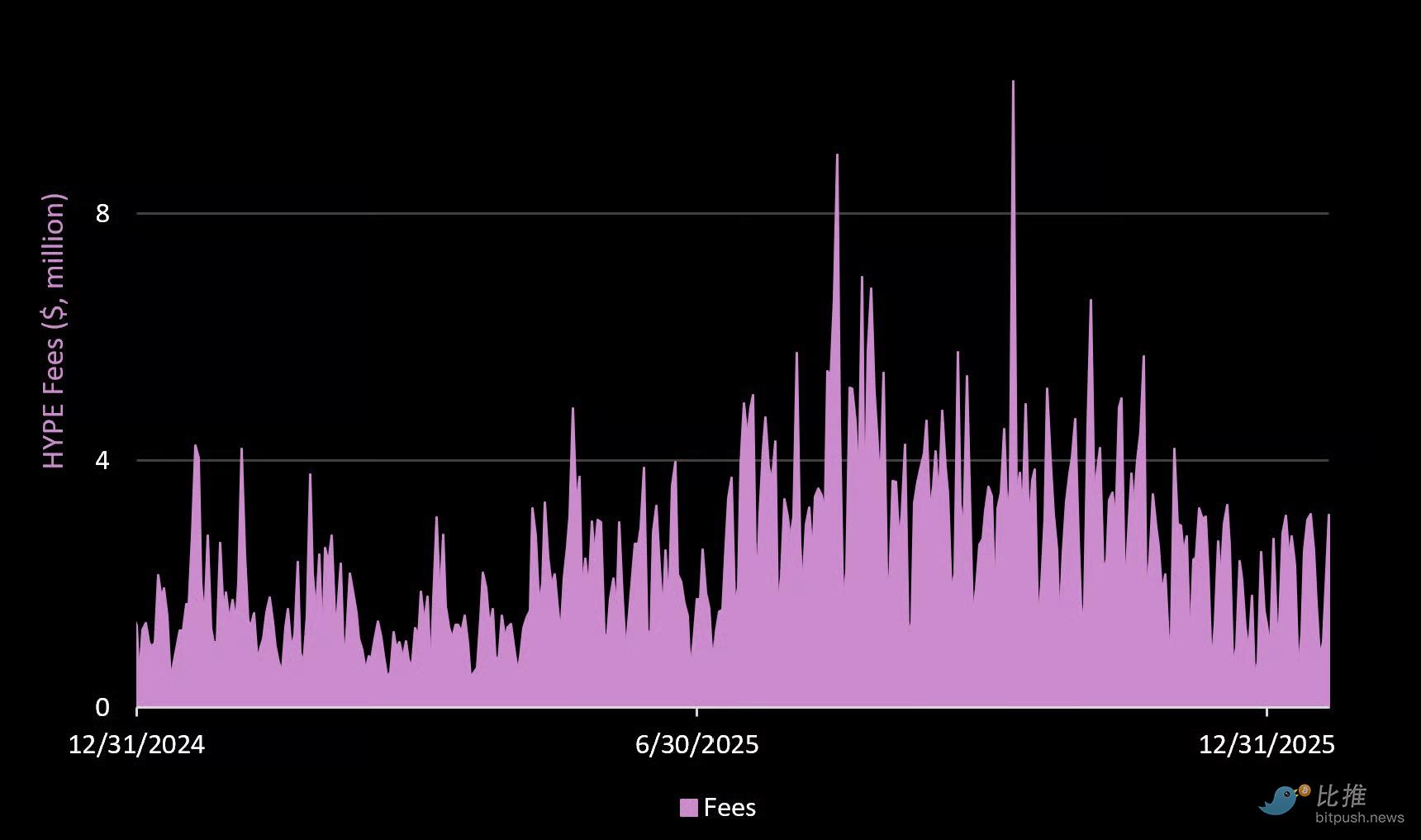
- 365-Day Cumulative Fees: $915 million
- 90-Day Cumulative Fees: $230 million
- 30-Day Cumulative Fees: $57 million
Perpetual trading contributes about 97% of the fees, while spot trading accounts for only 3%.
Key Points
Hyperliquid's perpetual DEX fee revenue has declined, but the drop is much smaller than what we've seen on Solana and its top applications.
For example, in Q4, Hyperliquid generated $270 million in fee revenue (down 16% from Q3). During the same period, Solana's REV fell by 60%. How did the top applications on Solana perform during the same period?
- Raydium: down 79%
- Jito: down 76%
- Axiom: down 61%
- Jupiter: down 37%
- Pump.Fun: down 19%
In an environment of rising risk aversion and a cliff-like drop in market interest in cryptocurrencies, Hyperliquid's performance has been quite resilient relative to other top blockchains and applications. This is unique, especially for a "high-flying" application experiencing its first bear market.
Buyback Activity
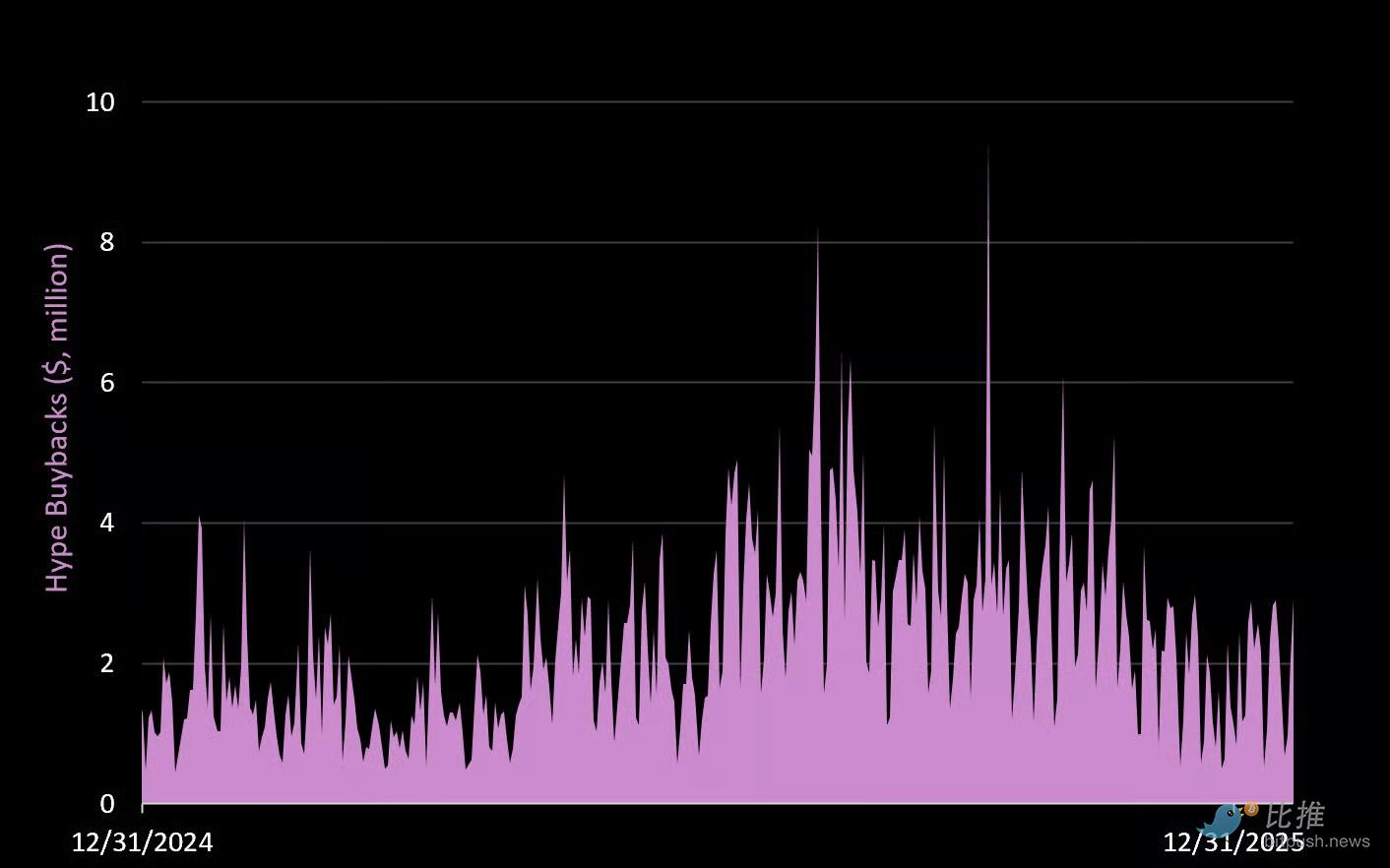
Over the past year, Hyperliquid has used 93.3% of its fees for HYPE token buybacks, totaling $854 million (an average of $2.3 million per day).
Key Points
If Hyperliquid can maintain its user base during the bear market, the stable buying pressure on the token may help offset any increased selling pressure, meaning its "cycle low" could be shallower than what we typically see in new projects during their first bear market.
More details on the tokenomics and team unlocks will be covered later in the report.
Perpetual DEX Fundamentals
Open Interest
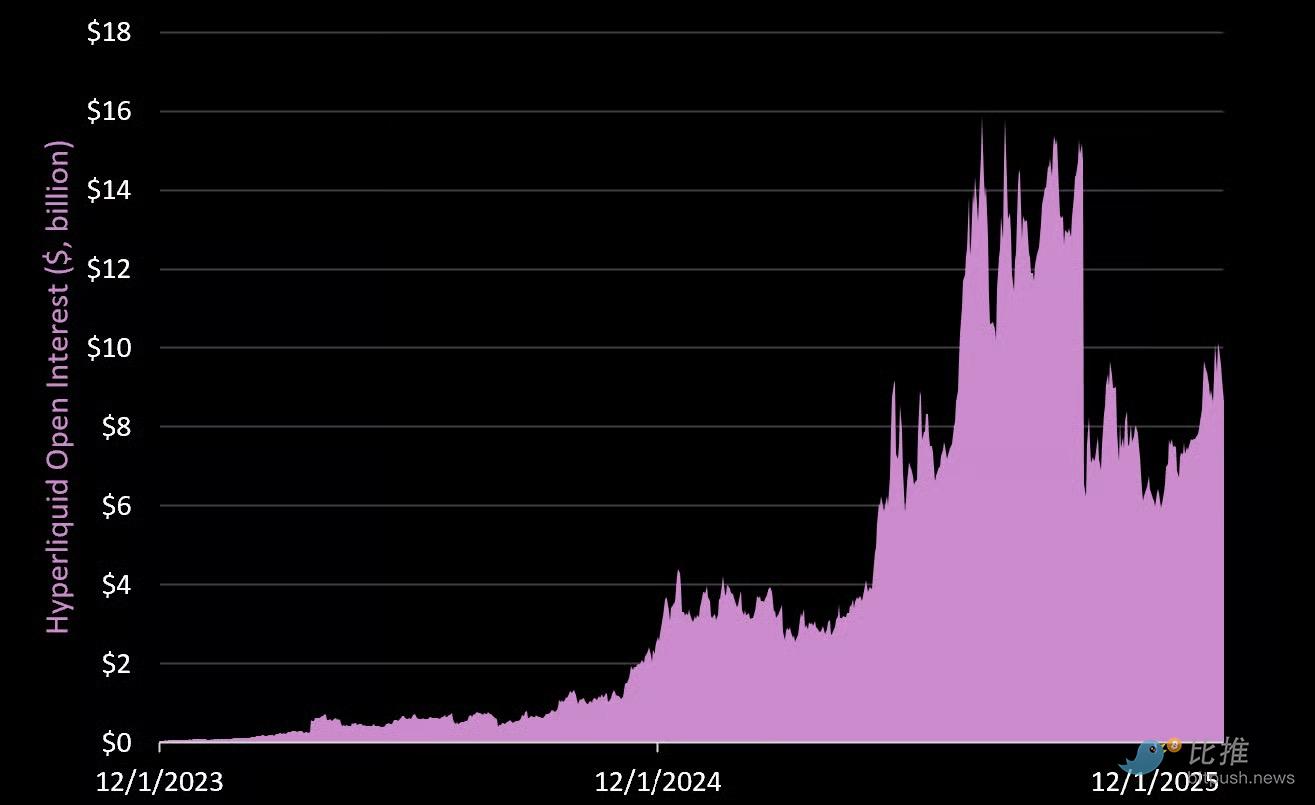
Hyperliquid's open interest is currently just under $10 billion, down from its peak of $15.8 billion last August.
The largest centralized perpetual exchange, Binance, currently has an open interest of $29 billion, having peaked at $44.5 billion in early October last year.
Compared to its decentralized competitors:
- Aster Open Interest = $2.5 billion
- Lighter Open Interest = $1.2 billion
- Drift Open Interest = $247 million
- Jupiter Open Interest = $181 million
Key Points
In just over a year, Hyperliquid has captured a significant share of the centralized perpetual exchange market (equivalent to 34% of Binance's open interest and 54% of CME's crypto futures open interest).
Simultaneously, its open interest is more than double the combined total of its top four decentralized competitors.
Active Addresses
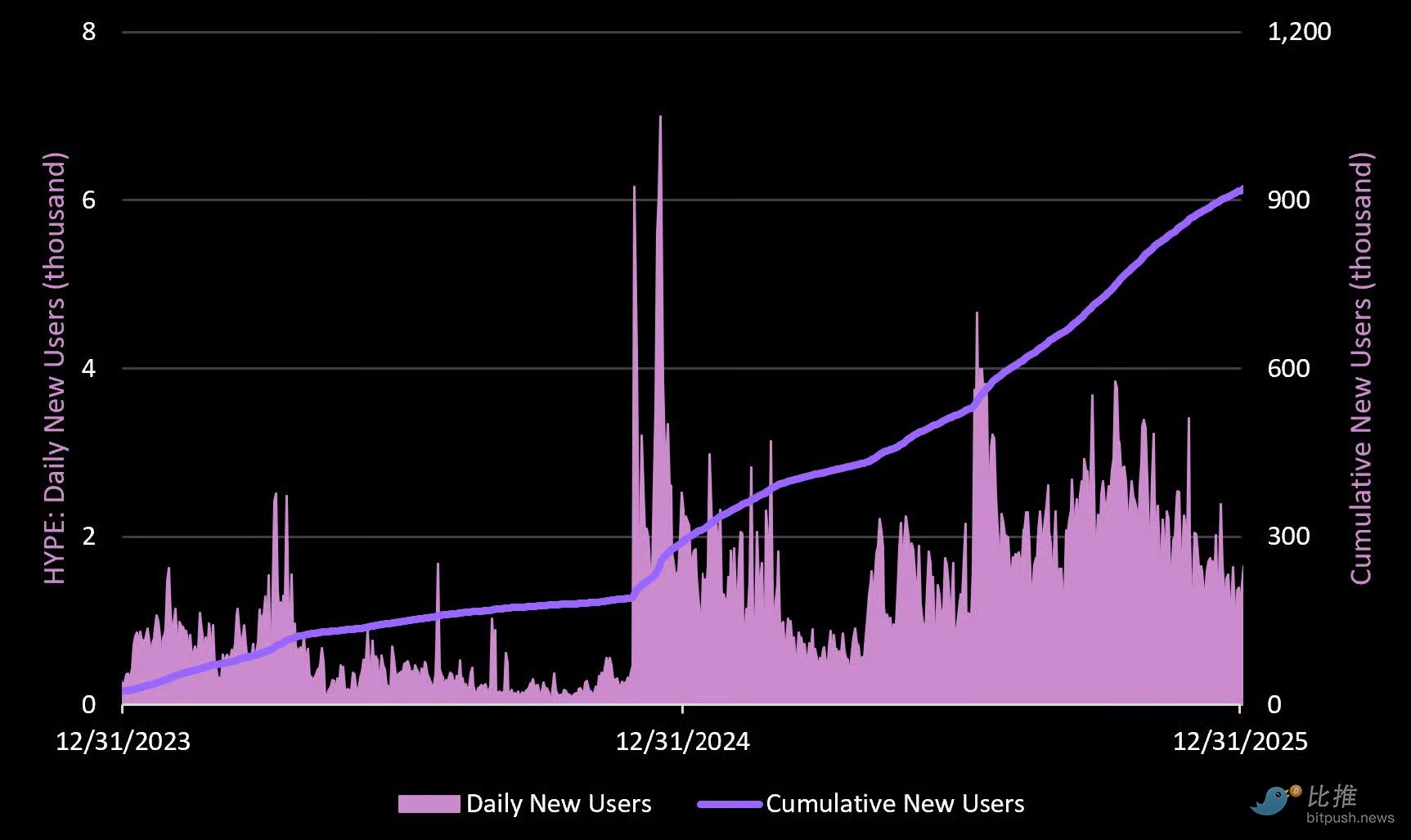
At its peak, the Hyperliquid Perpetual DEX added approximately 2,600 new users daily. Over the past 30 days, that number has dropped to about 1,600 new users per day (a 38% decline).
The number of new addresses might seem low, but this aligns with our understanding of unit economics in the crypto trading market. A small subset of highly active traders tends to contribute the majority of revenue. The key is to observe how this holds up during a bear market.
Perpetual Trading Volume
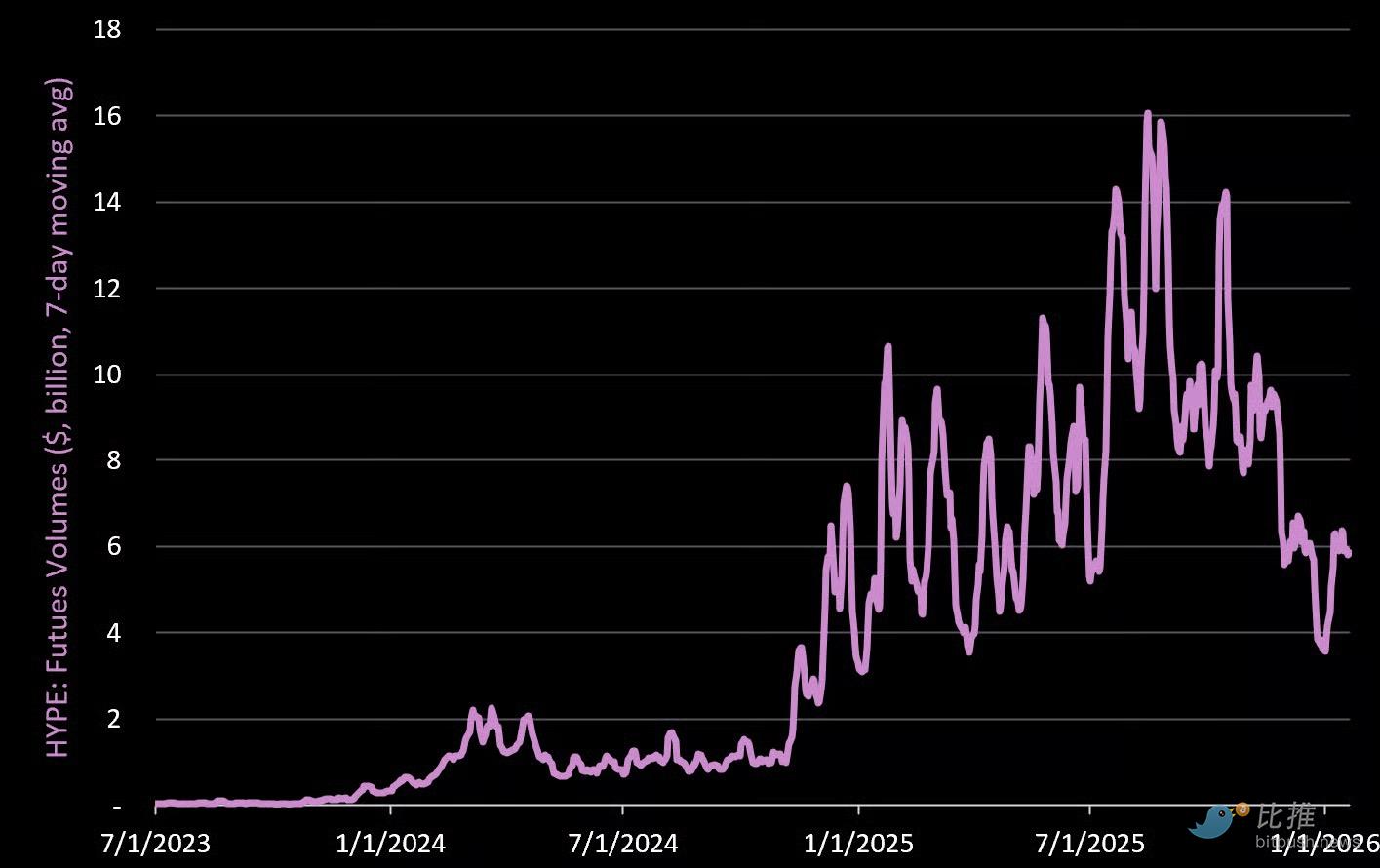
Over the past 30 days, Hyperliquid's average daily futures trading volume was $5.2 billion—down 47% from its peak of approximately $9.8 billion per day.
Interestingly, real-world assets (RWAs) currently drive the third-highest trading volume, behind only BTC and Layer 1 tokens.
Key Points
The decline in futures trading volume (relative to fee revenue) is greater, suggesting that liquidation fees may have filled part of the gap. For reference, the DEX processed over $90 billion in liquidations on October 10th last year, generating over $10 million in fees (almost double the revenue of Hyperliquid's second most profitable day).
Spot Trading Volume
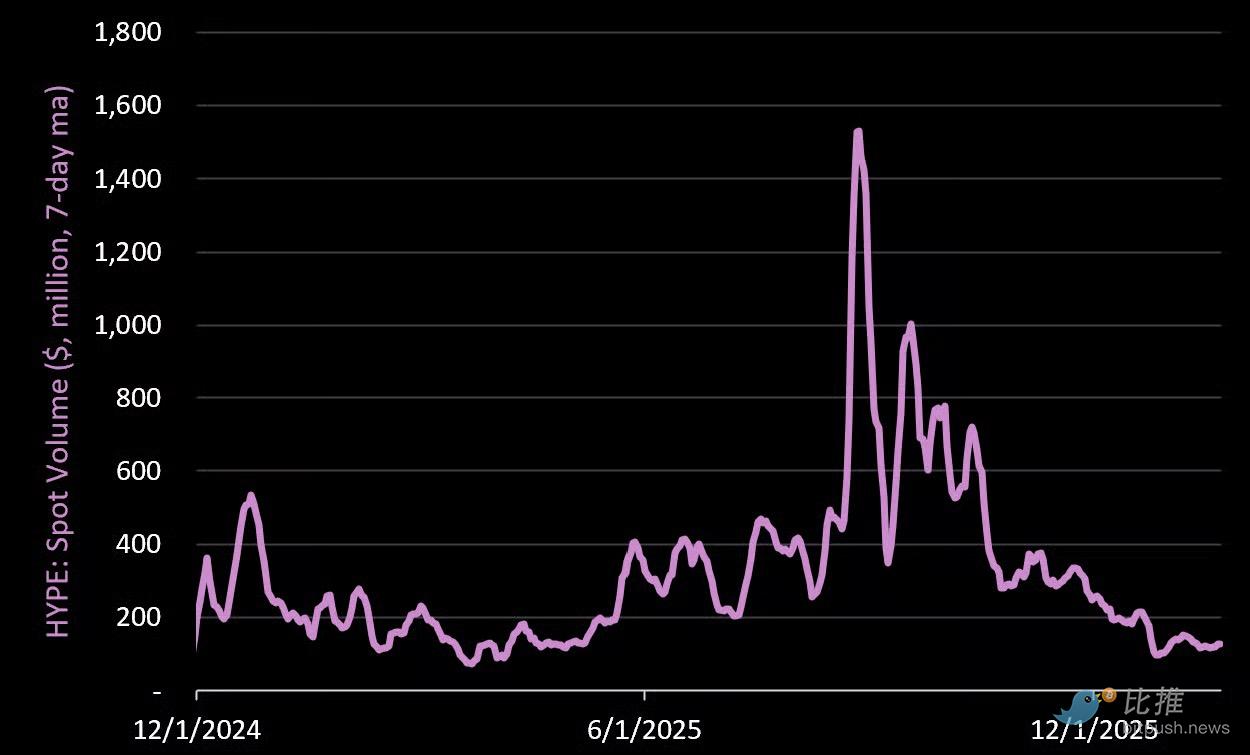
Over the past 365 days, spot trading volume has accounted for about 3% of Hyperliquid's total fees.
Cross-Chain Bridged Value
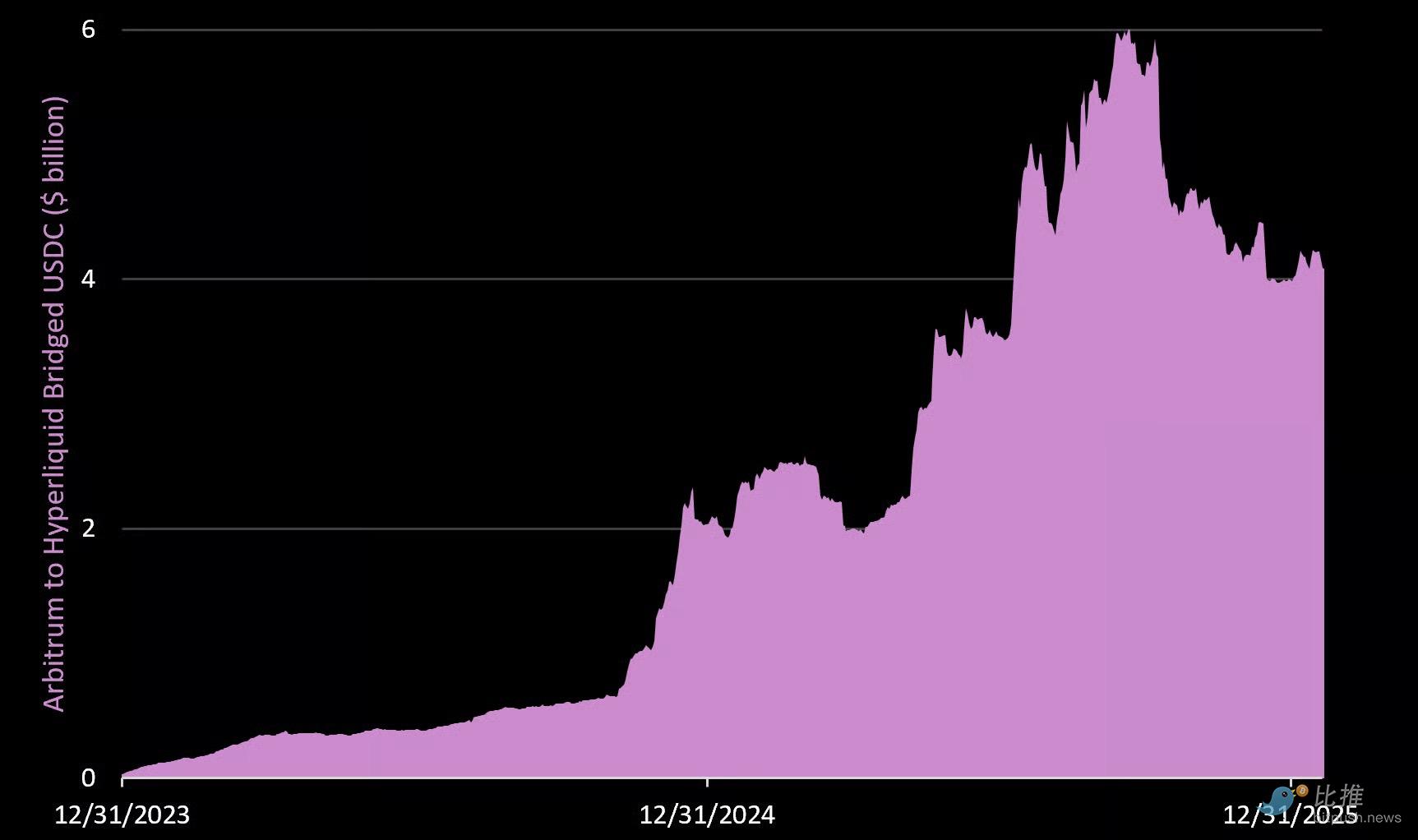
There is currently over $4.1 billion in value locked on the Hyperliquid DEX. This is down from a peak of $6 billion last September.
For reference, Solana's TVL is currently $8.7 billion.
Since launch, a cumulative $318 billion in value has been deposited for trading, with $314 billion withdrawn.
HyperEVM Fundamentals
Hyperliquid is unique in that it started as a perpetual DEX, but it is also a Layer 1 blockchain. In this section, we provide an update on the nascent but growing HyperEVM.
REV (Revenue)
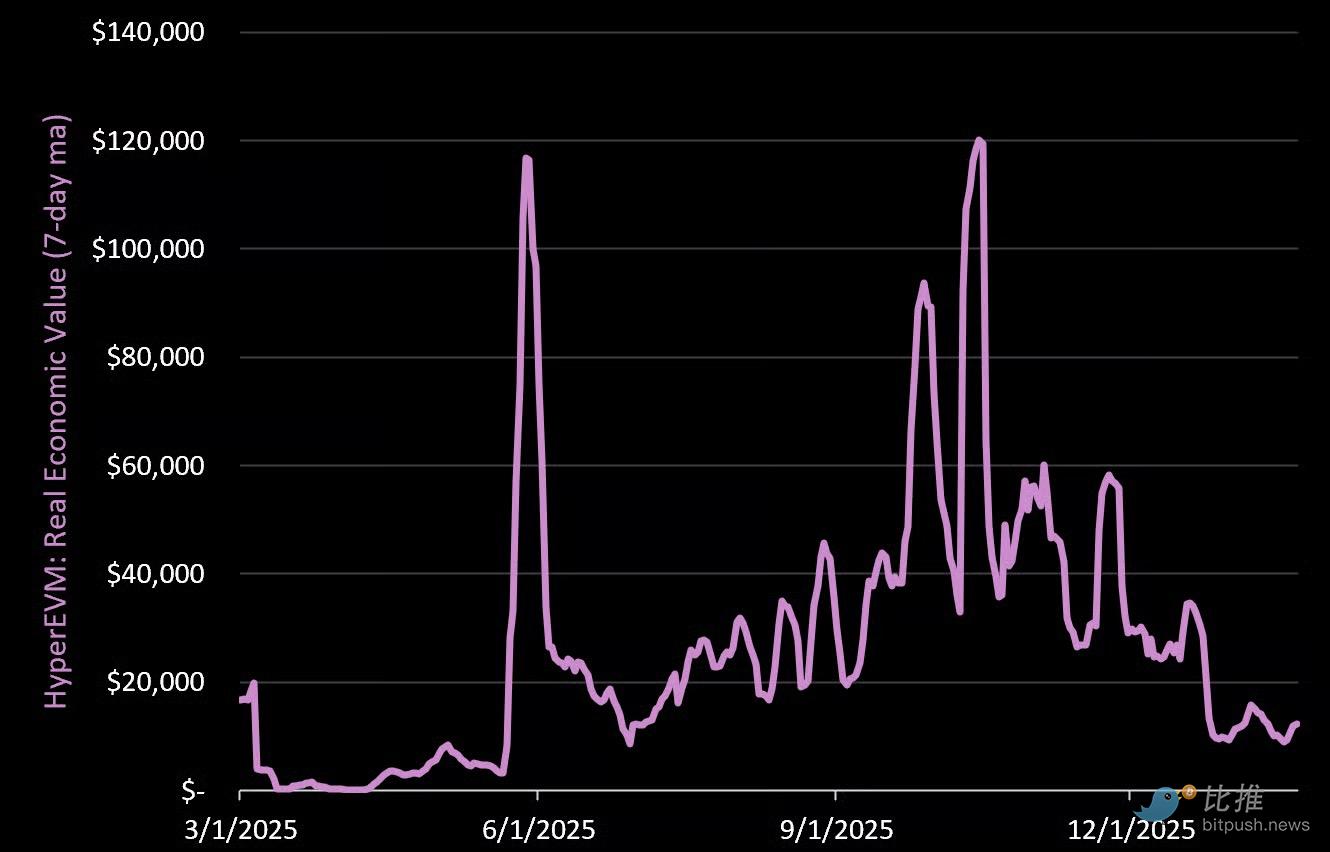
Since its launch (last February), HyperEVM has generated $8.9 million in REV. Over the past 30 days, its average daily REV was only $11.7K, down from a peak of $66K/day. On October 10th last year, the protocol generated $450K in fees.
In terms of TVL, the Hyperliquid L1 currently secures just under $12 billion in value. Of this, the liquid staking protocol Kinetiq has over $500 million; the lending protocol Morpho has over $300 million; and the lending protocol HyperLend has over $240 million.
Active Addresses
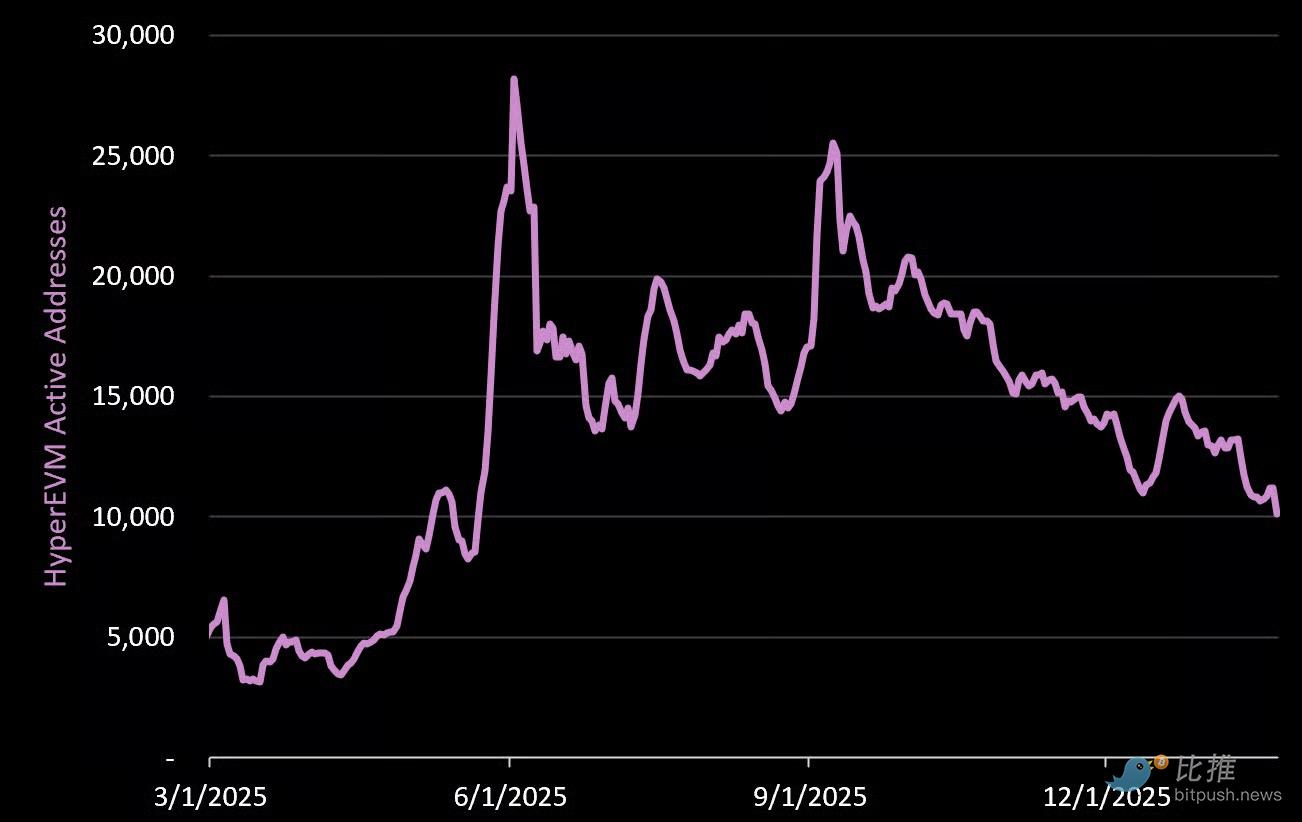
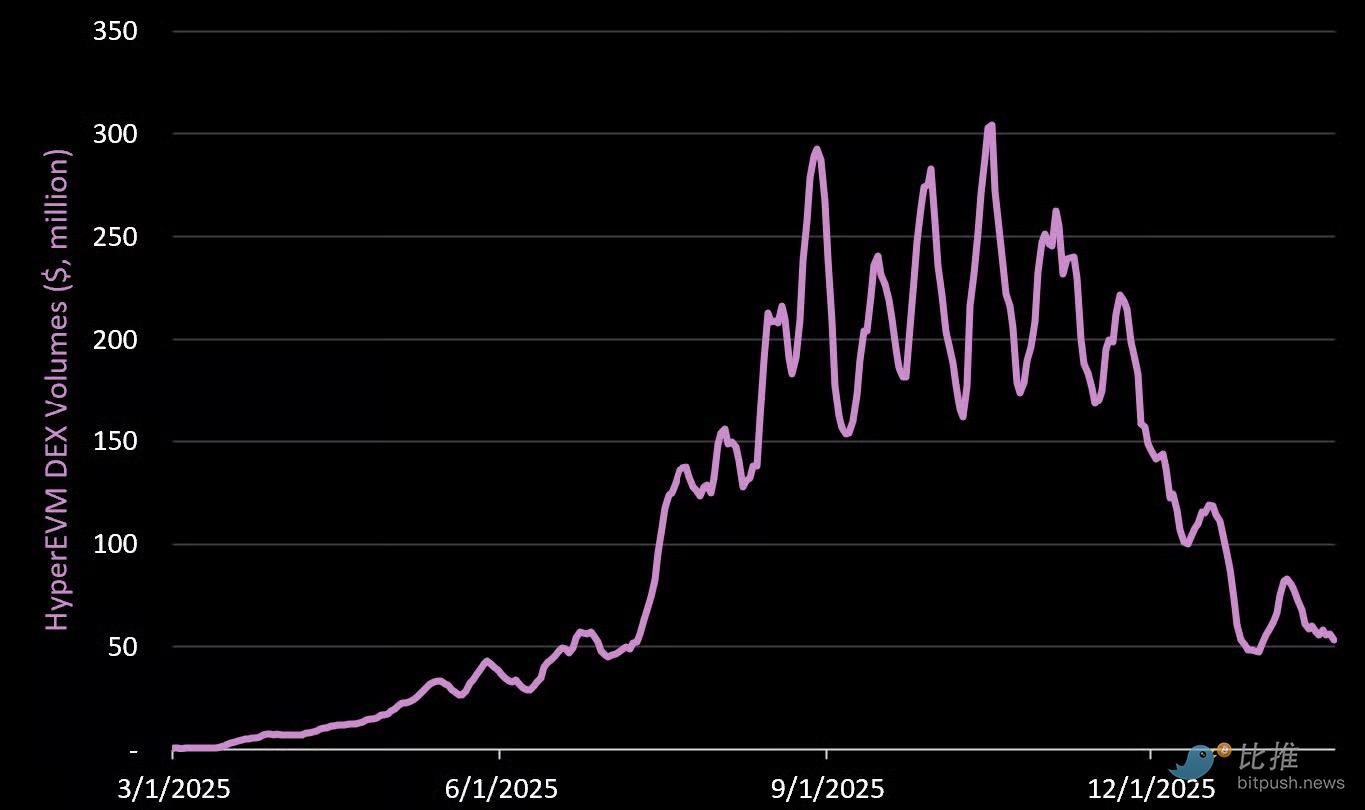
DEX Trading Volume
Stablecoin Supply
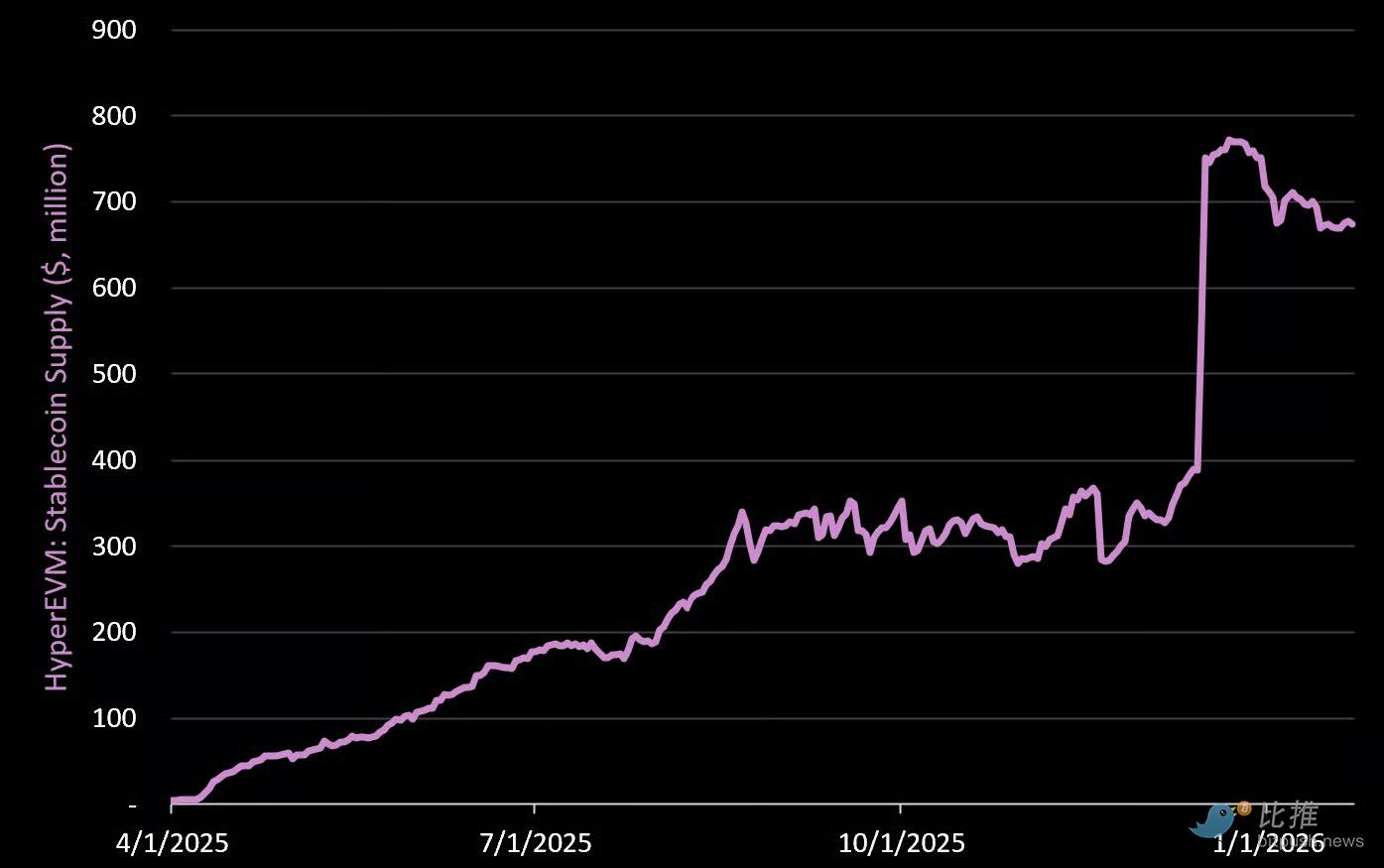
As of January 21, 2026, there are over $674 million in stablecoins on the Hyperliquid L1. Recent growth can be attributed to Circle (USDC) deploying on Hyperliquid and capturing 50% market share. Tether accounts for 21% of stablecoins on Hyperliquid, Paxos for 12%, and Ethena for 11%.
Tokenomics
This section covers the HYPE token—which represents an interest in the Hyperliquid Perpetual DEX and L1.
- Max Supply: 1,000,000,000
- Circulating Supply: 395,494,480
- Core Contributors: 22.3M
- Hyper Foundation: 60M
- Genesis Airdrop Allocation: 310M
- HIP-2: 120K
- Community: 3M
Token Allocation
- Genesis Airdrop: 31%
- Future Releases & Community Rewards: 38.88%
- Core Contributors: 23.8% (Began unlocking in November 2025, continuing until November 2027)
- Hyper Foundation Budget: 6%
- Community Grants: 0.3%
- HIP-2 (Hyperliquidity): 0.012%
Token Unlocks
Team tokens began unlocking last November. From now until November 2027, the protocol releases 9,916,666 HYPE tokens to the team monthly (valued at $213 million per month at the current HYPE price).
Hyperliquid has no venture capital backing, so there are no investor unlocks.
Buybacks
Over the past 30 days, the average daily buyback amount was $1.7 million (79,000 HYPE per day). At this rate, approximately 2.3 million HYPE are removed from circulation monthly, or 28 million HYPE annually.
Key Points
Hyperliquid's buyback program provides solid buying support for the token, but the monthly team unlock is currently more than 4 times the buyback amount. Of course, if user activity declines, buybacks will correspondingly decrease.
More analysis on "buyback yield" is below.
Relative Performance
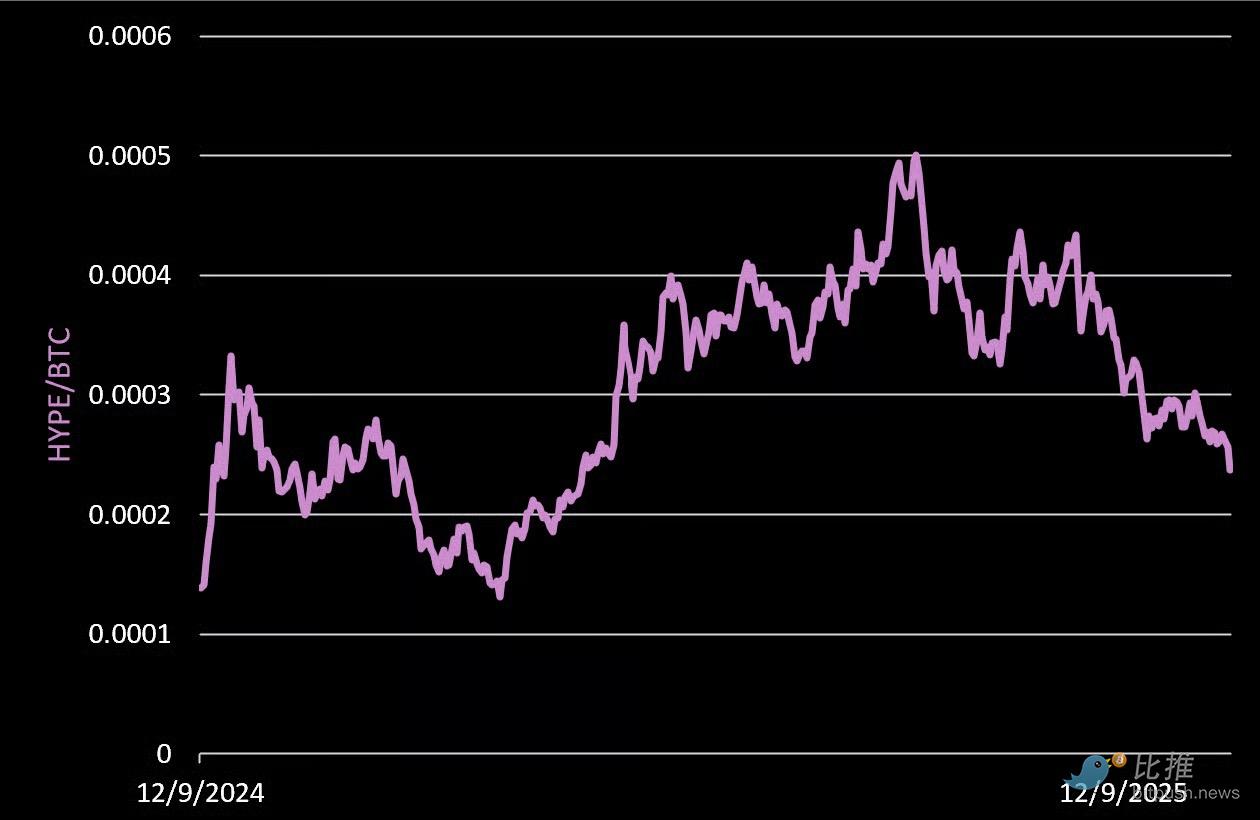
Since launch, HYPE is up 71% against BTC. From last April to September, it outperformed BTC by 278%.
However, since its peak last September, HYPE has underperformed BTC by 52%.
For reference, during the same period, ETH is down 21% against BTC, and SOL is down 47% against BTC.
Valuation Analysis
HYPE's current fully diluted valuation is $20.5 billion. Its 365-day fee revenue is $915 million. This implies a fully diluted Price-to-Sales (P/S) ratio of 22.4x (down from 66x in August).
In terms of the circulating market cap P/S ratio, it is 7.1x (down from 21.9x in August). This is now below the levels we typically see for high-growth tech/fintech companies (8-16x).
Buyback Yield
This analysis differs from traditional tech/fintech companies due to Hyperliquid's buyback mechanism—because the revenue it earns is not hoarded by a company (with fiduciary duty to investors) but is used to buy back HYPE tokens.
- 365-Day Total Buybacks = $854 million.
- Circulating Market Cap = $6.5 billion.
- Current implied "Buyback Yield" is 13.1%.
This means Hyperliquid has bought back tokens equivalent to 13% of its market cap over the past 365 days.
However, this does not account for new token issuance/unlocks—currently, its monthly unlock is over 4 times the buyback amount.
Conclusion
We believe perpetual futures are likely to become the mainstream abstraction for user trading of macro financial assets, particularly forex and interest rates. Furthermore, listing and trading RWA derivatives is much easier than trading tokenized stocks/bonds themselves (tokenized assets require custody, transfer agents, corporate actions, dividends, etc.—perpetuals avoid all of this).
The key current risk is regulation, and whether Hyperliquid/decentralized solutions will be included in US crypto market structure legislation. Our view is that Hyperliquid itself might not be directly regulated, but its consumer-facing interfaces will be.
Nonetheless, Hyperliquid is succeeding. We believe there are five main reasons:
1. An excellent product with a user experience comparable to CEXs, while allowing users to self-custody.
2. The best narrative since BTC and ETH: 31% of tokens airdropped to early users, creating massive wealth effects and a loyal community.
3. Excellent tokenomics, highly aligned with the interests of users and token holders.
4. A technically strong and focused founding team.
5. Early integration with mainstream wallets like Phantom and applications like Axiom. Today, Hyperliquid is increasingly becoming the default "perpetual trading" infrastructure for the entire crypto space, allowing users to trade through friendly front-end interfaces while utilizing Hyperliquid's liquidity on the backend.
Twitter:https://twitter.com/BitpushNewsCN
Bitpush TG Discussion Group:https://t.me/BitPushCommunity
Bitpush TG Subscription: https://t.me/bitpush