Author: Deep Tide TechFlow
While market attention is being drawn away by U.S. stocks, AI, and gold, Sui recently announced a new move:
Hashi, a Bitcoin collateral primitive based on Sui, is about to launch and has garnered support from top-tier institutions.
Bitcoin finance, a topic that has been discussed for a long time but remains unresolved:
As the largest on-chain asset treasury with a market cap exceeding $1.4 trillion, the proportion of Bitcoin used in DeFi is still less than 0.22%.
The core reason it remains unresolved is not due to insufficient functionality but the wrong premise of trust. In many past attempts, users were often misled—you thought your Bitcoin was in your hands, but it was actually on someone else’s ledger. The collapses of Celsius, Voyager, Genesis, and other projects have repeatedly sounded the alarm for the logic of "sacrificing trust for efficiency."
Especially synthetic Bitcoin, although it has attracted a considerable number of retail users, this structure has failed to convert a large amount of Bitcoin into DeFi capital and cannot attract institutions and large asset holders who require stronger guarantees.
This is precisely the important opportunity for the launch of Sui’s new developer primitive Hashi:
Reconstructing the most critical trust base for Bitcoin finance.
Enabling native BTC collateral to be organized more transparently in Sui’s smart contract environment—no wrapping, no synthesizing, no handing over keys to any centralized entity—and turning this capability into directly reusable interfaces.
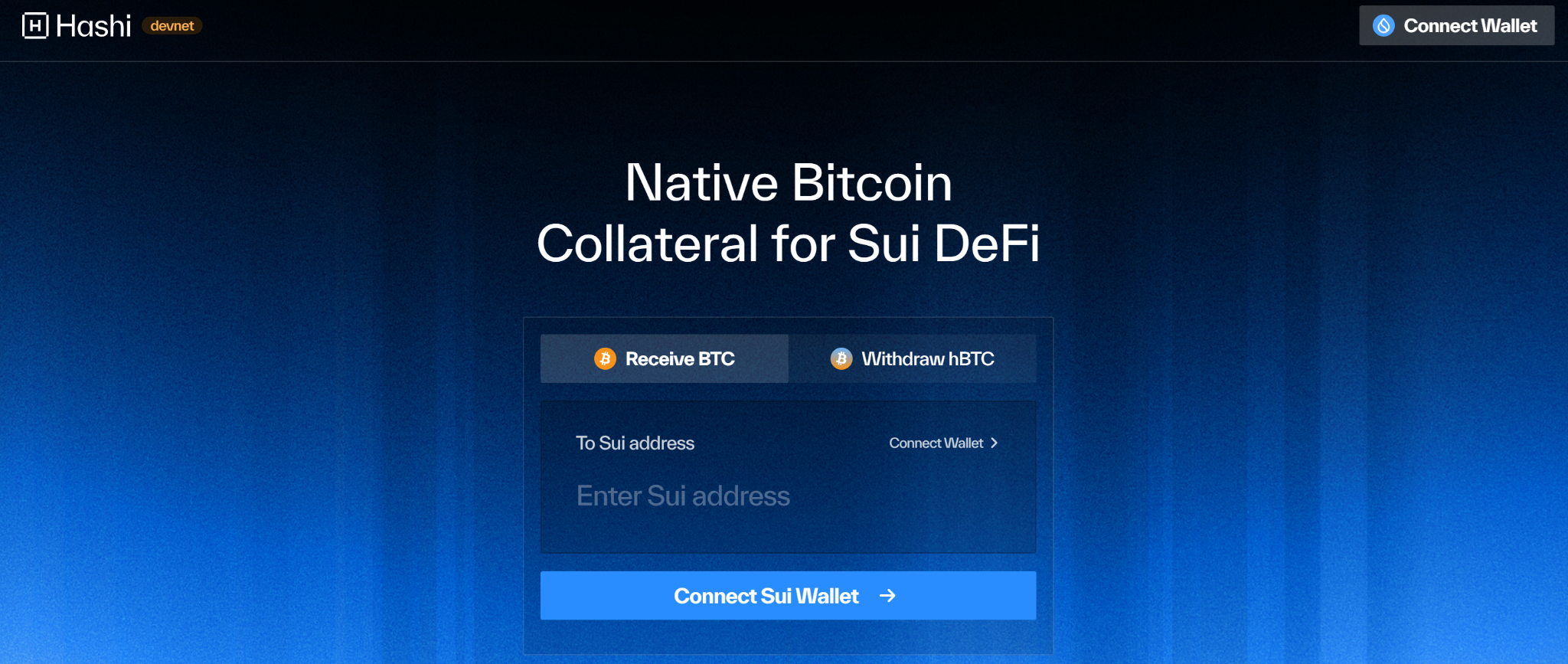
Hashi Native BTC Programmability: BTC Stays on the Chain, Collateral Rights Enter the Sui Network
The design philosophy of Hashi can be summarized in one sentence:
Assets remain on the Bitcoin network, rights exist on the Sui network—both occur simultaneously without interference.
Suppose you have one Bitcoin and want to use it as collateral to borrow some USDC.
In most past solutions:
You either deposit BTC into a centralized platform to obtain a borrowing limit or accept Wrapped BTC. Your Bitcoin, at some point, must be handed over to someone else, essentially trading "trust in an entity" for "programmability."
With Hashi:
- Deposit: Users deposit BTC into a dedicated address (a unique Bitcoin deposit address generated by Hashi for their Sui address). The private key for this address does not belong to any single entity but is collectively managed by the validators on the Sui network. The BTC can only be moved if enough validators reach a consensus. This means no single entity can run away with your money unless they control more than one-third of the entire Sui validator network.
- Proof Generation: Validators simultaneously monitor the Bitcoin network. Once they confirm your BTC is locked in, a corresponding collateral proof is generated on the Sui chain. This proof is not a newly issued token or a wrapped asset; it is an on-chain certificate proving that a real BTC is locked, and you are its owner.
- As Collateral: With this proof, you can borrow money, participate in DeFi, or set up yield strategies in Sui’s smart contracts. All rules are written in code and executed automatically, with no room for interference.
- Repayment and Withdrawal: After repayment, validators automatically release the native BTC on the Bitcoin mainnet through MPC threshold signatures, which can be withdrawn to any Bitcoin address without manual intervention.
- Guardian Layer: To prevent extreme situations (such as validator collusion), Hashi additionally introduces a Guardian Layer as a secondary check and backup protection, primarily monitoring large withdrawals or abnormal thresholds to prevent potential systemic risks.
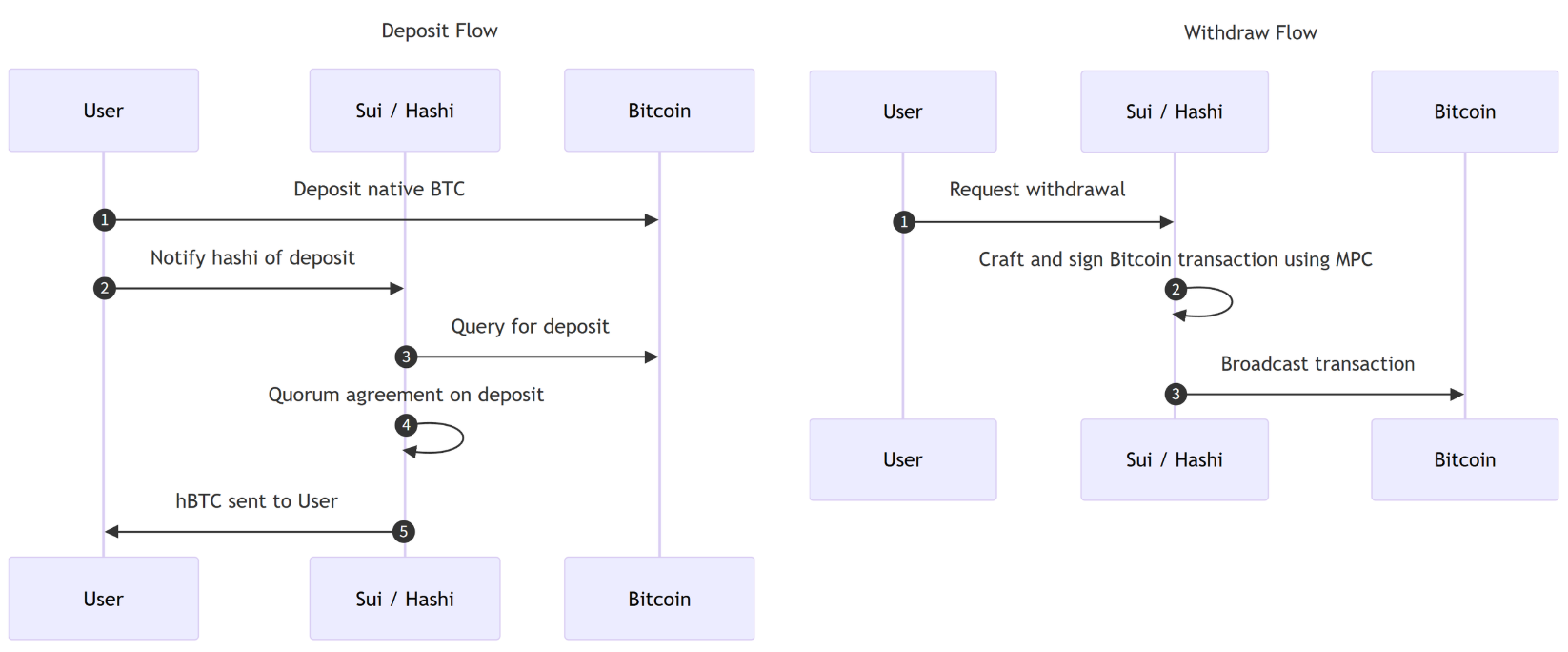
Throughout the entire lifecycle:
BTC always remains on the Bitcoin mainnet and is not moved into any platform’s internal account;
No single centralized entity has exclusive control of the private key;
What circulates on Sui is the collateral right backed by real BTC, reopening the programmability of native BTC;
And the only entities users need to trust are the validator network and the smart contract.
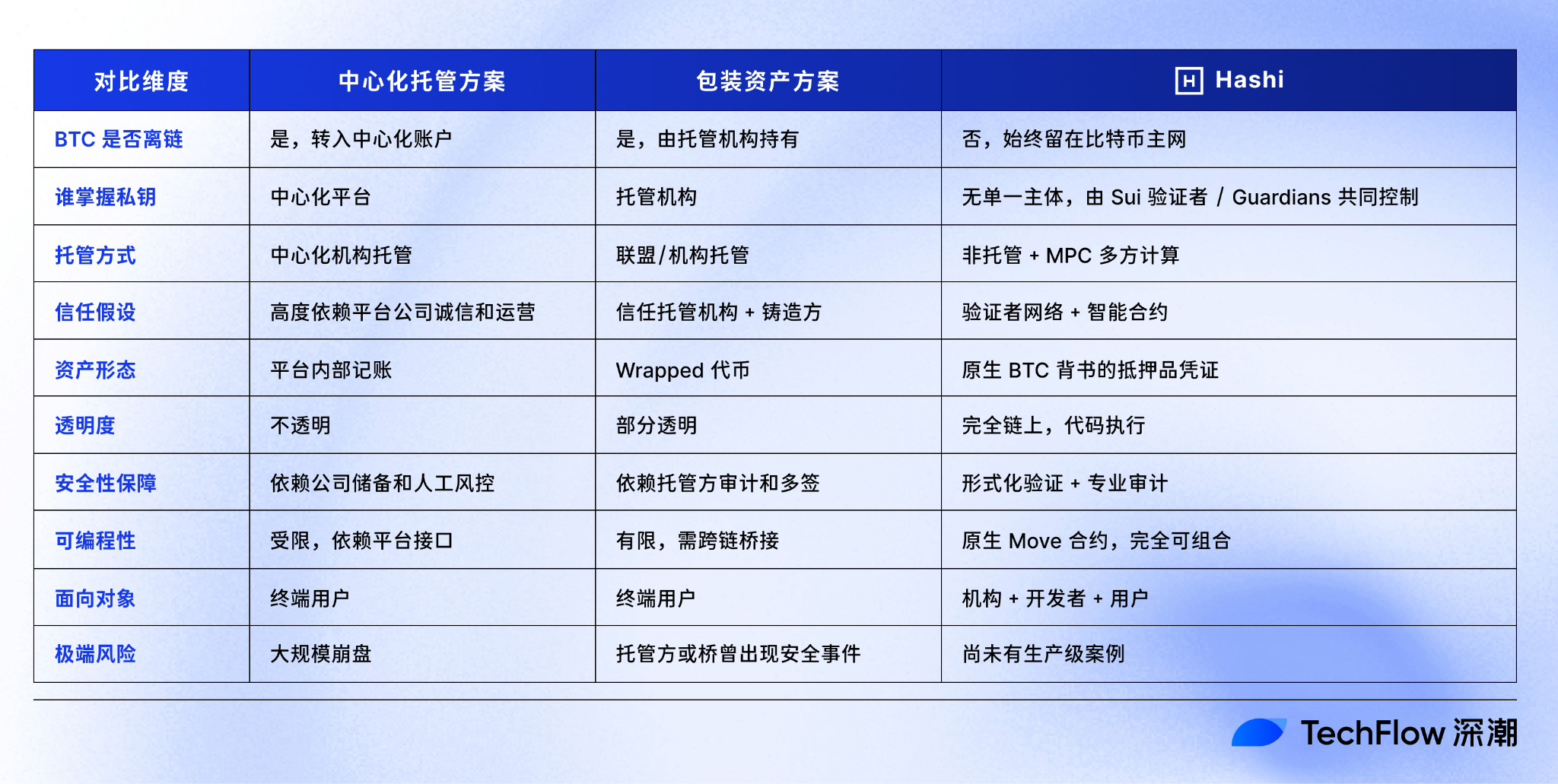
Simply put, Hashi is committed to enabling the collateral relationship of native BTC to be directly recognized by the on-chain financial system, with minimal trust placed in centralized entities.
During stable market conditions, users may perceive little difference, but in extreme situations like platform collapses or liquidity crises, it is the difference between whether your BTC is still there or not.
Not a Product, but a "Primitive": A Directly Reusable "Standard Brick"
From a design perspective, Hashi is a more decentralized, trust-minimized, and secure transparent Bitcoin financial solution.
However, if Hashi is understood solely as a single "solution," its most potential aspect might be missed.
It is important to note that for a long time, Sui has been striving to evolve from "a chain" to "a complete set of developer infrastructure." Whether it’s launching Walrus, Seal, or Nautilus, the goal has been to achieve full-stack nativity from execution, storage, permission control to off-chain computation, providing convenience for developers and building the necessary foundation for ecosystem prosperity.
This time, facing Bitcoin finance is no exception.
According to the official definition:
Hashi is the first decentralized Bitcoin collateral primitive developed by Mysten Labs, allowing developers to actively handle UTXOs from the Bitcoin network in Sui’s native smart contract language.
The key word is "primitive."
In the context of blockchain and DeFi, a primitive often refers to a fundamental building block or underlying infrastructure component. It is like a "standard brick" in Lego:
It is not an end product for ordinary users but a basic module for developers to build products.
Just as TCP/IP is not an app but all apps run on it; Hashi is not a product, but lending platforms, yield strategies, and structured products can all be built on it.
In other words, Hashi does not provide a closed financial service but an underlying capability, enabling native BTC to become collateral that Sui smart contracts can directly call.
As for what this collateral is used for, how it is used, and under what rules, Hashi does not interfere—it leaves it to the contracts, developers, and the market.
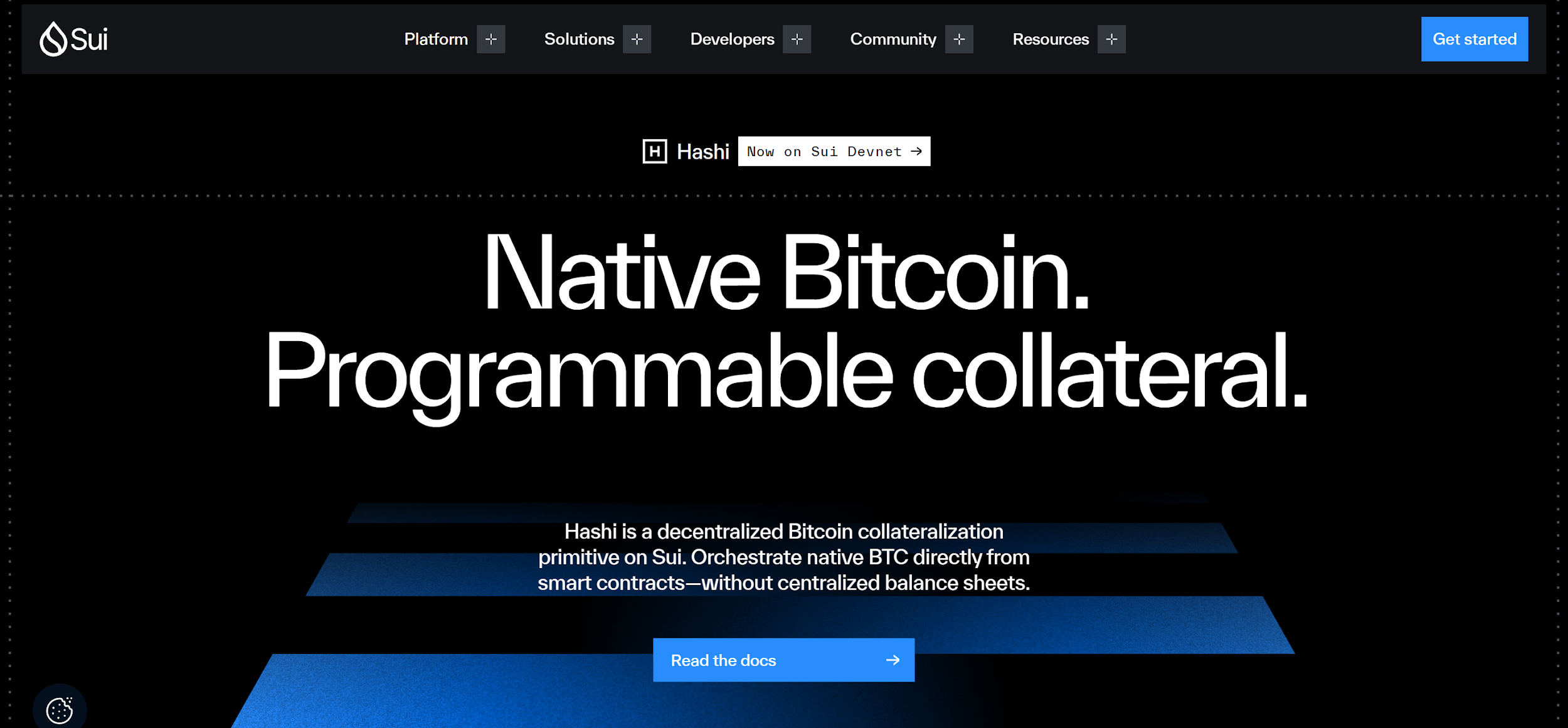
Before Hashi, if developers wanted to build a protocol with BTC as collateral, they faced numerous challenges: either accept the trust risks of centralized custody or implement the complex logic of native BTC collateral from scratch.
As a primitive, Hashi turns this difficult problem into a directly reusable interface.
Now, when building specific products, developers can directly call the mechanisms provided by Hashi, enabling their protocols to inherently possess native BTC collateral capabilities without having to solve underlying problems again, significantly reducing development barriers and time costs.
Users, whether institutional or retail, will, through products built on Hashi, for the first time truly gain the ability to earn yields with Bitcoin without giving up control over it. In the initial phase, lending will be the first use case for Hashi, allowing BTC to be lent out or used as collateral to borrow stablecoins. In the future, Hashi’s scenarios will gradually expand to vaults, insurance, structured products, credit derivatives, and RWA yield strategies.
Bitcoin is the asset with the broadest global consensus and deepest liquidity, but in the past, this wealth was almost invisible to the on-chain financial world: it is massive but not programmable; it is valuable but cannot be directly perceived and called by smart contracts.
Therefore, when Hashi turns the native BTC collateral capability into an interface that any developer can directly call, the upper-layer application space it can leverage far exceeds any specific product or protocol.
And the correctness of this judgment is already answered by the extensive institutional support Hashi has received.
Institutional Day One Support: Building a Complete Ecosystem Around Hashi
Currently, Hashi is live on Sui Devnet, primarily for developer testing and auditing, and has not yet entered the production environment. However, it has already received explicit support commitments from several leading industry institutions.
In terms of infrastructure: Including BitGo, Blockdaemon, Cobo, Ledger, and other major institutions, directly bridging institutional BTC from cold storage into on-chain collateral scenarios.
In terms of trading and liquidity: Including FalconX, Bullish, CF Benchmarks, and other major institutions, providing Hashi with reliable pricing, liquidity exits, and institutional-grade counterparty support.
In terms of security and compliance: Multiple teams, including security auditing firm OtterSec, smart contract formal verification security company Certora, and cryptography and zero-knowledge proof research and engineering team Asymptotic, have chosen to support Hashi and will conduct smart contract audits, formal verification, cryptography, and zero-knowledge proof research before Hashi’s mainnet launch.
At the same time, projects including Suilend, Scallop, NAVI Protocol, Matrixdock, and Bluefin have announced they will integrate Hashi to unleash on-chain financial potential, enabling retail and institutional users to quickly access BTC collateral lending experiences.
In addition, Soter Insure, a provider of institutional-grade insurance solutions, has announced a partnership with Hashi to bring built-in institutional-grade insurance mechanisms as a risk protection layer.

These institutions represent thousands of billions of dollars in Bitcoin nominal value and mature compliance infrastructure. Their commitment to integration at the Hashi Devnet stage means that once Hashi officially launches, large-scale institutional Bitcoin assets will have the practical conditions to enter on-chain scenarios.
At the same time, looking at these 20+ institutions together, an interesting fact emerges: they almost cover every环节 of a complete Bitcoin financial ecosystem:
From Bitcoin security custody, on-chain collateral, price pricing, liquidity support, lending protocols, yield strategies, RWA integration, to security audits and user entry, an end-to-end chain has already taken shape.
In other words, behind this list of supporters, a complete ecosystem map of Bitcoin finance围绕 the Hashi primitive will be ready from day one of Hashi’s mainnet launch.
Conclusion
Of course, Hashi is still in the Devnet stage. It has not yet undergone long-term testing in the mainnet environment, with real asset scale and extreme market fluctuations. Its production-level performance still needs time to verify. The path of Bitcoin finance will not immediately become smooth just because a new primitive emerges.
However, judging from the integration commitments of over 20 leading institutions in custody, liquidity, security, and protocol layers from day one, market recognition of this path is clear enough.
The story of Bitcoin finance has been told for many years, but the real breakthrough point has never been about "what can be done" but "why trust."
Past solutions, whether centralized custody or wrapped assets, essentially required users to make the same choice: either give up control for yield or hold the keys but be excluded from on-chain finance.
Hashi attempts to rewrite the question itself: making the collateral capability of native BTC an underlying interface that developers can directly call, enabling Bitcoin’s sleeping trillion-dollar treasury to be truly "seen" by the smart contract world in a non-custodial, verifiable, and composable way for the first time.
Reconstructing trust is often harder than stacking functions.
If the endgame of Bitcoin finance is to make Bitcoin truly the native collateral of on-chain finance, then what Hashi is doing may be laying the first pile for this bridge.




















