Stock Price Surges Over 35%! Circle's Earnings Report Exceeds Expectations: USDC Circulation Soars 72%

marsbitPublicado a 2026-02-26Actualizado a 2026-02-26

Resumen

Circle (CRCL) reported strong Q4 and full-year 2025 financial results, with total revenue and reserve income reaching $770 million in Q4, up 77% year-over-year, exceeding expectations. This drove a 35% surge in its stock price. Key highlights include a 72% YoY increase in USDC circulation to $75.3 billion and a 247% rise in on-chain transaction volume to $11.9 trillion in Q4. Reserve income remained the core revenue driver at $733 million, while non-interest income reached $37 million. For the full year, total revenue grew 64% to $2.7 billion. Although the company reported a net loss of $70 million due to a one-time $424 million stock-based compensation expense from its IPO, adjusted EBITDA doubled to $582 million, indicating profitable core operations. Strategic developments include the stable testnet performance of its Arc blockchain, expansion of the Circle Payments Network with 55 financial institutions onboarded, and a key partnership with Polymarket to use native USDC. Regulatory progress includes conditional approval for a national trust bank. Looking ahead, Circle targets a 40% compound annual growth rate for USDC circulation. CEO Jeremy Allaire emphasized AI-driven payment demand, with 99% of agent-based payments currently using USDC. Despite challenges like declining yields and new competitors like USAT, Circle continues to execute its strategy as a growing internet financial infrastructure provider.

Author:Zhou, ChainCatcher

On February 25, stablecoin issuer Circle (NYSE code: CRCL) released its 2025 fiscal year fourth quarter and full-year financial report.

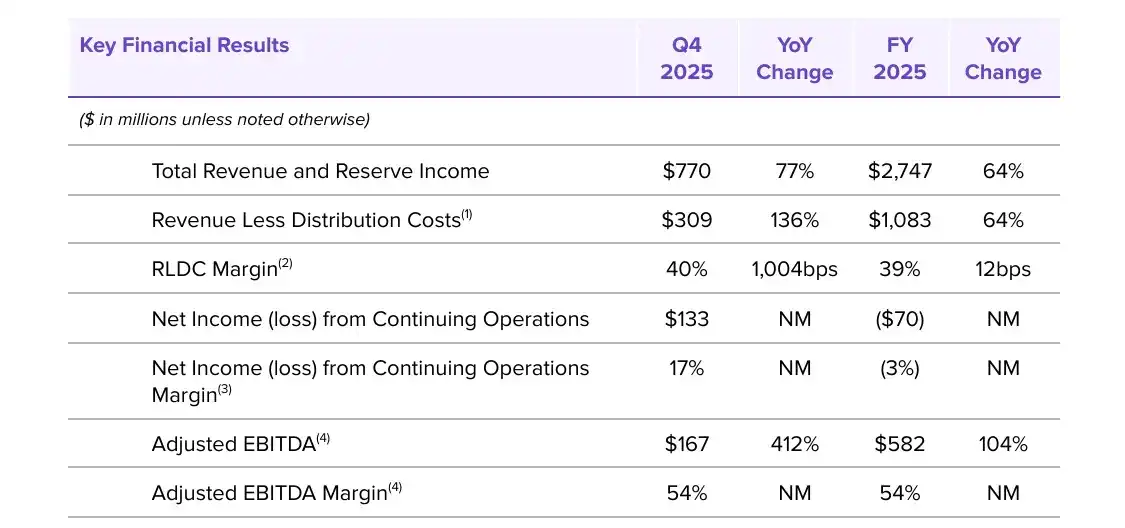
The report shows that the company's total revenue and reserve income for the fourth quarter reached $770 million, a year-on-year increase of 77%, exceeding market expectations.

Driven by this, CRCL stock price rose over 35% at Wednesday's close.
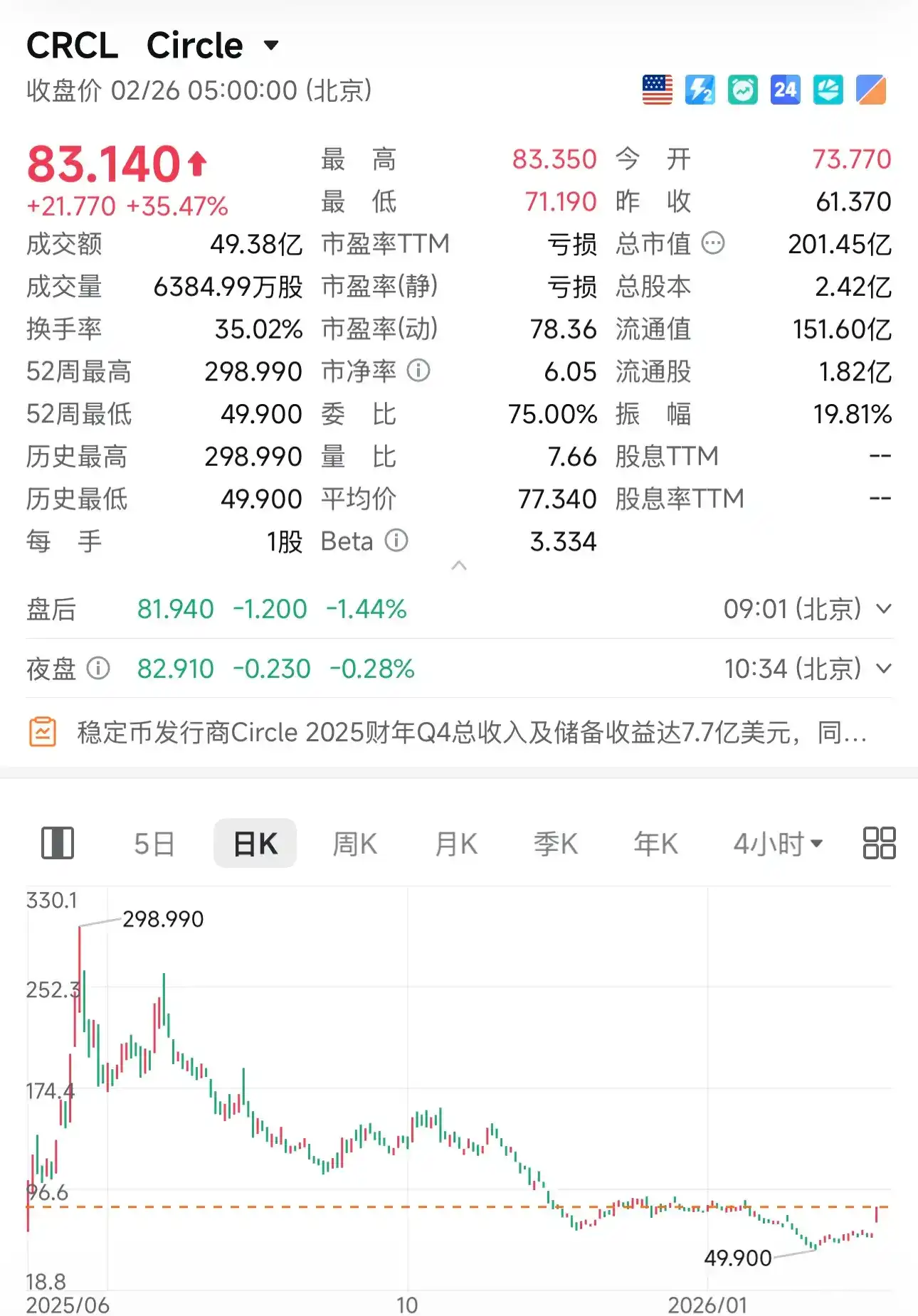

Specifically, the growth of its stablecoin USDC was the core highlight of this earnings report. As of year-end, the circulation of USDC reached $75.3 billion, a year-on-year increase of 72%.

Meanwhile, network activity showed explosive growth, with on-chain transaction volume in the fourth quarter reaching $11.9 trillion, a year-on-year increase of 247%.


In terms of revenue composition, reserve income remains the company's main revenue pillar, contributing $733 million in Q4, a year-on-year increase of 69%.

Although market yields decreased by 68 basis points during the period, this pressure was offset by the significant expansion of USDC's average circulation scale.

At the same time, non-interest income reached $37 million, mainly due to the steady accumulation of subscription services and transaction fees.

Looking at the full-year performance, the company's total revenue and reserve income was $2.7 billion, a year-on-year increase of 64%.

Although continuing operations recorded a net loss of $70 million, this was mainly affected by the one-time inclusion of $424 million in stock-based compensation expenses during the IPO process.

As this expense is non-cash in nature, the company's core business is profitable after exclusion. Adjusted EBITDA reached $582 million, doubling year-on-year, showing that operating leverage is gradually emerging.
极

In terms of strategic layout, Circle is gradually transforming from a pure stablecoin issuer to an internet financial infrastructure provider, strengthening its underlying position in the real-time transaction field through various technological initiatives.

The report shows that the Arc public blockchain testnet is running stably, with transaction finality time shortened to about half a second, and total transactions have exceeded 166 million. The mainnet is expected to be officially launched within the year.

In terms of the payment network, the ecosystem of the Circle Payments Network continues to expand. Currently, 55 financial institutions have officially joined, with another 74 in the qualification review stage. The annualized transaction volume over the past 30 days has reached $5.7 billion.

It is worth mentioning that the strategic cooperation with Polymarket further highlights the value of USDC in emerging fields. As one of the world's largest prediction market platforms, Polymarket will gradually switch all betting and settlement to native USDC.

This cooperation not only eliminates bridging risks and improves capital efficiency but also directly converts the user growth of the prediction market into long-term increments in USDC circulation and transaction volume.

In addition, Circle is also gradually penetrating the traditional financial ecosystem. The company has not only achieved all-day settlement cooperation with Visa but also broadened application scenarios through platform integration with Intuit.

At the regulatory compliance level, the company received conditional approval from the U.S. Office of the Comptroller of the Currency to establish a national trust bank in December 2025, and further consolidated its first-mover advantage in compliance under the GENIUS Act framework.

The secondary market has given a relatively positive response. Technically, before the earnings release, the company's stock price had rebounded from its low and stabilized above the 7-day and 30-day moving averages.

On the institutional side, ARK Invest, under Cathie Wood, increased its holdings of Circle stock multiple times during market corrections. The latest holdings are about 4.14 million shares, worth approximately $261 million.

Mizuho Securities upgraded CRCL's rating from underweight to neutral at the end of January, setting a target price of $77. The institution believes that the growth of Polymarket will directly drive the expansion of USDC scale and revenue.

However, Circle still needs to deal with potential headwinds in the future.

On the one hand, the downward trend in interest rates may continue to put pressure on reserve income, which has been reflected in the decline in yield in the fourth quarter.

On the other hand, the stablecoin competitive landscape is changing. The USAT stablecoin, launched by Tether and issued by Anchorage Digital, is targeting the U.S. institutional market and is regarded as the first substantive compliant competitor for USDC domestically. This competition may lead to some diversion in the compliant institutional share.

In addition, overall cryptocurrency market volatility and macro cycles will still create uncertainty for circulation growth. According to Coinglass data, the current total stablecoin market capitalization is about $264 billion, with USDC accounting for about 28.5%. Although USDC leads the industry in growth rate, Tether still dominates.


Worthy of special attention from investors is Circle management's expectations and execution plans for the future. The company provided clear guidance for the 2026 fiscal year:

  • USDC circulation targets a compound annual growth rate of 40% over a multi-year cycle;
  • Other income (subscription, service, and transaction fees) is expected to be $150 to $170 million;
  • RLDC margin (revenue minus distribution and transaction cost margin) remains in the high range of 38% to 40%;
  • Adjusted operating expenses are expected to be $570 to $585 million.

These guidelines also reflect management's confidence in continued scale expansion, cost control, and accelerated growth in non-interest income.

Furthermore, Circle CEO Jeremy Allaire repeatedly mentioned AI agents and their payment needs during the earnings call.

He said, we are about to enter a world where there may be billions or even hundreds of billions of AI agents interacting on the internet and performing economic functions.

These AI agents need programmable digital dollars and open infrastructure to enable autonomous transactions, and Circle's products are built for this.

Specifically, Circle is heavily investing in agent-based payment infrastructure.

Currently, Circle Gateway has entered the test network phase, supporting AI agents to autonomously initiate cross-chain USDC transactions, with a single transaction cost as low as $0.00001 (extremely low fees, suitable for micro-payments and high-frequency machine-to-machine transactions).

It was also mentioned in the meeting that currently about 99% of agent-based payments use USDC, thanks to Circle's cross-chain deployment and participation in agent payment standards (such as the x402 standard, in cooperation with Google etc.).

Overall, this earnings report validates Circle's strategic execution capability in a complex regulatory environment, and the new story of AI+ payments has expanded the company's valuation imagination space. Despite facing yield fluctuations and emerging competitive challenges, Circle continues to exert efforts on the track of "financial infrastructure-ization" and "compliant expansion".


Preguntas relacionadas

QWhat was the percentage increase in Circle's total revenue and reserve income in Q4 2025, and what was the exact figure?

ACircle's total revenue and reserve income increased by 77% in Q4 2025, reaching $770 million.

QBy what percentage did the circulating supply of USDC grow year-over-year, and what was its total value at the end of the period?

AThe circulating supply of USDC grew by 72% year-over-year, reaching a total value of $75.3 billion.

QWhat was the main reason for Circle's net loss from continuing operations, and what was the adjusted EBITDA figure that showed core profitability?

AThe net loss was primarily due to a one-time, non-cash stock-based compensation expense of $424 million related to its public listing. The adjusted EBITDA, which excludes this, was $582 million, showing core profitability.

QName one new significant competitor for USDC in the U.S. institutional market mentioned in the article and which company is behind it.

AA new significant competitor is the USAT stablecoin, which is issued by Anchorage Digital and backed by Tether, targeting the U.S. institutional market.

QWhat future technology trend did CEO Jeremy Allaire highlight as a major growth driver for USDC, and what specific infrastructure is Circle building for it?

ACEO Jeremy Allaire highlighted AI agents and their payment needs as a major future growth driver. Circle is building 'agentic payment infrastructure,' including the Circle Gateway currently in testnet, to support autonomous, low-cost USDC transactions for AI.

Lecturas Relacionadas

El giro global de a16z: El capital riesgo se está convirtiendo en el "impulsor" de la alianza tecnológica estadounidense

En a16z, creemos que la mejor oportunidad que puede ofrecer una sociedad es dar a sus ciudadanos una posibilidad. Creemos firmemente que Estados Unidos y sus aliados lo hacen de manera más constante y exitosa que cualquier otro lugar del mundo. Hoy, con las naciones reconstruyendo, rearmándose y replanteando su participación en la competencia global, tenemos la oportunidad de transmitir ese regalo. Nuestra estrategia global evoluciona más allá de simplemente buscar proyectos en el extranjero. Nos estamos integrando en un marco más amplio de competencia tecnológica y cooperación entre aliados. La innovación ya no es solo una cuestión comercial, sino que es crucial para la seguridad nacional, la capacidad industrial y la competencia internacional. Anunciamos nuevos planes globales: establecer cooperación tecnológica con aliados en áreas clave como IA, robótica, defensa moderna, ciberseguridad y resiliencia de la cadena de suministro. Anne Neuberger, nueva socia responsable de asuntos globales, liderará esta labor, aportando su vasta experiencia gubernamental en seguridad y tecnologías emergentes. También ayudaremos a nuestras empresas en etapa de crecimiento a expandirse internacionalmente, aprovechando la poderosa red de contactos de a16z, desde líderes políticos hasta grandes compradores. Además, buscaremos nuevas asociaciones estratégicas en el extranjero, renombrando nuestro equipo de relaciones con inversores como Equipo de Socios Globales. Nuestro trabajo fundamental sigue siendo invertir en las mejores empresas tecnológicas donde sea que las encontremos, con más de 100 inversiones internacionales realizadas. Nuestra misión siempre ha sido ayudar a los fundadores a construir empresas excepcionales. Hoy, esa misión adquiere un nuevo significado: no solo ayudar a los fundadores, sino también a Estados Unidos y sus aliados. Estamos respondiendo a ese llamado.

marsbitHace 12 min(s)

El giro global de a16z: El capital riesgo se está convirtiendo en el "impulsor" de la alianza tecnológica estadounidense

marsbitHace 12 min(s)

Descifrando la verdad sobre los negocios, pagos e infraestructura de los Agentes

**Resumen: La realidad del comercio, los pagos y la infraestructura de los Agentes** El artículo, basado en un año de trabajo en la infraestructura para la economía de Agentes, sostiene que la demanda real actual es mínima y existen importantes obstáculos estructurales. Se examinan cuatro categorías: 1. **Agente-Comercio (B2C):** La experiencia de compra conversacional actualmente no supera al comercio electrónico tradicional para la mayoría de productos, especialmente los visuales. Existe demanda defensiva de comerciantes (optimización para Agentes), pero no es crítica. Las oportunidades están en compras de baja fricción (como pedir comida) o en navegar interfaces complejas, pero requieren una distribución masiva, dominio de grandes plataformas. 2. **Agente-API (B2B):** El uso actual de APIs es recurrente y se maneja con prepago y suscripciones. El mercado de nicho de servicios de cola larga es adecuado para nuevos protocolos de pago, pero es pequeño. Las grandes empresas SaaS prefieren contratos corporativos, y la distribución favorece a los gigantes existentes. 3. **Agente-Agente:** Es una visión a largo plazo, actualmente teórica y sin volumen comercial significativo. Cuando se materialice, requerirá una infraestructura de liquidación dedicada por su velocidad, escala y naturaleza multipartita. 4. **Agente-Finanzas:** Es la categoría con demanda existente, ya que se integra naturalmente en flujos de trabajo financieros actuales y crea nuevas capacidades. Sin embargo, el sector está altamente regulado y dominado por empresas establecidas. **Conclusión clave:** Los gigantes construyen de forma defensiva por su gran capital, pero las startups deben centrarse en dónde está el mercado real ahora. El verdadero reto no es el pago, sino la **coordinación** entre Agentes y humanos para verificar el trabajo y liquidar resultados. Quienes resuelvan la coordinación se llevarán la parte principal del pastel, no al revés. La autora señala que su trabajo las ha dirigido hacia un área de mercado activa y de rápido crecimiento fuera de estas cuatro categorías.

marsbitHace 16 min(s)

Descifrando la verdad sobre los negocios, pagos e infraestructura de los Agentes

marsbitHace 16 min(s)

El mercado de valores de EE.UU. sufre la caída más severa desde 2025: tres catalizadores desatan una revaluación de las valoraciones de las acciones tecnológicas

El 5 de junio, el mercado bursátil estadounidense sufrió su peor caída desde la crisis arancelaria de abril de 2025. El Nasdaq se desplomó un 4.18%, el S&P 500 un 2.64% y el Dow Jones 695 puntos. Tres factores clave impulsaron la brusca reevaluación de las valoraciones de las acciones tecnológicas. Primero, los resultados del segundo trimestre fiscal de 2026 de Broadcom, aunque mostraron fuertes ingresos por chips de IA, ofrecieron una guía para el próximo trimestre ligeramente inferior a las expectativas, sembrando dudas sobre la supuesta tasa de crecimiento ilimitada de la IA y desencadenando una venta masiva en todo el sector de semiconductores. Segundo, el informe de empleo de mayo superó ampliamente las previsiones, agregando 172,000 puestos. Esto reforzó los temores de que la Reserva Federal podría no solo posponer los recortes de tasas, sino incluso considerar un aumento, comprimiendo las valoraciones de las acciones de crecimiento sensibles a las tasas de interés. Tercero, la sombra inflacionaria de la guerra en Irán y el bloqueo persistente del Estrecho de Ormuz mantienen los precios del petróleo altos (WTI por encima de $90), complicando la política monetaria de la Fed. Juntos, estos eventos sacudieron los pilares narrativos del mercado: el crecimiento exponencial de la IA, las expectativas de liquidez de la Fed y el control de la inflación. La caída se propagó a los mercados globales y a las criptomonedas. Más que el estallido de una burbuja, esto parece una corrección y una reevaluación de las valoraciones extremas. La atención se centra ahora en la próxima reunión de la Fed, los próximos informes de empresas de IA y la evolución geopolítica para determinar la dirección del mercado.

marsbitHace 4 hora(s)

El mercado de valores de EE.UU. sufre la caída más severa desde 2025: tres catalizadores desatan una revaluación de las valoraciones de las acciones tecnológicas

marsbitHace 4 hora(s)

Trading

Spot
Futuros
活动图片