Odds Of Crypto Market Structure Bill Passing This Year Fall To 40% On Polymarket

bitcoinistPublicado a 2026-02-25Actualizado a 2026-02-25

Resumen

According to prediction market Polymarket, the odds of the crypto market structure bill, the CLARITY Act, passing this year have fallen sharply to 42%. This drop reflects growing skepticism that ongoing high-level negotiations between the crypto industry and banking representatives will reach a breakthrough in time, despite months of discussions at the White House. A key sticking point is draft legislation addressing bank concerns, particularly around crypto rewards programs. A major outcome is that paying yield on idle stablecoin balances is now off the table. The debate has shifted to whether rewards can be tied to specific user activities instead of simple account balances. Market experts suggest that if passed, the bill could significantly impact Bitcoin derivatives markets. It would likely cement the CFTC's authority, potentially leading to more regulated US trading venues and the emergence of CFTC-registered perpetual futures platforms. This clarity could encourage greater institutional participation and reduce discrepancies between spot and futures markets. Furthermore, Bitcoin options markets might see new regulated venues and potentially lower volatility, making strategies like hedging more accessible.

The likelihood that the long‐awaited crypto market structure legislation, known as the CLARITY Act, will become law this year has fallen sharply over the past 24 hours, according to data from prediction platform Polymarket.

Traders now assign the bill a 42% chance of passing in 2026, reflecting growing skepticism that ongoing negotiations between the crypto industry and the banking sector will produce a breakthrough in time.

Crypto And Banks Remain Divided

The drop in confidence comes despite months of high-level discussions at the White House. Lawmakers and industry representatives have been attempting to build consensus around a broader market structure framework.

However, three key White House meetings between crypto firms and banking representatives have yet to yield a final agreement. Even so, public messaging from officials has remained upbeat.
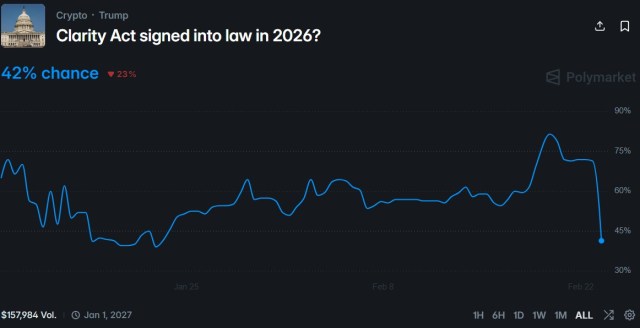
Crypto market structure bill odds of passing drop to 42%. Source: Polymarket

As Bitcoinist reported last week, Patrick Witt, Executive Director of the President’s Council of Advisors for Digital Assets, described the latest round of talks as “a big step forward.” “We’re close,” Witt wrote, adding that if both sides continue negotiating in good faith, he expects the administration’s March 1 deadline to be met.

At the center of the discussions is draft legislative language designed to address concerns raised by banks in a document titled “Yield and Interest Prohibition Principles.”

While the proposed text acknowledges the banking sector’s objections, it also makes clear that any restrictions on crypto rewards programs would be narrowly tailored.

One significant outcome of the negotiations is that paying yield on idle stablecoin balances — a major objective for many crypto firms — is effectively off the table.

Instead, the debate has shifted toward whether companies should be permitted to offer rewards tied to specific user activities rather than simple account balances.

How New Rules Could Change Bitcoin Derivatives Markets

Beyond the political back‐and‐forth, market expert MartyParty recently highlighted potential structural shifts that could follow the bill’s passage, arguing that the changes may be more significant than many investors realize.

In the Bitcoin (BTC) futures market, clearer jurisdictional boundaries would likely cement the Commodity Futures Trading Commission’s (CFTC) authority over digital asset commodities.

The expert believes that could accelerate the growth of regulated US trading venues, similar to CME, and potentially open the door to CFTC‐registered perpetual futures platforms.

According to MartyParty’s analysis, clear commodity classification may also encourage greater institutional participation, particularly from funds that are restricted from investing in assets deemed securities.

Perpetual futures contracts — a crypto‐native product widely used outside the United States — could also evolve. With CFTC registration, US‐based perpetual products might emerge with stronger consumer protections, greater transparency around funding rates, and tighter safeguards against manipulation.

Greater regulatory clarity could also reduce discrepancies between spot and futures markets, narrowing price gaps and stabilizing funding dynamics. At the same time, stricter leverage caps or margin requirements imposed under CFTC rules could limit the extreme levels of retail speculation currently seen on offshore platforms.

Bitcoin options markets would likely experience parallel shifts. The expert asserts that a clearer regulatory framework could encourage the development of additional US‐regulated options venues offering both physically settled and cash‐settled contracts tied to Bitcoin futures.

Reduced enforcement uncertainty may also lower implied volatility premiums, potentially making options more affordable for hedging and speculative strategies.

Institutional investors, in particular, could more confidently deploy advanced strategies — including collars and straddles — if Bitcoin’s commodity status is firmly established.

The 1D chart shows BTC’s price consolidation, currently at around $66,000. Source: BTCUSDT on TradingView.com

Featured image from OpenArt, chart from TradingView.com

Preguntas relacionadas

QAccording to Polymarket, what are the current odds that the CLARITY Act will pass this year?

AThe current odds that the CLARITY Act will pass this year are 42%.

QWhat is the major sticking point in the negotiations between the crypto industry and banks, as mentioned in the article?

AA major sticking point is the debate over whether companies should be permitted to offer rewards tied to specific user activities rather than simple account balances, with paying yield on idle stablecoin balances effectively being off the table.

QWhich US regulatory body is expected to gain clearer authority over digital asset commodities if the bill passes?

AThe Commodity Futures Trading Commission (CFTC) is expected to have its authority over digital asset commodities cemented.

QWhat potential benefit for institutional investors does the expert MartyParty highlight regarding Bitcoin's classification?

AMartyParty highlights that if Bitcoin's commodity status is firmly established, institutional investors could more confidently deploy advanced options strategies like collars and straddles.

QWhat was the public messaging from officials like, despite the lack of a final agreement from the White House meetings?

ADespite the lack of a final agreement, public messaging from officials remained upbeat, with one executive director describing the latest talks as 'a big step forward' and expressing that they are 'close' to a deal.

Lecturas Relacionadas

Los retiros de Bitcoin continúan: 8 años de almacenamiento en una cartera fría Coldcard terminaron en cero

Retirada de bitcoin continúa: 8 años en cartera fría Coldcard terminan en cero La cartera hardware Coldcard ha sido vulnerada, provocando una nueva oleada de retiradas de fondos de dispositivos afectados. Galaxy Research informa que el volumen total robado asciende a 1.367,05 BTC (unos 88,6 millones de dólares) desde 4.585 direcciones, superando ampliamente los 594,5 BTC reportados inicialmente el 30 de julio de 2026. La mayor parte de lo robado permanece inactiva en las direcciones de los atacantes. El problema no reside en el firmware, que ya fue actualizado por Coinkite, sino en las frases semilla (seed phrases) generadas desde marzo de 2021 debido a un error de programación. Estas frases son fácilmente descifrables, y actualizar el firmware no las cambia. Solo transferir los fondos a una nueva dirección con una nueva frase semilla elimina la vulnerabilidad. El fallo se originó al integrar la biblioteca libNgU, lo que hizo que los dispositivos dejaran de usar el generador de números aleatorios por hardware STM32 y pasaran a usar el generador software Yasmarang, inicializado con datos públicamente accesibles como el número de serie del chip. Afecta a frases semilla creadas en dispositivos Mk2/Mk3 (firmware 4.0.1–4.1.9 y hasta 5.0.3), Mk4/Mk5 (hasta v5.6.0) y Q (hasta v1.5.0Q). Se excluyen aquellas creadas con al menos 50 lanzamientos de dados independientes o una passphrase BIP-39 fuerte y única. Los usuarios deben generar una nueva frase semilla en firmware corregido y transferir sus activos. Un caso ilustrativo es el de un inversor de 39 años que perdió 2 BTC (unos 130.000 dólares) en minutos, ahorrados durante ocho años mediante trabajo físico como protección contra la hiperinflación en su país, con el objetivo de una jubilación anticipada a los 50 años. Su estrategia conservadora de "comprar y mantener en frío" se vio truncada, dejándolo devastado y decidido a abandonar las criptomonedas. Este incidente recuerda vulnerabilidades históricas por generadores de números aleatorios débiles, como la de la biblioteca BitcoinJS (2011-2015), que causó grandes pérdidas. Subraya que el almacenamiento offline no garantiza automáticamente seguridad criptográfica, especialmente cuando la entropía se ve comprometida dentro del propio dispositivo "cerrado".

cryptonews.ruHace 1 hora(s)

Los retiros de Bitcoin continúan: 8 años de almacenamiento en una cartera fría Coldcard terminaron en cero

cryptonews.ruHace 1 hora(s)

Trading

Spot
活动图片





