National-Level Players Enter the Game: The 2025 Revelation of Cryptocurrency Crime Spiraling Out of Control

marsbitPublicado a 2026-01-10Actualizado a 2026-01-10

Resumen

Summary: In 2025, state-level cryptocurrency activity surged, marking a new phase in the maturation of illicit on-chain ecosystems. Illicit addresses received at least $154 billion, a 162% year-over-year increase, largely driven by a 694% spike in transactions involving sanctioned entities. Stablecoins dominated these flows, accounting for 84% of all illicit transaction volume. Key trends include North Korean hackers stealing a record $2 billion, including the largest crypto theft in history from Bybit. Russia launched the ruble-backed A7A5 token, which saw $93.3 billion in transaction volume within a year, facilitating large-scale evasion. Chinese money laundering networks emerged as dominant, sophisticated operators offering full-service criminal enterprises. Iran-linked proxy networks moved over $2 billion for activities including oil sales and weapons procurement. Illicit actors and nations increasingly rely on full-stack infrastructure providers resistant to takedowns and sanctions. Furthermore, the connection between crypto and real-world violent crime is growing, with increased use in human trafficking and a rise in violent coercion attacks to seize crypto assets during price peaks. Collaboration between law enforcement, regulators, and crypto firms is crucial to counter these evolving, interconnected threats.

Original Author: Chainalysis

Original Compilation: Chopper, Foresight News

In 2025, we observed a significant increase in cryptocurrency-related activities at the national level, marking a new mature stage in the development of the illegal on-chain ecosystem. Over the past few years, the professionalization of the cryptocurrency crime sector has deepened; illegal organizations have now established large-scale on-chain infrastructure to support transnational criminal networks in procuring goods and services and laundering proceeds from crypto crimes. Against this backdrop, governments have also begun to enter this field, leveraging these mature professional service providers on one hand, while building their own customized infrastructure on the other to evade sanctions on a large scale. As governments connect to this cryptocurrency supply chain originally built for cybercriminals and organized crime groups, government agencies, compliance, and security teams now face severe challenges in terms of consumer rights protection and national security.
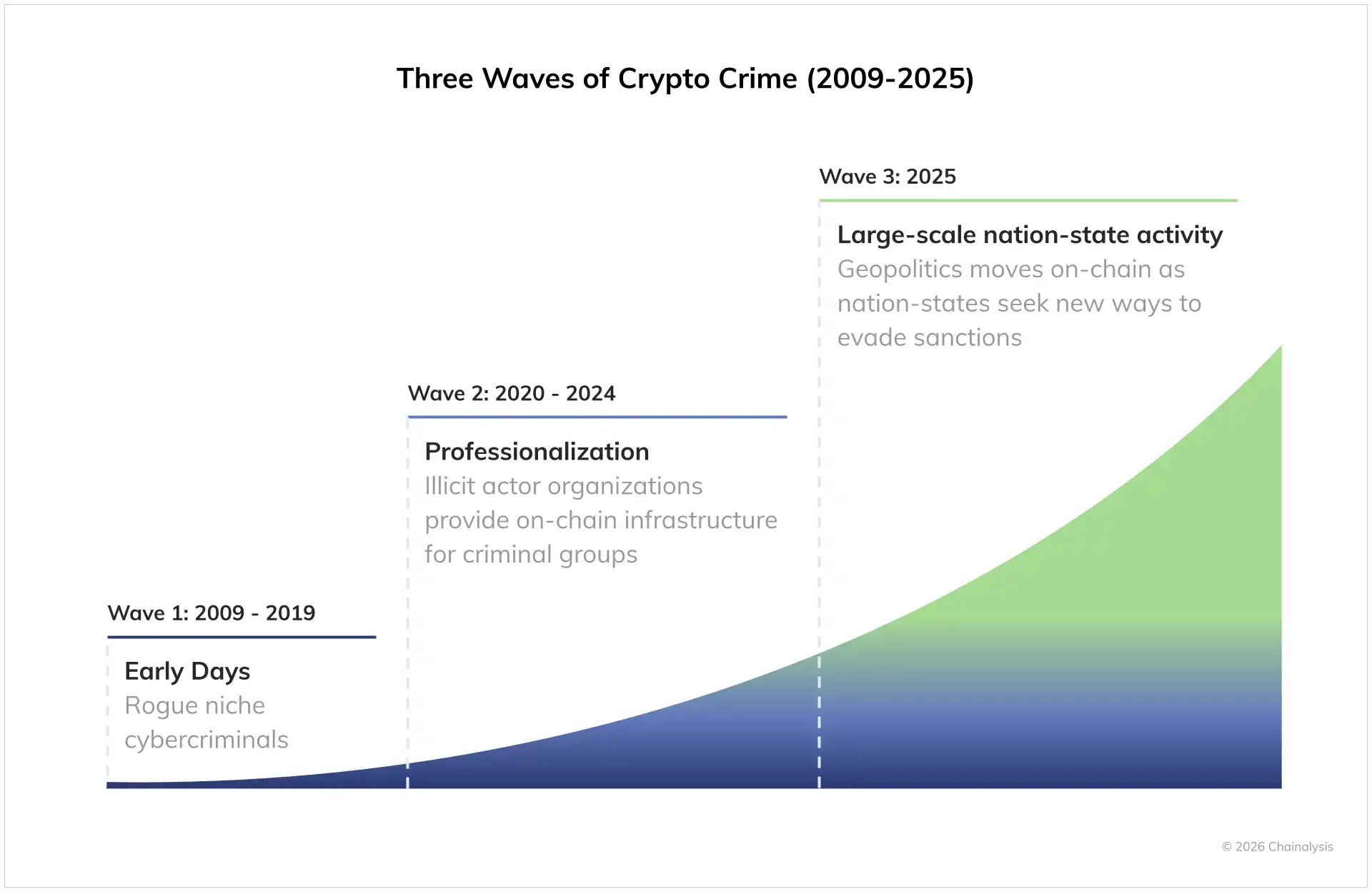
What are the specific on-chain manifestations of these trends and other industry changes? Next, we will analyze them by combining data and macro trends.
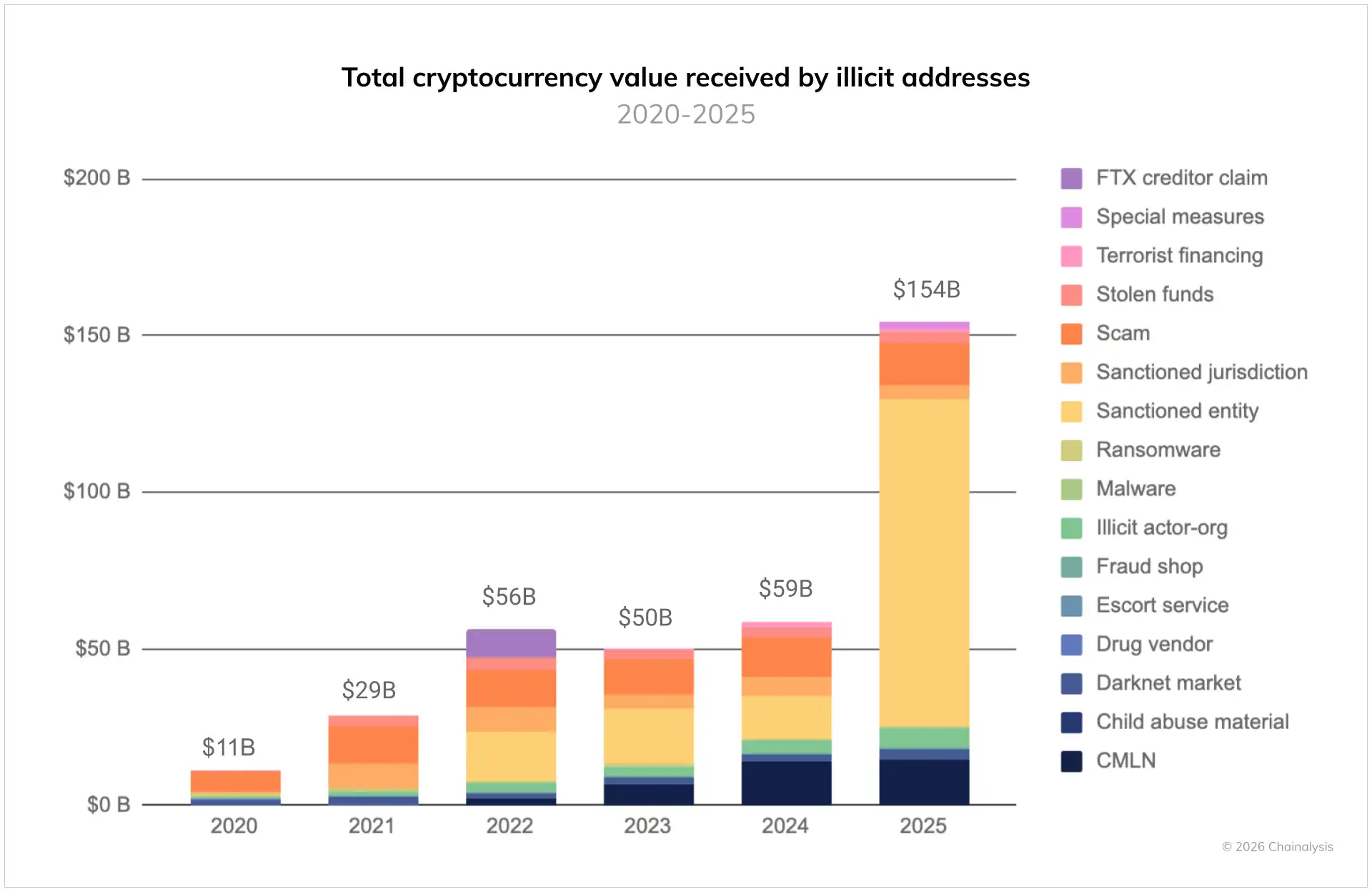
According to our monitoring data, the scale of funds flowing into illegal cryptocurrency addresses in 2025 reached at least $154 billion, a sharp increase of 162% year-on-year. This growth was primarily driven by a surge in fund inflows to sanctioned entities, which soared by 694% year-on-year. However, even excluding the growth from sanctioned entities, 2025 was still a record year for cryptocurrency crime, as the scale of the vast majority of illegal activities increased.

Nevertheless, the scale of these illegal transactions still pales in comparison to the overall cryptocurrency economy, as the main participants in the cryptocurrency market remain legitimate transactions. According to our estimates, although the proportion of illegal transactions in the total traceable cryptocurrency transaction volume in 2025 increased slightly compared to 2024, it remained below 1%.

As shown in the figure below, we also observed a continuous shift in the types of assets involved in cryptocurrency crimes.
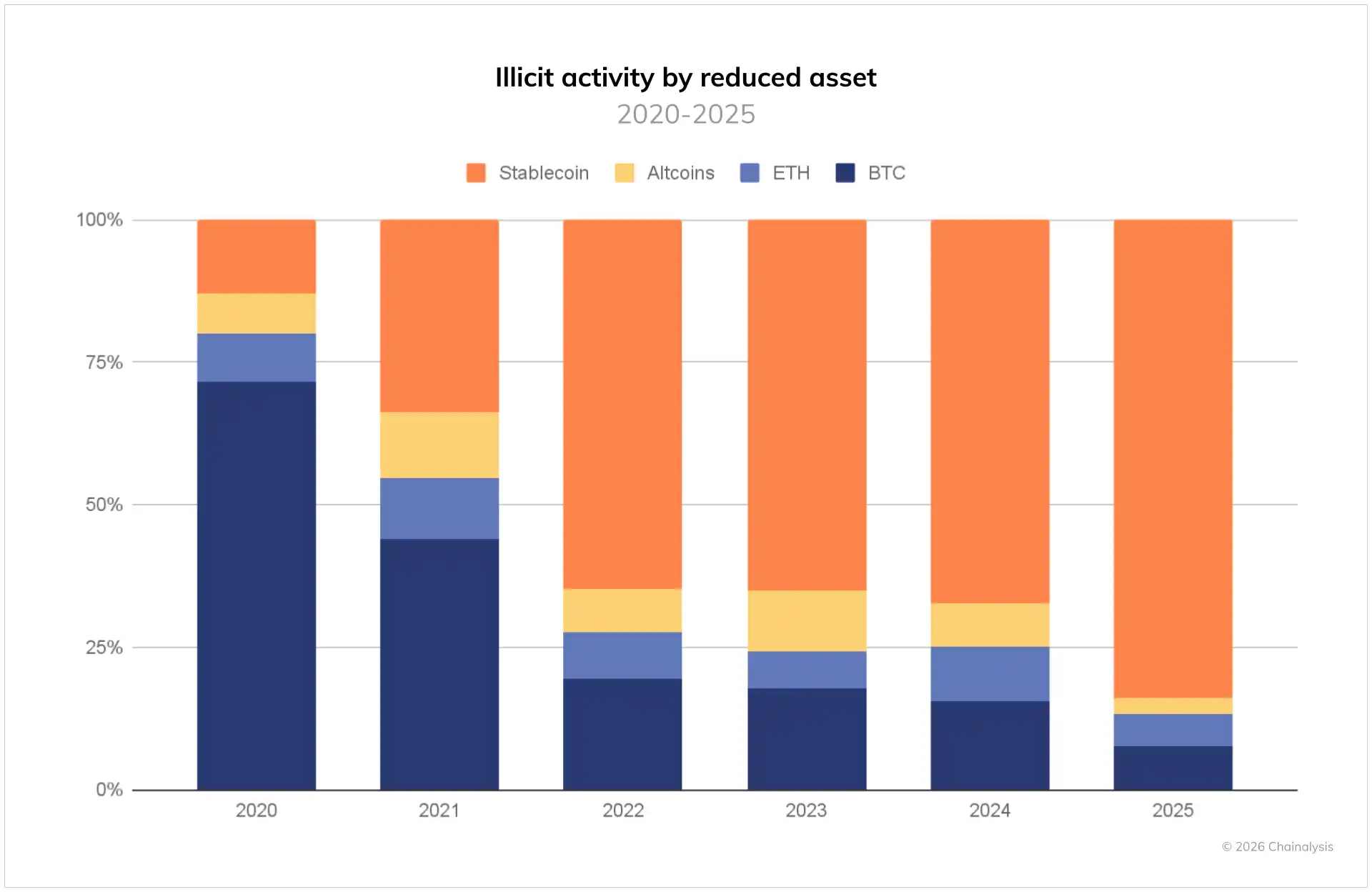
Over the past few years, stablecoins have gradually become the dominant asset in illegal transactions, currently accounting for 84% of the total illegal transaction volume. This trend aligns with the overall development characteristics of the cryptocurrency ecosystem: with advantages such as convenient cross-border transfers, low volatility, and wide application scenarios, stablecoins continue to expand their share in the overall cryptocurrency transactions.

The following sections will delve into the core trends that defined the cryptocurrency crime landscape in 2025, which remain worthy of attention in the future.

National-Level Threats Drive Transaction Scale: North Korea Sets New Record in Theft, Russia's A7A5 Token Facilitates Large-Scale Sanction Evasion

In 2025, stolen funds remained a major threat to the cryptocurrency ecosystem, with hacking groups linked to North Korea alone stealing $2 billion. This figure was primarily driven by several highly destructive large-scale hacking incidents, the most notable of which was the attack on the Bybit exchange in February. The incident involved nearly $1.5 billion, making it the largest digital asset theft in the history of cryptocurrency. Although North Korean hackers have long been a major force threatening the cryptocurrency ecosystem, the past year set new records both in terms of the amount stolen and the sophistication of intrusion and money laundering methods.

Particularly noteworthy is that the scale of on-chain activities by governments reached unprecedented levels in 2025. Russia introduced relevant legislation in 2024 to promote the use of cryptocurrencies to evade sanctions, and this measure was officially implemented in February 2025. The country launched the ruble-backed token A7A5, which achieved a transaction volume of over $93.3 billion in less than a year since its launch.

Meanwhile, over the past few years, Iran's proxy networks have conducted money laundering, illegal oil transactions, and bulk commodity procurement for weapons through confirmed wallet addresses that have been placed on the sanctions list, with a cumulative transaction volume exceeding $2 billion. Despite multiple military strikes, Iran-supported terrorist groups such as Hezbollah, Hamas, and the Houthis continue to use cryptocurrencies on an unprecedented scale.

In 2025, Chinese money laundering networks emerged as a dominant force in the illegal on-chain ecosystem. These organizations operate with high precision, greatly driving the diversification and professionalization of cryptocurrency crimes, offering specialized criminal services including "money laundering services." Building on early illegal operation models such as "Huiyin Guarantee," these networks have established full-service criminal enterprises, covering areas such as fraud, scams, laundering proceeds from North Korean hacking thefts, sanction evasion, and terrorism financing.

Full-Stack Illegal Infrastructure Providers Fuel Malicious Network Activities

While governments are increasing their use of cryptocurrencies, traditional cybercrime activities remain rampant: ransomware operators, child sexual abuse and cybercrime platforms, malware distributors, scammers, and illegal trading markets still rely on extensive support networks to maintain operations. Illegal actors and governments are increasingly dependent on full-stack on-chain infrastructure providers, including domain registrars, secure and reliable hosting services, and other technical infrastructure that can be used to carry out malicious network activities.

These infrastructure providers have evolved into comprehensive infrastructure platforms capable of resisting platform takedowns, abuse complaints, and sanction enforcement. As the scale of these services continues to expand, they may become key drivers in expanding the scope of malicious network activities for economic crime and state-supported forces.

The Increasing Correlation Between Cryptocurrency and Violent Crime

In the perception of many, cryptocurrency crime is still confined to the virtual world. The masterminds are merely anonymous figures hiding behind keyboards, posing no real-world threat. However, in reality, the connection between on-chain activities and violent crime is deepening. Human trafficking groups are increasingly using cryptocurrencies for transactions; at the same time, disturbingly, the number of violent coercion attacks has risen significantly, with criminals using violent means to force victims to transfer crypto assets, and such assaults often occur during peak cryptocurrency price periods.

Looking ahead, collaboration between law enforcement agencies, regulatory bodies, and cryptocurrency companies will be key to addressing these complex, ever-changing, and interconnected threats. Although the proportion of illegal transactions in legitimate cryptocurrency transaction volume remains limited, maintaining the integrity and security of the cryptocurrency ecosystem has never been more important.


Preguntas relacionadas

QWhat was the total value of illicit cryptocurrency transactions in 2025, and what was the primary driver of this growth?

AThe total value of illicit cryptocurrency transactions in 2025 reached at least $154 billion, representing a 162% year-over-year increase. This growth was primarily driven by a massive 694% surge in transaction volume from sanctioned entities.

QWhich asset has become the dominant currency for illicit transactions and what percentage of the total illicit volume does it represent?

AStablecoins have become the dominant asset for illicit transactions, currently accounting for 84% of the total illicit transaction volume.

QWhat significant role did nation-states play in the 2025 crypto crime landscape according to the article?

ANation-states significantly escalated their involvement in 2025. Russia launched the ruble-backed A7A5 token, which processed over $93.3 billion in volume to circumvent sanctions. North Korean hacking groups stole a record $2 billion, and Chinese money laundering networks emerged as dominant, sophisticated players in the illicit ecosystem.

QWhat new concerning trend connects cryptocurrency to real-world physical violence?

AA concerning trend is the rise in violent coercion attacks, where criminals use physical violence to force victims to transfer their cryptocurrency assets. These attacks often occur during periods of peak cryptocurrency prices.

QDespite the growth in illicit activity, how does its scale compare to the overall cryptocurrency economy?

ADespite the significant growth, illicit transactions still represent less than 1% of the total traceable cryptocurrency transaction volume, meaning the vast majority of cryptocurrency market activity remains legitimate.

Lecturas Relacionadas

human.tech lanza el Clean SDK para aplicaciones Web3 centradas en la privacidad

human.tech ha lanzado el Clean SDK, un kit de desarrollo que permite crear aplicaciones Web3 con privacidad por defecto y responsabilidad transparente. Este SDK, lanzado junto a Aztec v5, proporciona componentes para integrar verificación de identidad de conocimiento cero, screening de sanciones y transacciones privadas, sin necesidad de manejar datos sensibles o infraestructura de cumplimiento desde cero. El SDK resuelve el dilema entre privacidad y responsabilidad, combinando pruebas de conocimiento cero con verificación programable. Esto permite a las aplicaciones demostrar que los usuarios son legítimos y que los fondos han pasado controles, manteniendo la confidencialidad. Shield, la primera aplicación construida con el Clean SDK, es un puente privado a Aztec. Permite a usuarios y agentes autónomos transferir activos demostrando, sin revelar identidades, que hay una persona real detrás de cada transferencia y que los fondos han sido verificados contra sanciones. El kit incluye tres técnicas de verificación: Prueba de Inocencia (screening contra 23 fuentes de sanciones), Prueba de Personalidad (verificación simplificada con Human Passport) y Prueba de Manos Limpias (credenciales de identidad gubernamental de conocimiento cero para transacciones de alto valor). Diseñado para desarrolladores en Aztec, el SDK permite integrar privacidad programable directamente en aplicaciones descentralizadas. Shield ejemplifica su uso, pero el objetivo es habilitar un ecosistema completo de aplicaciones financieras y servicios descentralizados que requieran verificación respetuosa con la privacidad. human.tech desarrolla soluciones de conocimiento cero para demostrar personalidad, mantener la privacidad y crear sistemas digitales escalables y responsables, con un ecosistema que incluye también Human Passport, Wallet as a Protocol (WaaP) y Human Network.

TheNewsCryptoHace 2 min(s)

human.tech lanza el Clean SDK para aplicaciones Web3 centradas en la privacidad

TheNewsCryptoHace 2 min(s)

¿Liberando 100 millones de dólares en liquidez? La nueva política de Pump.fun pone a prueba la técnica del 'pump' de 5 minutos

**Resumen en español europeo: Pump.fun lanza el modo BOOST para redirigir 1.000 millones de dólares en liquidez "inerte"** El 21 de julio, Pump.fun anunció oficialmente el modo BOOST, un nuevo mecanismo por defecto para el lanzamiento de memecoins. El objetivo es abordar un problema central de su plataforma: aproximadamente el 20% de la liquidez que se bloquea en los pools (LP) cuando un token se migra desde su curva de enlace (bonding curve) queda permanentemente inutilizable, incluso si el precio del token cae a cero. La plataforma estima que esta "liquidez muerta" supone un desperdicio de más de 1.000 millones de dólares anuales. El funcionamiento de BOOST es directo: en lugar de inmovilizar ese 20% de fondos en el LP, la plataforma los utiliza durante los primeros 5 minutos tras la migración para comprar el propio token en el mercado secundario mediante un sistema TWAP (Precio Medio Ponderado en el Tiempo). Todos los tokens comprados se queman inmediatamente, creando presión de compra a corto plazo y reduciendo permanentemente la oferta en circulación. Este cambio no añade liquidez externa ni altera la experiencia de trading en la bonding curve. Su propósito es mejorar la experiencia post-migración: generar un "fuego artificial" de 5 minutos que podría aumentar la retención de traders y la actividad comercial. La lógica subyacente es que para que el modelo de negocio de Pump.fun sea sostenible, los tokens lanzados necesitan generar volumen de trading continuo después de su lanzamiento inicial. Sin embargo, el mecanismo genera debate. Los críticos señalan que el breve impulso de 5 minutos podría facilitar que proyectos de baja calidad parezcan exitosos, fomentando lanzamientos más especulativos. Además, una vez finalizada la compra automática, los tokens podrían sufrir caídas bruscas si se enfrentan a grandes órdenes de venta, intercambiando el riesgo de un colapso posterior por una breve ilusión de bombeo inicial.

marsbitHace 9 min(s)

¿Liberando 100 millones de dólares en liquidez? La nueva política de Pump.fun pone a prueba la técnica del 'pump' de 5 minutos

marsbitHace 9 min(s)

Vender espacio de bloques está muerto: las blockchains públicas deben encontrar nuevas formas de sobrevivir

El modelo de negocio de vender espacio en bloques para las cadenas públicas (L1/L2) está en crisis. Mientras aplicaciones y otros proyectos generan grandes ingresos, la mayoría de las blockchains luchan por monetizar. Un ejemplo claro: Hyperliquid generó unos 58 millones de dólares en 30 días, frente a los 430.000 de Arbitrum. La conclusión es clara: las cadenas públicas deben evolucionar más allá de ser infraestructuras neutrales. El futuro está en convertirse en estudios de productos, distribuidores de aplicaciones, pasarelas de pago o soluciones SaaS especializadas para nichos verticales específicos. El artículo también analiza otros temas clave: 1. **El ataque a Ostium:** Un fallo en su infraestructura off-chain para importar precios permitió a un atacante robar más de 23 millones de USDC, reduciendo su TVL en más del 40%. Este caso subraya los riesgos críticos al conectar mercados tradicionales con DeFi. 2. **El futuro de las opciones on-chain:** Para lograr adopción masiva, los derivados complejos como las opciones deben dejar de comercializarse como tales. El éxito reside en abstraer su complejidad en productos sencillos como bóvedas de rendimiento, opciones binarias a corto plazo o productos estructurados, donde el usuario final solo ve el resultado, no la mecánica. En resumen, la industria se mueve hacia una especialización profunda, donde la seguridad, la experiencia de usuario simplificada y un claro enfoque en generar valor para clientes específicos serán claves para la supervivencia y los ingresos.

marsbitHace 28 min(s)

Vender espacio de bloques está muerto: las blockchains públicas deben encontrar nuevas formas de sobrevivir

marsbitHace 28 min(s)

Notas de Podcast|En conversación con el director de gestión de activos de GSR: Para saber si este repunte de criptomonedas es real o falso, basta con observar las tasas de interés de préstamos en Aave

Resumen del podcast: En conversación con Andy Baehr, Director General de Gestión de Activos de GSR, se analiza si el actual repunte del mercado cripto es real o efímero. Baehr describe el mercado actual como en un estado de "ambivalencia", con rebotes cortos que carecen de convicción y momentum sostenido. Destaca tres señales clave a seguir: 1. **Tipos de interés en DeFi (ej. Aave)**: Actualmente, los tipos para stablecoins como USDC rondan el 3.75%, similares a los bonos del Tesoro estadounidense. La ausencia de un diferencial por riesgo ("credit spread") indica poca demanda de apalancamiento, señal de baja energía en el mercado. Un aumento repentino sería un indicador claro de una recuperación genuina con mayor apetito por el riesgo. 2. **Consenso sobre el "pico de medidas restrictivas" de la Fed**: El mercado necesita alcanzar un "Fed Solstice", el momento en que se perciba claramente el fin del ciclo de subidas de tipos. Hasta entonces, cualquier rebote es vulnerable. 3. **Posible aprobación de la CLARITY Act**: Su probabilidad ha caído del 75% al 40%. Si se aprueba antes del 7 de agosto, sería una sorpresa positiva que probablemente impulse los precios. Baehr también señala la falta de compradores estructurales actuales, como los fondos ETF (cuya salida de capitales es notable) o las empresas del tesoro con cripto (DAT), que suelen entrar más tarde en un ciclo alcista. Concluye que, para que el rebote sea sostenido, se necesita un nuevo aumento del apalancamiento, visible a través de los tipos de DeFi.

marsbitHace 38 min(s)

Notas de Podcast|En conversación con el director de gestión de activos de GSR: Para saber si este repunte de criptomonedas es real o falso, basta con observar las tasas de interés de préstamos en Aave

marsbitHace 38 min(s)

Trading

Spot
活动图片




