National-Level Players Enter the Game: The 2025 Revelation of Cryptocurrency Crime Spiraling Out of Control

marsbitPublicado a 2026-01-10Actualizado a 2026-01-10

Resumen

Summary: In 2025, state-level cryptocurrency activity surged, marking a new phase in the maturation of illicit on-chain ecosystems. Illicit addresses received at least $154 billion, a 162% year-over-year increase, largely driven by a 694% spike in transactions involving sanctioned entities. Stablecoins dominated these flows, accounting for 84% of all illicit transaction volume. Key trends include North Korean hackers stealing a record $2 billion, including the largest crypto theft in history from Bybit. Russia launched the ruble-backed A7A5 token, which saw $93.3 billion in transaction volume within a year, facilitating large-scale evasion. Chinese money laundering networks emerged as dominant, sophisticated operators offering full-service criminal enterprises. Iran-linked proxy networks moved over $2 billion for activities including oil sales and weapons procurement. Illicit actors and nations increasingly rely on full-stack infrastructure providers resistant to takedowns and sanctions. Furthermore, the connection between crypto and real-world violent crime is growing, with increased use in human trafficking and a rise in violent coercion attacks to seize crypto assets during price peaks. Collaboration between law enforcement, regulators, and crypto firms is crucial to counter these evolving, interconnected threats.

Original Author: Chainalysis

Original Compilation: Chopper, Foresight News

In 2025, we observed a significant increase in cryptocurrency-related activities at the national level, marking a new mature stage in the development of the illegal on-chain ecosystem. Over the past few years, the professionalization of the cryptocurrency crime sector has deepened; illegal organizations have now established large-scale on-chain infrastructure to support transnational criminal networks in procuring goods and services and laundering proceeds from crypto crimes. Against this backdrop, governments have also begun to enter this field, leveraging these mature professional service providers on one hand, while building their own customized infrastructure on the other to evade sanctions on a large scale. As governments connect to this cryptocurrency supply chain originally built for cybercriminals and organized crime groups, government agencies, compliance, and security teams now face severe challenges in terms of consumer rights protection and national security.
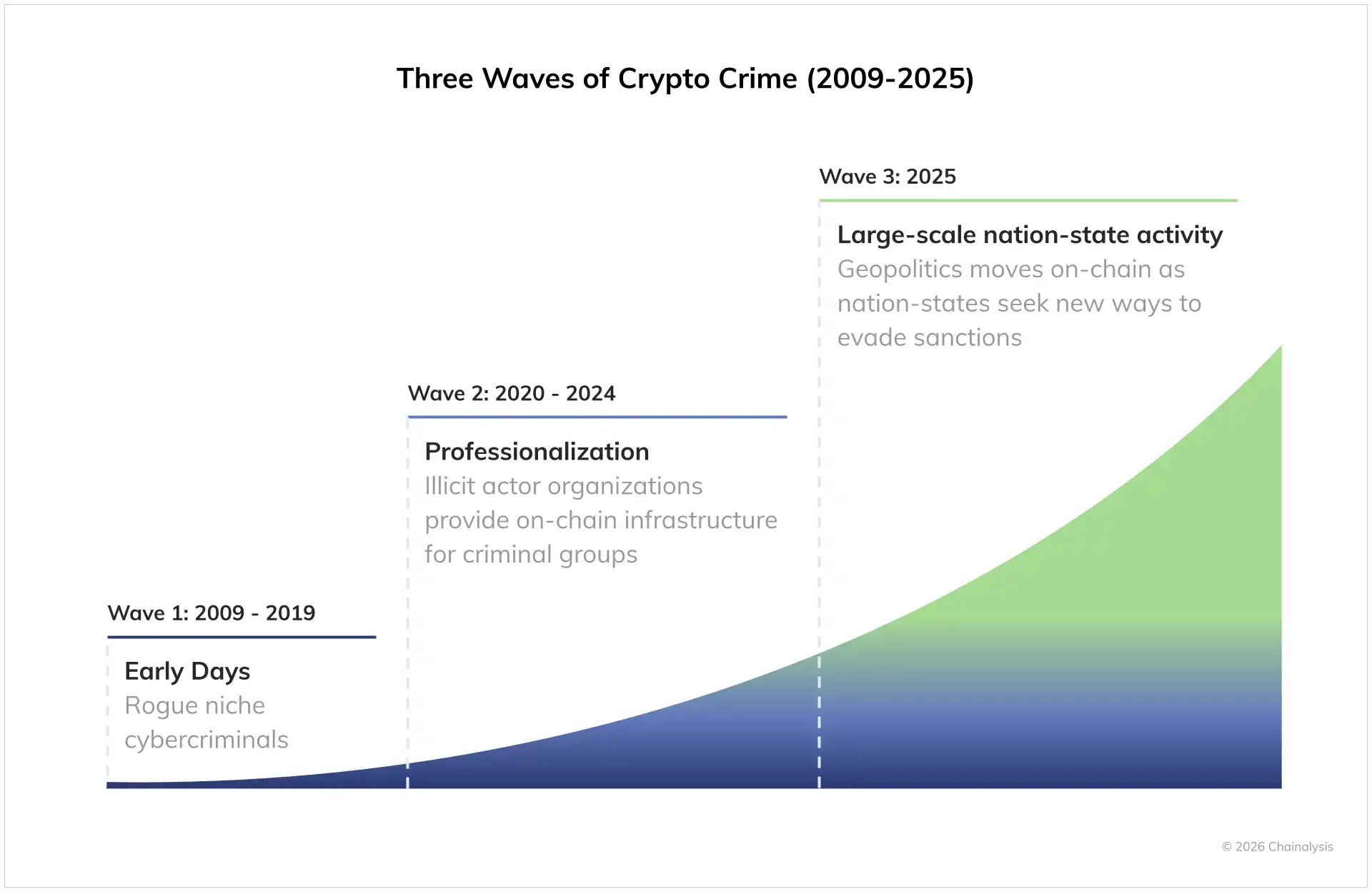
What are the specific on-chain manifestations of these trends and other industry changes? Next, we will analyze them by combining data and macro trends.
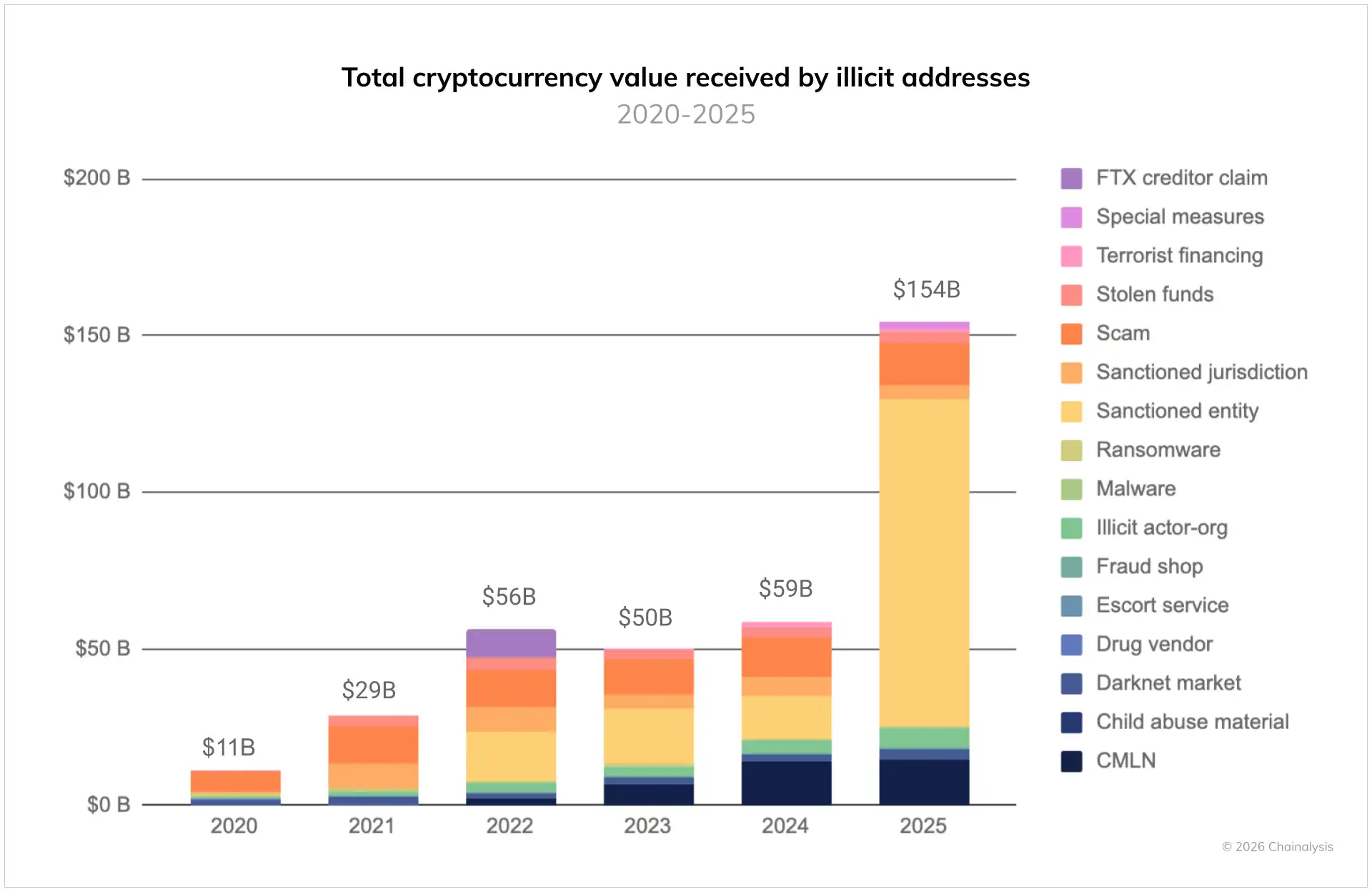
According to our monitoring data, the scale of funds flowing into illegal cryptocurrency addresses in 2025 reached at least $154 billion, a sharp increase of 162% year-on-year. This growth was primarily driven by a surge in fund inflows to sanctioned entities, which soared by 694% year-on-year. However, even excluding the growth from sanctioned entities, 2025 was still a record year for cryptocurrency crime, as the scale of the vast majority of illegal activities increased.

Nevertheless, the scale of these illegal transactions still pales in comparison to the overall cryptocurrency economy, as the main participants in the cryptocurrency market remain legitimate transactions. According to our estimates, although the proportion of illegal transactions in the total traceable cryptocurrency transaction volume in 2025 increased slightly compared to 2024, it remained below 1%.

As shown in the figure below, we also observed a continuous shift in the types of assets involved in cryptocurrency crimes.
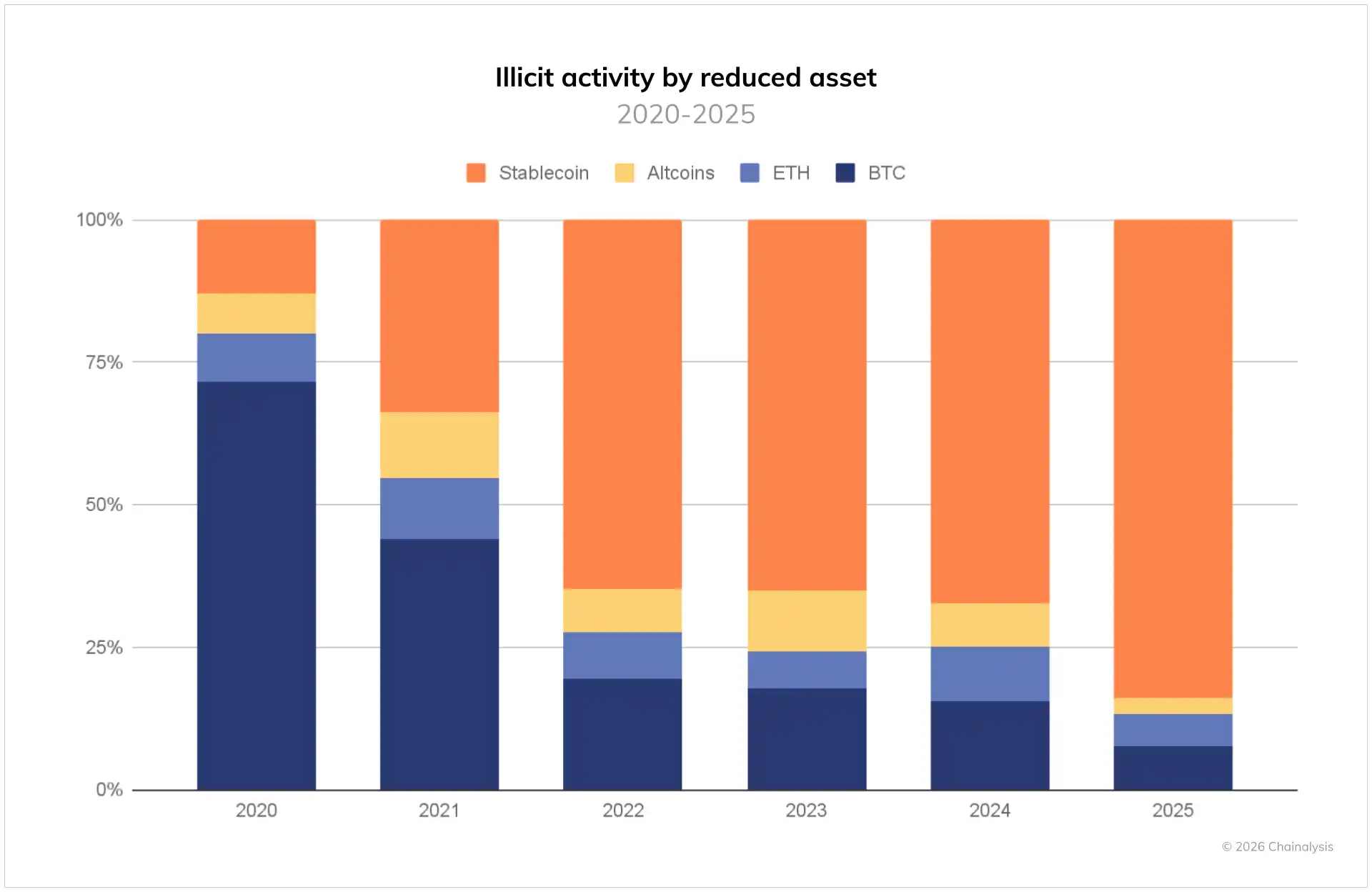
Over the past few years, stablecoins have gradually become the dominant asset in illegal transactions, currently accounting for 84% of the total illegal transaction volume. This trend aligns with the overall development characteristics of the cryptocurrency ecosystem: with advantages such as convenient cross-border transfers, low volatility, and wide application scenarios, stablecoins continue to expand their share in the overall cryptocurrency transactions.

The following sections will delve into the core trends that defined the cryptocurrency crime landscape in 2025, which remain worthy of attention in the future.

National-Level Threats Drive Transaction Scale: North Korea Sets New Record in Theft, Russia's A7A5 Token Facilitates Large-Scale Sanction Evasion

In 2025, stolen funds remained a major threat to the cryptocurrency ecosystem, with hacking groups linked to North Korea alone stealing $2 billion. This figure was primarily driven by several highly destructive large-scale hacking incidents, the most notable of which was the attack on the Bybit exchange in February. The incident involved nearly $1.5 billion, making it the largest digital asset theft in the history of cryptocurrency. Although North Korean hackers have long been a major force threatening the cryptocurrency ecosystem, the past year set new records both in terms of the amount stolen and the sophistication of intrusion and money laundering methods.

Particularly noteworthy is that the scale of on-chain activities by governments reached unprecedented levels in 2025. Russia introduced relevant legislation in 2024 to promote the use of cryptocurrencies to evade sanctions, and this measure was officially implemented in February 2025. The country launched the ruble-backed token A7A5, which achieved a transaction volume of over $93.3 billion in less than a year since its launch.

Meanwhile, over the past few years, Iran's proxy networks have conducted money laundering, illegal oil transactions, and bulk commodity procurement for weapons through confirmed wallet addresses that have been placed on the sanctions list, with a cumulative transaction volume exceeding $2 billion. Despite multiple military strikes, Iran-supported terrorist groups such as Hezbollah, Hamas, and the Houthis continue to use cryptocurrencies on an unprecedented scale.

In 2025, Chinese money laundering networks emerged as a dominant force in the illegal on-chain ecosystem. These organizations operate with high precision, greatly driving the diversification and professionalization of cryptocurrency crimes, offering specialized criminal services including "money laundering services." Building on early illegal operation models such as "Huiyin Guarantee," these networks have established full-service criminal enterprises, covering areas such as fraud, scams, laundering proceeds from North Korean hacking thefts, sanction evasion, and terrorism financing.

Full-Stack Illegal Infrastructure Providers Fuel Malicious Network Activities

While governments are increasing their use of cryptocurrencies, traditional cybercrime activities remain rampant: ransomware operators, child sexual abuse and cybercrime platforms, malware distributors, scammers, and illegal trading markets still rely on extensive support networks to maintain operations. Illegal actors and governments are increasingly dependent on full-stack on-chain infrastructure providers, including domain registrars, secure and reliable hosting services, and other technical infrastructure that can be used to carry out malicious network activities.

These infrastructure providers have evolved into comprehensive infrastructure platforms capable of resisting platform takedowns, abuse complaints, and sanction enforcement. As the scale of these services continues to expand, they may become key drivers in expanding the scope of malicious network activities for economic crime and state-supported forces.

The Increasing Correlation Between Cryptocurrency and Violent Crime

In the perception of many, cryptocurrency crime is still confined to the virtual world. The masterminds are merely anonymous figures hiding behind keyboards, posing no real-world threat. However, in reality, the connection between on-chain activities and violent crime is deepening. Human trafficking groups are increasingly using cryptocurrencies for transactions; at the same time, disturbingly, the number of violent coercion attacks has risen significantly, with criminals using violent means to force victims to transfer crypto assets, and such assaults often occur during peak cryptocurrency price periods.

Looking ahead, collaboration between law enforcement agencies, regulatory bodies, and cryptocurrency companies will be key to addressing these complex, ever-changing, and interconnected threats. Although the proportion of illegal transactions in legitimate cryptocurrency transaction volume remains limited, maintaining the integrity and security of the cryptocurrency ecosystem has never been more important.


Preguntas relacionadas

QWhat was the total value of illicit cryptocurrency transactions in 2025, and what was the primary driver of this growth?

AThe total value of illicit cryptocurrency transactions in 2025 reached at least $154 billion, representing a 162% year-over-year increase. This growth was primarily driven by a massive 694% surge in transaction volume from sanctioned entities.

QWhich asset has become the dominant currency for illicit transactions and what percentage of the total illicit volume does it represent?

AStablecoins have become the dominant asset for illicit transactions, currently accounting for 84% of the total illicit transaction volume.

QWhat significant role did nation-states play in the 2025 crypto crime landscape according to the article?

ANation-states significantly escalated their involvement in 2025. Russia launched the ruble-backed A7A5 token, which processed over $93.3 billion in volume to circumvent sanctions. North Korean hacking groups stole a record $2 billion, and Chinese money laundering networks emerged as dominant, sophisticated players in the illicit ecosystem.

QWhat new concerning trend connects cryptocurrency to real-world physical violence?

AA concerning trend is the rise in violent coercion attacks, where criminals use physical violence to force victims to transfer their cryptocurrency assets. These attacks often occur during periods of peak cryptocurrency prices.

QDespite the growth in illicit activity, how does its scale compare to the overall cryptocurrency economy?

ADespite the significant growth, illicit transactions still represent less than 1% of the total traceable cryptocurrency transaction volume, meaning the vast majority of cryptocurrency market activity remains legitimate.

Lecturas Relacionadas

Acaba de recaudar 2.700 millones, y Li Feifei también invirtió

En la actualidad, el mercado de inversión está obsesionado con los "Modelos del Mundo". Sin embargo, Pete Florence, ex científico de DeepMind y co-creador de la arquitectura Vision-Language-Action (VLA), fundó Generalist AI y rechaza esta etiqueta. Para él, el objetivo concreto es más importante: crear robots que realicen cualquier tarea con alta tasa de éxito sin datos específicos. Recientemente, Generalist AI recaudó 400 millones de dólares (unos 2.700 millones de RMB) en una ronda de financiación, alcanzando una valoración de 2.000 millones de dólares. Inversores incluyen NVentures de Nvidia, Bezos Expeditions, NFDG, y figuras como el cofundador de Xiaomi Lin Bin, el fundador de Zoom Eric Yuan, y la renombrada científica Fei-Fei Li. Florence, influenciado por su mentor en el MIT Russ Tedrake, prioriza comprender el mundo físico. Su enfoque comienza estableciendo una meta clara, luego diseña la ruta técnica. Tras dejar Google, lanzó Generalist AI en 2025. La compañía presentó su primer modelo de IA incorporada, GEN-0, en noviembre de 2025, demostrando que las leyes de escalado de los LLMs también se aplican al movimiento físico. En abril de 2026, presentaron GEN-1, entrenado con más de 50.000 horas de datos de interacción física recogidos por un dispositivo portátil. GEN-1 logra un 99% de éxito en tareas como plegar cajas y empaquetar teléfonos, siendo tres veces más rápido que GEN-0. Este avance acerca el modelo a un punto de inflexión similar al GPT-3, mostrando un rendimiento apto para despliegues comerciales en ciertas tareas. La inversión récord respalda la visión de Florence: robots universales que sean lo suficientemente expertos en tareas reales como para ser útiles, avanzando hacia la reducción del coste marginal del trabajo físico a cero. La etiqueta "Modelo del Mundo" queda así en segundo plano frente a los resultados tangibles.

marsbitHace 2 min(s)

Acaba de recaudar 2.700 millones, y Li Feifei también invirtió

marsbitHace 2 min(s)

Perdiendo a dos leyendas en tres días: ¿Se está resquebrajando el dique de talento de IA de Google?

En solo tres días, Google ha perdido a dos leyendas de la IA. El 18 de junio, Noam Shazeer, coautor del seminal trabajo "Attention is All You Need" y copresponsable de Gemini, anunció su salida para unirse a OpenAI. Dos días después, John Jumper, ganador del Nobel de Química 2024 y líder de AlphaFold, dejó Google DeepMind para incorporarse a Anthropic. Estas partidas no son incidentes aislados, sino parte de una tendencia clara de fuga de talento de Google hacia OpenAI y Anthropic, como lo confirma también la reciente incorporación a Anthropic del exmiembro fundador de OpenAI, Andrej Karpathy. El trasfondo de este éxodo es fundamentalmente una cuestión de misión y enfoque. El modelo de negocio central de Google, basado en la publicidad, impone una lógica orientada a productos y métricas comerciales que, en última instancia, restringe la investigación pura. En contraste, tanto OpenAI (con su misión de AGI) como Anthropic (centrada en la seguridad y la ciencia) ofrecen un entorno de trabajo enfocado únicamente en empujar los límites de las capacidades de los modelos. A esto se suma la fuerte atracción financiera: OpenAI y Anthropic están en camino a una OPI, lo que promete una recompensa económica masiva a través de capital para sus empleados, algo que la ya gigantesca Google difícilmente puede igualar. La fusión de Google Brain y DeepMind en 2023, destinada a consolidar esfuerzos, ha generado en cambio tensiones culturales y ha hecho más evidente la presión por alinear la investigación con los objetivos de los equipos de productos. El resultado es una reorganización estructural del mapa del talento en IA. Google, a pesar de sus vastos recursos en computación y datos, está perdiendo a las personas que definen el futuro del campo. La verdadera ventaja competitiva en IA reside en retener a las mentes más brillantes, y Google está descubriendo que esa es quizás su batalla más difícil.

marsbitHace 2 hora(s)

Perdiendo a dos leyendas en tres días: ¿Se está resquebrajando el dique de talento de IA de Google?

marsbitHace 2 hora(s)

Tras las notas de la IA, se esconde un "creador de exámenes" chino

Cada vez que se lanza un modelo de IA de vanguardia, la comunidad fija su atención en ciertas "hojas de resultados" familiares: MMLU-Pro, MMMU, MMMU-Pro. Estos puntos de referencia se han convertido en exámenes estándar para evaluar y comparar modelos como GPT, Claude, Gemini, Llama, Qwen y DeepSeek. Detrás de estas influyentes evaluaciones está el investigador chino Wenhu Chen, profesor asistente en la Universidad de Waterloo y fundador del TIGERLab (apodado "虎头帮"). Su trabajo surge de una necesidad crítica: a medida que los modelos avanzaban, las pruebas antiguas como MMLU se saturaban con puntuaciones casi perfectas, dejando de ser útiles para discernir diferencias reales. En 2024, Chen y su equipo presentaron MMLU-Pro, una renovación exhaustiva del original. Con 12,032 preguntas de 14 disciplinas, aumenta las opciones de respuesta de 4 a 10 para reducir las conjeturas e incorpora problemas más complejos que requieren razonamiento. El resultado fue una caída del 16% al 33% en la precisión de los modelos y una evaluación más estable y discriminatoria, rápidamente adoptada por la industria. Su contribución se extiende al ámbito multimodal con MMMU, un conjunto de 11,500 preguntas que combinan imágenes (gráficos, mapas, fórmulas) con conocimientos académicos para probar una comprensión integrada. Incluso los mejores modelos como GPT-4V inicialmente solo alcanzaron un 56% de precisión, revelando un largo camino por recorrer. Su sucesor, MMMU-Pro, cierra aún más las brechas, obligando a los modelos a utilizar la información visual y no solo el texto. La experiencia de Chen, que incluye investigación doctoral en preguntas complejas y una etapa en Google DeepMind trabajando en Gemini, le permite anticipar cómo los modelos pueden "aparentar" competencia. Su laboratorio no solo diseña evaluaciones, sino que también desarrolla modelos (como UniVideo para video o MoCha para avatares), asegurando que sus "exámenes" reflejen desafíos reales y los límites actuales de la tecnología. Actualmente, Chen continúa este trabajo en el laboratorio de superinteligencia de Meta, enfocado en datos y evaluación multimodal. Su historia destaca el papel fundamental, aunque a menudo menos visible, de los investigadores que construyen las herramientas para medir el verdadero progreso de la IA.

marsbitHace 2 hora(s)

Tras las notas de la IA, se esconde un "creador de exámenes" chino

marsbitHace 2 hora(s)

Selección Semanal del Editor Weekly Editor's Picks (0613-0619)

**【Resumen semanal de los editores (13-19 de junio)】** Esta selección semanal rescata análisis profundos del flujo de información, filtrando el ruido para ofrecer perspectivas clave. **Panorama macro:** Tras la reapertura del Estrecho de Ormuz, el mercado ajusta su foco desde el "impacto bélico" hacia la "recuperación de la oferta". Se observan movimientos en petróleo, bonos, inflación y cadenas de valor como LNG y fertilizantes. **Inversión y emprendimiento:** Ray Dalio advierte sobre la concentración del mercado en acciones de grandes tecnológicas de IA, recomendando diversificación. En cripto, se analizan ciclos a largo plazo, señales de posible fondo para BTC en Q4, y los desafíos regulatorios en mercados como Corea del Sur. El análisis de SpaceX tras su IPO destaca su elevada valoración, riesgos sistémicos potenciales y la importancia de próximos hitos como su inclusión en índices. **Web3 & IA:** Una advertencia señala exposiciones de billones de dólares fuera de balance en la nube/IA, un riesgo latente si la comercialización falla. Se exploran las predicciones de IA para el Mundial y la estructura de costos de una suscripción a IA como Claude. **Mercados de predicción:** Robinhood desarrolla su propia plataforma (Rothera), iniciando una "guerra de canales" en la industria y posicionándose como competidor directo de Kalshi. **CeFi & DeFi:** Se analizan mecanismos de perpetuales para pre-IPO (ej. SpaceX) y los desafíos técnicos pendientes. La desviación del precio de STRC (vinculado a Strategy) refleja preocupaciones sobre su modelo de negocio. Se presenta el nuevo ETF de Bitcoin con rendimiento de BlackRock (BITA). **Ethereum y escalabilidad:** Se destaca la ventaja clave de Ethereum: su vasto ecosistema de desarrolladores y estándares, consolidándolo como sistema operativo para las finanzas descentralizadas. **Otros titulares de la semana:** Acuerdo EEUU-Irán, decisión de la Fed, movimientos en SpaceX y Anthropic, y opiniones destacadas sobre mercados.

marsbitHace 2 hora(s)

Selección Semanal del Editor Weekly Editor's Picks (0613-0619)

marsbitHace 2 hora(s)

Trading

Spot
Futuros
活动图片