Nasdaq Stalls, But Power Stocks Keep Hitting New Highs? AI's Second Half: A Deep Dive into the 2026 U.S. Grid Modernization Investment Map

marsbitPublicado a 2026-02-27Actualizado a 2026-02-27

Resumen

The U.S. stock market in 2026 shows a clear divergence: while the Nasdaq stagnates, industrial, energy, and utility stocks surge. This signals a shift in AI competition from algorithms to physical resources—specifically, power and grid infrastructure. The AI-driven explosion in data center energy consumption, alongside manufacturing reshoring and broader electrification (EVs, heat pumps), is straining an aging U.S. grid. Much of the infrastructure is decades old and ill-equipped for modern demands, leading to bottlenecks, extended delays for critical components like transformers, and rising costs. Grid modernization is not just about expansion but about creating a digital, bidirectional, and self-healing network. Key layers include: - Smart metering (AMI) for real-time data exchange, - Automation and self-healing systems (e.g., FLISR by GE Vernova), - Virtual power plants (VPPs) enabling decentralized energy distribution. Investment opportunities are stratified: - High-margin software/automation firms (e.g., GEV, Siemens, Itron), - Critical equipment manufacturers (e.g., Eaton, ABB, Schneider Electric), - Engineering and construction leaders (e.g., Quanta Services, MasTec) directly capturing infrastructure spending, - Regulated utilities (e.g., NextEra Energy, Duke Energy) managing upgraded networks. The value reassessment of power assets is underway, positioning the grid as a national strategic asset essential to AI and economic resilience.

Entering 2026, the U.S. stock market exhibits an extreme divergence: the Nasdaq has failed to hit a new high for four consecutive months, with the valuations of AI leaders suffering in the anxious stalemate awaiting a new round of rate cuts; yet, on the other end of the market, industrial, energy, and utility stocks are breaking through first amidst the roar of the "old world."

This divergence sends a clear signal: the competition in AI has decisively shifted from an algorithm race to a physical resource race. If 2024 was the "Year of the Chip," then 2026 is the "Year One of Grid Modernization."

Currently, the revaluation of power assets is unstoppable. The market was buying the "brain" (chips) in 2023-2024, while in 2025-2026, capital is flowing to the "heart and blood vessels" (power and grid).

This article will provide a complete recap for investors on the structural changes, competitive landscape, and the opportunities within the U.S. power and grid industry.

The RockFlow investment research team believes investors should focus on three tiers: the high-margin software and automation layer represented by GEV, the high-certainty equipment manufacturing layer centered on Eaton and Schneider, and the direct harvesters of the infrastructure boom led by PWR.

1. AI Demand Shock and the U.S. Grid's "Ailments of Age"
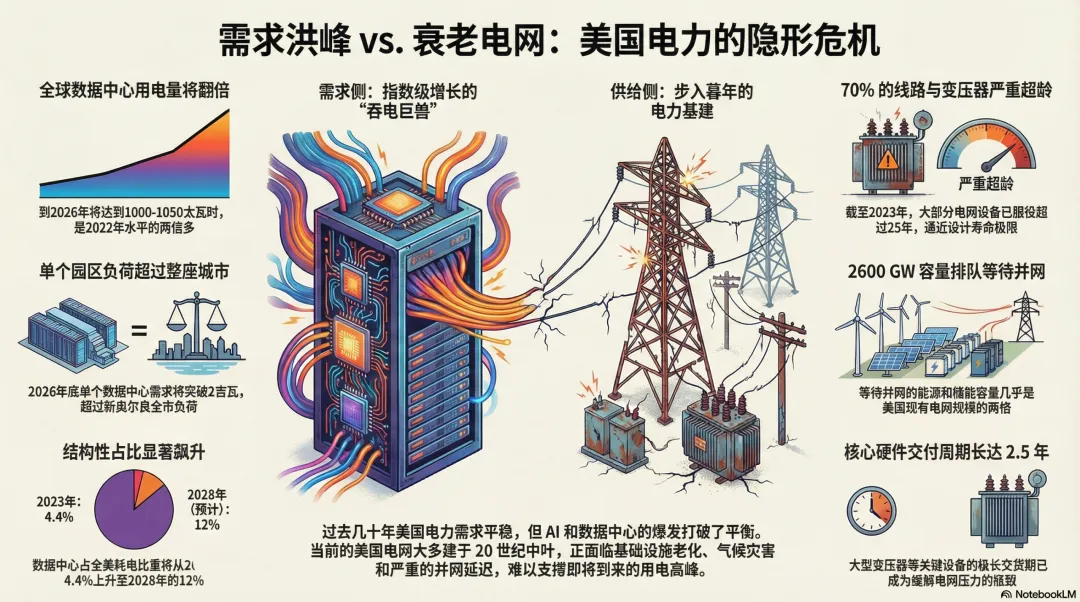
For the past few decades, Americans had almost forgotten what "power shortage" meant. In the early 2000s, thanks to the widespread adoption of LED lighting and the mandatory enforcement of the EPA's "Energy Star" certification, energy consumption in the U.S. miraculously plateaued despite population growth.

But this stagnation was completely shattered in 2025. With the exponential growth of large-scale data centers and AI applications, the energy demand curve experienced a near-vertical inflection point:

  • Doubled Consumption: Global data center consumption is expected to reach 1000-1050 Terawatt-hours (TWh) by 2026, more than double the 2022 level.
  • The Magnitude of a City: By the end of 2026, the power demand of a single, independent data center campus will exceed 2 Gigawatts (GW). This is equivalent to the power load of a medium-sized city.
  • Structural Share: In 2023, data centers accounted for only 4.4% of U.S. electricity consumption; by 2028, this figure is projected to soar to 12%.

Beyond AI, this "power-guzzling behemoth," the reshoring of manufacturing and overall societal electrification (EVs, heat pumps, etc.) are also simultaneously increasing the load. The power industry is transitioning from a "zero-growth" boring sector into a new period of rapid expansion.

In stark contrast to this are the "ailments of age" plaguing the U.S. grid.

The current U.S. grid was not designed to support the AI era. It more closely resembles a "Frankenstein's monster" patched together with mid-20th-century technology.

The grid consists mainly of three parts: generation, transmission, and distribution. The current problems lie in:

  • Aging Infrastructure: As of 2023, 70% of U.S. power lines and transformers are over 25 years old. Most of the grid was built in the 1960s and 70s, approaching the 50 to 80-year design life limit.
  • Climate Change's "Final Straw": The first half of 2025 alone saw dozens of weather disasters costing billions of dollars each. Grid failures caused by extreme heat (sagging lines) and hurricanes are becoming the norm for regional blackouts.

On the other hand, we see a desperate "queueing crisis." Nearly 2600 GW of energy and storage capacity (almost twice the size of the current U.S. grid) is currently queued up waiting for grid connection.

Reportedly, lead times for large transformers have stretched to 2.5 years. Just for the 2026/27 delivery year, customers of PJM Interconnection will pay an additional $3.5 billion in capacity costs due to interconnection bottlenecks.

2. Redefining the Smart Grid
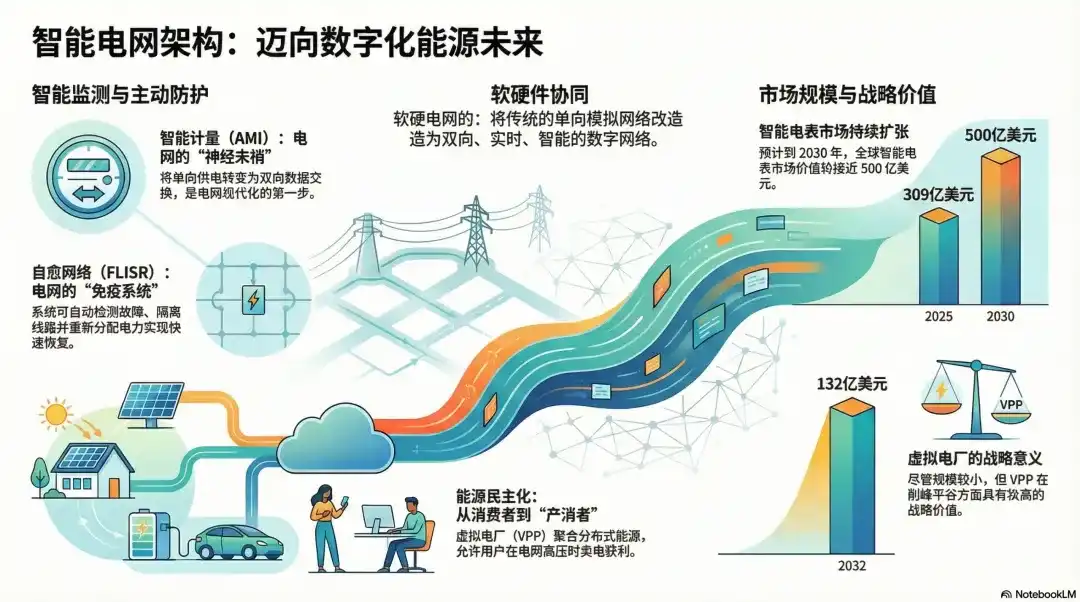
So-called grid modernization is not simply about stringing up more power lines; it's about transforming the traditional one-way analog network into a two-way, real-time, intelligent digital network.

Nerve Endings: Advanced Metering Infrastructure (AMI)

AMI is the first step in modernization. It turns one-way power supply into two-way data exchange. Its core lies in smart meters transmitting data back to the system via radio frequency or cellular networks.

Statistics show the global smart meter market was worth approximately $30.9 billion in 2025 and is expected to approach $50 billion by 2030.

Immune System: Automation and Self-Healing Networks (FLISR)

This is the infrastructure's shift from passive to active. Using software developed by companies like GE Vernova, upgraded power systems can:

1. Automatically Detect: Precisely locate the position of a fallen tree or exploding transformer.

2. Automatically Isolate: Instantly cut off the faulty line.

3. Automatically Restore: Redirect power from adjacent feeders to unaffected areas, achieving "self-healing."

Energy Democratization: Virtual Power Plants (VPP)

VPPs use cloud software to aggregate home solar systems and electric vehicle batteries. Consumers are no longer just buying electricity; they become "prosumers," selling power back to the grid for profit during times of high stress.

Although the niche market size is only in the hundreds of billions of dollars, its strategic importance for peak shaving and load balancing is immense.

3. Who is Sharing This Massive Pie?
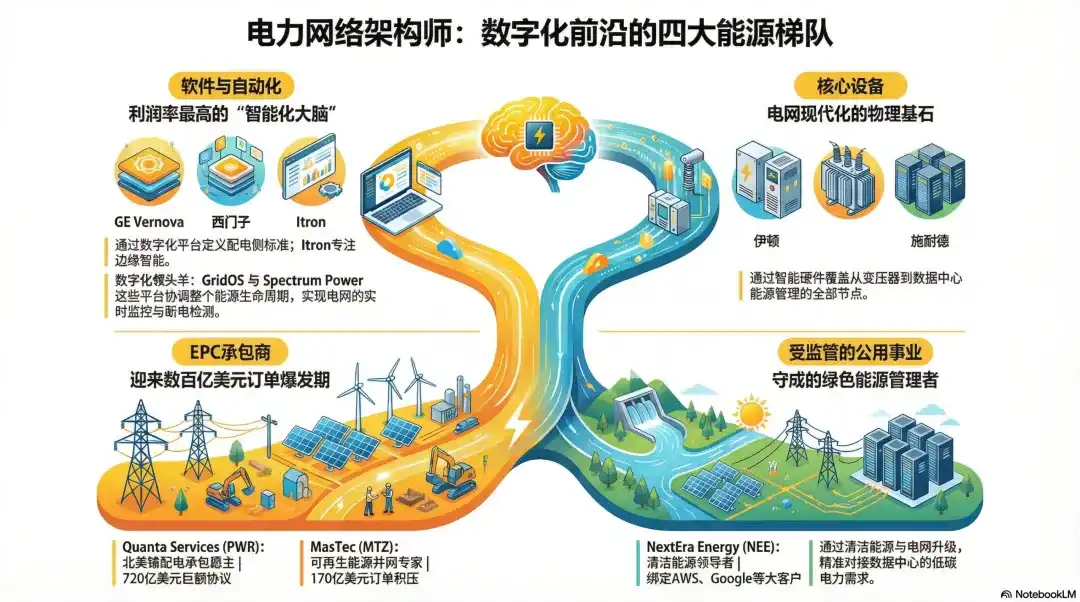
Based on the current industry attributes and profit structure of the U.S. power grid, the RockFlow investment research team categorizes the beneficiary companies into four tiers:

Software & Automation: The Intelligent "Brain"

This is the segment with the highest profit margins and the deepest moats.

  • GE Vernova (GEV): Coordinates the entire energy lifecycle through its GridOS platform. As a pure-play entity after the GE spin-off, it is the absolute leader in grid digitization.
  • Siemens (SIEGY): Possesses the leading Spectrum Power system. Its latest Gridscale X platform is defining the digital standards for the distribution side.
  • Itron (ITRI): The king of smart metering. Its "edge intelligence" products can detect outages in real-time without central processing, acting as the "guardian" at the distribution grid's endpoint.

Equipment Manufacturing & Power Electronics: The Critical Foundation

  • Eaton (ETN): A giant in electrical distribution equipment. From circuit breakers to transformers, Eaton's product portfolio covers almost every physical node of grid modernization.
  • ABB: A global expert in high-voltage products and automation. Its record order backlog is primarily driven by grid modernization projects.
  • Schneider Electric (SBGSY): Focuses on smart grid technology and microgrid solutions, providing end-to-end energy management solutions to help data centers maximize energy efficiency. It deeply integrates hardware with digital management through its EcoStruxure platform, holding a dominant position, especially in data centers and microgrids.

Engineering, Procurement & Construction (EPC): The Builders

  • Quanta Services (PWR): The dominant force in North American transmission and distribution contracting. Its recent massive $72 billion agreement with AEP is the best footnote to the grid upgrade trend. (Note: Corrected likely typo from 720 to 72 billion based on common scale)
  • MasTec (MTZ): Focuses on renewable energy interconnection. Its $17 billion order backlog foreshadows an earnings explosion over the next two years.

Regulated Utilities: The Established "Managers"

  • NextEra Energy (NEE): The largest clean energy company in the U.S., focused on wind and solar power generation. It owns extensive renewable energy assets and secures stable revenue through long-term Power Purchase Agreements (PPAs) with large customers.
  • Duke Energy (DUK): Owns extensive grid infrastructure covering multiple data center clusters. By modernizing its transmission and distribution networks, the company can provide efficient, low-loss power transmission services for data centers. Additionally, DUK is investing in clean energy generation to meet data center demand for green power.

Conclusion: The "Revaluation" of Power Assets Has Begun

In 2026, the power network is no longer that forgotten "utility" but a core asset concerning national security and the outcome of the AI race.

The RockFlow investment research team believes that for investors, software-driven automation companies (GEV, ITRI) possess the highest premium capability; equipment manufacturers (ETN, ABB) have the most certain order visibility; and EPC giants (PWR) are the direct harvesters of the infrastructure boom.

In the next five years, Alpha in U.S. stocks will no longer exist solely in code, but also in the hum of every smart transformer.


Preguntas relacionadas

QWhat is the main reason for the current revaluation of power assets in the US stock market according to the article?

AThe revaluation is driven by the shift in AI competition from algorithms to physical resources, with massive electricity demand from data centers and AI applications, coupled with an aging US grid infrastructure that is ill-equipped to handle this new load.

QWhich three investment gradients does the RockFlow research team recommend focusing on for the US power grid modernization trend?

AThe three gradients are: 1) High-margin software and automation layer (e.g., GEV), 2) High-certainty equipment manufacturing layer (e.g., Eaton, Schneider), and 3) Direct infrastructure红利 harvesters in the EPC sector (e.g., PWR).

QWhat are the two major challenges facing the existing US power grid as highlighted in the article?

AThe two major challenges are: 1) Aging infrastructure, with 70% of lines and transformers over 25 years old, and 2) The 'queueing crisis,' where nearly 2600 GW of energy and storage capacity is waiting to connect to the grid, exacerbated by long lead times for critical components like large transformers.

QName one company mentioned as a leader in the 'Software and Automation' layer and describe its role.

AGE Vernova (GEV) is highlighted as the absolute leader in grid digitization. It coordinates the entire energy lifecycle through its GridOS platform, acting as the intelligent 'brain' for the modern grid.

QWhat is a Virtual Power Plant (VPP) and what role does it play in grid modernization?

AA Virtual Power Plant (VPP) uses cloud software to aggregate distributed energy resources like home solar panels and EV batteries. It turns consumers into 'prosumers' who can sell power back to the grid during peak demand, playing a crucial strategic role in peak shaving and balancing the grid.

Lecturas Relacionadas

El mercado de CoreWeave, que Duan Yongping compró en la caída, se ha convertido en un sangriento campo de batalla entre alcistas y bajistas

El proveedor de capacidad de computación en la nube para IA, CoreWeave (CRWV), experimentó una caída del 11,4% en sus acciones tras presentar sus resultados del primer trimestre. Aunque los ingresos se duplicaron interanuales hasta los 2.080 millones de dólares, las pérdidas netas también se ampliaron, superando los 740 millones. La guía del Q2, inferior a las expectativas del mercado, avivó las ventas. La compañía, una de las apuestas más controvertidas del sector, presenta una narrativa alcista basada en una cartera de pedidos de casi 1.000 billones de dólares, una relación privilegiada con Nvidia y una creciente diversificación de clientes, incluyendo a Meta y Anthropic. Sin embargo, los bajos márgenes operativos (solo un 1% ajustado), el rápido aumento del gasto en capital y la deuda (unos 25.000 millones) alimentan la tesis bajista. En este contexto, destaca la operación del inversor chino Duan Yongping, quien tomó una pequeña posición (0,12% de su cartera) en el cuarto trimestre de 2025, coincidiendo con mínimos anuales de la acción. Su movimiento contrasta con las continuas ventas de directivos e inversores internos de CoreWeave. La cuestión clave es si la compañía, que el CEO Michael Intrator promete alcanzará una facturación anualizada de más de 30.000 millones en 2027, encontrará el punto de inflexión hacia la rentabilidad, o si la expansión agresiva seguirá erosionando los márgenes. El próximo informe del segundo trimestre servirá como una prueba decisiva para la credibilidad de la narrativa de crecimiento a largo plazo frente a los datos financieros actuales.

marsbitHace 7 min(s)

El mercado de CoreWeave, que Duan Yongping compró en la caída, se ha convertido en un sangriento campo de batalla entre alcistas y bajistas

marsbitHace 7 min(s)

El "Burning Man" tecnológico chino hace su debut en Shanghái, muShanghai crea una "ciudad pop-up" global para geeks

Del 10 de mayo al 6 de junio de 2026, se celebró en Shanghai el experimento de "ciudad efímera" (Pop-up City) organizado por muShanghai, iniciado por la comunidad internacional de código abierto The Mu y coorganizado por el Centro Alibaba de Hongqiao. Esta "fiesta tecnológica al estilo Burning Man" china reunió durante 28 días a desarrolladores, investigadores y emprendedores de más de 50 países para construir colectivamente una "ciudad paralela" para la comunidad tecnológica global. El evento atrajo más de 2000 solicitudes, con 800 participantes seleccionados de países como Estados Unidos, Argentina, Canadá, Japón, Francia, Sudáfrica, Reino Unido y China. La asistencia incluyó talentos destacados como ex ingenieros de OpenAI, fundadores de startups y contribuidores clave de proyectos como OpenClaw. La agenda se estructuró en cuatro semanas temáticas con cerca de 100 eventos: * **Semana de IA (11-15 mayo):** Conferencias sobre grandes modelos, seguridad de IA y aplicaciones de consumo. * **Semana de Biotecnología (18-22 mayo):** Enfocada en longevidad, automatización de laboratorios y ciencia de materiales. * **Semana de Robótica (25-29 mayo):** Con competiciones, desfiles de moda cibernética y exposiciones de hardware. * **Semana Cultural (1-6 junio):** Explorando futuras formas sociales, cultura ciberpunk y creación de videojuegos. Se destacaron los "mercados de innovadores" semanales y el principio de "Build in Public" para fomentar la iteración abierta de proyectos. El Centro Alibaba de Hongqiao sirvió como hub de apoyo integral para talento internacional. Tras éxitos en Argentina, San Francisco y la Expo Osaka 2025, The Mu eligió Shanghai para este desafío, superando obstáculos logísticos y regulatorios. El evento contó con la presencia de autoridades locales en su inauguración. En resumen, muShanghai fue tanto un festival tecnológico de vanguardia como una ventana crucial para la conexión del ecosistema de innovación chino con el mundo.

marsbitHace 9 min(s)

El "Burning Man" tecnológico chino hace su debut en Shanghái, muShanghai crea una "ciudad pop-up" global para geeks

marsbitHace 9 min(s)

GensynAI : Que la IA no repita los errores de Internet

En los últimos meses, el auge de la IA ha atraído talento del sector cripto. Muchos proyectos exploran cómo la blockchain puede integrarse en la infraestructura de IA, pero pocos logran un modelo de negocio cerrado. Gensyn se distingue al enfocarse en el núcleo más costoso: el entrenamiento de modelos. Su propuesta es organizar recursos de GPU dispersos globalmente en una red abierta para entrenamiento de IA. Los desarrolladores pueden enviar tareas, los nodos aportan capacidad de cálculo, y la red verifica los resultados y distribuye incentivos. Esto aborda un problema crítico: la creciente centralización del poder de cálculo en grandes tecnológicas, donde el acceso a GPUs como la H100 se ha convertido en una barrera clave para la innovación. Gensyn destaca por cuatro razones: 1. Ataca la capa de infraestructura central de la IA (entrenamiento), no solo aplicaciones. 2. Ofrece un modelo de colaboración abierto que puede optimizar costes y eficiencia para equipos más pequeños. 3. Su principal barrera tecnológica y ventaja es la capacidad de verificar resultados y garantizar fiabilidad en un entorno distribuido. 4. Responde a una demanda real y creciente en un mercado ya validado, más allá de la narrativa cripto. En conclusión, la frontera entre cripto e IA se desdibuja. La IA necesita coordinación de recursos e incentivos para la colaboración global, áreas donde la tecnología blockchain puede aportar soluciones. Gensyn representa un paso hacia una infraestructura de IA más abierta y accesible, no solo controlada por unos pocos gigantes.

marsbitHace 14 hora(s)

GensynAI : Que la IA no repita los errores de Internet

marsbitHace 14 hora(s)

Trading

Spot
Futuros
活动图片




