Wall Street behemoth Morgan Stanley has launched its long-awaited crypto trading pilot on its E*Trade platform, aiming to challenge major established players with competitive pricing.
Morgan Stanley Debuts Crypto Trading Pilot
Baking giant Morgan Stanley has rolled out a pilot to offer direct crypto trading on its E*Trade platform, with cheaper pricing than its competition, Bloomberg reported on Wednesday.
According to the report, the bank is charging E*Trade users a 50-basis-point fee on the transaction value, placing its prices below those of other major players. For instance, Robinhood’s fees start at 95 basis points, while Coinbase and Charles Schwab’s fees start at 60 and 75 basis points, respectively.
Morgan Stanley is currently offering its crypto trading pilot to a limited number of users, but expects to give access to all of E*Trade’s 8.6 million clients later this year. Jed Finn, Morgan Stanley’s head of wealth management, said in an interview that the launch is “much bigger than trading crypto at a cheaper rate,” adding that “the strategy is disintermediating the disintermediators.”
The banking giant bought E*Trade in 2020 for $13 billion. In May 2025, it introduced plans to allow crypto trading on the platform, following the Trump administration’s efforts to make the US “the crypto capital of the world.”
People familiar with the matter told Bloomberg that executives are preparing an offering to directly convert cryptocurrencies into shares of exchange-traded products (ETPs) without selling the assets. In addition, the bank reportedly plans to add the ability to trade tokenized equities in the second half of 2026.
Morgan Stanley’s Strategic Digital Assets Push
The launch is part of Morgan Stanley’s broader push to expand in the digital assets space, an industry that until recently was off-limits to banks. Over the past few years, the Wall Street giant has been betting on the convergence of traditional finance (TradFi) and decentralized finance (DeFi).
In 2024, Morgan Stanley, which has built one of the most significant Bitcoin Exchange-Traded Fund (ETF) holdings in the US, allowed its managers to offer the funds as an investment option for its wealthy customers.
Last year, it expanded access to crypto fund investments for all clients, moving away from the previous restrictions that limited access to individuals with at least $1.5 million in assets and an aggressive risk tolerance. The shift allowed its financial advisors to present the funds to any client, including those with retirement accounts.
Notably, Morgan Stanley became the first Wall Street bank to debut a spot Bitcoin ETF in April, and made it the cheapest fund in the category. The bank also filed for spot Ethereum and Solana ETFs earlier this year, which are expected to debut this year.
In February, it joined the list of companies applying for a national trust bank charter with the Office of the Comptroller of the Currency (OCC). In its application, the bank said that the charter would be used to conduct crypto trading and staking for its investment clients, reinforcing its strategic push for the broader digital asset industry.
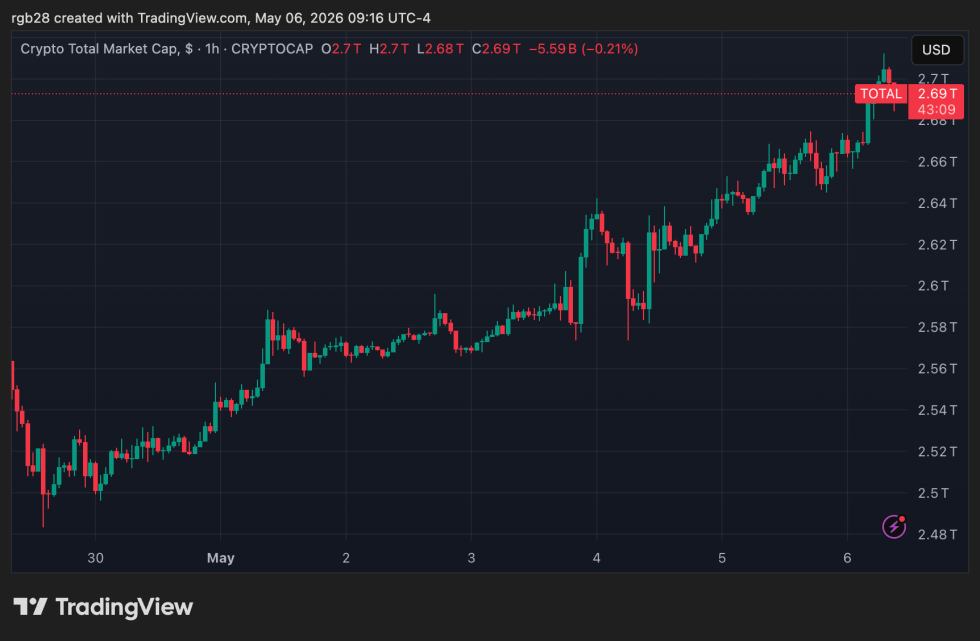
The total crypto market capitalization is at $2.69 trillion in the one-week chart. Source: TOTAL on TradingView