ETC Olympia Development Part 1: Implementing ECIP-1111 and ECIP-1112

金色财经Publicado a 2025-12-12Actualizado a 2025-12-12

Resumen

ETC Olympia Development Series Part 1: Implementing ECIP-1111 and ECIP-1112 This article introduces the first part of the Ethereum Classic Olympia development series, focusing on the implementation of ECIP-1111 and ECIP-1112. These two proposals are the only components within the broader Olympia framework that modify consensus behavior. ECIP-1111 modernizes the fee market by introducing an EIP-1559-style mechanism with a base fee and optional priority tip (miner tip). A key difference from Ethereum is that the base fee is not burned but is instead redirected to a treasury address defined by ECIP-1112. It also adds support for Type-2 transactions and the BASEFEE opcode (0x48), ensuring compatibility with modern EVM tooling and wallets. Crucially, it does not change miner rewards, monetary policy, or existing transaction types. ECIP-1112 defines an immutable, deterministic treasury smart contract that will receive the redirected base fees. This vault is designed to be receive-only upon activation, meaning it can accumulate value but cannot distribute funds until a separate, subsequent governance layer (defined in other ECIPs) is deployed and activated on the contract layer. The article emphasizes the modular architecture of Olympia. While the suite includes five ECIPs (1111-1115), only these two affect consensus. This separation ensures that the core protocol remains minimal and auditable, while future governance and funding mechanisms can evolve independently at the contra...

Ethereum Classic Core Developers - Olympia Development Series (Part 1)

Implementing ECIP-1111 and ECIP-1112: Base Fee Redirection and the Immutable Treasury

1. Introduction - From Concept to Code

This section provides an overview of the overall architecture of Olympia: its purpose, development history, and how ECIPs 1111-1115 fit into the modular, multi-layer upgrade path. This article will delve into the current engineering practices for two ECIPs, which together define the consensus boundaries of Olympia:

  • ECIP-1111 — EVM and Protocol Upgrades

  • ECIP-1112 — Immutable Treasury Contract

These two proposals are the only components in Olympia that modify consensus behavior. Other parts of the framework—governance (ECIP-1113), funding proposals (ECIP-1114), and the optional smoothing mechanism (ECIP-1115)—all operate at the contract layer and do not affect block validity or fork choice. On November 11, 2025, Ethereum Classic core developers initiated the implementation phase, preparing consensus logic and reference client infrastructure for a potential Mordor testnet deployment.

This article outlines:

  • What ECIP-1111 introduces

  • How ECIP-1112 defines the treasury target address

  • How these components work together

  • What is currently being prototyped in reference client development

This article only describes design proposals and implementation work and does not indicate that they will necessarily be activated or adopted in the future through the ECIP-1000 process. Before deploying the consensus layer changes of ECIP-1111 or ECIP-1112 to Mordor or the mainnet, ETC clients must first verify their stability and compatibility under baseline conditions.

2. ECIP-1111 — Modernizing the Fee Mechanism, Minimizing Network Disruption

ECIP-1111 integrates two widely adopted EVM improvements:

  • EIP-1559-style fee mechanism (Base Fee + optional tip) This mechanism introduces:

  • A dynamically adjusting base fee (BASEFEE),

  • An optional high-priority fee (tip) still paid directly to miners

  • And a more predictable fee market for modern tools.

2. Support for Type-2 (1559-style) transactions: This functionality has become standard for most wallets and infrastructure.

3. BASEFEE opcode (0x48): This exposes the current block's BASEFEE to contract logic (gas estimators, DEX routers, toolchains, etc.).

What changes for Ethereum Classic (ETC)?

Only one behavior differs from the Ethereum mainnet:

  • Ethereum Foundation (ETH): BASEFEE is burned.

  • Ethereum Classic (ETC): BASEFEE is redirected to the treasury defined by ECIP-1112. All other EIP-1559 semantics remain unchanged.

What remains the same?

  • Miner tips remain unchanged.

  • Block rewards remain unchanged.

  • Monetary policy (ECIP-1017) remains unchanged.

  • Traditional transaction types (Type-0 and Type-1) remain fully valid.

  • Existing contracts will not break; existing applications require no modifications.

  • No additional trust assumptions or permission mechanisms are introduced.

ECIP-1111 is additive, minimal, and strictly limited to modernizing the fee mechanism and enabling the BASEFEE redirection function.

3. ECIP-1112 — The Immutable Deterministic Treasury

ECIP-1112 defines the receiving address for the redirected base fees: a minimal, immutable smart contract deployed at a deterministic address. These definitions remain theoretical until client software demonstrates consistent behavior in a multi-client environment, a milestone requiring comprehensive testing to safely assess the Olympia components.

Core Features

  • Immutability: No upgrade key, no admin, no proxy pattern.

  • Deterministic address (e.g., via CREATE2): All clients agree on the same treasury destination.

  • Receive-only upon activation: The treasury can accumulate value but cannot release funds until subsequent governance is activated.

  • No internal governance logic: Purely a custody layer, not a decision-making layer.

Upon activation (testnet or mainnet):

  • The treasury can only receive funds.

  • No withdrawal mechanism is enabled until ECIP-1113 and ECIP-1114 are deployed, audited, and intentionally activated. This separation ensures predictability for consensus upgrades and makes them independent of the implementation of any governance scheme.

4. Clear Consensus Boundaries

Although Olympia comprises five ECIP proposals, only ECIP-1111 and ECIP-1112 change consensus behavior.

Consensus Boundary Summary

  • ECIP-1111 — Protocol layer. Introduces consensus changes: new base fee mechanism, Type-2 transactions, and the BASEFEE opcode.

  • ECIP-1112 — Protocol/Contract layer. Introduces consensus changes: defines the deterministic treasury receiving address for redirected base fees.

  • ECIP-1113 — Contract/Application layer. No consensus changes.
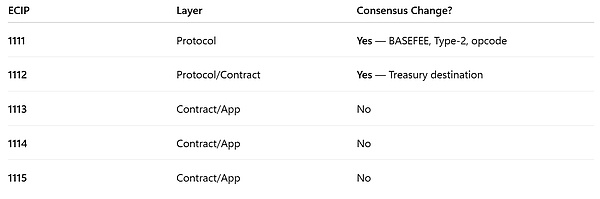
  • ECIP-1114 — Contract/Application layer. No consensus changes.

  • ECIP-1115 — Contract/Application layer. No consensus changes.

This modular structure ensures:

  • Consensus-critical logic remains lean and auditable,

  • Governance and funding mechanisms can evolve at the contract layer,

  • Improvements to ECIP-1113 to 1115 require no additional consensus changes.

If adopted, clients implementing ECIP-1111 and ECIP-1112 will maintain consensus compatibility, unaffected by subsequent governance layer deployments. Reference implementations can begin prototyping consensus logic during the draft stage, but these changes must undergo comprehensive testing (including baseline client validation such as the Gorgoroth verification described in Part II) before being merged into production clients.

5. Why Governance Activation is Delayed

If ECIP-1111 and ECIP-1112 are activated, base fees will begin flowing into the treasury—but treasury spending will remain disabled.

This phased deployment enables:

  • Independent testing of base fees

  • Comprehensive auditing of ECIP-1113 and ECIP-1114

  • Precise coordination among client implementers and infrastructure providers

  • Predictable behavior for node operators

If governance contracts are subsequently deployed and activated, the treasury will connect with authorized executors entirely at the contract layer (not the consensus layer).

6. Type-2 Transactions and Long-term EVM Interoperability

Type-2 transaction support is crucial for Ethereum Classic to maintain compatibility with:

  • Modern wallets

  • Exchanges and custody services

  • RPC infrastructure

  • Tooling frameworks (Hardhat, Foundry, etc.)

  • Block explorers

  • Cross-chain interoperability

Type-2 transactions do not alter user requirements or introduce permission mechanisms. Traditional transaction types will remain fully supported.

Type-2, as an incremental feature, ensures ETC maintains interoperability with the mainstream transaction format of the EVM ecosystem.

7. The Broader Context — Maintaining a Programmable Proof-of-Work Base Layer

Together, ECIP-1111 and ECIP-1112 constitute a foundational step for Ethereum Classic towards a sustainably funded, operational model for programmable proof-of-work—provided the community chooses to adopt these proposals.

These proposals achieve their goals without:

  • Modifying miner incentives

  • Introducing inflation

  • Changing monetary policy

  • Adding a governance layer to consensus

  • Altering Ethereum Classic's security assumptions

Their purpose is limited to:

  • Modernizing the fee market

  • Establishing a transparent protocol-level value accrual mechanism

If adopted, these changes will pave the way for the contract-layer governance and funding systems in subsequent Olympia proposals, without requiring new consensus rules.

8. Conclusion — Minimal, Secure, and Forward-Compatible

ECIP-1111 and ECIP-1112 define the consensus layer components proposed within the Olympia framework. They:

  • Add Type-2 and base fee mechanisms

  • Redirect the base fee to a deterministic treasury

  • Keep all existing user and miner behavior unchanged

  • Prepare ETC for future contract-layer components

These proposals do not introduce governance logic into the consensus mechanism, nor do they add trust assumptions on top of the existing EIP-1559/EIP-3198 semantics. Their aim is to preserve the conservatism of ETC's core protocol and EVM ecosystem compatibility, while enabling sustainable value flows at the contract layer.

9. ECIP Process Clarity

The Olympia ECIP specifications (1111–1115) are currently in the draft stage and under active discussion. Reference clients have initiated early implementation work on ECIP-1111 and ECIP-1112, which is fully consistent with the provisions of the ECIP-1000 draft stage. Reference implementations will only be considered for mainnet activation after testing on the Mordor testnet is completed. After testnet results are qualified, ECIP proposers may submit specification update proposals. Any decision to advance to "Accepted" status or schedule mainnet activation must undergo community review and the full ECIP-1000 evaluation process. This article outlines the design and implementation work being advanced during the draft stage.

10. What's Next in the Series

With the consensus design framework established, the next installment will focus on the client layer—the Fukuii alpha testing plan is about to launch, aiming to validate ETC client interoperability before Olympia integrations.

Disclaimer: The content of this article does not constitute any investment or financial advice. The content is reproduced from EthereumClassic and is for industry information reference only. If you have questions or copyright issues, please contact us for removal.


Criptos en tendencia

Preguntas relacionadas

QWhat are the two ECIPs that modify consensus behavior in the Olympia upgrade series?

AECIP-1111 (EVM and Protocol Upgrades) and ECIP-1112 (Immutable Vault Contract) are the two proposals that modify consensus behavior.

QHow does the handling of the BASEFEE differ between Ethereum (ETH) and Ethereum Classic (ETC) under ECIP-1111?

AOn Ethereum (ETH), the BASEFEE is burned. On Ethereum Classic (ETC), the BASEFEE is redirected to the treasury defined by ECIP-1112.

QWhat is the core purpose of the vault defined in ECIP-1112 at the time of its initial activation?

AAt activation, the vault is receive-only; it can accumulate value but has no mechanism to withdraw or release funds until governance proposals (ECIP-1113 and ECIP-1114) are deployed, audited, and intentionally activated.

QWhich components of the Olympia series operate purely at the contract/application layer without changing consensus rules?

AECIP-1113 (Governance), ECIP-1114 (Funding Proposals), and ECIP-1115 (Optional Smoothing Mechanism) operate at the contract/application layer and do not change consensus behavior.

QWhat is the stated goal of implementing Type-2 (EIP-1559-style) transactions on Ethereum Classic?

AThe goal is to ensure interoperability with the broader EVM ecosystem, including modern wallets, exchanges, RPC infrastructure, development frameworks, and block explorers, by supporting a mainstream transaction format.

Lecturas Relacionadas

Fragmentos Eternos del Dinero: Los Pagos de Terceros no tienen una Primera Naturaleza

**Fragmentos eternos del dinero: Los pagos de terceros carecen de una primera naturaleza** El sector de pagos vive una época convulsa, con Stripe intentando adquirir PayPal. Stripe, que alcanzó una valoración de 100.000 millones de dólares durante la pandemia pero no salió a bolsa, busca ahora nuevas narrativas de crecimiento a través de adquisiciones y la expansión hacia las stablecoins y la economía de los agentes. El artículo argumenta que la industria de pagos es inherentemente fragmentada y está subordinada a la banca tradicional, lo que limita el potencial disruptivo de cualquier jugador. Los esfuerzos de Stripe en stablecoins (como OUSD) y su red de pago para agentes (Tempo) son vistos como apuestas de futuro, pero enfrentan el desafío de la adopción real más allá del ámbito cripto. Se destaca que los modelos de negocio basados solo en procesamiento de pagos son limitados. El futuro podría estar en los servicios de valor añadido, especialmente en las redes de liquidación. Empresas como Stripe y Circle, al obtener licencias bancarias, podrían desarrollar sistemas de liquidación más eficientes que capturen parte del valor tradicionalmente retenido por los bancos. En conclusión, Stripe se enfrenta a una guerra de trincheras en un sector fragmentado. Su éxito depende de si puede trascender el simple procesamiento y capitalizar las oportunidades en stablecoins, agentes y, sobre todo, en la infraestructura de liquidación, para escapar de la eterna fragmentación del dinero.

marsbitHace 18 min(s)

Fragmentos Eternos del Dinero: Los Pagos de Terceros no tienen una Primera Naturaleza

marsbitHace 18 min(s)

La odisea legislativa del proyecto de ley cripto 'Clarity': El camino del compromiso bipartidista en EE.UU. está plagado de espinas

Los legisladores estadounidenses intentan avanzar la ley Clarity para regular el mercado de criptomonedas, pero el camino hacia un acuerdo bipartidista está lleno de obstáculos. Tras un acuerdo inicial roto en enero, se logró un compromiso en mayo sobre los rendimientos ("yield"), pero la inclusión de cláusulas éticas para los funcionarios electos se ha convertido en una línea roja para los demócratas, dejando el proyecto sin su apoyo en un comité clave. En julio, los republicanos apuran una votación en el pleno del Senado, pero las divisiones persisten. Algunos republicanos se alían con los grandes bancos en la disputa sobre los rendimientos, mientras que las agencias de aplicación de la ley se oponen a las protecciones para desarrolladores. Aunque hay consenso sobre la necesidad de una ley de estructura de mercado, las cuestiones de financiación ilícita y protección al consumidor siguen siendo preocupaciones centrales. Se espera un texto de compromiso entre comités del Senado, pero su éxito bipartidista es incierto. Los demócratas insisten en que sin fuertes disposiciones éticas, no habrá votos a favor. El proceso continúa con reuniones y debates, pero el resultado final—ya sea una votación simbólica, una ley para 2026 o un nuevo marco de compromiso—sigue siendo una incógnita en esta carrera contra el reloj legislativo.

Foresight NewsHace 46 min(s)

La odisea legislativa del proyecto de ley cripto 'Clarity': El camino del compromiso bipartidista en EE.UU. está plagado de espinas

Foresight NewsHace 46 min(s)

¿Los fundadores de Kalshi y Polymarket son como el agua y el fuego? Esta guerra comercial es mucho más feroz de lo que se imagina

En noviembre de 2024, agentes del FBI registraron el apartamento de Shayne Coplan, fundador de Polymarket, en relación con una investigación sobre posibles apuestas ilegales. Aunque Coplan atribuyó públicamente la redada a motivos políticos, su equipo sospechaba de su principal competidor: Tarek Mansour, CEO de Kalshi. Según fuentes, abogados de Kalshi habrían informado previamente a fiscales federales sobre el modelo de operación de Polymarket, señalando que usuarios estadounidenses podían acceder a su plataforma a pesar de las prohibiciones. Este incidente marcó un punto álgido en la intensa rivalidad entre ambas empresas de mercados de predicción. Coplan (28 años) y Mansour (30) no solo compiten por el dominio del mercado, sino que mantienen una profunda animosidad personal que impregna sus negocios. Mientras Kalshi enfatiza el cumplimiento normativo y opera con licencia en EE.UU., Polymarket ha funcionado principalmente desde plataformas offshore sin dicha licencia, permitiendo apuestas anónimas incluso sobre eventos sensibles. La competencia ha incluido tácticas agresivas: intentos de sabotear inversiones, acusaciones regulatorias mutuas, caza de talento y campañas en redes sociales. En 2025, Polymarket, respaldado por una inversión de Jeffrey Sprecher (fundador de Intercontinental Exchange), adquirió la empresa con licencia QCX para lanzar una app en EE.UU. Mientras, Kalshi aseguró una asociación con el Madison Square Garden, un movimiento interpretado como una provocación hacia Coplan, conocido fanático de los Knicks. Actualmente, Kalshi lidera en valoración (220.000 millones) y volumen de transacciones, pero ambas plataformas enfrentan un escrutinio regulatorio creciente. La disputa, que trasciende lo comercial, refleja un desacuerdo fundamental sobre la ética y los límites en la incipiente industria de los mercados de predicción.

Foresight NewsHace 1 hora(s)

¿Los fundadores de Kalshi y Polymarket son como el agua y el fuego? Esta guerra comercial es mucho más feroz de lo que se imagina

Foresight NewsHace 1 hora(s)

Trading

Spot

Artículos destacados

Cómo comprar ETC

¡Bienvenido a HTX.com! Hemos hecho que comprar Ethereum Classic (ETC) sea simple y conveniente. Sigue nuestra guía paso a paso para iniciar tu viaje de criptos.Paso 1: crea tu cuenta HTXUtiliza tu correo electrónico o número de teléfono para registrarte y obtener una cuenta gratuita en HTX. Experimenta un proceso de registro sin complicaciones y desbloquea todas las funciones.Obtener mi cuentaPaso 2: ve a Comprar cripto y elige tu método de pagoTarjeta de crédito/débito: usa tu Visa o Mastercard para comprar Ethereum Classic (ETC) al instante.Saldo: utiliza fondos del saldo de tu cuenta HTX para tradear sin problemas.Terceros: hemos agregado métodos de pago populares como Google Pay y Apple Pay para mejorar la comodidad.P2P: tradear directamente con otros usuarios en HTX.Over-the-Counter (OTC): ofrecemos servicios personalizados y tipos de cambio competitivos para los traders.Paso 3: guarda tu Ethereum Classic (ETC)Después de comprar tu Ethereum Classic (ETC), guárdalo en tu cuenta HTX. Alternativamente, puedes enviarlo a otro lugar mediante transferencia blockchain o utilizarlo para tradear otras criptomonedas.Paso 4: tradear Ethereum Classic (ETC)Tradear fácilmente con Ethereum Classic (ETC) en HTX's mercado spot. Simplemente accede a tu cuenta, selecciona tu par de trading, ejecuta tus trades y monitorea en tiempo real. Ofrecemos una experiencia fácil de usar tanto para principiantes como para traders experimentados.

156 Vistas totalesPublicado en 2024.12.10Actualizado en 2026.06.02

Cómo comprar ETC

Discusiones

Bienvenido a la comunidad de HTX. Aquí puedes mantenerte informado sobre los últimos desarrollos de la plataforma y acceder a análisis profesionales del mercado. A continuación se presentan las opiniones de los usuarios sobre el precio de ETC (ETC).

活动图片