Crypto Morning Brief: X Revokes API Access for 'Reward Posting Apps', Bitmine Invests in MrBeast

marsbitPublicado a 2026-01-16Actualizado a 2026-01-16

Resumen

Crypto Morning Brief: X Revokes API Access for 'Reward Posting Apps', Bitmine Invests in MrBeast Key market developments include better-than-expected US jobless claims and the Senate Banking Committee canceling a meeting amid Coinbase controversy. CME Group announced new futures for Cardano, Chainlink, and Stellar. X (formerly Twitter) revoked API access for applications that reward users for posting, citing a flood of AI-generated spam. Interactive Brokers now supports 24/7 USDC deposits for accounts, with plans to add more stablecoins. State Street launched a new digital asset platform. In notable closures, MilkyWay Protocol is shutting down permanently, and Polygon laid off nearly 30% of its staff as it pivots to a payments-focused strategy. CoinGecko's co-founder responded to acquisition rumors, stating the platform is operating normally while evaluating strategic opportunities. Finally, Bitmine announced a $200 million investment into MrBeast's Beast Industries.

Author: Deep Tide TechFlow

Yesterday's Market Dynamics

US Initial Jobless Claims for the Week Ending Jan 10: 198K, Expected 215K

According to Jinshi Data, US initial jobless claims for the week ending January 10 were 198,000, compared to an expectation of 215,000. The previous week's figure was revised from 208,000 to 207,000.

Senate Banking Committee Cancels Market Structure Hearing Due to Coinbase Controversy

As reported by EleanorTerrett, the Senate Banking Committee announced the cancellation of a market structure hearing originally scheduled for tomorrow, citing the controversy with Coinbase that occurred today. A new date for the hearing has not yet been set.

CME Group to Launch Cardano, Chainlink, and Stellar Futures

CME Group announced it will launch futures for Cardano (ADA), Chainlink (LINK), and Stellar (XLM) on February 9th, expanding its crypto derivatives product portfolio.

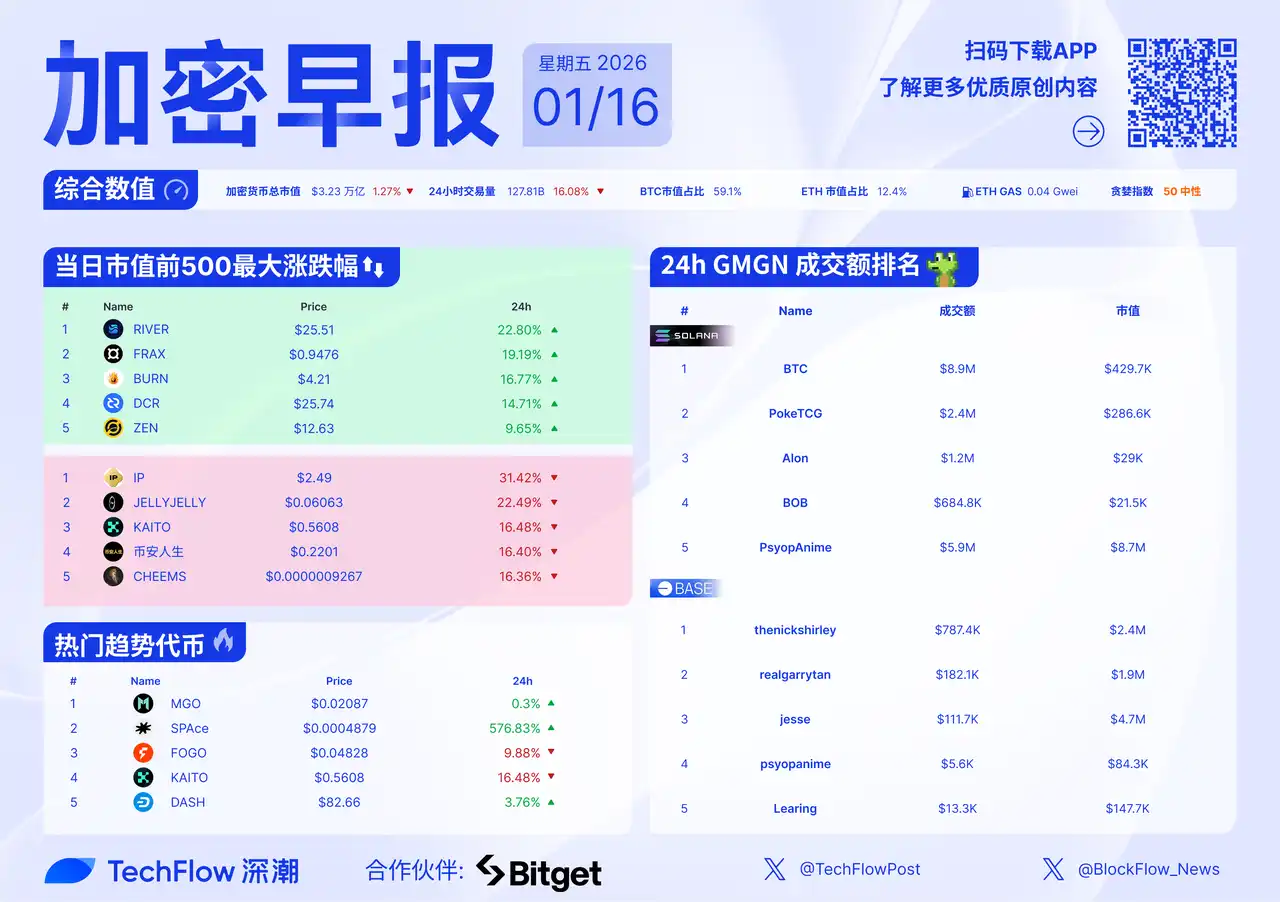
Fogo Announces Airdrop Claim is Open

According to an official announcement, the SVM Layer1 blockchain project Fogo has opened airdrop claims.

X Revokes API Access for "Reward Posting Apps"

According to X product lead and Solana ecosystem advisor Nikita Bier, the X platform is revising its developer policy and will no longer allow applications that reward users for posting on X. Bier stated that such apps have led to a large amount of AI-generated low-quality content and reply spam on the platform. The X platform has revoked the API access for these applications, and user experience is expected to improve soon. For developer accounts whose API access has been terminated, the X platform stated it will assist in transitioning their business to Threads and Bluesky.

Interactive Brokers Launches 24/7 Account Funding with USDC, Plans to Expand Stablecoin Options

According to The Block, traditional brokerage firm Interactive Brokers announced that traders can now use Circle's USDC for 24/7 account funding operations, enabling round-the-clock trading functionality.

The company's CEO, Milan Galik, stated that stablecoins offer a faster, lower-cost, and globally accessible funding option compared to traditional wire transfers. This integration is supported by crypto infrastructure provider Zerohash. Users can send USDC via the Ethereum, Solana, or Base networks, and the system will automatically convert it to US dollars and deposit it into the brokerage account. Interactive Brokers plans to expand support to include more stablecoin options such as Ripple's RLUSD and PayPal's PYUSD as early as next week.

State Street Launches Digital Asset Platform to Expand Crypto Business

According to Bloomberg, global custody banking giant State Street Corporation announced the launch of a digital asset platform aimed at expanding its business in this rapidly growing asset class. A statement from the Boston-based company said the new platform will develop and support money market funds, exchange-traded funds (ETFs), and cash products including tokenized deposits and stablecoins.

MilkyWay Protocol Announces Imminent Permanent Shutdown

According to an official announcement from MilkyWay Protocol, the protocol is shutting down permanently and will begin the liquidation process.

The announcement stated that the decision to close stems from decentralized finance (DeFi) demand not growing as expected, the transient nature of restaking demand, the interruption of plans for real-world asset (RWA) tokenization, and insufficient funding.

MilkyWay completed a snapshot on January 14th and will automatically distribute protocol fees proportionally to MILK token holders in the form of USDC. All liquid staking functions are disabled effective immediately, and existing positions will be automatically unstaked. MilkyWay initially launched as the first liquid staking token (LST) provider for Celestia, later expanding to the Initia and Babylon ecosystems, and attempted to launch services including restaking, RWA tokenization, and payment cards.

Polygon Lays Off Nearly 30% of Staff, Shifts to Payments Strategy

According to BeInCrypto, Polygon has reduced its workforce by approximately 30%, a move that is part of integration measures following its acquisitions of Coinme and Sequence. The company is shifting from traditional scaling and DeFi narratives to an "open money stack" strategy centered around stablecoin payments. Polygon's CEO confirmed the layoff decision but stated that with the addition of newly acquired teams, the overall headcount is expected to remain stable.

Coingecko Co-founder Responds to Sale Rumors: Regularly Evaluate Strategic Opportunities, Platform Operating Normally

In response to previous reports that crypto data platform CoinGecko was considering a sale at a valuation of approximately $500 million, the company's co-founder and CEO Bobby Ong posted on X, stating that he has received many inquiries about a potential platform sale. Having operated CoinGecko for 12 years, like any growing and profitable company, they regularly evaluate strategic opportunities to strengthen the business and accelerate their mission. He declined to comment on specific acquisition talks for now but expressed excitement about possibilities that could help better serve users and support institutional adoption of cryptocurrency. CoinGecko will continue to operate as usual, with no changes to how they work or provide trusted data.

Bitmine Announces $200 Million Investment in MrBeast's Beast Industries

According to Prnewswire, Bitmine announced a $200 million investment in MrBeast's Beast Industries. The transaction is expected to be completed around January 19th.

Market Dynamics
Recommended Reading

"Wankeyun" Godfather Flees Overseas: The $200 Million Corruption Mystery of Former Xunlei CEO Chen Lei

This article tells the career story of former Xunlei CEO Chen Lei, from his peak as a technological idealist to his fall due to alleged corruption and misappropriation. The article reviews Chen Lei's journey from joining Xunlei, promoting shared computing and blockchain technology innovation, the success and crisis of the Wankeyun project, and ultimately his removal from office and exile overseas due to allegations of misusing company funds, internal and external conflicts, and legal disputes.

Hiring at $200K Salaries: Wall Street Marches into Prediction Markets

This article focuses on Wall Street's entry into prediction markets, with traditional retail-dominated markets gradually being taken over by institutions. Major companies like DRW, Susquehanna, and Tyr Capital are recruiting highly paid traders focused on cross-platform arbitrage and structural market opportunities. Prediction markets are increasingly becoming a new tool for hedge funds to manage investment risk, but opportunities for retail traders to arbitrage based on information asymmetry will be significantly reduced.

a16z: Two Suggestions for Crypto Industry Builders in 2026

This article discusses the current state and future direction of the crypto industry, suggesting that entrepreneurs should focus on product innovation rather than short-term market fit, and emphasizing the importance of regulation for the healthy development of the industry.

Delphi Digital: Crypto is Building the Foundation of Global Finance, 10 Predictions for 2026

This article explores how the crypto industry is rapidly developing and gradually becoming a key component of global financial infrastructure. It presents ten key predictions for the crypto industry in 2026, including the transformation of decentralized exchanges, the rise of the AI agent economy, the upgrade of prediction markets, changes in stablecoin yield distribution, innovations in unsecured lending in decentralized finance, the potential of on-chain forex, the performance of gold versus Bitcoin, the transformation of exchanges into "super apps," the growing demand for privacy infrastructure, and the divergence trend in the altcoin market.

Arthur Hayes: Bitcoin Trapped in 'Dollar Liquidity Anxiety', What is its Fate in an Easing Cycle?

This article analyzes the relationship between Bitcoin, gold, the Nasdaq index, and US dollar liquidity, explores potential future market trends, and discusses the impact of policy directions in the artificial intelligence (AI) field by the US and China on the economy and markets.


Preguntas relacionadas

QWhat action did X take regarding 'reward posting applications' and why?

AX revoked API access for 'reward posting applications' because they were causing a proliferation of low-quality AI-generated content and reply spam on the platform.

QWhich three cryptocurrencies will CME Group launch futures for on February 9th?

ACME Group will launch futures for Cardano (ADA), Chainlink (LINK), and Stellar (XLM).

QWhat was the reason given by MilkyWay Protocol for its permanent shutdown?

AMilkyWay Protocol is shutting down due to decentralized finance demand not growing as expected, a short-lived restaking market, the interruption of its real-world asset tokenization plans, and insufficient funding.

QHow much did Bitmine invest in MrBeast's Beast Industries and when is the deal expected to close?

ABitmine invested $200 million in MrBeast's Beast Industries, and the deal is expected to close around January 19th.

QWhat new feature did Interactive Brokers introduce for its users regarding USDC?

AInteractive Brokers introduced 24/7 account funding using Circle's USDC stablecoin, allowing traders to send funds at any time via the Ethereum, Solana, or Base networks.

Lecturas Relacionadas

El apogeo ha pasado, ¿qué está experimentando el capital riesgo en cripto?

**Resumen en español europeo:** Los fondos de capital riesgo (VC) especializados exclusivamente en criptomonedas están atravesando una transición crítica. Su ventaja competitiva original—la profunda experiencia y conocimiento especializado del sector—se está erosionando a medida que la tecnología blockchain se integra en la corriente principal financiera. Grandes actores tradicionales (como BlackRock, Stripe, Visa) ahora comprenden y adoptan la infraestructura cripto, y los grandes fondos generalistas (como Sequoia, a16z) evalúan proyectos cripto con la misma lógica que otras empresas fintech. Esto está provocando una polarización en el ecosistema de VC. Los fondos de tamaño medio (en la "zona de la muerte") ya no pueden sobrevivir solo con inversiones en cripto, ya que no pueden generar retornos suficientes ni competir por rondas de crecimiento con los gigantes generalistas. Ejemplos como Paradigm (que diversifica hacia IA y robótica) o Framework Ventures ilustran esta expansión forzada. La tendencia está impulsada por la presión de los inversores (LP) que, tras malos resultados en cripto (DPI bajo), exponen exposición a sectores más calientes como la IA. Para los emprendedores cripto, esto significa una reducción de fondos especializados dispuestos a apostar por ellos y una mayor competencia por la atención dentro de los fondos generalistas, que priorizan proyectos con lógica comercial clara y no suelen financiar infraestructura pública o investigación básica para el ecosistema. El futuro, según la teoría de los ciclos tecnológicos, apunta a que la criptografía se convierta en una infraestructura subyacente, no en una categoría de inversión independiente. El panorama se reconfigurará en forma de "pesas": los grandes cheques de crecimiento los pondrán los fondos generalistas, mientras que pequeñas apuestas especializadas en nichos emergentes (tokenización, valores on-chain) quedarán para pequeños fondos boutique. Los fondos cripto de tamaño medio puro están en declive.

Foresight NewsHace 12 min(s)

El apogeo ha pasado, ¿qué está experimentando el capital riesgo en cripto?

Foresight NewsHace 12 min(s)

¿En qué están apostando los jóvenes inversores cuando el consenso se acelera?

En el ámbito de las inversiones tecnológicas, los inversores más jóvenes están adaptando sus estrategias al rápido cambio de paradigma. Con avances simultáneos en IA, robótica, aeroespacial y computación cuántica, el modelo tradicional de inversión ya no es suficiente. Ahora, comprender el lenguaje técnico y evaluar rutas tecnológicas aún inmaduras antes de que se forme un consenso es crucial. La inversión se está desplazando de la simple especulación con conceptos hacia la identificación de caminos reales de adopción industrial. Se destacan cuatro tendencias principales: Primero, la IA está abandonando las pantallas para integrarse en el mundo físico, impulsando áreas como la inteligencia encarnada, los robots humanoides y los dispositivos inteligentes de borde. El desafío ya no es solo una demostración técnica, sino la capacidad de entrega fiable y rentable a gran escala, como se ve en sectores como la entrega autónoma. Segundo, el enfoque en los modelos de lenguaje grandes (LLM) está cambiando. Más allá de buscar el próximo avance arquitectónico, el foco está en las empresas que pueden integrar estas capacidades en flujos de trabajo reales para crear un "volante de inercia de inteligencia": un ciclo virtuoso donde el uso genera datos que mejoran el modelo, lo que atrae a más usuarios y refuerza su ventaja. La creación de valor sostenible y profundo en la cadena de valor de la IA es clave. Tercero, frente al posible cuello de botella en datos de alta calidad para entrenar LLMs, surgen nuevas direcciones como los modelos de base científica. Estos modelos, entrenados con datos científicos rigurosos y capaces de generar conocimiento o simulaciones, podrían ser la próxima frontera para expandir las capacidades de la IA más allá de los datos disponibles en Internet. Finalmente, en áreas de tecnología profunda como el espacio comercial, la computación cuántica o la energía avanzada, se requiere un "capital paciente". Estos campos tienen ciclos de validación más largos y mayor incertidumbre técnica, pero son fundamentales para la infraestructura futura. La inversión aquí implica apostar por la capacidad de ingeniería, la resiliencia del equipo y la demanda a largo plazo, aceptando horizontes de retorno más extensos. En resumen, los jóvenes inversores están navegando un panorama donde el éxito depende de una comprensión técnica profunda, la identificación temprana de tendencias industriales genuinas y la voluntad de realizar apuestas a largo plazo en tecnologías transformadoras, tanto en el mundo digital como en el físico.

marsbitHace 39 min(s)

¿En qué están apostando los jóvenes inversores cuando el consenso se acelera?

marsbitHace 39 min(s)

¿Liberar 100 millones de dólares de liquidez? La nueva política de Pump.fun prueba la táctica de 'pump' de 5 minutos

**Pump.fun lanza el modo BOOST: una "tracción" de 5 minutos para memecoins en lanzamiento** El 21 de julio, la plataforma de lanzamiento de memecoins Pump.fun implementó el modo BOOST como su nuevo mecanismo estándar para nuevos tokens. El objetivo es abordar un problema persistente: aproximadamente el 20% de la liquidez se bloqueaba permanentemente y quedaba inutilizable ("liquidez muerta") cada vez que un token migraba de su curva de bonos a un pool de liquidez, lo que la plataforma estima en más de $100 millones en pérdidas anuales. El funcionamiento de BOOST es directo: en lugar de bloquear ese 20% de fondos (unos 17,6 SOL o 2516 USDC) en el pool de liquidez, la plataforma los utiliza para comprar el propio token durante los 5 minutos posteriores a su migración, utilizando un sistema de precio promedio ponderado en el tiempo (TWAP). Todos los tokens comprados son inmediatamente quemados, creando presión de compra a corto plazo y reduciendo la oferta circulante de forma permanente. La medida no añade liquidez nueva, sino que redirige la que antes se desperdiciaba. Su lógica subyacente es clara: mejorar la experiencia de los traders que buscan un "bombeo" inmediato tras el lanzamiento, con la esperanza de aumentar la retención de usuarios y el volumen de negociación sostenido en la plataforma. Esto, a su vez, podría impulsar los ingresos del protocolo de forma más orgánica. Sin embargo, surgen dudas. Algunos actores del mercado temen que esta presión de compra artificial pueda facilitar el lanzamiento de tokens de baja calidad y crear una ilusión fugaz de éxito. Advierten que, una vez finalizada la compra programada a los 5 minutos, los tokens podrían enfrentarse a caídas bruscas si encuentran fuertes órdenes de venta, intercambiando un riesgo de colapso posterior por un breve espectáculo inicial.

Foresight NewsHace 51 min(s)

¿Liberar 100 millones de dólares de liquidez? La nueva política de Pump.fun prueba la táctica de 'pump' de 5 minutos

Foresight NewsHace 51 min(s)

Trading

Spot
活动图片




