Circle stock drops nearly 20% as stablecoin yield restrictions spark concern

ambcryptoPublicado a 2026-03-24Actualizado a 2026-03-24

Resumen

Shares of Circle Internet Group (CRCL) fell nearly 19% on March 24, dropping from an intraday high of around $127 to approximately $102. The sharp decline followed a strong rally earlier in March and was accompanied by high trading volume, indicating a shift in investor sentiment. The sell-off appears linked to emerging regulatory concerns, particularly a draft legislative proposal that could prohibit platforms from offering yield or interest-like rewards for holding stablecoins. This restriction, which targets both direct and indirect incentives, may impact Circle’s USDC stablecoin growth and user engagement. The proposal would still permit activity-based rewards but could reduce stablecoins' competitiveness against traditional financial products. The move underscores the sensitivity of crypto equities to regulatory developments.

Shares of Circle Internet Group [CRCL] fell sharply on 24 March, dropping nearly 19% in a single session as markets reacted to emerging concerns around potential restrictions on stablecoin yield and rewards.

The stock declined from an intraday high of around $127 to approximately $102, marking one of its steepest single-day losses in recent weeks. The move comes after a strong rally earlier in March, when CRCL climbed from below $60 to above $130.

Sharp reversal follows March rally

CRCL’s latest decline stands in contrast to its recent momentum, with the stock having more than doubled earlier this month before reversing course.
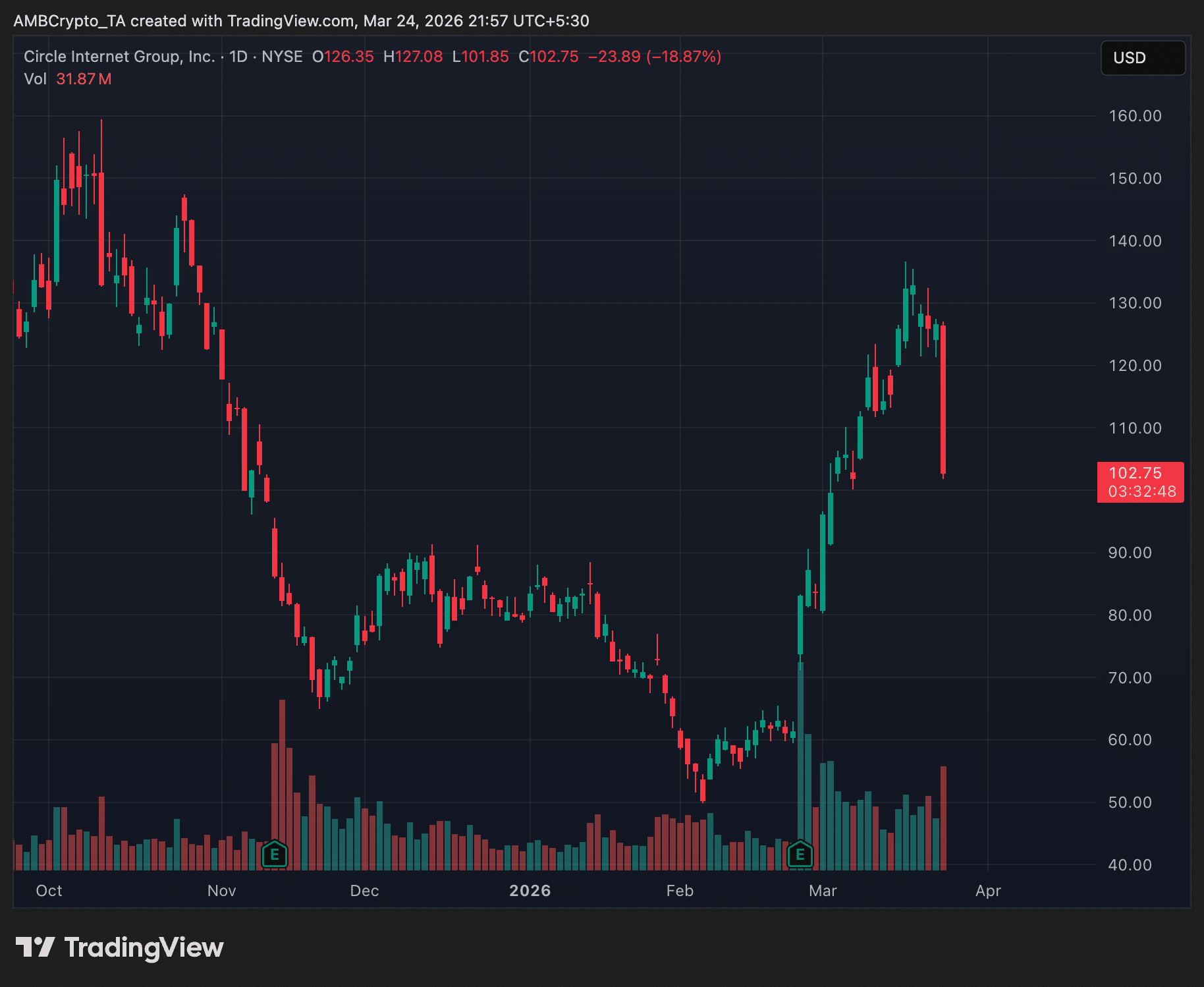
Source: TradingView

The sell-off was accompanied by a spike in trading volume, suggesting strong conviction behind the move rather than routine market fluctuations.

The abrupt reversal suggests a potential shift in sentiment, with investors reacting quickly to new developments in the stablecoin sector.

While no official trigger has been confirmed, the timing of the decline coincides with growing regulatory scrutiny around stablecoins.

Draft proposal targets stablecoin yield

According to a report from Eleanor Terrett, new legislative language under discussion could significantly limit how stablecoin issuers and platforms offer rewards to users.

The proposal would prohibit platforms from offering yield “directly or indirectly” for holding a stablecoin, or in any way that resembles a bank deposit. The restriction would apply broadly across exchanges, brokers, and affiliated services.

It would also ban any mechanism deemed “economically or functionally equivalent” to interest.

At the same time, the draft would allow activity-based rewards tied to user behavior, such as loyalty or promotional programs, provided they are not interpreted as interest-like incentives.

The proposal is expected to undergo further review, including feedback from banking representatives.

Implications for Circle and stablecoin issuers

For Circle, which issues the USDC stablecoin, yield restrictions could have direct implications for growth and user incentives.

Stablecoin yield and reward programs have become a key mechanism for attracting and retaining users across exchanges and platforms.

Limiting these features could reduce stablecoins’ competitiveness relative to traditional financial products and narrow revenue opportunities tied to user balances.

The uncertainty surrounding how regulators may interpret “economic equivalence” adds another layer of risk, particularly for business models that rely on flexible reward structures.


Final Summary

  • Circle’s sharp decline highlights how sensitive crypto-linked equities are to emerging regulatory risks, particularly around stablecoin incentives.
  • Growing scrutiny and industry moves toward transparency suggest a structural shift in how stablecoin issuers operate going forward.


Preguntas relacionadas

QWhat caused Circle's stock (CRCL) to drop nearly 20% on March 24?

AThe sharp decline was triggered by emerging concerns and a draft legislative proposal that could restrict stablecoin issuers and platforms from offering yield or interest-like rewards to users.

QWhat was the price range of CRCL's intraday movement during the sell-off?

AThe stock dropped from an intraday high of around $127 to approximately $102.

QWhat specific activity does the new legislative proposal aim to prohibit regarding stablecoins?

AThe proposal aims to prohibit platforms from offering yield 'directly or indirectly' for holding a stablecoin, or any mechanism deemed 'economically or functionally equivalent' to interest or a bank deposit.

QHow might the proposed restrictions impact Circle and other issuers?

AThe restrictions could reduce stablecoins' competitiveness compared to traditional financial products, narrow revenue opportunities from user balances, and create uncertainty for business models relying on reward structures.

QWhat type of rewards would still be allowed under the draft proposal?

AActivity-based rewards tied to user behavior, such as loyalty or promotional programs, are allowed provided they are not interpreted as interest-like incentives.

Lecturas Relacionadas

El patrón de 'cabeza y hombros' invertido en el gráfico de Bitcoin augura una subida a $67,200

A pesar de la lenta caída a principios de agosto, se está formando un patrón de inversión en los gráficos de precios, incluido el de Bitcoin. Actualmente, el BTC cotiza alrededor de $63,200, formando el hombro derecho de la figura clásica invertida "Cabeza y Hombros". El analista TechCharts, Axel Kibard, señala esto como el único motivo real para el optimismo alcista a corto plazo este mes. La cuestión principal es si los compradores tendrán la fuerza para un impulso decisivo hacia el nivel clave de $67,000. Mientras tanto, en el par ETH/BTC, ya se ha superado al alza un fondo de inversión similar. El principal altcoin se consolida en una tendencia alcista, demostrando que los grandes capitales prefieren actualmente invertir en ETH. Esta rotación de liquidez está agotando a Bitcoin. En cuanto a Ethereum, frente al dólar, está probando con cautela el nivel de $1,875. Si este soporte se mantiene, se abriría un camino directo hacia $2,163. La fuerza relativa de ETH es una buena señal para el mercado en general, pero la situación sigue siendo tensa para los tenedores de Bitcoin. O bien el BTC sigue el ejemplo de Ethereum y confirma el patrón de inversión superando los $67,200, o el patrón no se materializará. Según Kibard, si no se produce un ataque al "cuello" del patrón en los próximos días, los vendedores recuperarán el control y llevarán al Bitcoin hacia niveles de soporte sostenidos en $60,000 y $58,000.

cryptonews.ruHace 1 hora(s)

El patrón de 'cabeza y hombros' invertido en el gráfico de Bitcoin augura una subida a $67,200

cryptonews.ruHace 1 hora(s)

Las acciones de empresas de inteligencia artificial se negocian como 'memecoins', mientras que Bitcoin apenas cambia de precio: revisión de la semana

El artículo comienza con una advertencia de seguridad sobre una vulnerabilidad en las carteras frías Coldcard que podría comprometer las claves privadas, instando a los usuarios a tomar medidas inmediatas. En los mercados financieros tradicionales, la atención se centró en una fuerte venta masiva en el sector de la IA y los mercados asiáticos, especialmente en Corea del Sur, donde el índice KOSPI cayó un 35% en un mes. El fondo "Situational Awareness" de Leopold Aschenbrenner sufrió grandes pérdidas, lo que provocó liquidaciones forzosas y se especula con una posible manipulación por parte de Citadel. Los analistas debaten el futuro del sector de la IA y los semiconductores tras la corrección. En el ámbito macroeconómico, la reunión de la Fed generó preocupación, mientras que Japón intervino para frenar la caída del yen, con resultados limitados hasta ahora. En criptomonedas, el panorama fue negativo: varias plataformas como BitMart anunciaron su cierre, y empresas como Coinbase (COIN) reportaron resultados decepcionantes y despidos. MicroStrategy (MSTR) continuó acumulando reservas en dólares y recompró acciones propias, en una estrategia criticada por algunos. Se destacan debates sobre el futuro de DeFi (como Trade.xyz en Hyperliquid) y posibles actividades de información privilegiada. Finalmente, se menciona un renovado interés de inversores como Jason Calacanis en proyectos de cripto e IA como Bittensor ($TAO), aunque se advierte sobre la precaución necesaria con este tipo de recomendaciones. El artículo cierra reiterando la advertencia sobre la vulnerabilidad de Coldcard y la importancia de la autodeposición y la responsabilidad personal en cripto.

cryptonews.ruHace 2 hora(s)

Las acciones de empresas de inteligencia artificial se negocian como 'memecoins', mientras que Bitcoin apenas cambia de precio: revisión de la semana

cryptonews.ruHace 2 hora(s)

Trading

Spot
活动图片




