After the Great NFT Collapse: Speculation is Dead, Utility Reigns?

marsbitPublicado a 2026-01-06Actualizado a 2026-01-06

Resumen

The NFT market has experienced a dramatic collapse, marked by the cancellation of NFT Paris 2025 due to severe financial strain. Over five years, NFTs transitioned from a speculative frenzy—epitomized by Beeple’s $69.3 million sale—to a period of severe contraction. Data reveals a 35% increase in supply in 2025, while sales plummeted by 37%, and the total market capitalization fell 86% from its 2022 peak. Average sale prices dropped to $96, down 75% from the bull market highs. Even blue-chip projects like CryptoPunks and Bored Ape Yacht Club saw floor prices crash by over 78%. Major platforms struggled: OpenSea’s monthly revenue fell from up to $120 million to under $1 million, prompting a pivot to a broader “Trade Everything” model. Blur and Magic Eden saw token prices drop over 98%, while older platforms like X2Y2 shut down entirely. Amid the downturn, Pudgy Penguins emerged as a success story by leveraging its IP into physical consumer goods, generating an estimated $50 million annually through retail partnerships and brand campaigns—avoiding crypto terminology to appeal to mainstream audiences. Similarly, Yuga Labs transferred CryptoPunks to a non-profit to focus on cultural preservation rather than speculation. NFTs are increasingly functioning as utility tools: Courtyard.io tokenizes physical Pokémon cards, facilitating over $12.7 million in sales in a month, while FIFA uses NFTs for World Cup ticket verification to combat scalping. The speculative NFT era i...

Original Author: Sanqing, Foresight News

On January 5th, the NFT Paris developer conference, originally scheduled for February, was abruptly canceled. The banks of the Seine, once home to all-night parties, are now left with only a cold official announcement tweet: "The market crash has hit us hard. Even with aggressive cost-cutting measures, we are still unable to sustain it."

Five years ago, digital artist Beeple's work "Everydays: The First 5000 Days" sold for a staggering $69.3 million at Christie's auction house. Subsequently, from CryptoPunks selling for tens of millions to countless digital collectibles backed by mainstream institutions, that was the golden age of NFTs.

From a record-breaking, historic auction sale to a forced industry conference cancellation, NFTs have completed a full cycle from frenzy to清算 (liquidation/reckoning) in just five years.

Image - Everydays: The First 5000 Days NFT

NFT Market Supply and Demand Imbalance

Supply Explosion. According to CryptoSlam data, the supply in 2025 increased by 35% compared to 1 billion in 2024. Over the past four years, the total number of NFTs has skyrocketed from 38 million to 1.34 billion, an increase of approximately 3,400%.

Sales Shrinkage. According to CryptoSlam data, the total NFT sales in 2025 were approximately $5.63 billion, a 37% decrease from $8.9 billion in 2024. According to CoinGecko data, the total NFT market capitalization fell from a peak of about $17 billion in April 2022 to about $2.4 billion by the end of 2025, a drop of about 86%. In 2025 alone, the total NFT market capitalization shrank from about $9.2 billion in January to its year-end size, a staggering annual decline of 68%.

Liquidity Dilution. As the minting threshold lowered, the market entered a "high-frequency, low-price" mode. According to CryptoSlam data, the average transaction price has fallen from $124 in 2024 to $96 by the end of 2025. Compared to the average transaction price of over $400 during the peak of the 2021-2022 bubble, it has fallen by three-quarters.
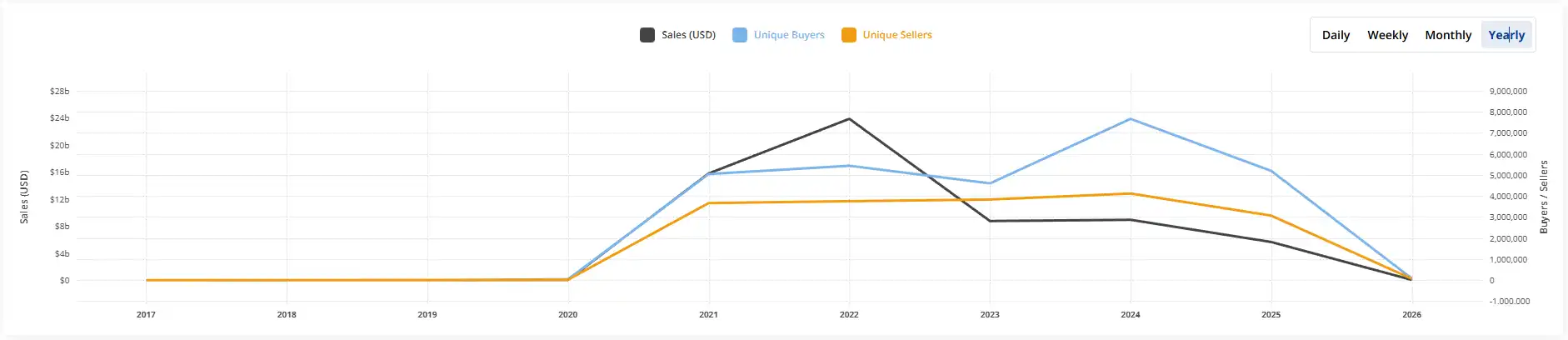
Image Source: CryptoSlam

Even former top-tier NFT projects and blue-chip NFTs could not escape the fate. Taking CryptoPunks as an example, the floor price has fallen to about 30 ETH, down 78% from its peak of 125 ETH in 2021; Bored Ape Yacht Club (BAYC) fell about 83% from around 30 ETH to about 5 ETH; Azuki fell about 93% from around 12 ETH to 0.8 ETH.

Collective "Flight" and Evolution of Platforms

The movements of industry leaders mark the end of this cycle.

OpenSea, which once firmly held the top spot in the NFT market, saw its platform revenue drop from $50 million to $120 million per month during the NFT golden age to less than one million.

Therefore, OpenSea announced a transformation. The platform will shift from a单纯的 "NFT marketplace" to a universal on-chain trading center for "Trade Everything", covering physical collectibles and digital assets like tokens, and confirmed it will issue a token.

Blur, which had a meteoric rise, saw its TVL continuously hit new lows, and its token price also fell 99% from its high.

Then there's Magic Eden, which started on Solana. After a year of operation, it issued a token. Affected by the NFT market conditions and the落地 (materialization) of short-selling expectations, the platform's trading volume began to shrink, and its token price also fell over 98% from its high.

Even projects that couldn't keep up with the changing times, like the older NFT marketplace X2Y2, have been淘汰 (eliminated), completely shutting down, with the team having pivoted to the AI field.

From "Token" to "Brand"

Amid the widespread despair, Pudgy Penguins successfully broke through against the trend, becoming an industry outlier. Its success does not rely on complex innovation in token technology or short-term speculative hype, but rather on transforming digital IP into physical consumer goods, gradually building a sustainable brand ecosystem that spans Web3 and traditional retail.

Through the dual revenue model推行 (implemented) by CEO Luca Netz, Pudgy Penguins deeply integrates IP licensing with physical goods. Its physical toys have entered over 10,000 retail channels globally, including Walmart, Target, and Walgreens. According to an AInvest report, this transformation has brought the project approximately $50 million in annual revenue, effectively offsetting the impact of the overall crypto market contraction.
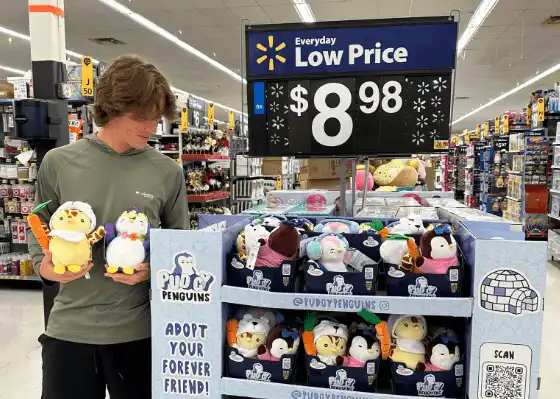
Image - Pudgy Penguins toy shelf in a US Walmart

During the 2025 Christmas period, Pudgy Penguins spent approximately $500,000 to project a giant animation on the Las Vegas landmark Sphere.

Image - Pudgy Penguins image on the Sphere

This advertisement, aimed at millions of tourists, avoided crypto jargon and the term NFT, presenting only a family-friendly IP image. It stimulated secondary market liquidity through brand exposure. In the past 14 days, the floor price of this NFT rose 25%, and trading volume increased by about 33%.

This shift in thinking from speculation to cultural operation seems to be becoming a consensus among industry survivors. Last May, Bored Ape Yacht Club (BAYC) issuer Yuga Labs transferred the IP rights of the top NFT project CryptoPunks to the non-profit organization Infinite Node Foundation, aiming to剥离 (strip) it from its speculative nature of price fluctuations and seek longer-term art preservation and cultural operation.

Physical Backing and Functional Return

Beyond IP branding, NFTs are becoming the underlying tool for connecting real-world assets (RWA).

Physical Card Trading. The platform Courtyard.io is changing the game. They deposit real Pokémon cards into certified vaults and tokenize them as NFTs. In the 30 days leading up to the end of 2025, the platform processed over 230,000 transactions, generating approximately $12.7 million in sales, proving strong market demand for this type of highly liquid, physically-backed asset.

Functional Tickets. FIFA (Fédération Internationale de Football Association) has also joined this camp, introducing "priority purchase right" NFTs in the ticket sales for the 2026 World Cup. These NFTs are not for speculation but serve as a verification tool to prevent scalper premiums and price fraud in the secondary market.

What Died in NFTs, and What Remains

NFTs have not "completely died out," but they have indeed died once.

What died is the fantasy of viewing NFTs as a financial asset that could脱离 (detach from) real-world value and be continuously minted and traded based solely on narrative. In the face of the reality of infinite supply and limited demand, this path was destined to be unsustainable.

What remains is the role of NFTs as a "credential layer." They are no longer required to create value alone but are embedded within IP brands, physical assets, and functional scenarios,承担 (undertaking) the basic functions of rights confirmation, transfer, participation, and verification.

From Pudgy Penguins' toy shelves, to the on-chain circulation of physical cards, to the anti-scalping mechanism for World Cup tickets, NFTs are stepping down from the stage of speculation and returning to the toolbox.

For the NFT speculative market, this is undoubtedly a winter. But for NFTs themselves, this is more like a rebirth after disenchantment.


Lecturas Relacionadas

El apogeo ha pasado, ¿qué está experimentando el capital riesgo en cripto?

**Resumen en español europeo:** Los fondos de capital riesgo (VC) especializados exclusivamente en criptomonedas están atravesando una transición crítica. Su ventaja competitiva original—la profunda experiencia y conocimiento especializado del sector—se está erosionando a medida que la tecnología blockchain se integra en la corriente principal financiera. Grandes actores tradicionales (como BlackRock, Stripe, Visa) ahora comprenden y adoptan la infraestructura cripto, y los grandes fondos generalistas (como Sequoia, a16z) evalúan proyectos cripto con la misma lógica que otras empresas fintech. Esto está provocando una polarización en el ecosistema de VC. Los fondos de tamaño medio (en la "zona de la muerte") ya no pueden sobrevivir solo con inversiones en cripto, ya que no pueden generar retornos suficientes ni competir por rondas de crecimiento con los gigantes generalistas. Ejemplos como Paradigm (que diversifica hacia IA y robótica) o Framework Ventures ilustran esta expansión forzada. La tendencia está impulsada por la presión de los inversores (LP) que, tras malos resultados en cripto (DPI bajo), exponen exposición a sectores más calientes como la IA. Para los emprendedores cripto, esto significa una reducción de fondos especializados dispuestos a apostar por ellos y una mayor competencia por la atención dentro de los fondos generalistas, que priorizan proyectos con lógica comercial clara y no suelen financiar infraestructura pública o investigación básica para el ecosistema. El futuro, según la teoría de los ciclos tecnológicos, apunta a que la criptografía se convierta en una infraestructura subyacente, no en una categoría de inversión independiente. El panorama se reconfigurará en forma de "pesas": los grandes cheques de crecimiento los pondrán los fondos generalistas, mientras que pequeñas apuestas especializadas en nichos emergentes (tokenización, valores on-chain) quedarán para pequeños fondos boutique. Los fondos cripto de tamaño medio puro están en declive.

Foresight NewsHace 31 min(s)

El apogeo ha pasado, ¿qué está experimentando el capital riesgo en cripto?

Foresight NewsHace 31 min(s)

¿En qué están apostando los jóvenes inversores cuando el consenso se acelera?

En el ámbito de las inversiones tecnológicas, los inversores más jóvenes están adaptando sus estrategias al rápido cambio de paradigma. Con avances simultáneos en IA, robótica, aeroespacial y computación cuántica, el modelo tradicional de inversión ya no es suficiente. Ahora, comprender el lenguaje técnico y evaluar rutas tecnológicas aún inmaduras antes de que se forme un consenso es crucial. La inversión se está desplazando de la simple especulación con conceptos hacia la identificación de caminos reales de adopción industrial. Se destacan cuatro tendencias principales: Primero, la IA está abandonando las pantallas para integrarse en el mundo físico, impulsando áreas como la inteligencia encarnada, los robots humanoides y los dispositivos inteligentes de borde. El desafío ya no es solo una demostración técnica, sino la capacidad de entrega fiable y rentable a gran escala, como se ve en sectores como la entrega autónoma. Segundo, el enfoque en los modelos de lenguaje grandes (LLM) está cambiando. Más allá de buscar el próximo avance arquitectónico, el foco está en las empresas que pueden integrar estas capacidades en flujos de trabajo reales para crear un "volante de inercia de inteligencia": un ciclo virtuoso donde el uso genera datos que mejoran el modelo, lo que atrae a más usuarios y refuerza su ventaja. La creación de valor sostenible y profundo en la cadena de valor de la IA es clave. Tercero, frente al posible cuello de botella en datos de alta calidad para entrenar LLMs, surgen nuevas direcciones como los modelos de base científica. Estos modelos, entrenados con datos científicos rigurosos y capaces de generar conocimiento o simulaciones, podrían ser la próxima frontera para expandir las capacidades de la IA más allá de los datos disponibles en Internet. Finalmente, en áreas de tecnología profunda como el espacio comercial, la computación cuántica o la energía avanzada, se requiere un "capital paciente". Estos campos tienen ciclos de validación más largos y mayor incertidumbre técnica, pero son fundamentales para la infraestructura futura. La inversión aquí implica apostar por la capacidad de ingeniería, la resiliencia del equipo y la demanda a largo plazo, aceptando horizontes de retorno más extensos. En resumen, los jóvenes inversores están navegando un panorama donde el éxito depende de una comprensión técnica profunda, la identificación temprana de tendencias industriales genuinas y la voluntad de realizar apuestas a largo plazo en tecnologías transformadoras, tanto en el mundo digital como en el físico.

marsbitHace 59 min(s)

¿En qué están apostando los jóvenes inversores cuando el consenso se acelera?

marsbitHace 59 min(s)

¿Liberar 100 millones de dólares de liquidez? La nueva política de Pump.fun prueba la táctica de 'pump' de 5 minutos

**Pump.fun lanza el modo BOOST: una "tracción" de 5 minutos para memecoins en lanzamiento** El 21 de julio, la plataforma de lanzamiento de memecoins Pump.fun implementó el modo BOOST como su nuevo mecanismo estándar para nuevos tokens. El objetivo es abordar un problema persistente: aproximadamente el 20% de la liquidez se bloqueaba permanentemente y quedaba inutilizable ("liquidez muerta") cada vez que un token migraba de su curva de bonos a un pool de liquidez, lo que la plataforma estima en más de $100 millones en pérdidas anuales. El funcionamiento de BOOST es directo: en lugar de bloquear ese 20% de fondos (unos 17,6 SOL o 2516 USDC) en el pool de liquidez, la plataforma los utiliza para comprar el propio token durante los 5 minutos posteriores a su migración, utilizando un sistema de precio promedio ponderado en el tiempo (TWAP). Todos los tokens comprados son inmediatamente quemados, creando presión de compra a corto plazo y reduciendo la oferta circulante de forma permanente. La medida no añade liquidez nueva, sino que redirige la que antes se desperdiciaba. Su lógica subyacente es clara: mejorar la experiencia de los traders que buscan un "bombeo" inmediato tras el lanzamiento, con la esperanza de aumentar la retención de usuarios y el volumen de negociación sostenido en la plataforma. Esto, a su vez, podría impulsar los ingresos del protocolo de forma más orgánica. Sin embargo, surgen dudas. Algunos actores del mercado temen que esta presión de compra artificial pueda facilitar el lanzamiento de tokens de baja calidad y crear una ilusión fugaz de éxito. Advierten que, una vez finalizada la compra programada a los 5 minutos, los tokens podrían enfrentarse a caídas bruscas si encuentran fuertes órdenes de venta, intercambiando un riesgo de colapso posterior por un breve espectáculo inicial.

Foresight NewsHace 1 hora(s)

¿Liberar 100 millones de dólares de liquidez? La nueva política de Pump.fun prueba la táctica de 'pump' de 5 minutos

Foresight NewsHace 1 hora(s)

Trading

Spot
活动图片



