Cross-Chain Bridges Actively Adapt, LI.FI Leverages Intent Architecture to Become the Liquidity Hub for TradFi Institutions

Odaily星球日报Publicado a 2026-06-03Actualizado a 2026-06-03

Resumen

Cross-Chain Bridge LI.FI Transforms with Intents Architecture to Serve as Liquidity Hub for TradFi Institutions Facing declining cross-chain transaction volumes and overall crypto market liquidity, cross-chain bridge protocol LI.FI is proactively shifting its strategy. Moving beyond its role as a "liquidity transfer protocol," LI.FI is targeting new assets, clients, and operational systems. Key to this transformation is the launch of LI.FI Intents, an intent-based execution architecture. This product positions itself as a foundational layer for stablecoin payments, Real World Assets (RWA), and compliant on-chain liquidity, catering specifically to fintech companies, neobanks, wallets, and regulated financial institutions. LI.FI Intents simplifies user experience by offering a turnkey solution. It leverages a solver network for market-maker level execution, enabling precise cross-chain swaps (e.g., between USDC and USDT) without users managing gas tokens or complex blockchain steps. It lowers barriers to entry by integrating with applications like Jumper and Rabby, allowing enterprise users to bypass direct wallet interactions for transactions like payments and asset transfers. The architecture emphasizes compliance. Its network consists of verified legal entities, and enterprises can review and approve orders within their compliance frameworks before processing. All interacting wallets undergo OFAC screening. For ecosystem coverage, LI.FI Intents supports major networks i...

Original|Odaily Planet Daily (@OdailyChina)

Author|Wenser(@wenser2010)
When TradFi becomes a must-have for the crypto industry, no project can stand apart. However, some choose to start with asset types, while others set their sights on the various companies and institutions behind the assets.

Last month, the cross-chain bridging protocol LI.FI officially and prominently announced the launch of its intent-based execution architecture, LI.FI Intents. This product will serve as the underlying execution layer providing stablecoin payments, RWA, and compliant on-chain liquidity, targeting services for fintech companies, neobanks, wallets, and regulated financial institutions.

Amidst the current trend of stablecoin payments, RWA assets, and compliant assets converging with the on-chain ecosystem, Li.Fi is no longer content with being just a "liquidity transfer protocol." Instead, it is proactively seeking breakthroughs and role upgrades in areas such as new assets, new customers, and new operating systems.

When Industry Liquidity Tightens, Cross-Chain Bridge Protocols Actively Adapt

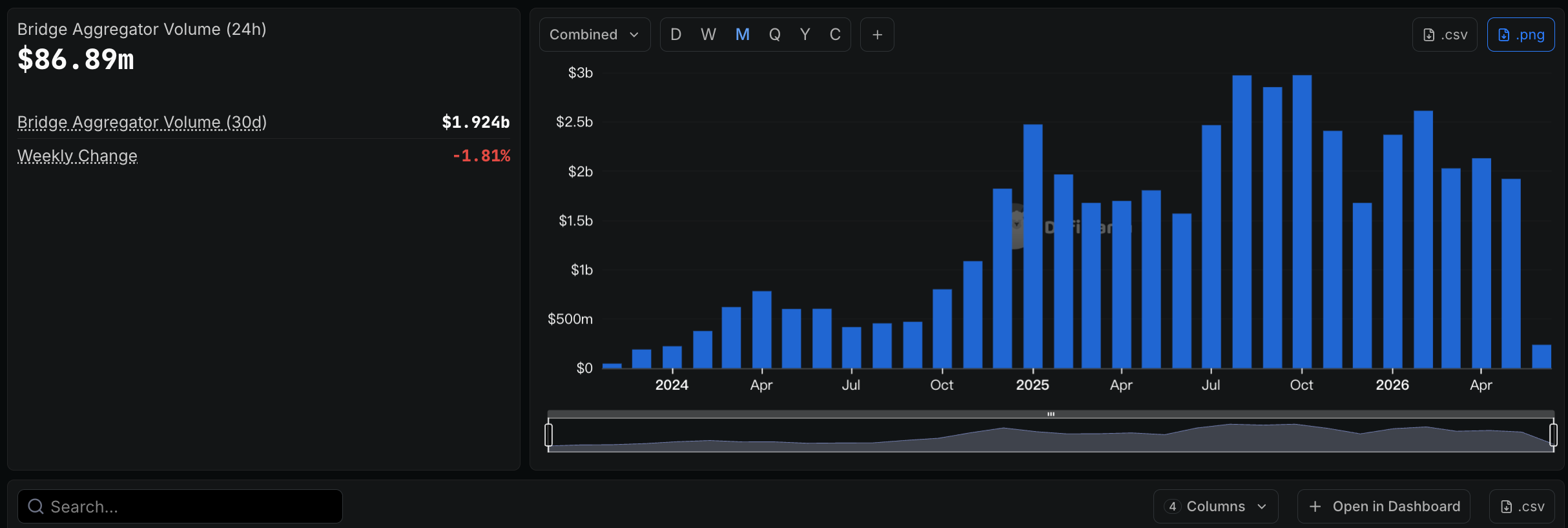
According to DefiLlama data, cross-chain bridge aggregated trading volume over the past 30 days was approximately $1.92 billion, with a weekly decline of about 1.81%. Since reaching a high of $2.974 billion in October last year, the monthly trading volume of cross-chain bridges has shown a slow downward trend. The trading volume in May dropped to around $1.9 billion, representing a decline of nearly 34% compared to the peak.
On the other hand, the overall crypto market is in a fluctuating downward trend, with BTC spot trading volume having fallen by as much as 81% from last year's highs; on-chain liquidity has further tightened as a result.

Faced with this situation, Li.Fi, as a cross-chain bridge protocol, did not wait passively like most crypto projects. Instead, it actively explored new business areas, seeking new application scenarios and service targets to ensure its long-term development.

In December last year, LI.FI announced the completion of a $29 million funding round led by Multicoin and CoinFund, bringing its total funding raised to $52 million. At that time, the project stated it planned to use this latest funding to expand its business into different trading domains, including perpetual futures, yield opportunities, prediction markets, and lending markets.

Ample funding gave Li.Fi the confidence to explore and build new products while maintaining its core business.

In April this year, LI.FI announced the launch of a new product, LI.FI Earn, providing on-chain yield functionality for enterprises with digital asset strategies. It supports accessing strategies from over 20 vault protocols through a single integration and features built-in cross-chain execution capabilities across more than 60 chains.

In May, the intent execution architecture LI.FI Intents was released, marking Li.Fi's official entry into the enterprise services sector. It empowers a range of B2B clients with the underlying operational capabilities for stablecoin payments, RWA assets, and compliant liquidity.

In the current convergence of TradFi assets and crypto assets, Li.Fi's new direction for upgrades is to lower user barriers, improve liquidity operation efficiency, and open channels for tokenized asset exchange from the operational execution layer. Compared to cross-chain protocols limited to the crypto market, providing financial services to global fintech companies, neobanks, wallets, and regulated financial institutions is undoubtedly a cash cow business with a much higher ceiling.

In terms of user experience, Li.Fi Intents provides users with a more streamlined execution solution, ready to use. It is reported that it primarily offers market-maker-level execution through a solver network, supporting precise output cross-chain swaps between stablecoins like USDC and USDT without requiring users to manage Gas tokens or handle complex underlying blockchain steps. Simultaneously, the architecture allows applications to integrate multiple tokenized asset issuers through a unified interface.

Regarding entry barriers, LI.FI Intents is already live on applications and wallets like Jumper and Rabby. Moreover, with LI.FI Intents, enterprise users do not need to interact with any wallet, which will significantly lower the cognitive barrier for enterprises in areas like transfer payments and asset movements, reducing many cumbersome operational steps.
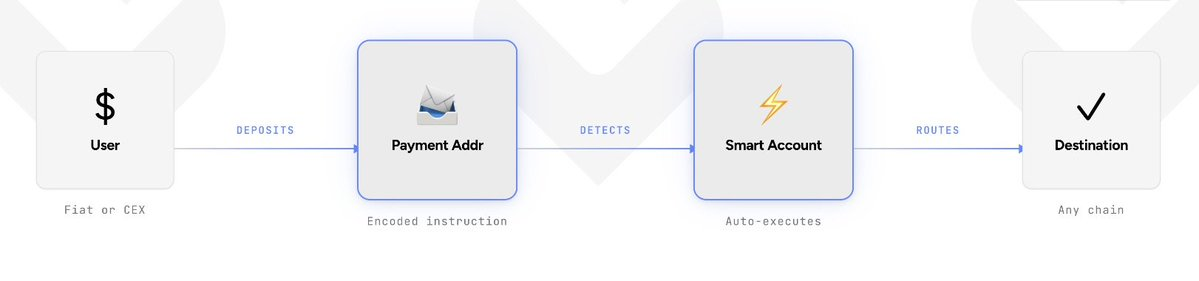
In terms of compliance, the network built by LI.FI Intents consists of verified legitimate entities. Enterprises can review and approve corresponding orders one by one before the trading processing system handles them, precisely choosing the trading processing systems they trust. This ensures orders flow within a compliant approval system. All wallets interacting with this system are subject to OFAC (U.S. Department of the Treasury's Office of Foreign Assets Control) screening, which can be considered the final layer of "compliance insurance."

Regarding ecosystem coverage, LI.FI Intents covers mainstream blockchain networks, including the EVM ecosystem, Solana network, and Tron network. It achieves a certain level of adaptation in ecosystem usability and broad coverage, avoiding potential security risks or single points of failure caused by high dependence on a single blockchain network.

Conclusion: Efficient Automated Services Behind Intent Execution

If tokenized U.S. stocks and RWA assets solve the problems of asset type updates and traditional finance entry barriers, then what Li.FI Intents targets is how to introduce stablecoin payments, RWA assets, and compliant on-chain liquidity into the ecosystems of enterprise users in a better and faster way, improving their operational efficiency and capital utilization.

More importantly, the Li.FI Intents system serves intent execution. Like destination navigation in autonomous driving, enterprise users only need to set the goal; all intermediate execution steps are outsourced and handled by the system.

In today's world of extremely rich asset types, the value of efficient operations will be further amplified, and Li.Fi has already taken the most crucial step.

Lecturas Relacionadas

Tras un aumento del 32% de Marvell, sale a la luz la familia china de semiconductores escondida detrás

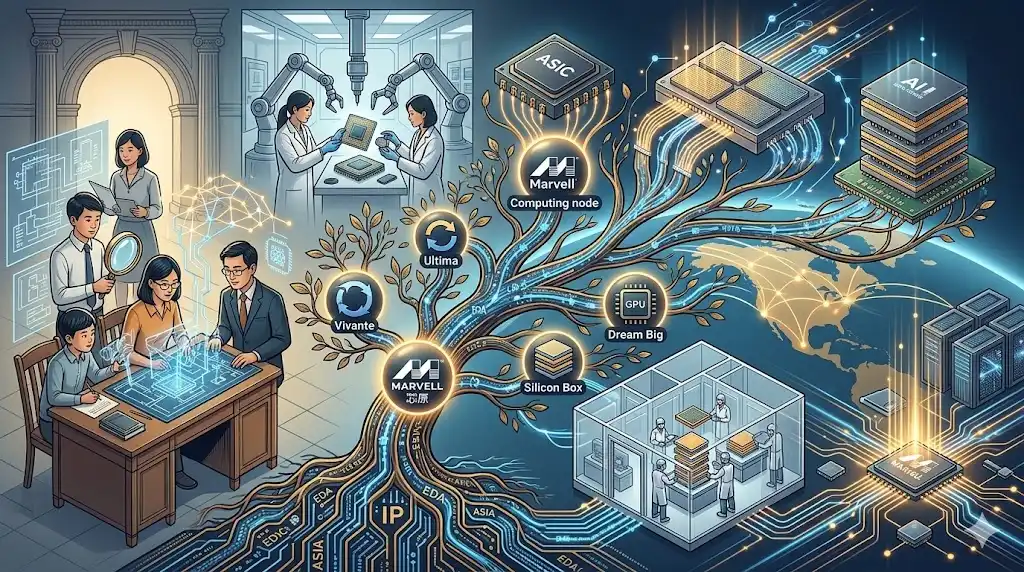
El 2 de junio, Marvell subió un 32.5%, alcanzando un máximo histórico tras ser destacada por Jensen Huang de NVIDIA como un núcleo clave de la arquitectura de centros de datos de IA. Esta empresa fue fundada en 1995 por Weili Dai y su esposo Sehat Sutardja, miembros de una influyente familia chino-estadounidense en la industria de semiconductores. Los tres hermanos Dai, todos graduados en ingeniería eléctrica de UC Berkeley, han lanzado seis empresas en treinta años, coincidiendo con cambios de paradigma en la industria. Weili Dai cofundó Marvell. Weimin Dai, el hermano mayor, fundó VeriSilicon (Cotización en China, 1500 millones de RMB), líder en IP de semiconductores en China. Weijin Dai, el segundo hermano, fundó Vivante, una empresa de IP de GPU integradas adquirida por VeriSilicon. La alianza entre las familias Dai y Sutardja ha tejido una red industrial que abarca desde EDA e IP hasta fábricas de encapsulado avanzado. Su cartera de inversiones incluye empresas clave de la era de los "chiplets" y la IA, como Alphawave (adquirida por Qualcomm), Dream Big Semiconductor (adquirida por Arm) y Silicon Box (empresa de encapsulado avanzado valorada como unicornio). La revalorización de Marvell se debe a su enfoque en ASIC personalizados e interconexión de alta velocidad para IA. La estrategia de la familia sigue una lógica similar: construir componentes críticos para estándares abiertos en la era de los chiplets, en lugar de competir directamente con gigantes como NVIDIA. Su combinación de activos, que incluye VeriSilicon, Silicon Box y participaciones en más de diez empresas, se estima en más de 22 mil millones de dólares, posicionándolos de manera única en la infraestructura de IA actual.

marsbitHace 36 min(s)

Tras un aumento del 32% de Marvell, sale a la luz la familia china de semiconductores escondida detrás

marsbitHace 36 min(s)

Microsoft teme ser marginada por los gigantes de la IA

La conferencia Build 2026 de Microsoft revela una estrategia crucial para evitar quedar marginada en la era de la IA. Tras revisar su acuerdo con OpenAI en abril, perdiendo la exclusividad sobre sus modelos, Microsoft se enfrenta a un dilema: aunque su negocio de IA en Azure genera miles de millones, depende en gran medida de ejecutar modelos de socios como OpenAI y Anthropic. El CEO Satya Nadella respondió con el lanzamiento de siete modelos propios, enfocados principalmente en competir con Anthropic en el segmento empresarial y de desarrollo. Sin embargo, el verdadero foco de Microsoft no es solo crear modelos, sino construir la plataforma subyacente que los gestione. Los datos muestran que productos de consumo como Copilot tienen una adopción limitada. Por ello, Build 2026 se centró en herramientas para empresas y desarrolladores, como Surface RTX Spark Dev Box y, sobre todo, Agent 365, una plataforma para gobernar y asegurar agentes de IA en entornos corporativos. La preocupación subyacente es el futuro: con OpenAI y Anthropic preparando sus OPVs, podrían independizarse de la infraestructura de Azure. La apuesta de Nadella es que, aunque los modelos y la nube sean intercambiables, la capa de gestión empresarial de Microsoft (identidad, cumplimiento, seguridad) se vuelva indispensable. Microsoft aspira a ser el sistema operativo de la IA empresarial, no solo un proveedor de infraestructura, para no repetir su papel secundario en eras tecnológicas pasadas.

marsbitHace 49 min(s)

Microsoft teme ser marginada por los gigantes de la IA

marsbitHace 49 min(s)

La CPU, regresando sigilosamente al centro del escenario de la potencia computacional de IA

En los últimos tres años, la narrativa del cómputo de IA se centró casi exclusivamente en las GPU. Sin embargo, a partir de 2026, esta visión está cambiando. A medida que las cargas de trabajo de IA evolucionan desde el entrenamiento de modelos a gran escala hacia la inferencia masiva y la ejecución de agentes inteligentes, surge un nuevo cuello de botella: la orquestación, la concurrencia y el flujo de datos. El CPU está recuperando un papel central, no como proveedor principal de cómputo paralelo, sino como el "plano de control" de la infraestructura de IA. Este cambio es impulsado por la necesidad de gestionar miles de tareas ligeras, peticiones de inferencia y agentes simultáneamente, tareas para las cuales la arquitectura de GPU no está optimizada. Un ejemplo concreto: en los centros de datos de IA avanzados, como el proyecto "Fairwater" de Microsoft para OpenAI, extensos clusters de CPU son necesarios para sostener y gestionar las operaciones de los masivos clusters de GPU, manejando el flujo de datos y la planificación de tareas. Intel, con su nuevo procesador Xeon 6+ (fabricado en su proceso Intel 18A y con hasta 288 núcleos de eficiencia -E-cores), apuesta precisamente por este nicho. Su diseño prioriza la alta densidad de núcleos y la eficiencia energética para manejar cargas de trabajo de alto rendimiento y alta concurrencia propias de la inferencia y los agentes de IA. Sin embargo, el éxito de este "regreso del CPU" no está garantizado para Intel. Enfrenta una competencia multifacética: las soluciones integradas "CPU+GPU" de NVIDIA, el avance de los CPU ARM de alta densidad de AMD y Ampere, y la tendencia de los principales proveedores de nube (AWS, Google, Microsoft, Alibaba) a desarrollar sus propios CPU ARM personalizados para estos mismos workloads. En conclusión, la redefinición del CPU como el plano de control orquestador en la infraestructura de IA es una tendencia industrial clara. Que Intel, con su Xeon 6+, logre capitalizar esta oportunidad dependerá de su capacidad para competir en un panorama donde la arquitectura, el proceso de fabricación y los ecosistemas están en constante disputa.

marsbitHace 1 hora(s)

La CPU, regresando sigilosamente al centro del escenario de la potencia computacional de IA

marsbitHace 1 hora(s)

Trading

Spot
Futuros
活动图片