Why Bitcoin Drawdown May Still Not Be Painful Enough For Bottom

BitcoinistPublicado a 2022-11-18Actualizado a 2022-11-18

Resumen

The Bitcoin supply in profit metric could hint that the current bear market hasn't been painful enough yet for the...

The Bitcoin supply in profit metric could hint that the current bear market hasn’t been painful enough yet for the cyclical bottom to be formed.
Bitcoin Supply In Profit Has Plummeted To 45% Following Crash
As pointed out by an analyst in a CryptoQuant post, all the historical bottoms took place when the profit in supply dipped below 40%.
The “supply in profit” is an indicator that measures the percentage of the total Bitcoin circulating supply that’s currently in some profit.
This metric works by going through the on-chain history of each coin to see what price it was last moved at. If this previous price for any coin was less than the value of BTC right now, then that particular coin is carrying some profit at the moment.
The indicator takes the total of such coins and then gives the percentage based on the total number of coins in circulating supply. The opposite metric is the “supply in loss” and it’s simply calculated by subtracting the supply in profit from 100.
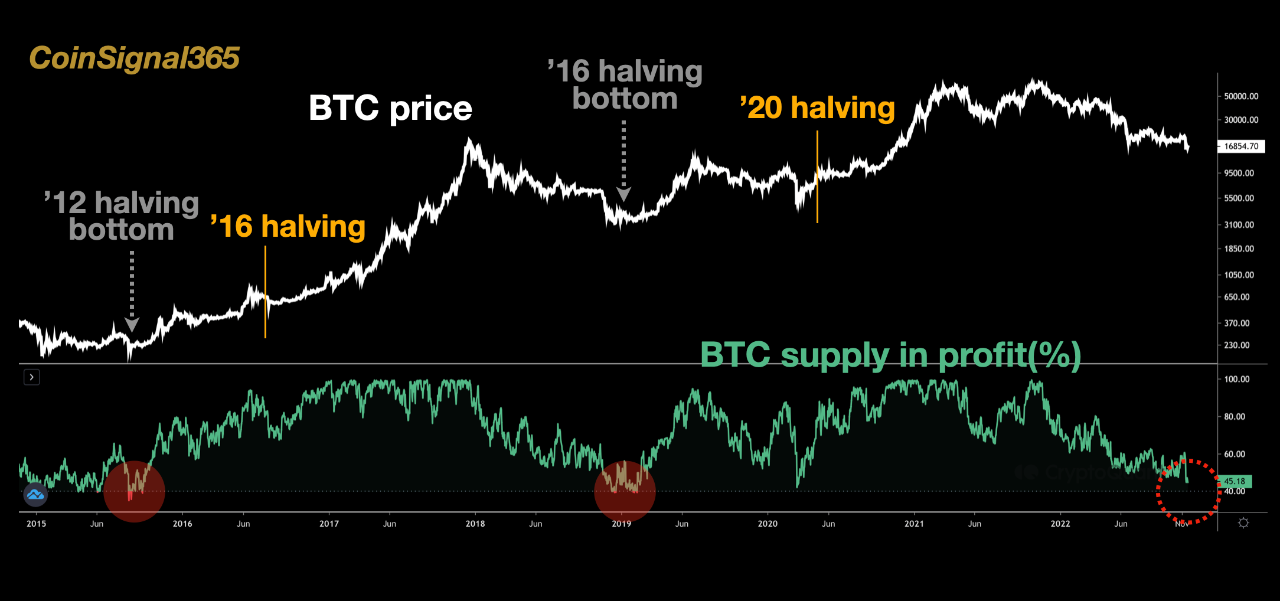
Now, here is a chart that shows the trend in the Bitcoin supply in profit over the last several years:
Bitcoin Supply In Profit


The value of the metric seems to have sharply dropped in recent days | Source: CryptoQuant
As you can see in the above graph, the percentage of the Bitcoin supply in profit has plunged recently due to the crash kicked off by the collapse of the FTX crypto exchange.
Following this plummet, the indicator now has a value of just 45%. This means that more than half of the total supply has now entered into a state of loss.

The chart also highlights the values of the metric that were observed during the bottoms of the previous two halving cycles.
It looks like less than 40% of the Bitcoin supply was carrying some unrealized profit in both of those bear market lows.
If the same pattern forms this time as well, then it would mean the supply in profit still has to drop by more than 5 units in order to hit the historical bottom values.
Such a shift in profitability can only take place after more decline in the price, which implies pain isn’t quite over for Bitcoin investors just yet.
BTC Price
At the time of writing, Bitcoin’s price floats around $16.6k, down 6% in the last week. Over the past month, the crypto has accumulated 14% in losses.

Bitcoin Price Chart

Looks like the price of the coin is still continuing its sideways movement | Source: BTCUSD on TradingView


Lecturas Relacionadas

La última pieza del puzzle de la ambición cripto de Franklin Templeton

El 22 de junio, Franklin Templeton anunció la adquisición de 250 Digital y la creación de su división de gestión de activos cripto, Franklin Crypto, enfocada en estrategias activas para inversores institucionales. Este movimiento representa la última pieza en la expansión cripto de la gestora, que comenzó en 2018 con un equipo de más de 50 personas. Su cartera de productos incluye el fondo tokenizado BENJI (aprox. 831M USD), lanzado en 2021, y una serie de ETF pasivos como EZBC (Bitcoin, 368M USD), EZET (Ethereum), XRPZ (XRP, 252M USD), SOEZ (Solana con staking) y EZPZ (índice cripto). En junio de 2026 solicitó a la SEC ETFs que reinvierten dividendos en Bitcoin. Más allá de los productos, Franklin Templeton ha invertido en el ecosistema, participando en rondas de financiación para proyectos como Ethena y Crossmint, y colaborando con cadenas como Aptos y Sui. Con Franklin Crypto, la empresa ahora cubre tres áreas: fondos tokenizados, ETF pasivos y gestión activa, dirigidos a clientes institucionales como fondos de pensiones. A modo de comparación, Fidelity, otro gigante tradicional, siguió un camino diferente desde 2014, construyendo su propia infraestructura de custodia. Su ETF de Bitcoin (FBTC) supera los 11.000M USD en activos. Ambos casos reflejan la creciente incursión de la gestión de activos tradicional en el espacio cripto.

Foresight NewsHace 28 min(s)

La última pieza del puzzle de la ambición cripto de Franklin Templeton

Foresight NewsHace 28 min(s)

El mayor rival de Unitree, ¿cómo es que se ha escindido de nuevo?

El principal rival de Unitree, la empresa de robótica china, Zhìyuán, ha creado otra empresa escindida. MiBee Tech, centrada en la adquisición, gestión y distribución de datos para la inteligencia embodied, completó recientemente una ronda de financiación estratégica. Esto refleja la creciente escasez de datos de alta calidad necesarios para entrenar robots humanoides y de uso general. Mientras que modelos de lenguaje grande se entrenan con datos de Internet, los robots requieren datos multimodales del mundo físico. Se estima que solo hay unas 500.000 horas de datos de alta calidad disponibles a nivel mundial, muy por debajo de las necesidades de entrenamiento. MiBee busca abordar este cuello de botella ofreciendo un modelo de "datos como plataforma". La empresa utiliza dos métodos principales: teleoperación con robots reales y una solución de "adquisición sin cuerpo" más económica, con dispositivos portátiles y pinzas de captura. Su motor de procesamiento de datos, MEgo Engine, automatiza tareas como limpieza y etiquetado, aumentando la eficiencia. MiBee también ha establecido un mercado de datos y la iniciativa "Beehive" para crear una red colaborativa de datos en la industria. El éxito de MiBee dependerá de demostrar su neutralidad, ya que comparte origen con Zhìyuán. Debe ganar la confianza de otros fabricantes de robots, incluyendo competidores directos, que necesitan garantías de que sus datos no se compartirán. Además, enfrenta competencia de empresas como JD.com, Lumeng y otras que también buscan solucionar la "hambruna de datos" en robótica. Su objetivo declarado es alcanzar una capacidad de producción de datos de decenas de millones de horas para 2026.

marsbitHace 28 min(s)

El mayor rival de Unitree, ¿cómo es que se ha escindido de nuevo?

marsbitHace 28 min(s)

Trading

Spot
Futuros
活动图片