[Key interpretation] Long term investors of BTC finally began to sell, and the long position explosion suggested that the market fell sharply

HuobiPublicado a 2022-10-21Actualizado a 2022-10-24

Resumen

Bulls continued to break positions accounted for the majority, indicating that the market is changing downward.

1. BTC retraction rollback continuation

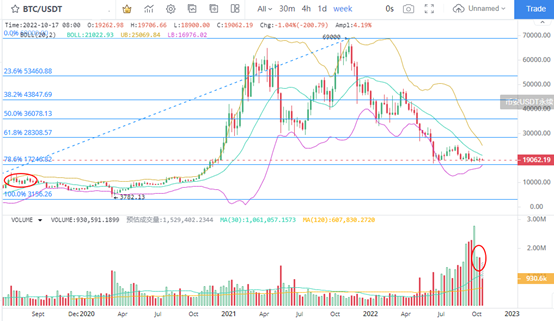
The weekly K line chart of BTC shows that the trading volume has shrunk for two consecutive weeks, indicating that the market is in the adjustment stage, and BTC prices may be at a new low this week. In terms of trading volume, the trading volume corresponding to the weekly K line is low, and it is likely that the trading volume will shrink this week. Therefore, it is judged that BTC is still in a weak operation stage, and once it breaks down, it will see a low of $14000 in the previous period.
2. BTC main force makes a profit and escapes

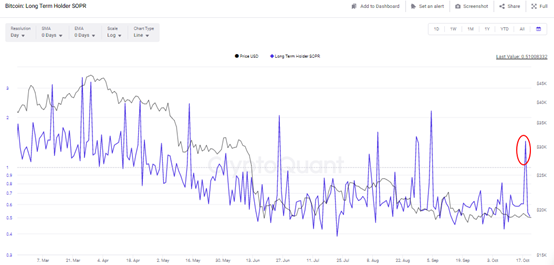
The main force of BTC made a lot of profit flight. From the numerical point of view, the profit flight of long-term investors occurred on October 18. As shown in the figure, the proportion of SOPR on October 18 reached 1.436, which means that long-term investors with 43% currency gains have changed hands with BTC in large numbers, indicating that BTC prices have shown signs of downward selection in the near future. In terms of trading, although the short-term fluctuation intensity of BTC remains at a low level, it is still brewing the trend of closing price retreat.
3. ETH represents an upward breakthrough

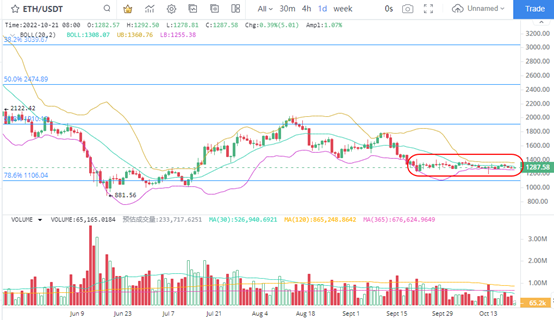
In terms of the daily K line, the ETH price kept fluctuating at a low level, and the breakthrough still did not occur, but the horizontal consolidation continued. In terms of trading volume, the current trading volume of ETH is obviously lower than the isometric line of different cycles after it started to scale down on October 1. At least for the moment, ETH investors have failed to expand trading volume, the time of low volatility adjustment has exceeded expectations, and the price may still fall during the sideways consolidation period.
4. Increase in the number of long positions in the overall market

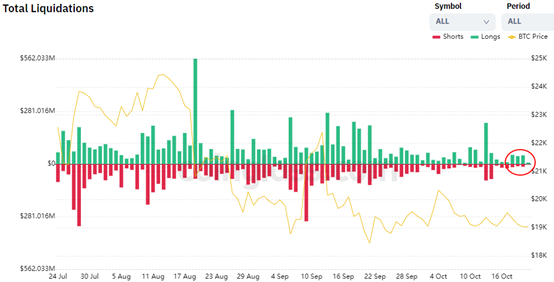
The number of positions of ETH investors increased slightly, and the number of positions of bulls recently was significantly higher than that of bears. From October 18 to October 20, the short positions of ETH were $16.95 million, $11.94 million and $14.51 million, while the long positions were $48.71 million, $41.97 million and $46.08 million, respectively. Compared with the size of short positions, the accumulated long positions can reach 93.36 million dollars. That is to say, after the number of long positions is significantly higher than that of short positions, the overall market is now on the eve of a break down.

Lecturas Relacionadas

El verdadero campo de batalla de la IA está en el "Bosque Oscuro"

El verdadero campo de batalla de la IA está en el "bosque oscuro": un análisis de la divergencia estratégica entre China y EE.UU. Mientras los modelos chinos de generación de video por IA (como el "Happy Horse" de Alibaba, Seedance 2.0 de ByteDance y Kling 3.0 de Kuaishou) superan técnicamente a Sora de OpenAI en aplicaciones de consumo, el panorama estratégico global muestra una divergencia crítica. EE.UU., liderado por Anthropic con su modelo Claude Mythos (capaz de descubrir y explotar vulnerabilidades de ciberseguridad) y OpenAI con GPT-5.4-Cyber, se enfoca en el sector empresarial y de seguridad, dominando mercados de alto valor como ciberseguridad (100.000 millones de dólares en EE.UU. en 2026) y herramientas de productividad. Anthropic alcanza 30.000 millones de dólares en ingresos anuales recurrentes (ARR), superando a OpenAI. China, en cambio, prioriza el mercado de consumo, integrando la IA en ecosistemas existentes (TikTok, Alibaba Cloud) para impulsar la creación de contenido y la retención de usuarios, aunque con ARR muy inferiores (ej: 300 millones de dólares para Kling). Esta estrategia "embebida" es eficiente en costes y se beneficia de un mercado de consumo maduro, pero no construye capacidades profundas en áreas críticas como ciberseguridad o programación. La raíz de esta divergencia es estructural: EE.UU. controla el 75% de la capacidad de computación de IA de vanguardia y tiene un mercado B2B maduro y dispuesto a pagar. China, con un 17-18% de la capacidad de computación y un mercado B2B menos desarrollado, optimiza para el consumo. El artículo advierte que la competencia está entrando en una fase de "bosque oscuro", donde la IA defensiva/ofensiva en ciberseguridad se convierte en el verdadero campo de batalla por la supremacía digital. La falta de capacidades equivalentes a Mythos podría dejar a China vulnerable. La solución propuesta es una "guerra asimétrica": impulsar modelos de código abierto (ej: GLM-5.1 de Zhipu AI), adaptarse al hardware local y buscar mercados globales en desarrollo (Sudeste Asiático, Oriente Medio) no cubiertos por los gigantes estadounidenses.

marsbitHace 1 hora(s)

El verdadero campo de batalla de la IA está en el "Bosque Oscuro"

marsbitHace 1 hora(s)

Trading

Spot
Futuros
活动图片