Market Analysts Predict Ether Bearish Continuation That Could Crash Ethereum To $750

zycryptoPublicado a 2022-10-02Actualizado a 2022-10-08

Resumen

Bearish sentiments for Ether (ETH), the native token of the Ethereum blockchain, continues to build up.

Bearish sentiments for Ether (ETH), the native token of the Ethereum blockchain, continues to build up. ETH is currently trading around its July low of around $1,290, a level that analysts expect prices to fall from to between $750-$850 in the coming months.

According to the pseudonymous market analyst ‘CryptoCapo,’ the price of ETH has reached its next support level at the current price. Based on this, the analyst expects the market to show a slight bounce that will test the neckline of the Head & Shoulders (H&S) technical pattern due to a concentration of demand or buying interest.

Following this will be a bearish continuation characterized by a selloff that will dump the price of ETH to the primary target price of between $750-$850, likely to be the local bottom for several months.
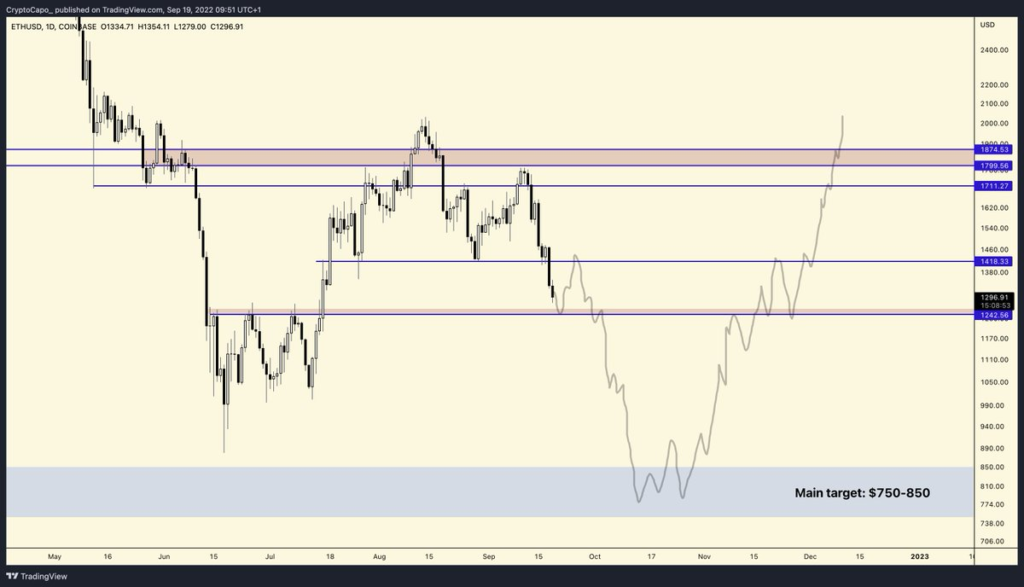
ETHUSD Chart by TradingView via @CryptoCapo_

The analysis is coming after the price of ETH has taken a hit from both a ‘sell-the-news’ and Fed rate hike sell pressures. However, it is not the only bearish price prediction for ETH.

In a TIME report, several analysts also indicated pessimism for the ETH market for several reasons. Venture capitalist Kavita Gupta forecasted a crash to as low as $500 if the broader market sell-off deepens. At the same time, the crypto market analyst Wendy O. also expects ETH to drop to around $750, an 85% drawdown from its all-time of $4800.

ETH bulls still hopeful for an upward breakout in 2022

Ether bulls persist in the market despite the prevailing bearish price trend of the second largest cryptocurrency. In the same TIME report, several analysts disclosed that they expect the price of ETH to close out 2022 to its previous high and even set new highs in 2023.

“I believe ethereum can go to $8,000. Ethereum is the clear leader, but other blockchains are onboarding new users at a faster pace due to ethereum’s high gas fees and low transaction speed,” said Ian Balina, investor and founder of crypto research and media company Token Metrics.

Options data noted by crypto and blockchain analytics company Glassnode indicates that traders are equally optimistic about an upside in the price of ETH. Per Glassnode’s report, despite ‘The Merge‘ – Ethereum blockchain’s transition to proof-of-stake – being completed, traders have yet to close their risk hedging positions in the ETH derivatives market.

Lecturas Relacionadas

El verdadero campo de batalla de la IA está en el "Bosque Oscuro"

El verdadero campo de batalla de la IA está en el "bosque oscuro": un análisis de la divergencia estratégica entre China y EE.UU. Mientras los modelos chinos de generación de video por IA (como el "Happy Horse" de Alibaba, Seedance 2.0 de ByteDance y Kling 3.0 de Kuaishou) superan técnicamente a Sora de OpenAI en aplicaciones de consumo, el panorama estratégico global muestra una divergencia crítica. EE.UU., liderado por Anthropic con su modelo Claude Mythos (capaz de descubrir y explotar vulnerabilidades de ciberseguridad) y OpenAI con GPT-5.4-Cyber, se enfoca en el sector empresarial y de seguridad, dominando mercados de alto valor como ciberseguridad (100.000 millones de dólares en EE.UU. en 2026) y herramientas de productividad. Anthropic alcanza 30.000 millones de dólares en ingresos anuales recurrentes (ARR), superando a OpenAI. China, en cambio, prioriza el mercado de consumo, integrando la IA en ecosistemas existentes (TikTok, Alibaba Cloud) para impulsar la creación de contenido y la retención de usuarios, aunque con ARR muy inferiores (ej: 300 millones de dólares para Kling). Esta estrategia "embebida" es eficiente en costes y se beneficia de un mercado de consumo maduro, pero no construye capacidades profundas en áreas críticas como ciberseguridad o programación. La raíz de esta divergencia es estructural: EE.UU. controla el 75% de la capacidad de computación de IA de vanguardia y tiene un mercado B2B maduro y dispuesto a pagar. China, con un 17-18% de la capacidad de computación y un mercado B2B menos desarrollado, optimiza para el consumo. El artículo advierte que la competencia está entrando en una fase de "bosque oscuro", donde la IA defensiva/ofensiva en ciberseguridad se convierte en el verdadero campo de batalla por la supremacía digital. La falta de capacidades equivalentes a Mythos podría dejar a China vulnerable. La solución propuesta es una "guerra asimétrica": impulsar modelos de código abierto (ej: GLM-5.1 de Zhipu AI), adaptarse al hardware local y buscar mercados globales en desarrollo (Sudeste Asiático, Oriente Medio) no cubiertos por los gigantes estadounidenses.

marsbitHace 1 hora(s)

El verdadero campo de batalla de la IA está en el "Bosque Oscuro"

marsbitHace 1 hora(s)

Trading

Spot
Futuros
活动图片