WLFI Banking License Sparks Concerns Among Trump Critics

cryptonews.ruPublicado a 2026-08-24Actualizado a 2026-08-24

Resumen

The U.S. Office of the Comptroller of the Currency (OCC) has granted conditional approval to World Liberty Financial ($WLFI), a company linked to former President Donald Trump's family, to launch a trust bank. Final approval requires the firm to hire an external auditor and maintain required capital levels. Three $WLFI investors, including a son of the former president, have agreed to limit their influence over the bank's management. Under the Trump administration, the OCC approved 22 new bank charters in 19 months, a significant increase, with many going to fintech and digital asset firms like Circle and Coinbase. The company claims the federal charter will enhance regulatory oversight and help expand use of its $USD1 stablecoin, which the bank would custody. However, the Trump family connection has drawn criticism from Democrats, with concerns the stablecoin could be used to curry favor with the White House amid perceived lighter regulation. Critics, including a Brookings Institution scholar, warn of risks if the public mistakenly believes the stablecoin is government-backed. A company representative defended the move, stating it subjects the project to continuous OCC supervision, with independent audits of reserves and compliance with anti-money laundering rules.

The Trump family-linked company World Liberty Financial ($WLFI) received conditional approval from the OCC to launch a trust bank in the United States. Bloomberg reports.

The application review took seven months. For final approval, the firm must hire an external auditor and maintain an established capital level. Three investors in $WLFI, including one of the president's sons, have agreed to limit their influence on the future bank's management.

Journalists noted that during the first 19 months of President Donald Trump's second term, the regulator approved 22 applications for banking licenses—more than in the previous five years combined.
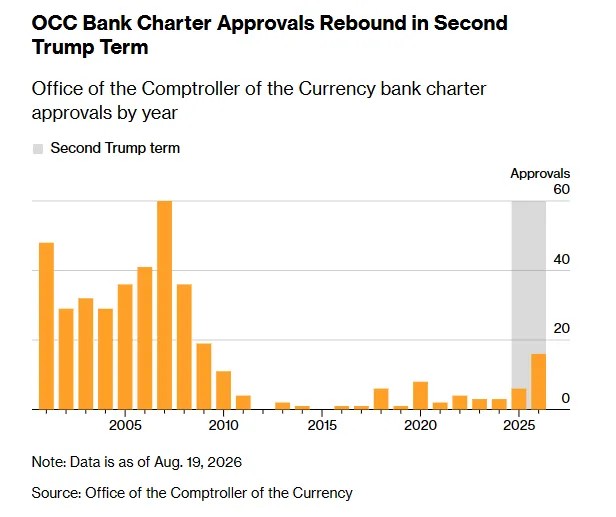
Source: Bloomberg.

Moreover, the majority of new permits went to fintech companies and firms working with digital assets, including Circle and Coinbase.

US Banks to Grant Clients Direct Access to Bitcoin

Earlier in August, representatives of $WLFI stated that a federal charter would strengthen regulatory oversight of the project and help expand the use of the stablecoin $USD1. According to the company, the future bank is intended to hold the assets backing the stablecoin.

The project's connection to the family of US President Donald Trump has raised questions among Democrats. Sources familiar with the matter told Bloomberg that the 'stable coin' could become a tool for gaining favor with the White House amid a more lenient regulatory approach.

According to Aaron Klein, a senior fellow at the Brookings Institution, 'creating the illusion among people that stablecoins are backed by the state raises real concerns.'

In response to the criticism, company representative David Waxman emphasized that the firm is not evading oversight but is transitioning to ongoing OCC supervision. The project must still comply with anti-money laundering and consumer protection requirements, and weekly reports on reserves and operations with $USD1 will undergo independent verification.

Recall that a Reuters poll showed that 63% of Americans found Trump's income from cryptocurrency inappropriate.

Trump Received Over $1.4 Billion from Crypto Projects
end-content

Preguntas relacionadas

QWhat type of approval did World Liberty Financial ($WLFI) receive from the OCC, and what conditions were attached to it?

AWorld Liberty Financial ($WLFI) received conditional approval from the OCC to launch a trust bank in the United States. To receive final approval, the company must hire an external auditor and maintain a specific level of capital.

QWhat concerns did the article raise regarding the connection between World Liberty Financial ($WLFI) and the Trump family?

AThe article raised concerns that the project's connection to US President Donald Trump's family, including an investor who is one of the president's sons, led to questions from Democrats. Critics suggested the stablecoin $USD1 could be used as a tool to gain favor with the White House, given a perceived softer regulatory approach.

QAccording to the article, how did the number of banking license approvals under Trump's second term compare to the previous period?

AAccording to Bloomberg journalists, in the first 19 months of President Donald Trump's second term, the regulator approved 22 applications for banking licenses. This number is greater than the total approvals granted over the five preceding years combined.

QWhat point did Brookings Institution senior fellow Aaron Klein make about stablecoins in relation to this news?

AAaron Klein, a senior fellow at the Brookings Institution, expressed concern that 'creating the illusion for people that stablecoins are backed by the government raises real concerns.'

QHow did a representative from World Liberty Financial ($WLFI) respond to the criticism about the project's oversight?

ADavid Waxman, a representative of the company, responded by emphasizing that the firm is not avoiding oversight but is transitioning under the permanent supervision of the OCC. He stated that the project must still comply with anti-money laundering and consumer protection requirements, with weekly reports on reserves and $USD1 transactions undergoing independent review.

Lecturas Relacionadas

¡Un altcoin ha sido hackeado, lo que provocó una caída brusca de su precio! ¡También cotiza en grandes exchanges!

El valor del token NES cayó bruscamente tras detectarse actividad sospechosa y ventas masivas en la red. Observadores de la cadena de bloques sugieren que una billetera generó aproximadamente 55 millones de dólares en tokens NES y comenzó a venderlos en exchanges descentralizados. Esta presión vendedora hizo que el precio de NES cayera hasta un 40%. Según los datos, en la dirección mencionada aún quedan tokens NES por valor de unos 18 millones de dólares, por lo que es probable que la presión vendedora continúe. Antes del incidente, se reportó la transferencia de unos 62,9 millones de tokens NES (equivalente a 12,35 millones de dólares) a la red principal de Ethereum. Más tarde, se afirmó que se retiró liquidez y se vendieron los tokens, aunque estas cifras aún no han sido confirmadas de forma independiente. El equipo de NESA confirmó que detectó un comportamiento malicioso que explotaba una vulnerabilidad en su red de capa 1, originada en Cosmos EVM. Declararon estar trabajando para contener el impacto, responder con rapidez y restaurar los servicios tras implementar un parche de software y medidas de seguridad adicionales. Nesa también notificó a todos los exchanges de criptomonedas y señaló que las operaciones de depósito se reanudarán una vez finalizados los trabajos necesarios. *Esto no es una recomendación de inversión.

cryptonews.ruHace 2 hora(s)

¡Un altcoin ha sido hackeado, lo que provocó una caída brusca de su precio! ¡También cotiza en grandes exchanges!

cryptonews.ruHace 2 hora(s)

PeaqOS y World ID implementan pruebas ZK en robots autónomos

PeaqOS y World ID han integrado pruebas de conocimiento cero (ZK) en robots autónomos, permitiendo que las máquinas verifiquen que interactúan con personas reales y únicas sin recopilar nombres, fotos u otros datos personales. Disponible a través de robotic.sh, esta actualización permite a los dispositivos conectados solicitar y verificar directamente las pruebas de World ID. El sistema utiliza tecnología de "prueba de conocimiento cero", donde una persona puede confirmar su condición humana manteniendo la privacidad de su identidad. Esto resuelve el desafío de verificar la autenticidad del usuario en interacciones con robots de reparto, máquinas compartidas o sistemas autónomos, sin depender de códigos PIN, contraseñas o documentos de identificación que puedan ser robados o requieran recopilar información personal. World ID proporciona una prueba criptográfica de que el usuario es una persona real. PeaqOS actúa como capa de coordinación, permitiendo a los dispositivos usar World ID a través de identificadores descentralizados y un mercado de dispositivos. Un robot puede solicitar la verificación, recibir una prueba de conocimiento cero y registrar una entrada auditable de la interacción, todo sin revelar datos subyacentes que identifiquen a la persona. El sistema también admite la verificación de unicidad para hacer cumplir normas como "un artículo por persona". Un caso de ejemplo es la entrega autónoma de medicamentos: el paciente se verifica en la World App al hacer el pedido, el farmacéutico verifica antes de cargar el medicamento y el robot verifica al paciente en la entrega antes de desbloquear el compartimento. Robots de muestras promocionales o máquinas compartidas podrían usar el sistema de manera similar para garantizar un artículo por persona o permitir acceso sin crear cuentas. La integración ya está disponible para robots y dispositivos que operan en PeaqOS a través de robotic.sh, permitiendo que los sistemas autónomos confirmen interacciones con personas reales mientras minimizan la información de identidad que reciben o almacenan.

cryptonews.ruHace 3 hora(s)

PeaqOS y World ID implementan pruebas ZK en robots autónomos

cryptonews.ruHace 3 hora(s)

Trading

Spot
活动图片