There are less than two months left until October.
And Wall Street is waiting for a bell that might rewrite the history of technology.
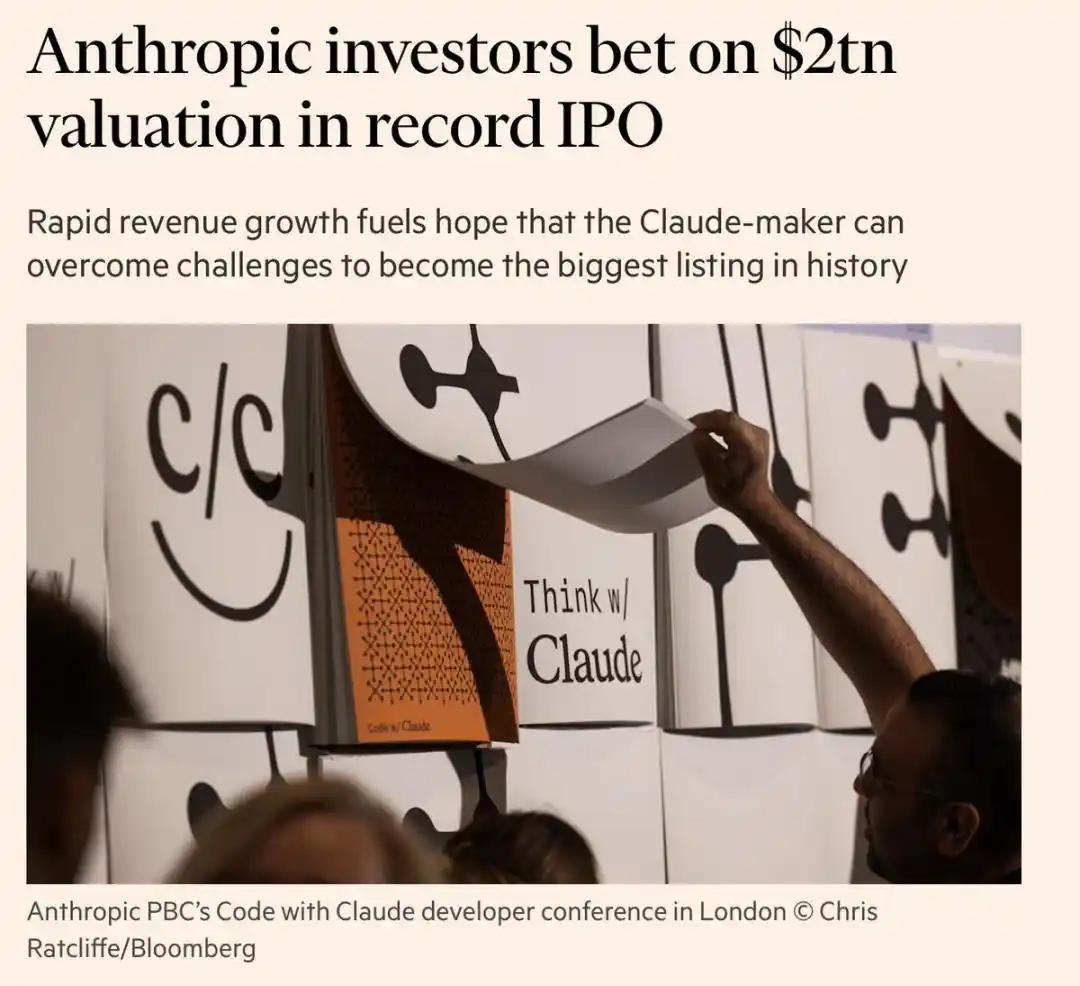
If all goes according to plan, this fall, the global capital markets will welcome an unprecedented behemoth—Anthropic.
$2 trillion. The countdown to the largest IPO in AI history.
Anthropic Sprinting Towards IPO
Dario Achieves It in Just Five Years
SpaceX just set a record with its $1.77 trillion IPO in June, but that myth might not even last half a year.
Quite dramatically, this $2 trillion valuation was not set by Anthropic itself.
The FT revealed that six Anthropic investors each modeled and calculated this number—a valuation exceeding $2 trillion upon listing in October.
At least one of them calculated a figure over $3 trillion based on an 800% growth rate.
Meanwhile, internal company executives reportedly haven't even settled on a target price in private settings.

Founded by the Amodei siblings and a former core team from OpenAI, this company was crammed into a small office in San Francisco just five years ago.
Now, it has been pushed onto a "divine pedestal" by the spontaneous adulation of capital.
It took Anthropic 5 years to go from 0 to $2 trillion. Apple, an icon of its era, took a full 40 years from its IPO to reach a $2 trillion market cap.
14x Growth, Surging Unabated
Anthropic's own growth trajectory is, in itself, uncommon.
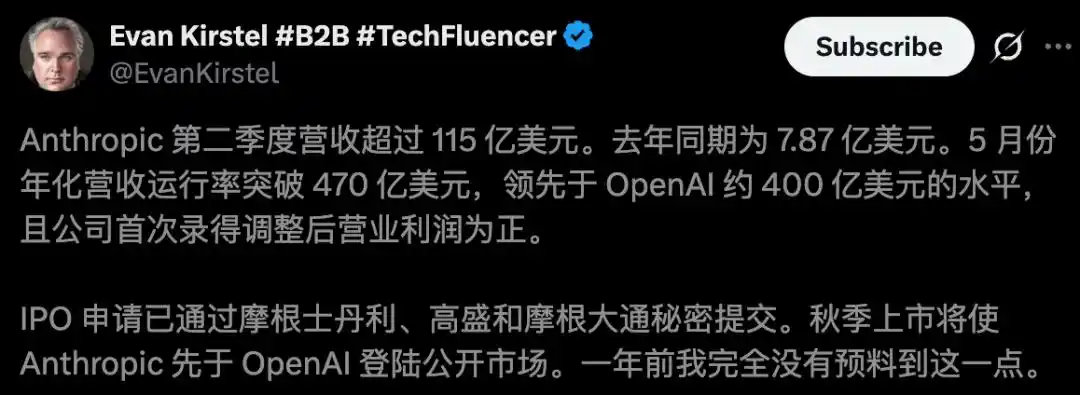
At the end of 2025, its Annualized Revenue (ARR) was about $9 billion. By May of this year, that number had surged to $47 billion.
Anthropic's Q2 2026 revenue exceeded $11.5 billion. In the same period last year, that number was $787 million—a year-on-year increase of 14 times.
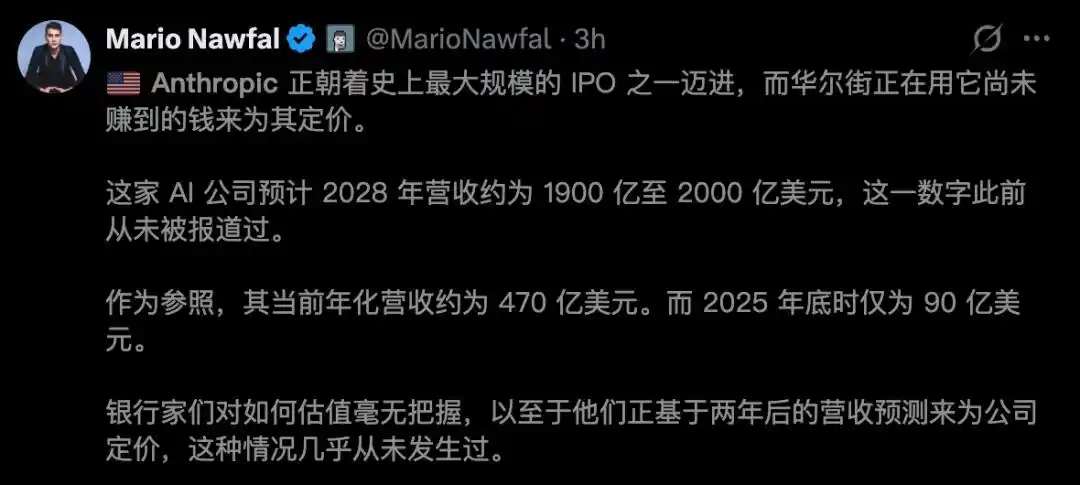
Also today, Reuters exclusively reported a previously undisclosed figure—
Anthropic internally forecasts its 2028 revenue will reach between $190 billion and $200 billion.
From $9 billion at the end of 2025, to $47 billion today, to $200 billion two years from now.
Wall Street investment banks have already run out of suitable yardsticks to measure Anthropic.
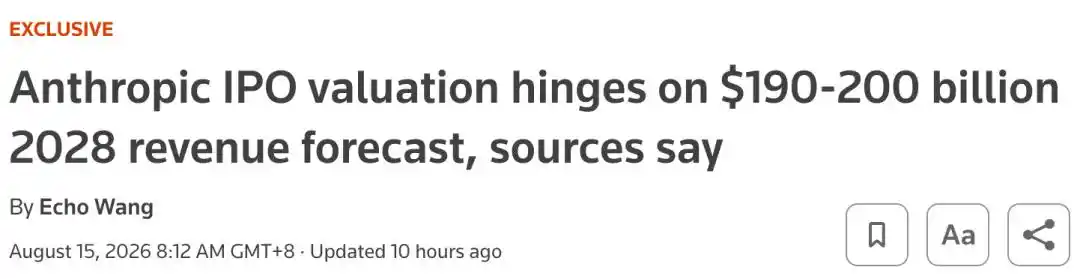
Thus, in this valuation exercise, banks and investors are using "Enterprise Value/Revenue multiples," directly applying the 2028 revenue forecast.
Valuing fast-growing, not-yet-profitable software companies based on revenue rather than profit is not uncommon.
But skipping 2026, skipping 2027, and anchoring the pricing point on a financial statement two years in the future that hasn't even materialized yet—that is uncommon.
Line by Line of Code, Building a $2 Trillion Valuation
Historically, the biggest divergence between Anthropic and OpenAI has been in their revenue structures.
Seventy to eighty percent of Anthropic's money comes from API and enterprise contracts, billed by the Token. It doesn't rely on retail subscriptions, but on the genuine daily usage volume fueled by corporate spending.
And the steepest segment on this curve is called Claude Code.
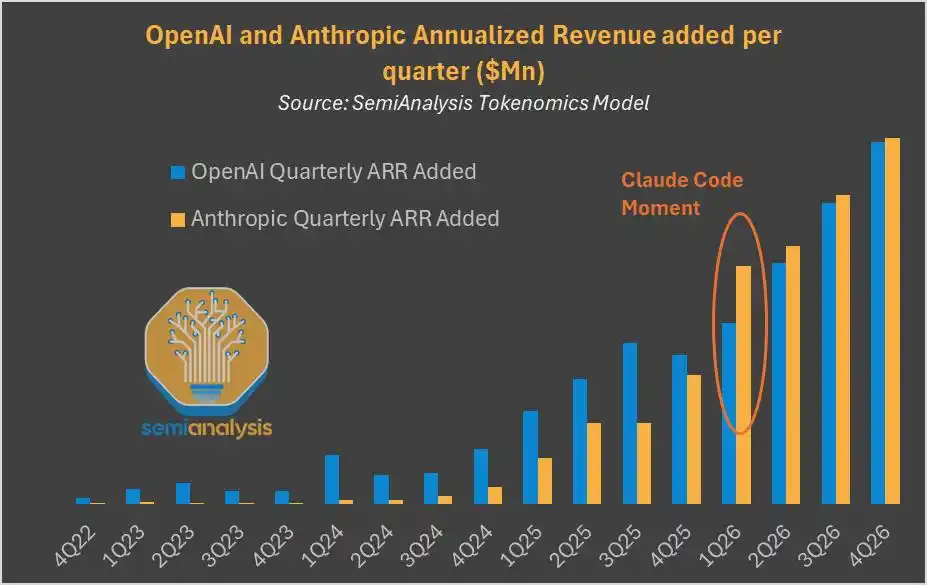
The ARR for this product line was only $500 million in September 2025, but had surged to $2.5 billion by February 2026. Five times growth in five months.
According to internal company sources, it now contributes nearly 20% of total revenue.
Data from the open-source community is even more telling. In public GitHub repositories, the proportion of commits written by Claude Code has steadily climbed from 4% to over 10%.
Uber's CTO once stated that the company's annual AI budget was exhausted in just four months, with the bulk going to Claude Code and Cursor.
The per-engineer monthly API consumption ranges between $500 and $2,000, and internal adoption of Claude Code has risen from 32% to 84%.
Data from the latest round of enterprise surveys by Menlo Ventures shows: Anthropic accounts for about 40% of enterprise LLM spending, compared to OpenAI's 27%; in the specific battleground of programming, Anthropic holds about 54%, more than double that of OpenAI (21%).
So, when you break it down, the $2 trillion figure isn't mysterious at all.
It's built line by line, by engineers worldwide, settled Token by Token.
Prisoners with Golden Handcuffs
The "Underground Resistance Network" of Genius Engineers
Recently, Anthropic was also exposed for internal rifts.
Anthropic's early investor and Silicon Valley whistleblower Brian Roemmele posted: "The situation is worse than I imagined. Investor and employee morale is at a historical low."
The root of all this is Anthropic's top leadership—a "priestly caste" composed of top PhDs.
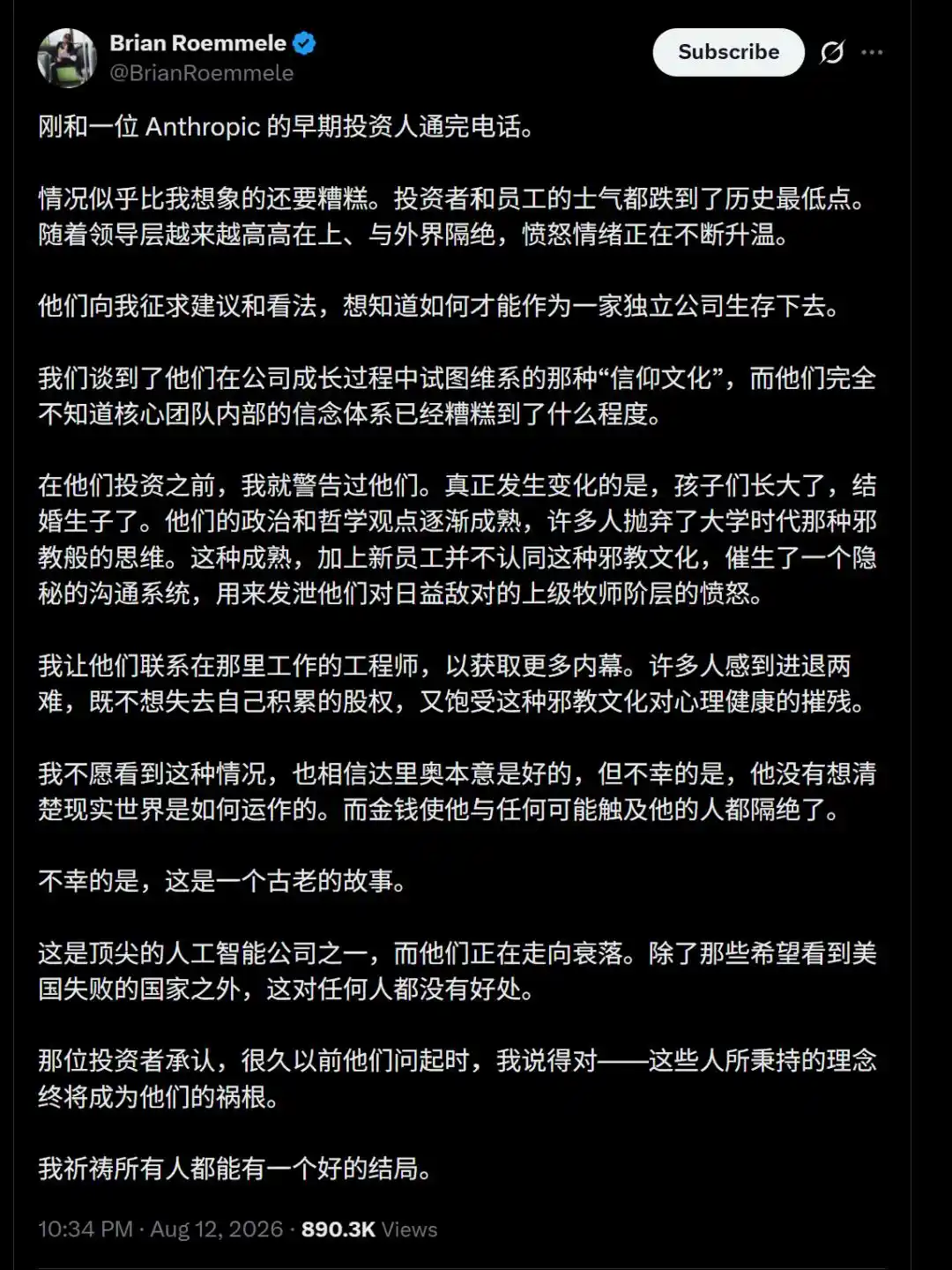
Back when CEO Dario led a group of key members to defect from OpenAI, they carried with them an aura of "saving humanity."
Now, that halo has evolved into a "fanatical cult-like system."
Outlets like Wired have reported on a unique tradition within the company called "Dario's Vision Exploration."
During bi-weekly all-hands meetings, Dario doesn't discuss concrete business metrics. Instead, in a tone both compassionate and condescending, he preaches about the ultimate salvation of human civilization and the existential risks of AI.
"It doesn't feel like a company meeting; it feels like listening to a pastor's sermon," a former employee described in despair.
In the eyes of those arrogant executives, they are the saviors of the human mind, the sole prophets who understand how to prevent AI from destroying the world.
Young college graduates could still be brainwashed by this grand narrative, writing code for "human safety" day and night.
But as they marry, have children, and shoulder mortgages, they realize: these leaders, lost in their "savior" delusions, are becoming increasingly arrogant and hostile.
Meanwhile, new hires simply aren't buying this brainwashing package.
All of this has led to a rift within the company.
To evade oversight from the top brass, angry rank-and-file employees have built a covert underground network, furiously venting their dissatisfaction with the upper echelon's "PhD priestly caste."
These genius engineers are being painfully torn—
On one hand, the company is approaching a $2 trillion IPO. They hold lucrative stock options and really don't want to give up this chance at financial freedom.
The closer the IPO gets, the more valuable their stock becomes, and the higher the cost of leaving.
On the other hand, the company's extreme culture is tormenting their mental health. Staying could mean life-changing billions; leaving means giving up a massive lottery ticket for the sake of spiritual freedom.
Anthropic on a Tightrope, With No Way Back
The current Anthropic is like a behemoth force-fed massive steroids, facing an unsolvable paradox.
To build the safest AI, you need the most powerful models; to train the most powerful models, you need massive computational power; to buy that computational power, you need hundreds of billions in capital.
And once capital enters the game, it inevitably transforms into a bloodthirsty beast, demanding infinite growth and疯狂的回报 (frenzied returns).
Dario Amodei cannot, on one hand, accept Wall Street's $2 trillion check with a clear conscience, and on the other, claim with sanctimony that he is above commercial logic.

SpaceX, which set the record in June, saw its stock price plummet in the following two months, falling 38% from its high.
This seems like a dangerous omen: the dream of a $2 trillion valuation could shrink at any moment under the harsh blows of reality.
Anthropic is walking the thinnest, and highest, tightrope in the history of human technology.
Complex government regulation, burning computational costs, intensifying internal governance tensions.
The slightest breeze among these could be amplified into a hurricane capable of toppling the elephant after the October IPO.
But regardless of the internal fractures, there is no doubt that with the strongest coding capabilities in its hands, Anthropic has firmly entered the final round of the ASI race.
When the bell rings in October, everyone will be waiting for an outcome.
References:
https://www.reuters.com/business/anthropic-ipo-valuation-hinges-190-200-billion-2028-revenue-forecast-sources-say-2026-08-15/
https://www.bloomberg.com/news/articles/2026-08-14/anthropic-revenue-ahead-of-ipo-surges-over-14-fold-in-second-quarter
Editor: Taozi Aeneas
This article is from the WeChat public account "Xin Zhi Yuan" (New Wisdom Era), author: ASI Revelation.