Unitree is Not Worth Its Current Valuation

Odaily星球日报Publicado a 2026-08-14Actualizado a 2026-08-14

Resumen

Unitree's recent IPO pricing at 150.80 yuan per share, valuing the company at 60.99 billion yuan, has sparked intense market speculation. The valuation metrics appear stretched, with a P/E ratio of 219.23x—nearly six times the industry average—earning it the nickname "dream valuation." Off-exchange platforms like Hyperliquid have seen even more extreme pre-market prices, implying valuations up to four times the IPO level. The core concern is the mismatch between this valuation and the company's current business reality. Unitree's revenue breakdown reveals that over 73% of its humanoid robot sales in the first nine months of 2025 came from research and education, with another 17% from commercial exhibitions. Only 9% was classified as industrial application, and within that small slice, approximately 70% was for enterprise tours and guest reception—essentially advanced display items. Consequently, revenue from actual industrial tasks like manufacturing, inspection, and logistics accounted for less than 3% of total humanoid robot sales. Financially, growth is showing signs of strain. While Q1 2026 revenue grew 68.49% year-over-year, this represents a sharp slowdown from the 332.64% growth seen in Q1 2025. More notably, net profit (non-GAAP) halved, dropping 52.55%, attributed to surging R&D and marketing expenses. The company has also updated its risk disclosures, highlighting the threat of competition from Tesla's Optimus, which plans mass production. Analysts and institutio...

Original | Odaily Planet Daily(@OdailyChina)

Author|jk

On the evening of August 6, Unitree Technology announced its STAR Market issue price at 150.80 yuan per share, corresponding to an issuance market capitalization of 60.993 billion yuan. On the day of online subscription, August 10, 9.78 million retail investors rushed in, with the preliminary effective subscription multiple reaching 8288.82 times, setting a new historical low for the lottery winning rate on the STAR Market. On the Hyperliquid perpetual contract platform, Unitree's pre-market quote once surged to 90 dollars, which translates to a market cap of over 240 billion yuan, four times its 60.993 billion yuan issuance market cap. These numbers together paint a picture of a near-nationwide frenzy for the new share subscription. But behind the frenzy, more and more voices are starting to question whether this price has already priced in too much imagination.

Odaily Planet Daily today takes you through the five reasons to short behind the euphoria.

1. P/E Ratio Far Exceeds Industry Levels

Unitree Technology announced its issue price on August 6 at 150.80 yuan per share, corresponding to an issuance market cap of approximately 60.99 billion yuan. What truly made the market gasp was its underlying P/E ratio: 219.23 times. For comparison, the average static P/E ratio for the general equipment manufacturing industry released by the China Securities Index over the recent month is only around 38.56 times. Unitree's pricing is about 5.7 times the industry average.
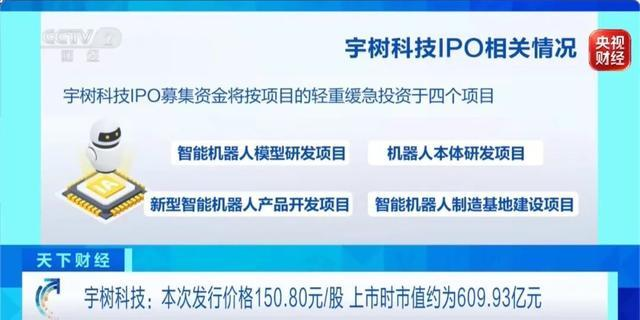
CCTV's report on Unitree. Source: CCTV

Some investors have already jokingly called this P/E ratio the "dream P/E ratio," meaning that at this price, you're not buying current profitability, but a distant dream.

2. Off-Market Quotes Are Even More Absurd Than the Issue Price

On overseas secondary market platforms like Hiive, Unitree's quote reached as high as 61.63 dollars per share during August 10-11. Based on this conversion, the overall valuation was close to 22.4 billion dollars, more than double the valuation corresponding to the issue price.

On Hyperliquid, the situation was even more extreme. Data as of the time of writing shows that the pre-market perpetual contract UNITREE-USDC for Unitree Technology once quoted around 90 dollars. Based on a total of 404 million shares, this corresponds to a market cap of approximately 35.47 billion dollars, or about 239 billion yuan, nearly four times the 60.993 billion yuan issuance market cap.
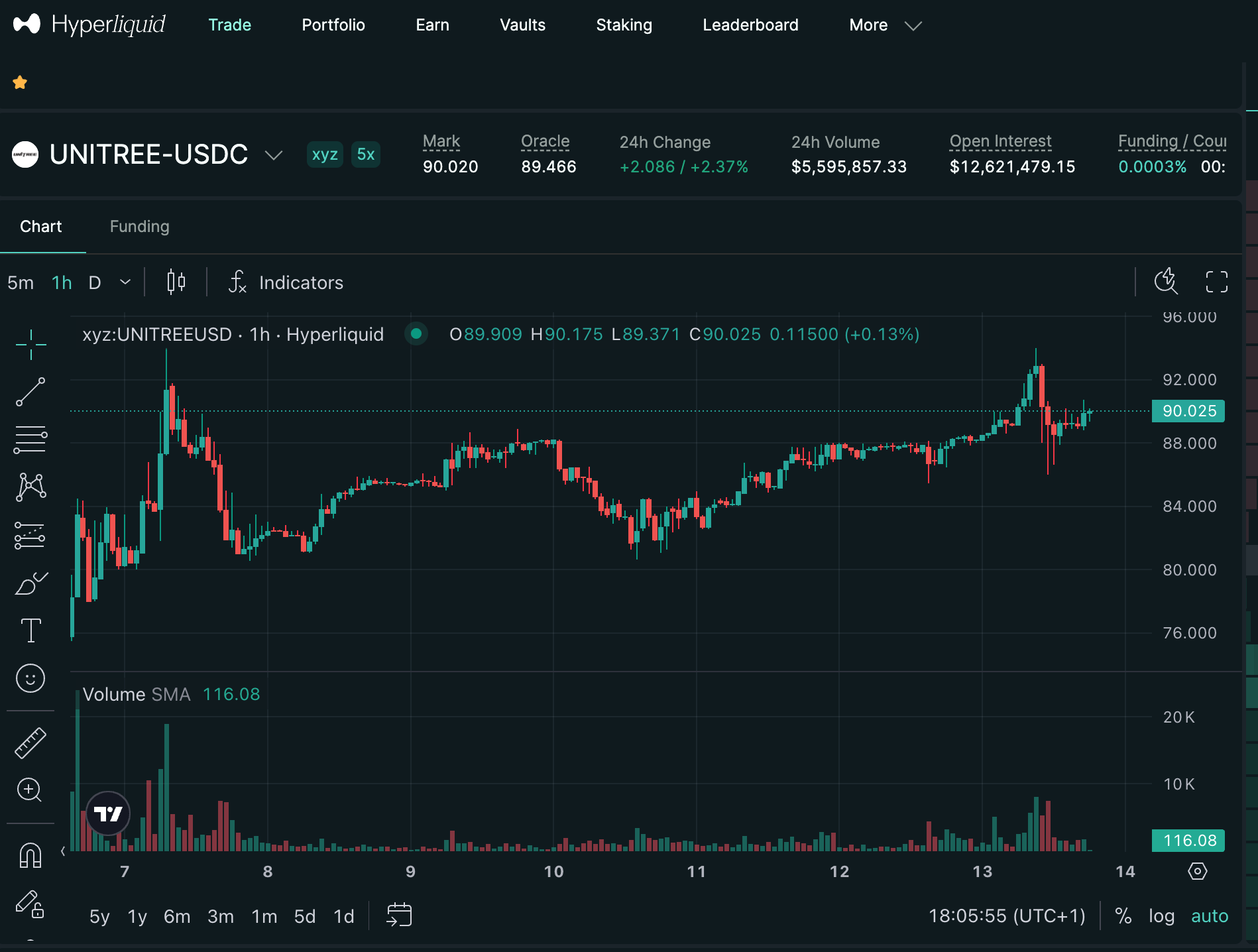
Unitree's pre-market quote on Hyperliquid. Source: Hyperliquid

But the sentiment it reflects is real: the market has priced an extreme amount of imagination into Unitree.

3. Only 3% of Robot Sales Are Actually for Industrialization

The narrative supporting this valuation is the story of humanoid robots entering factories on a large scale and replacing human labor. But opening Unitree's own prospectus reveals that this story is still just a story for now.

In the first nine months of 2025, 73.6% of Unitree's humanoid robot revenue came from scientific research and education scenarios, 17.4% from commercial exhibitions and performances. The revenue share from actual industrial application was only 9.01%. And within this 9%, revenue from actual work scenarios like manufacturing, inspection, and logistics was less than 3%, only 15.70 million yuan in the first nine months, with the majority of the remainder still being for corporate visit reception.

36Kr raised a pointed question in the article "Humanoid Robots: Not Yet 'Creating Prosperity,' But Already 'Creating Wealth'": "Does Unitree making money necessarily mean humanoid robots will definitely make money?" and provided specific data to support this doubt.

In the first nine months of 2025, scientific research and education accounted for 73.60% of humanoid robot business revenue, commercial consumption 17.39%, and industry application only 9.01%. And within this 9.01%, corporate tours accounted for 70%. Revenue actually used in defined industrial scenarios like intelligent manufacturing, intelligent inspection only amounted to 15.702 million yuan, accounting for 29.29% of industry application revenue.

The source of this data is actually Unitree's own written reply to the Shanghai Stock Exchange's second round of inquiry letter:
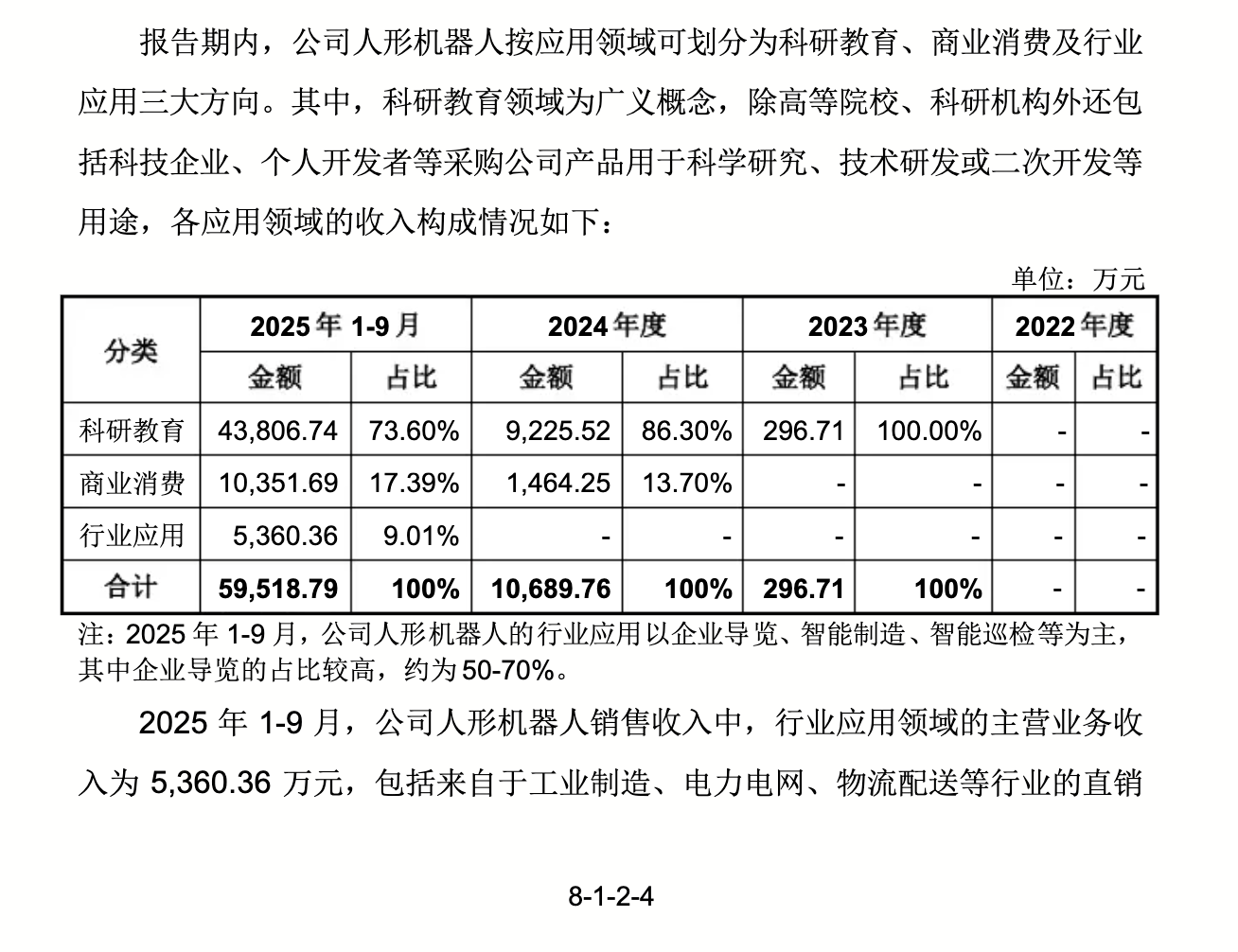
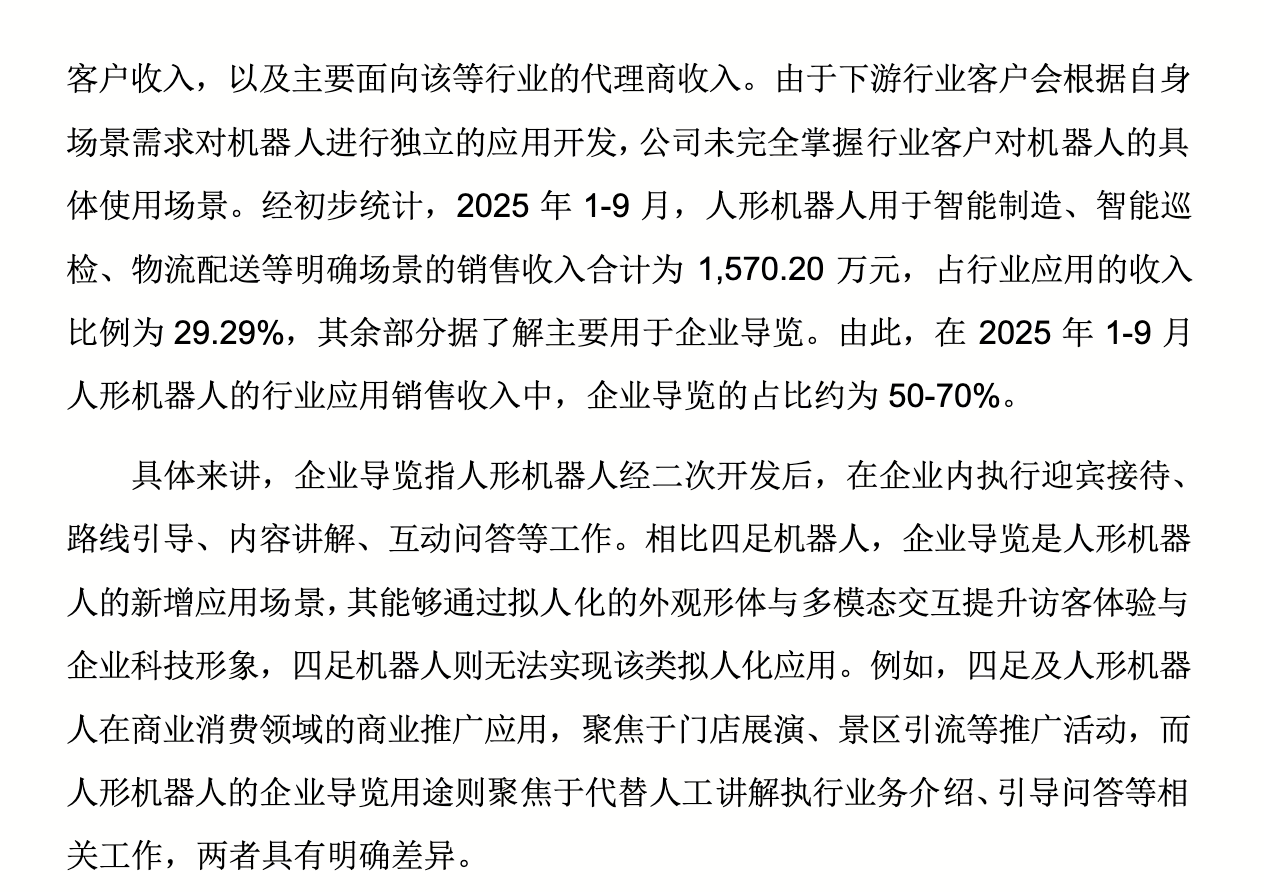
Unitree Technology's Reply Letter. Source: Shanghai Stock Exchange

In simple terms, the biggest buyers of humanoid robots currently are universities, research institutions, and tech companies, who buy robots for algorithm research, model training, teaching experiments. The demand in the research and education market is limited and could very quickly hit a ceiling.

And within this 9.01% industry application revenue, the portion corresponding to defined industrial scenarios like intelligent manufacturing, intelligent inspection, and logistics distribution is 15.702 million yuan, accounting for 29.29%. The remaining approximately 70%, according to the company's own statement, is "understood to be mainly used for corporate tours." So-called corporate tours refer to humanoid robots, after secondary development, performing tasks like reception, route guidance, content explanation, and interactive Q&A within companies, essentially being talking, walking exhibition pieces.

If you multiply the 9.01% industry application share by the roughly 70% corporate tours share, then a significant portion of revenue counted under the "industry application" statistic—which sounds like industrial deployment—is actually front desk reception and exhibition hall explanations, quite different from the imagined scenario of robots screwing screws or moving goods in factories.

Revenue that truly corresponds to intelligent manufacturing, intelligent inspection, and logistics distribution accounts for less than 3% of the company's total humanoid robot revenue.

The article also mentions that while competitor Ubtech's humanoid robots have frequently won large orders, its cumulative losses from 2020 to the first half of 2025 exceeded 5 billion yuan, and it has not yet turned a profit. For comparison, even with impressive orders, it doesn't mean the business is all set. Another analysis article on IPO subscriptions directly pointed out that scientific research and education is a good business, but it cannot support the premium in the 60.1 billion market cap related to "general-purpose robots entering every household." That part of the premium requires industrial scenarios and consumer markets to take over, and both are currently still in the pilot stage.

4. Slowing Profit Growth, Deteriorating Profit Quality

In the first quarter of this year, Unitree's revenue was 423 million yuan, a year-on-year increase of 68.49%, seemingly still strong. But compared to the 332.64% growth in Q1 2025, this is a cliff-like drop. Q1 non-GAAP net profit fell from 84.8365 million yuan in the same period last year to 40.2536 million yuan, a year-on-year decline of 52.55%, directly halved. The company's explanation is that R&D expenses increased year-on-year by a net 38.328 million yuan, mainly directed towards embodied AI large models, motion control algorithms, and body structure R&D, while intensive brand promotion on platforms like the CCTV Spring Festival Gala pushed up sales expenses.
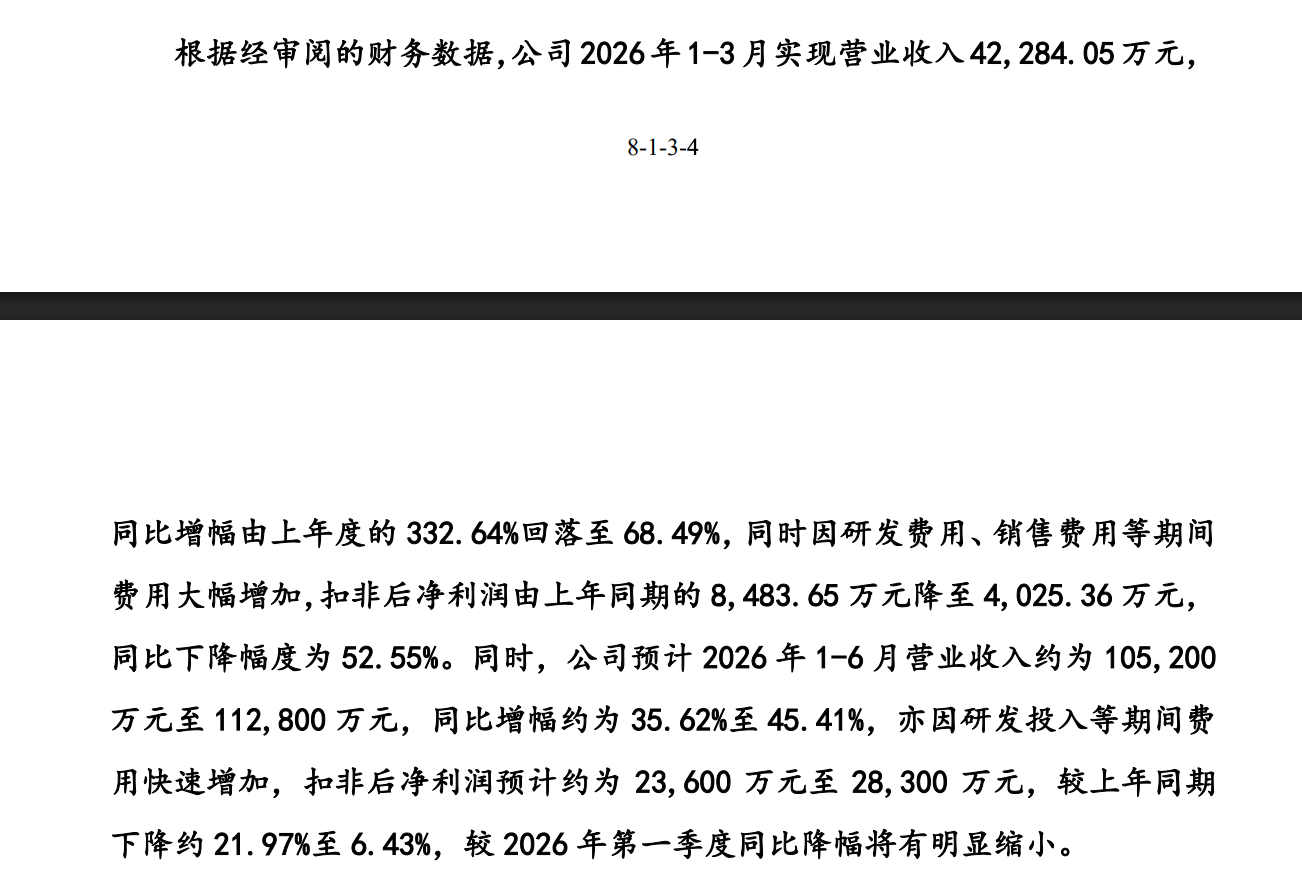
Unitree Technology Financial Reply Letter, Source: Shanghai Stock Exchange

Comparing the prospectus disclosed in March this year and the meeting draft disclosed in May, Unitree Technology made five modifications to its Special Risk Disclosure. The most critical one was adding a "Net Profit Year-on-Year Decrease Warning" and replacing the originally relatively broad "Risk of Technology Breakthrough and Product Innovation Falling Short of Expectations" with "Risk of Slowing Growth and Business Performance Fluctuations," placing it at the top of the seven special risk warnings. The prospectus also for the first time named Tesla as a threat, acknowledging that Tesla, leveraging mass production and supply chain integration capabilities, has started small-batch trial production of its humanoid robot Optimus Gen-3, with planned annual capacity reaching 1 million units. Once mass production is achieved, it will directly compete with Unitree.

Wang Feili, China Industrial Analyst at UBS Securities, mentioned that even if many manufacturers aim for shipments of ten thousand units this year, humanoid robots may not have truly reached a commercialization inflection point, because current industry orders are still mainly verification purchases, not expansion purchases based on productivity demand.

5. Institutions and Analysts' Bearish Views

Zhuo Wang, a partner at a Shanghai investment institution, told Reuters in an interview, "This IPO pricing is on the expensive side, the investment risk is already quite high," and pointed out that most of Unitree's sales revenue comes from research and exhibition scenarios, and true large-scale commercial application is still far away.

Even the relatively bullish Shenwan Hongyuan Research used cautious wording when commenting on this pricing, stating that the relatively high issuance valuation might draw market attention to the commercial value of the entire robot industry, thereby driving re-pricing of related stocks. Looking at this statement conversely, it can also be understood that Unitree's current commercial value itself still needs verification, and valuation has outpaced its business.

Research firm SemiAnalysis gave in its report that they estimate Unitree had only about 250 robots actually used in industrial scenarios in 2025, while annual shipments had already exceeded 5500 units, a relatively large discrepancy.

Conclusion: Valuation Ultimately Returns to Fundamentals

In the end, this round of pricing is largely the result of the combined push from the global humanoid robot frenzy and A-share retail investor sentiment. Since the beginning of this year, almost all companies tagged with "embodied intelligence," from Tesla Optimus to Zhiyuan, Dobot, and Yunsenchu, have been assigned far more imagination in the capital markets than their existing performance warrants.

For this bet to succeed, three assumptions need to materialize simultaneously: humanoid robot industry demand sees explosive growth in the short term, Unitree can defend its market share amid strong competitors like Zhiyuan Robot and Tesla Optimus, and it won't sacrifice its current high gross margin of around 60% due to price wars. All three conditions are indispensable, and each carries considerable uncertainty.

In the short term, constrained by structural factors like a small free float and index fund support, Unitree's stock price may not weaken immediately, and may even continue to rise in the initial post-listing period. But in the medium term, once these structural supporting forces fade over time, especially as the one-year post-listing lock-up period for institutional shares approaches, valuation will ultimately have to return to fundamentals for examination. If by then the revenue share from industrial scenarios has not significantly improved and profit growth continues to decline, this currently dream-based high valuation will likely experience a significant correction.

How similar this is to the trajectory of most crypto assets...

Preguntas relacionadas

QWhat is the key concern raised about Unitree's valuation based on its P/E ratio?

AThe key concern is that Unitree's P/E ratio of 219.23 times is significantly higher than the industry average of 38.56 times for the general equipment manufacturing sector, which is about 5.7 times the industry norm. This suggests its valuation is heavily based on future expectations rather than current profitability.

QWhat evidence does the article provide to challenge the narrative of large-scale industrial adoption of Unitree's humanoid robots?

AThe article cites Unitree's own prospectus data showing that in the first nine months of 2025, only 9.01% of humanoid robot revenue came from industry applications. Within that segment, roughly 70% was from enterprise tours and reception (e.g., guides, exhibits), with revenue from actual industrial scenarios like manufacturing, inspection, and logistics amounting to only 15.7 million RMB, accounting for less than 3% of total humanoid robot revenue.

QHow does Unitree's pre-market price on Hyperliquid compare to its official IPO valuation, and what does this indicate?

AOn the Hyperliquid perpetual contract platform, Unitree's pre-market price reached around $90, translating to a market cap of approximately 239 billion RMB. This is nearly four times its official IPO market cap of 60.993 billion RMB. This extreme premium indicates highly speculative and optimistic market sentiment that has vastly outpaced the official valuation.

QWhat negative trend in Unitree's financial performance is highlighted in the article?

AThe article highlights a sharp decline in profit growth. In Q1, while revenue grew 68.49% year-over-year, the growth rate slowed dramatically from 332.64% in Q1 2025. More critically, non-GAAP net profit fell by 52.55% to 40.2536 million RMB, attributed to increased R&D and marketing expenses.

QAccording to the article's conclusion, what three conditions must be met for Unitree's high valuation to be justified?

AThe article concludes that justifying the high valuation requires three simultaneous conditions: 1) The humanoid robot industry must experience explosive demand growth in the short term. 2) Unitree must maintain its market share against strong competitors like Tesla's Optimus and Zhiyuan Robot. 3) Unitree must avoid sacrificing its current high gross margin of around 60% in potential price wars. The article notes significant uncertainty for each condition.

Lecturas Relacionadas

Kaito reinicia la "economía de predicciones", pero mucha gente teme instalar el nuevo complemento

Kaito AI ha lanzado el complemento Kaito Pulse para navegadores, que integra la actividad en X (antigua Twitter) con comportamientos en la cadena de bloques (on-chain) para crear un nuevo sistema de puntuación de influencia social. Mientras que su proyecto anterior, Yaps, incentivaba la creación de contenido, Pulse busca verificar la autenticidad y credibilidad de los usuarios. Para ello, muestra públicamente en el feed de X información como posiciones de trading abiertas en plataformas como Polymarket, vinculando opiniones con acciones reales. Sin embargo, la extensión ha generado una importante controversia por la privacidad. Analistas como Ultra señalan que el complemento podría recopilar datos sensibles, incluyendo la huella digital del dispositivo, patrones de navegación en X e información de cuentas de terceros (como ChatGPT o exchanges). La comunidad está dividida: algunos defienden que la verificación es necesaria para combatir la influencia falsa y el "farming" de contenido, mientras que otros consideran que la recolección de datos es excesiva. Yu Hu, fundador de Kaito, respondió a las críticas afirmando que el principio de diseño es la minimización de datos. Explicó que Pulse no obtiene datos crudos del usuario, sino pruebas verificadas (por ejemplo, mediante zkTLS) de identidades o comportamientos, tras el consentimiento del usuario. Reconoció que la explicación de los permisos puede mejorarse. El debate sobre Kaito Pulse refleja el dilema central de los proyectos de "InfoFi" o "economía de hablar para ganar" (嘴撸经济): para medir la influencia auténtica y recompensar contribuciones reales, las plataformas necesitan más datos de verificación, pero esto choca con la privacidad y la confianza de los usuarios. El éxito del modelo dependerá de encontrar un equilibrio aceptable.

Odaily星球日报Hace 17 min(s)

Kaito reinicia la "economía de predicciones", pero mucha gente teme instalar el nuevo complemento

Odaily星球日报Hace 17 min(s)

Después de dos años y medio de emprendimiento y la IAización de toda la plantilla, la empresa se volvió más 'tradicional'

Tras dos años y medio desde su fundación, la empresa ha logrado sobrevivir y crecer, ahora trasladándose a una oficina más grande. Contrario a la expectativa común de que la IA reduciría la plantilla, la empresa, a pesar de una adopción de IA casi del 100% con agentes en finanzas, RRHH, legal, ventas y más, se ha vuelto más "tradicional". La clave no fue crear un departamento centralizado de IA, sino un "centro de soporte delgado" que gestiona seguridad y costos, empoderando a cada empleado para usar agentes y resolver sus propios problemas operativos. Esto devuelve la iniciativa y el control a la primera línea. La verdadera base es la **datos**. La empresa prioriza almacenar meticulosamente todos los datos (reuniones, documentos, etiquetas de colaboradores) como un activo invaluable. Sin datos limpios y bien gestionados, la IA solo amplifica el caos. A medida que la IA automatiza tareas repetitivas, la esencia del trabajo humano emerge con más fuerza: construir **confianza** y relaciones genuinas. Los comerciales dedican más tiempo a entender clientes, los agentes a conectar con creadores de contenido. La IA elimina fricciones, liberando tiempo para lo verdaderamente humano. Esto plantea desafíos cruciales: ¿A dónde va el tiempo ahorrado? La respuesta debería ser devolverlo a los empleados para una vida mejor y a los clientes para un servicio más profundo, no simplemente generar más trabajo. Para los **gerentes**, la IA expone su verdadero valor: definir objetivos claros, asumir riesgos y responsabilidades, y tomar decisiones difíciles, no solo supervisar tareas. La integración de **nuevos empleados** es un reto. Aunque un agente puede dar respuestas rápidas, es vital que los novatos comprendan el "porqué", cometan errores seguros y desarrollen su propio criterio para crecer profesionalmente. En esencia, la IA no reemplaza las conexiones humanas, sino que elimina ineficiencias para que estas florezcan. El propósito final no es ser una empresa automatizada, sino usar la tecnología para servir mejor a clientes y colegas, cumplir promesas y construir relaciones valiosas. La transformación con IA, en el fondo, prueba cómo una empresa trata a las personas: confiando en ellas, devolviéndoles tiempo y creando espacio para crecer. Como dijo Saint-Exupéry, el verdadero lujo son las relaciones humanas.

marsbitHace 21 min(s)

Después de dos años y medio de emprendimiento y la IAización de toda la plantilla, la empresa se volvió más 'tradicional'

marsbitHace 21 min(s)

Dirección de la Bolsa Estadounidense (21 de agosto): Recompra de bonos a largo plazo pierde efecto, venta masiva de Walmart arrastra al Dow a una fuerte caída de 700 puntos

La bolsa de EE.UU. cayó bruscamente el jueves, arrastrada por la reanudación de la presión sobre los bonos largos, el repunte del petróleo que reavivó los temores inflacionarios y las débiles ganancias de Walmart. El Dow Jones se hundió 703.84 puntos (-1.32%), mostrando la ineficacia de la intervención del Tesoro para comprar bonos a largo plazo, cuyos rendimientos (el del bono a 30 años cerca del 5.26%) recuperaron rápidamente las pérdidas del día anterior. El mercado interpretó que estas medidas solo alivian temporalmente la liquidez, sin abordar las presiones estructurales como el déficit fiscal y la fuerte demanda de financiación. El petróleo subió más de un 2% debido a tensiones geopolíticas, presionando las perspectivas de inflación. Las acciones de Walmart cayeron más de un 9% a pesar de superar las estimaciones de ganancias, ya que su débil guía anual y la desaceleración en las ventas en EE.UU. apuntan a una presión en el consumo de los hogares. En tecnología, Moderna se desplomó un 23% tras su enorme subida del día anterior, y los "Siete Magníficos" cayeron en general. Sin embargo, algunos valores de semiconductores, memoria y comunicación óptica avanzaron con catalizadores específicos. Bitcoin superó los $72,000. El foco ahora está en si los rendimientos de los bonos largos se estabilizan y en el discurso de la Fed en Jackson Hole para calibrar las expectativas de tasas de interés.

marsbitHace 26 min(s)

Dirección de la Bolsa Estadounidense (21 de agosto): Recompra de bonos a largo plazo pierde efecto, venta masiva de Walmart arrastra al Dow a una fuerte caída de 700 puntos

marsbitHace 26 min(s)

5.47亿枚OP从用户空投转入生态基金,DAO投票正在变成虚假民主

El 19 de agosto, una votación crucial en la gobernanza de Optimism estuvo a punto de rechazar una propuesta para transferir 546.9 millones de tokens OP (12.7% del suministro total) de la reserva de "airdrops para usuarios" a un "Fondo Estratégico para el Ecosistema" controlado por la Fundación. En los últimos 17 minutos, el equipo central de desarrollo "Test in Prod", financiado completamente por el Optimism Collective, emitió 8.49 millones de votos a favor, inclinando la balanza y aprobando la propuesta. La Fundación justificó la medida argumentando que los airdrops masivos ya no son efectivos para retener usuarios y que se necesitan recursos ágiles para impulsar la nueva estrategia "OP Enterprise", dirigida a clientes institucionales. Sin embargo, opositores como L2BEAT y el investigador Polynya criticaron la falta de claridad en el uso de los fondos, la ausencia de evaluación formal de inversiones pasadas y la vaguedad de los compromisos. Señalaron que, a pesar de haberse desplegado ya 686 millones de OP en fondos ecológicos (2.5 veces más que los airdrops), OP Mainnet no se ha convertido en una cadena de uso dominante. El caso expone problemas profundos en la gobernanza de los DAOs: la influencia decisiva de actores financiados por la misma entidad que se beneficia de la votación, planteando cuestiones de conflicto de intereses. Además, cuestiona si un voto mayoritario puede redefinir legítimamente las promesas de distribución establecidas en el origen del proyecto, erosionando la confianza de la comunidad. Así, un mecanismo diseñado para democratizar la toma de decisiones reproduce dilemas clásicos de la gobernanza tradicional.

marsbitHace 47 min(s)

5.47亿枚OP从用户空投转入生态基金,DAO投票正在变成虚假民主

marsbitHace 47 min(s)

Trading

Spot
活动图片