ENS Plans Large-Scale Expansion of Institutional Activity via Foundation Launch

cryptonews.ruPublicado a 2026-08-11Actualizado a 2026-08-11

Resumen

The Ethereum Name Service ($ENS) DAO token holders ratified the "Next Era of $ENS DAO" proposal, leading to the launch of the $ENS Foundation on-chain as a legal operational entity with a paid executive director, staff, and a five-member board, according to an August 11 blog post by $ENS Labs. This new foundation addresses limitations of the DAO structure, enabling activities like signing standardization agreements, hiring full-time staff, pursuing trademark infringements, and interacting with regulators and courts. $ENS Labs will now focus on technical development, including the ENSv2 upgrade, while the foundation handles off-chain operations, engages with bodies like ICANN and W3C, and pursues a .eth top-level domain. The $ENS DAO retains 54.6% of the total token supply and control over the protocol. The foundation is funded by .eth domain registration revenues, with its transactions subject to a 9-day security council veto period. It is a separate legal entity from $ENS Labs. The inaugural board includes Alexander Urbelis (Executive Director, former $ENS Labs CISO), founder Nick Johnson ($ENS Labs CEO), and three independent directors. Board terms last two years. This update follows governance tensions earlier in the year, including a June proposal for a temporary security council restructure. CEO Nick Johnson's significant token holdings reportedly influenced a vote against extending prior security council agreements, leading to a new eight-member council. Currently,...

$ENS token holders have ratified the "Next Era $ENS DAO" proposal and launched the executable code on the blockchain, creating the $ENS Foundation as a working organization with a paid executive director, employees, and a five-member board of directors, $ENS Labs announced in a blog post on August 11.

This change provides $ENS with its first legal entity capable of holding meetings where the DAO cannot. Furthermore, this entity will handle day-to-day operations, while token holders will continue to control the protocol.

Why the DAO Could Not Sign Documents

According to data from $ENS Labs, the DAO is not qualified to sign standardization agreements, hire full-time employees, sue a trademark owner for a phishing clone, or respond to legal inquiries.

Until now, most representative work remained undone, with some of it being handled by $ENS Labs; however, given that the company primarily specializes in engineering development, it was not prepared to objectively assess this role.

Now that the Foundation has been launched, $ENS Labs states it can focus on development, including the upgrade to ENSv2.

The Foundation has been tasked with taking on the off-chain computational workload. It can now join discussions with ICANN, IETF, and W3C and pursue recognition for the .ens top-level domain.

As a legal entity, it is also responsible for engaging with regulators, registrars, standardization bodies, and courts. Additionally, its duties include consolidating the $ENS brand's trademarks and assets to be able to combat impersonators.

What $ENS Says About Where the Money Remains

$ENS DAO's share of the total token supply is 54.6%, and it will continue to be under the control of the DAO, which includes token holders.

The Foundation, funded by revenue from .eth domain registrations, stores its assets in its own accounts; however, its transactions are now subject to a nine-day lock.

During these nine days, the $ENS Security Council can cancel any transaction that falls outside the Foundation's mandate.

The same post emphasized that the $ENS Foundation and $ENS Labs are not legally identical, and each functions as a separate legal entity. The Foundation does not own $ENS Labs, and the latter has no governance rights over the Foundation, its funds, or the protocol.

The closest ties the labs have with the Foundation are that the founder holds a seat on the Foundation's five-member board of directors; however, he does not participate in decisions regarding funding for the labs.

Who is on the $ENS Foundation's Five-Person Board of Directors?

The inaugural board includes Alexandre Urbelis, a cybersecurity attorney who previously held the roles of Chief Legal Counsel and Chief Information Security Officer (CISO) at $ENS Labs, and served as CISO for the NFL, and now holds the position of Executive Director.

Nick Johnson, founder and CEO of $ENS Labs, holds the founder seat.

The board consists of the remaining three Ventures and ETHGlobal; Brett Sun, co-founder of Prelude; and Anthony Leutenegger, CEO of Aragon. Kartik Talwar from A.Capital

Board directors will serve for two years, and their terms may be renewed by token holders.

The update from $ENS comes in a year already marked by some governance conflicts on the platform. In June a proposal for an interim review aimed to restructure their operations with a focus on the DAO and the foundation.

Johnson, the CEO, who owns approximately 3.26 million $ENS (equivalent to US bonds), has also been a source of some controversy, as, given the size of his holdings, he has the ability to influence the course of voting. This occurred when, reportedly, at the end of June, he managed to secure around 80% of votes against extending agreements with the Security Council.

They later approved a new eight-member council with a stricter requirement of 5 out of 8 votes for a two-year term.

Currently, $ENS is trading at approximately $4.12, down over 1.9% in the last 24 hours, according to CoinMarketCap data. It is now more than 95% below its peak of $85.69 reached in November 2021.


Criptos en tendencia

Preguntas relacionadas

QWhat did the token holders of Ethereum Name Service ($ENS) vote to create, and what is its main purpose?

AThe $ENS token holders ratified the 'Next Era $ENS DAO' proposal and launched the executable code on the blockchain, creating the $ENS Foundation. Its main purpose is to serve as a legal operating entity that can handle tasks the DAO cannot, such as signing standardization agreements, hiring full-time employees, pursuing legal action, and engaging with regulatory bodies and standards organizations.

QWhy was a foundation necessary for the $ENS ecosystem, according to the article?

AThe $ENS DAO lacked the legal authority to perform key functions like signing contracts, hiring full-time staff, suing trademark infringers, or responding to court requests. The new foundation takes over these off-chain operational burdens, allowing the DAO to focus on protocol governance and $ENS Labs to concentrate on technical development, including the upgrade to ENSv2.

QHow is the $ENS Foundation funded, and what financial safeguards are in place?

AThe $ENS Foundation is funded by revenue from .eth domain registrations. As a financial safeguard, the foundation's transactions are locked for nine days. During this period, the $ENS Security Council has the power to veto any transaction that falls outside the foundation's mandate.

QWho is the Executive Director of the newly formed $ENS Foundation, and what is his background?

AThe Executive Director of the $ENS Foundation is Alexander Urbelis. His background includes serving as Chief Legal Officer and Chief Information Security Officer (CISO) at $ENS Labs, and previously as CISO for the NFL.

QWhat recent governance controversy involving $ENS founder Nick Johnson is mentioned in the article?

AThe article mentions a governance controversy where $ENS Labs CEO and founder Nick Johnson, who holds approximately 3.26 million $ENS tokens, reportedly influenced a vote in late June. He was able to sway about 80% of votes against extending agreements with the Security Council. This later led to the approval of a new, 8-member council with stricter requirements.

Lecturas Relacionadas

Observación Diaria de MSX en Acciones Estadounidenses: Informe de Resultados del FY2027 Q1 de Alibaba: El Crecimiento de los Ingresos de AI Cloud Alcanza un Nuevo Máximo, y la Nube de IA Ya Ha Cerrado el Ciclo de Rentabilidad

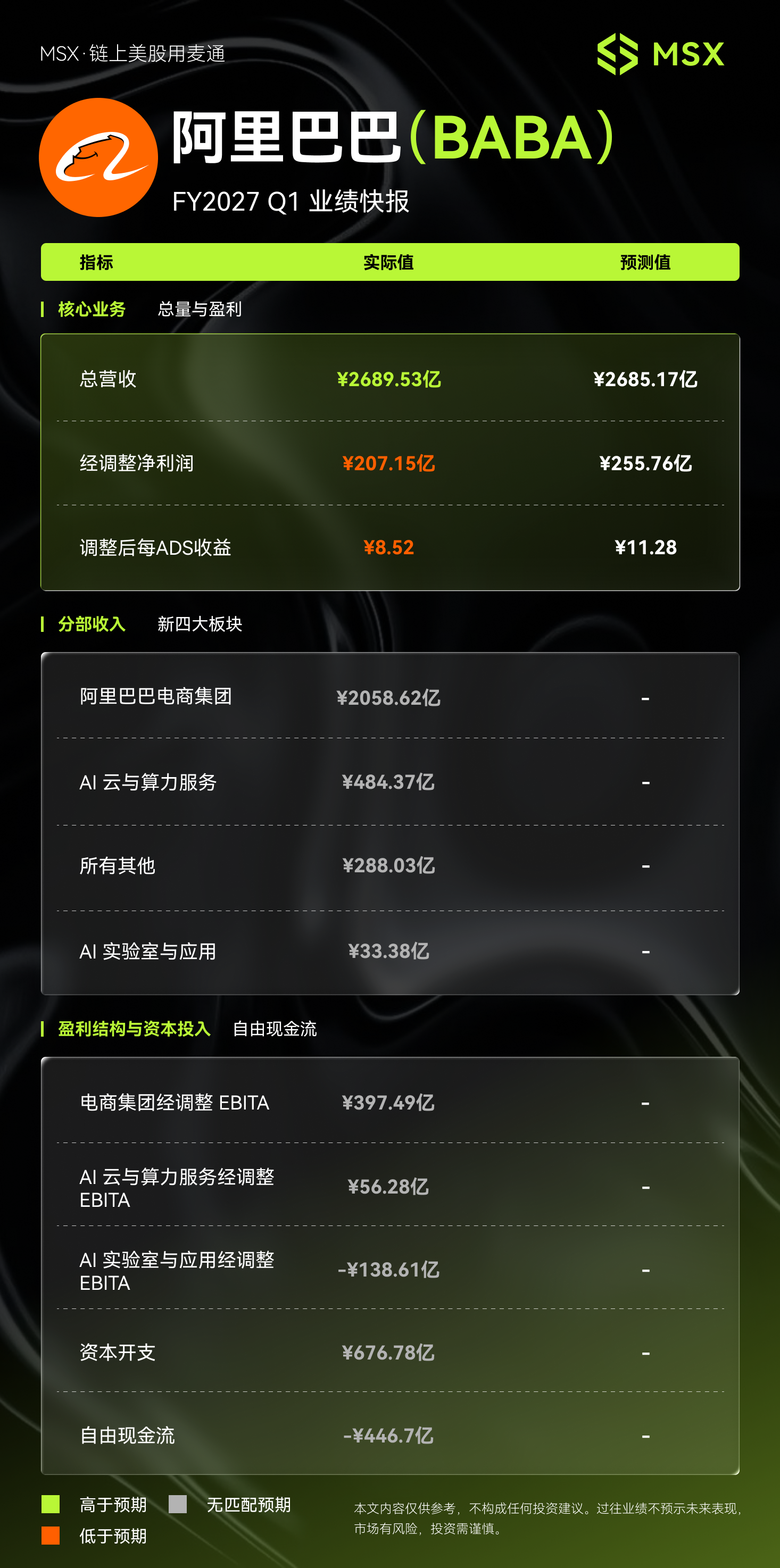
**MSX Resumen Diario del Mercado Bursátil Estadounidense: Ganancias de Alibaba FY2027 Q1: Los ingresos de IA en la nube alcanzan un nuevo máximo de crecimiento y la nube de IA ya es rentable.** Los ingresos totales de Alibaba para el Q1 del año fiscal 2027 fueron de 2,689.53 mil millones de RMB, un aumento del 9% interanual, ligeramente por encima de las expectativas del mercado. Sin embargo, la utilidad neta ajustada cayó un 38% interanual a 207.15 mil millones de RMB, y las ganancias por ADS ajustadas cayeron un 42%, ambas por debajo de las expectativas. Este descenso se debe principalmente a mayores inversiones en IA y dos partidas únicas: una provisión de 550 millones de euros por una multa de la UE y una depreciación de fondo de comercio de 4,458 millones de RMB. La reestructuración de la empresa revela un desempeño divergente entre sus segmentos. El segmento de **Nube e Servicios de Cómputo de IA** fue el más destacado, con ingresos de 484.37 mil millones de RMB, un aumento del 45% interanual, y un EBITA ajustado que se disparó un 133%, alcanzando una rentabilidad del 12%. Esto demuestra que el negocio de nube de IA ha cerrado el círculo comercial y muestra economías de escala. En el comercio electrónico, las ventas minoristas instantáneas en China crecieron un 45%, compensando en gran medida la contracción del 8% en el comercio electrónico tradicional, lo que resultó en que el EBITA del grupo de comercio electrónico apenas cayera un 1%. Un punto clave a observar es el flujo de caja. Los gastos de capital se dispararon un 75% interanual, lo que llevó a un flujo de caja libre negativo de 446.70 mil millones de RMB. Sin embargo, el flujo de caja operativo continuó creciendo, lo que indica que el consumo de efectivo es una elección activa para la inversión en IA, no una pérdida operativa. El éxito futuro de esta gran inversión dependerá de si la mejora de la rentabilidad de la nube de IA puede superar el ritmo de depreciación de las inversiones en capacidad de cómputo.

Odaily星球日报Hace 36 min(s)

Observación Diaria de MSX en Acciones Estadounidenses: Informe de Resultados del FY2027 Q1 de Alibaba: El Crecimiento de los Ingresos de AI Cloud Alcanza un Nuevo Máximo, y la Nube de IA Ya Ha Cerrado el Ciclo de Rentabilidad

Odaily星球日报Hace 36 min(s)

Análisis Diario de Acciones de EE.UU. de MSX: Resultados del Q2 de FY2027 de Walmart: Ingresos y Beneficios Superan Expectativas, Crecimiento de Ventas Mismo Almacén en EE.UU. Alcanza el Nivel Más Bajo en Más de Seis Años

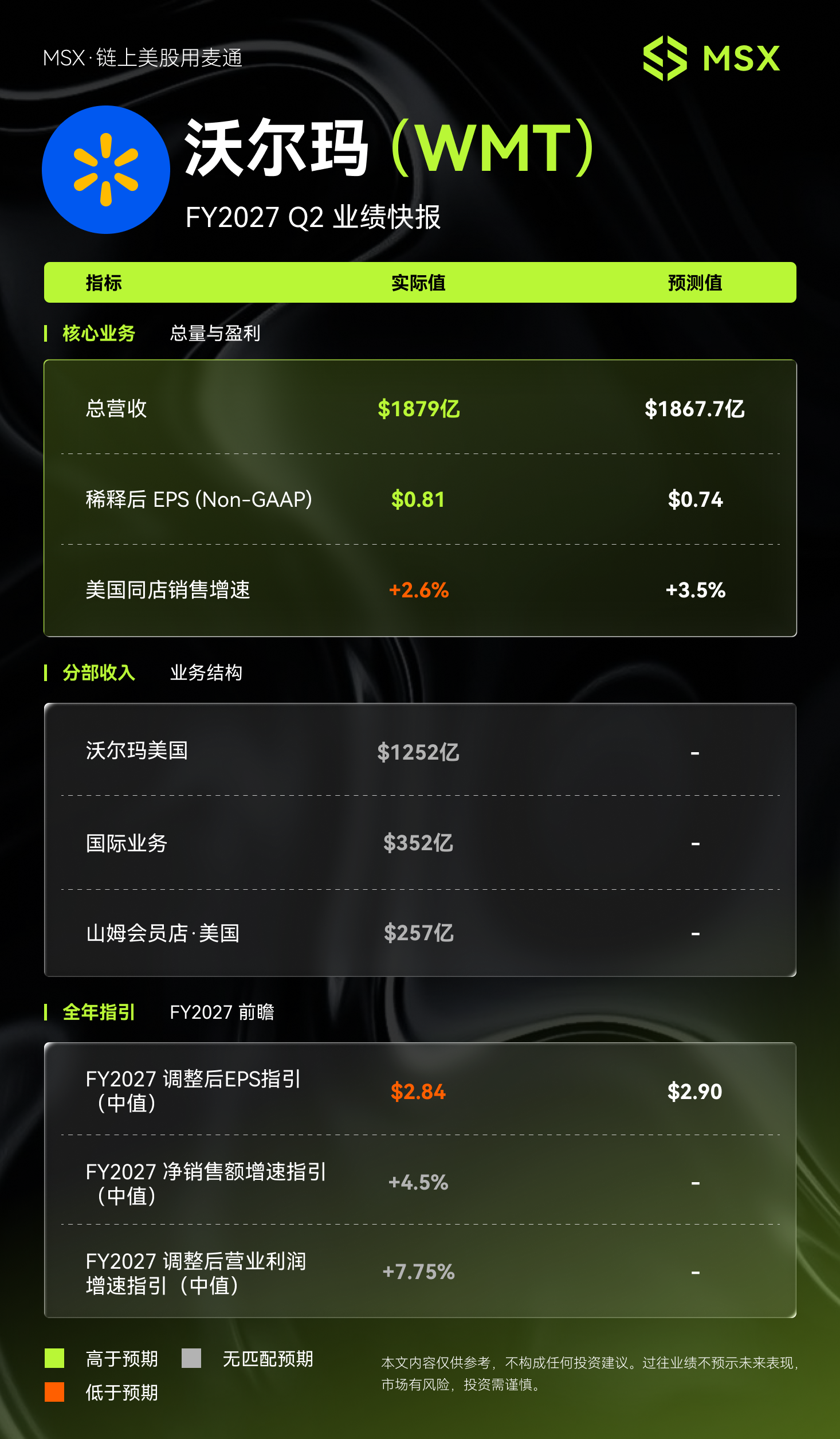
**Análisis diario de MSX sobre RWA en acciones estadounidenses: Resultados del Q2 de Walmart FY2027: Ingresos y beneficios superan expectativas, crecimiento comparable en EE.UU. alcanza mínimo en más de seis años** Los ingresos y el beneficio por acción (BPA) ajustado del último trimestre de Walmart superaron las previsiones. Los ingresos totales fueron de 187.900 millones USD (+5.9%) y el BPA ajustado de 0.81 USD (+19%). Sin embargo, la tasa de crecimiento de ventas en tiendas comparables en Estados Unidos se desaceleró al 2.6%, su nivel más bajo en más de seis años, arrastrada principalmente por la deflación de precios en farmacia. El negocio de mayor margen mantuvo un crecimiento robusto: comercio electrónico global (+23%), negocio publicitario global (+38%) y ventas en plataforma de terceros en EE.UU. (+52%). El beneficio operativo ajustado creció un 17.4%, superando el ritmo de los ingresos. La compañía revisó al alza su orientación anual para ventas y beneficios. No obstante, el límite superior de su guía para BPA ajustado (2.87 USD) permanece por debajo del consenso del mercado (2.90 USD). Esta revisión aún por debajo de las expectativas, junto con la desaceleración en ventas comparables, señalan un impulso de crecimiento más moderado en el negocio minorista principal, a pesar del fuerte desempeño de segmentos de mayor valor añadido como publicidad y marketplace.

Odaily星球日报Hace 36 min(s)

Análisis Diario de Acciones de EE.UU. de MSX: Resultados del Q2 de FY2027 de Walmart: Ingresos y Beneficios Superan Expectativas, Crecimiento de Ventas Mismo Almacén en EE.UU. Alcanza el Nivel Más Bajo en Más de Seis Años

Odaily星球日报Hace 36 min(s)

Trading

Spot

Artículos destacados

Cómo comprar ENS

¡Bienvenido a HTX.com! Hemos hecho que comprar Ethereum Name Service (ENS) sea simple y conveniente. Sigue nuestra guía paso a paso para iniciar tu viaje de criptos.Paso 1: crea tu cuenta HTXUtiliza tu correo electrónico o número de teléfono para registrarte y obtener una cuenta gratuita en HTX. Experimenta un proceso de registro sin complicaciones y desbloquea todas las funciones.Obtener mi cuentaPaso 2: ve a Comprar cripto y elige tu método de pagoTarjeta de crédito/débito: usa tu Visa o Mastercard para comprar Ethereum Name Service (ENS) al instante.Saldo: utiliza fondos del saldo de tu cuenta HTX para tradear sin problemas.Terceros: hemos agregado métodos de pago populares como Google Pay y Apple Pay para mejorar la comodidad.P2P: tradear directamente con otros usuarios en HTX.Over-the-Counter (OTC): ofrecemos servicios personalizados y tipos de cambio competitivos para los traders.Paso 3: guarda tu Ethereum Name Service (ENS)Después de comprar tu Ethereum Name Service (ENS), guárdalo en tu cuenta HTX. Alternativamente, puedes enviarlo a otro lugar mediante transferencia blockchain o utilizarlo para tradear otras criptomonedas.Paso 4: tradear Ethereum Name Service (ENS)Tradear fácilmente con Ethereum Name Service (ENS) en HTX's mercado spot. Simplemente accede a tu cuenta, selecciona tu par de trading, ejecuta tus trades y monitorea en tiempo real. Ofrecemos una experiencia fácil de usar tanto para principiantes como para traders experimentados.

352 Vistas totalesPublicado en 2024.12.10Actualizado en 2026.06.02

Cómo comprar ENS

Discusiones

Bienvenido a la comunidad de HTX. Aquí puedes mantenerte informado sobre los últimos desarrollos de la plataforma y acceder a análisis profesionales del mercado. A continuación se presentan las opiniones de los usuarios sobre el precio de ENS (ENS).

活动图片