Impermanent loss challenges the claim that DeFi is the ‘future of France’

CointelegraphPublicado a 2022-03-06Actualizado a 2022-03-06

Resumen

Impermanent loss is one of the most recognized risks that investors have to contend with when providing liquidity to an automated market maker (AMM) in the decentralized finance (DeFi) sector.

Impermanent loss is one of the most recognized risks that investors have to contend with when providing liquidity to an automated market maker (AMM) in the decentralized finance (DeFi) sector. Although it is not an actual loss incurred from the liquidity provider’s (LP) position — rather an opportunity cost that occurs when compared with simply buying and holding the same assets — the possibility of getting less value back at withdrawal is enough to keep many investors away from DeFi.
Impermanent loss is driven by the volatility between the two assets in the equal-ratio pool — the more one asset moves up or down relative to the other asset, the more impermanent loss is incurred. Providing liquidity to stablecoins, or simply avoiding volatile asset pairs, is an easy way to reduce impermanent loss. However, the yields from these strategies might not be as attractive.
So, the question is: Are there ways to participate in a high-yield LP pool and at the same time reduce as much impermanent loss as possible?
Fortunately for retail investors, the answer is yes, as new innovations continue to solve the existing problems in the DeFi world, providing many ways for traders to avoid impermanent loss.
Uneven liquidity pools help reduce impermanent loss
When talking about impermanent loss, people often refer to the traditional 50%/50% equal-ratio two-asset pool — i.e., investors have to provide liquidity to two assets at the same value. As DeFi protocols evolve, uneven liquidity pools have come into the picture to help reduce impermanent loss.
As shown in the graph below, the downside magnitude from an equal-ratio pool is much larger than an uneven pool. Given the same relative price change — e.g., Ether (ETH) increases or decreases by 10% relative to USD Coin (USDC) — the more uneven the ratio of the two assets, the less the impermanent loss.
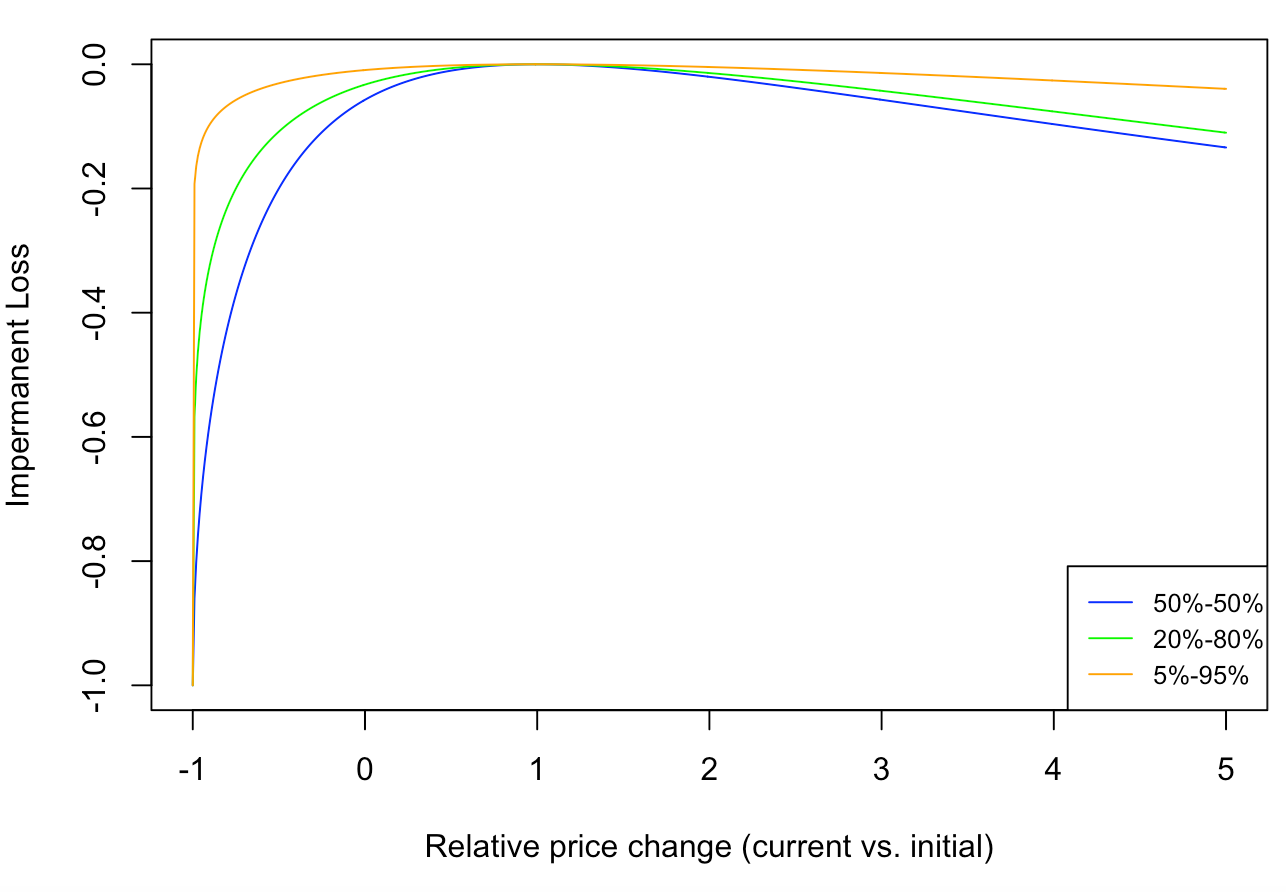
Impermanent loss from even and uneven liquidity pools. Source: Elaine HuDeFi protocols such as Balancer have made uneven liquidity pools available since as early as the beginning of 2021. Investors can explore a variety of uneven pools to seek out the best option.
Multi-asset liquidity pools are a step forward
In addition to uneven liquidity pools, multi-asset liquidity pools can also help reduce impermanent loss. By simply adding more assets to the pool, the diversification effects come into play. For example, given the same price movement in Wrapped Bitcoin (WBTC), the USDC-WBTC-USDT equal-ratio tri-pool has a lower impermanent loss than the USDC-WBTC equal-ratio pool, as shown below.
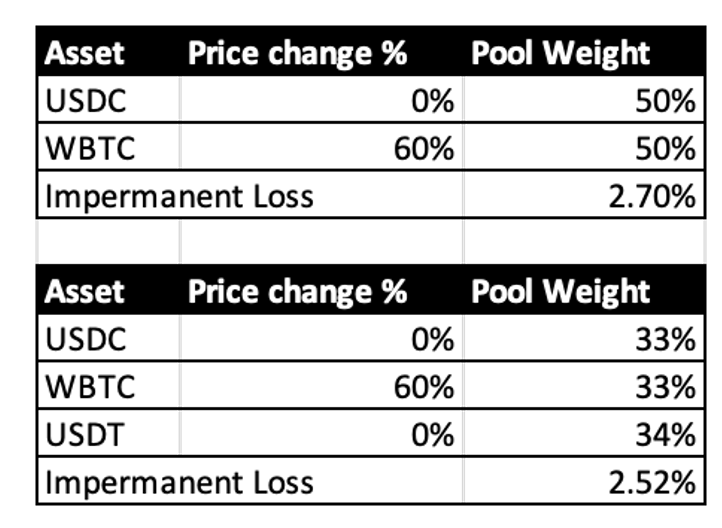
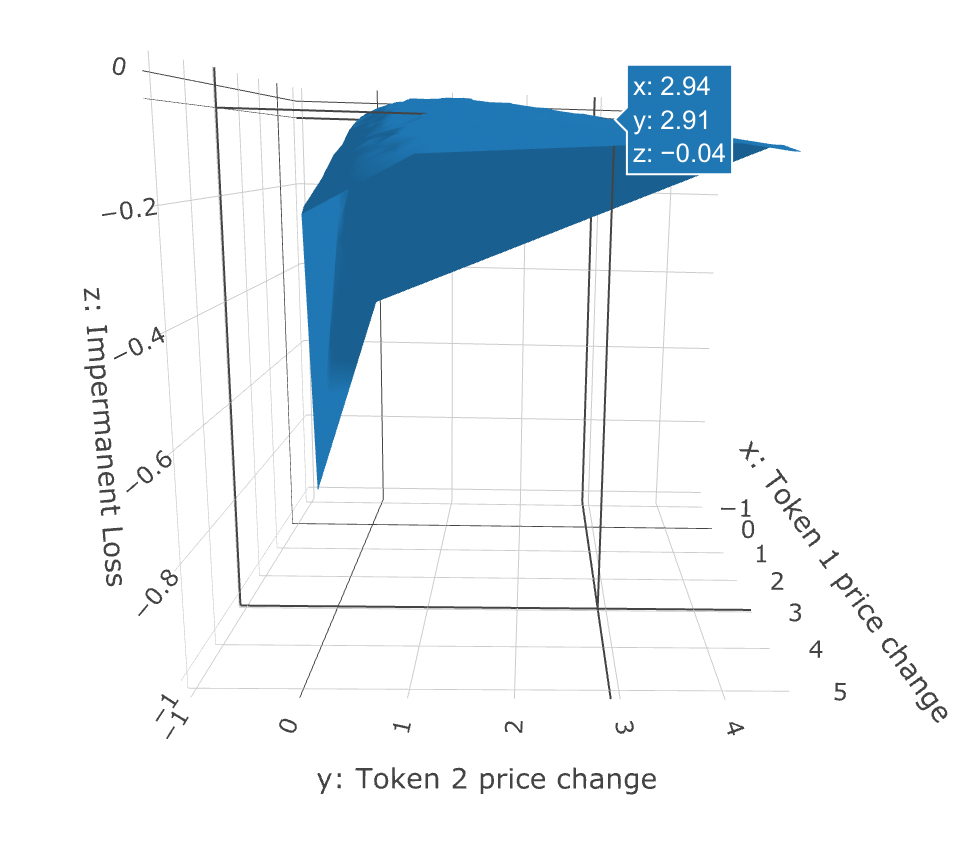
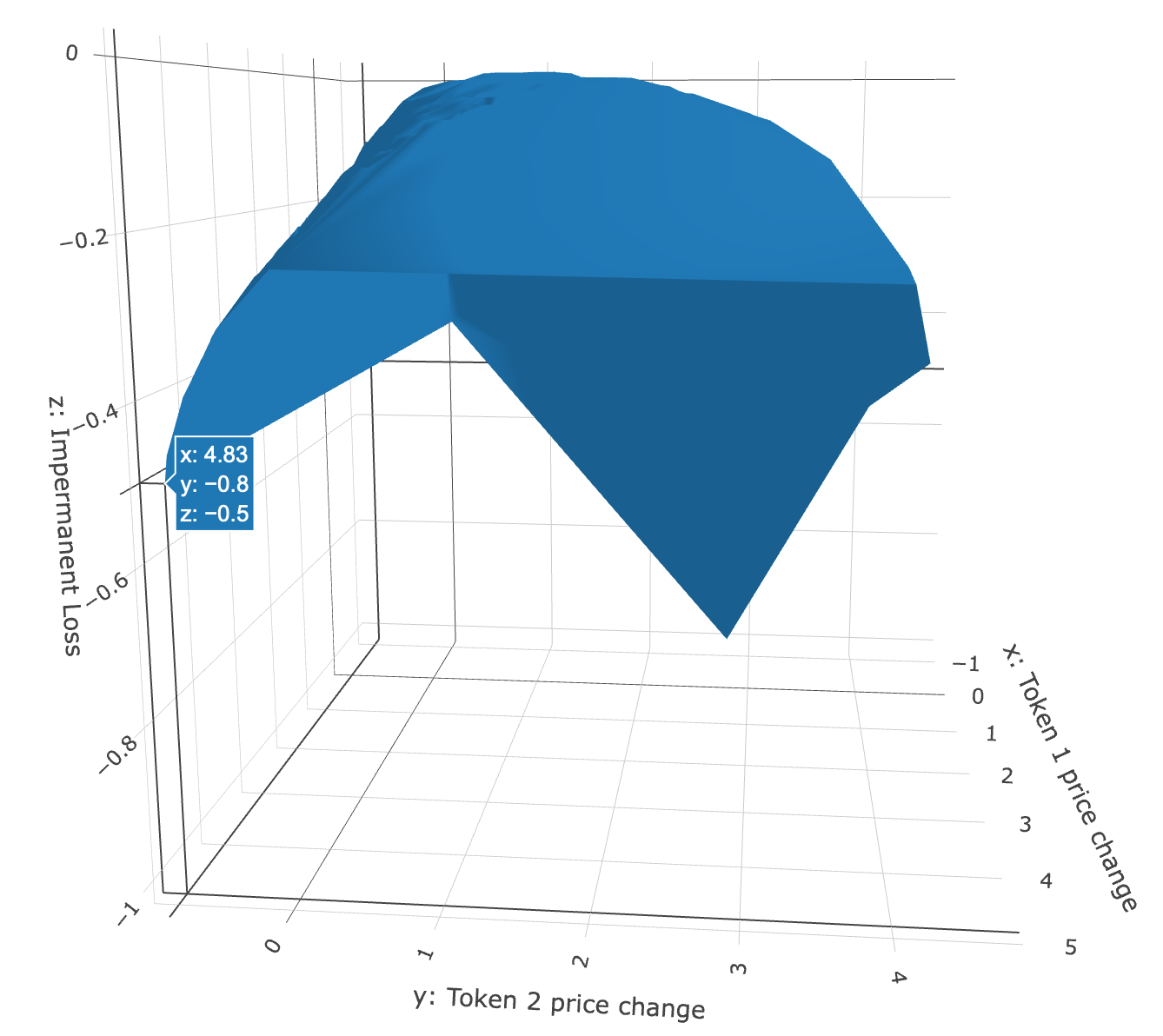
Two-asset vs. three-asset liquidity pool. Source: Topaze.blue/BancorSimilar to the two-asset liquidity pool, the more correlated the assets are in the multi-asset pool, the more the impermanent loss, and vice versa. The 3D graphs below display the impermanent loss in a tri-pool given different levels of the price change of Token 1 and Token 2 relative to the stablecoin, assuming one stablecoin is in the pool.
When the relative price change of Token 1 to the stablecoin (294%) is very close to the relative price change of Token 2 (291%), the impermanent loss is also low (-4%).
Simulation of impermanent loss from a tri-pool. Source: Elaine HuWhen the relative price change of Token 1 to stablecoin (483%) is very different and far away from the relative price change of Token 2 to stablecoin (8%), the impermanent loss becomes noticeably larger (-50%).
Simulation of impermanent loss from a tri-pool. Source: Elaine HuSingle-sided liquidity pools are the best option
Although the uneven liquidity pool and multi-asset pool both help reduce impermanent loss from the LP position, they do not eliminate it completely. If investors do not want to worry about impermanent loss at all, there are also other DeFi protocols that allow investors to provide only one side of the liquidity through a single-sided liquidity pool.
One might wonder where the risk of impermanent loss is transferred if investors do not bear the risk. One solution provided by Tokemak is to use the protocol’s native token, TOKE, to absorb this risk. Investors only need to supply liquidity such as Ether to one side, and TOKE holders will provide TOKE on the other side to pair up with Ether to create the ETH-TOKE pool. Any impermanent loss caused by the price movements in Ether relative to TOKE will be absorbed by the TOKE holder. In return, TOKE holders take all swap fees from the LP pool.
Since TOKE holders also have the power to vote for the next five pools the liquidity will be directed to, they also get bribed by protocols who want them to vote for their liquidity pools. In the end, TOKE holders bear the impermanent loss from the pool and are compensated by the swap fees and bribe rewards in TOKE.
Another solution is to separate risks into different tranches so that risk-averse investors are protected from impermanent loss and that risk-seeking investors who bear the risk will be compensated with a high-yield product. Protocols such as Ondo offer a senior fixed tranche where impermanent loss is mitigated and a variable tranche where impermanent loss is absorbed but higher yields are offered.
Automated LP manager can reduce investors’ headaches
If all of the above seems too complicated, investors can still stick to the most common 50%/50% equal-ratio pool and use an automated LP manager to actively manage and dynamically rebalance the LP position. This is especially useful in Uniswap v3, where investors need to specify a range to which they want to provide concentrated liquidity.
Automated LP managers conduct rebalancing strategies to help investors maximize LP fees and minimize impermanent loss by charging a management fee. There are two main strategies: passive rebalancing and active rebalancing. The difference is that the active rebalancing method swaps tokens to achieve the amount required at the time of rebalancing, whereas passive rebalancing does not and only swaps gradually when the pre-set price of the token is hit (similar to a limit order).
In a volatile market where prices are constantly moving sideways, a passive rebalancing strategy works well because it doesn’t need to rebalance frequently and pay large amounts of swap fees. But in a trending market where price continues to move in one direction, active rebalancing works better because the passive rebalancing strategy could miss the boat and sit outside the LP range for a long time and fail to collect any LP fees.
To choose the right automated LP manager, investors need to find the one that suits their risk appetite. There are passive rebalancing strategies such as Charm Finance that aim to earn a stable return by using a wide LP range to reduce impermanent loss. There are also passive managers such as Visor Finance that use a very narrow LP range to earn high LP fees, but are also exposed to more potential impermanent loss. Investors need to select automated LP managers based on not only their risk appetite but also their long-term investment goals.
Although traditional equal-ratio LP profits could be eroded by impermanent loss when the underlying tokens move in very different directions, there are alternative products and strategies available for investors to reduce or completely avoid impermanent loss. Investors just need to find the right trade-off between risk and return to find the best-suited LP strategy.


Criptos en tendencia

Lecturas Relacionadas

Lido, el gigante del staking líquido, traslada 8 millones de ETH a nuevos validadores para aliviar la carga de la red Ethereum

El gigante de staking líquido Lido está trasladando 8 millones de ETH, valorados en unos 16.500 millones de dólares y que representan alrededor de una quinta parte de todo el ETH actualmente en staking, a nuevos validadores. Este movimiento, facilitado por la actualización Pectra de Ethereum a principios de año, permite consolidar miles de validadores antiguos (0x01) en muchos menos validadores nuevos (0x02), ya que cada uno puede ahora contener hasta 2.048 ETH en lugar de 32 ETH. Esta migración reducirá el número total de validadores de Ethereum en casi un tercio, lo que disminuirá la carga de datos en la capa de consenso y hará la red más eficiente y económica. Para Lido, aumentará la proporción de su ETH en validadores 0x02 del 32% actual a aproximadamente el 52%. La actualización, llamada Curated Module v2 (CMv2), también introduce un cambio clave: los operadores profesionales ahora deben bloquear ETH como garantía para cubrir riesgos como penalizaciones (slashing) o fallos operativos, alineándose con el módulo comunitario (CSM) existente. Además, el CSM v3 añade una nueva categoría para grupos comunitarios verificados que usan tecnología de validador distribuido (DVT), lo que reduce el riesgo y los requisitos de garantía. Los titulares de stETH no necesitan realizar ninguna acción. Lido también anunció una fase posterior para 2027 que creará un mercado donde los operadores competirán en función de tarifas y rendimiento.

cryptonews.ruHace 1 hora(s)

Lido, el gigante del staking líquido, traslada 8 millones de ETH a nuevos validadores para aliviar la carga de la red Ethereum

cryptonews.ruHace 1 hora(s)

Crypto.com, respaldada por Citadel Securities, traslada XYO y XL1 a custodia regulada

Crypto.com, con el respaldo de Citadel Securities, integra los tokens XYO y XL1 en su servicio de custodia regulada, ofreciendo a instituciones e inversores adinerados un mecanismo seguro para almacenar, gestionar y negociar ambos activos sin necesidad de transferirlos previamente a un exchange. La custodia utiliza carteras MPC segregadas por cliente, gestionadas por una entidad a prueba de bancarrota, con claves protegidas mediante computación multipartita. Esto proporciona almacenamiento en frío, trazabilidad auditora y acceso a la liquidez institucional de Crypto.com, eliminando el paso operativo de mover fondos antes de operar. El presidente de Crypto.com, Eric Anziani, destacó que el acuerdo busca ofrecer seguridad y liquidez ininterrumpida, apoyando la expansión global del ecosistema XYO. Marcus Levin, cofundador de XYO, subrayó la importancia de una custodia corporativa para sus activos digitales mientras desarrollan infraestructuras de IA y robótica. El anuncio sigue a una inversión de 400 millones de dólares de Citadel Securities en Crypto.com y a la obtención de una licencia bancaria federal condicional por parte de la empresa en 2026. XYO opera una red DePIN con millones de nodos que generan datos del mundo real para IA y logística, mientras que XL1 gestiona transacciones y tarifas dentro de esa red. Para inversores institucionales, este acuerdo facilita la exposición a tokens de nicho al demostrar que cumplen con los mismos estándares regulatorios y de seguridad que los activos más establecidos.

cryptonews.ruHace 1 hora(s)

Crypto.com, respaldada por Citadel Securities, traslada XYO y XL1 a custodia regulada

cryptonews.ruHace 1 hora(s)

Faltan menos de dos semanas: comienza la cuenta regresiva del BIP-110 para Bitcoin, y el apoyo de los mineros crece gradualmente ante el momento decisivo

Quedan menos de dos semanas para el inicio de la ventana de señalización obligatoria del BIP-110 (fork temporal suave de datos reducidos) para Bitcoin, que se activará en el bloque 961.632, alrededor del 9 de agosto de 2026. Su objetivo es limitar datos en transacciones no financieras, como inscripciones Ordinals y grandes cargas OP_RETURN. Aunque el apoyo entre mineros ha crecido del 1% al 3%, esto aún es insuficiente. Los principales pools (Foundry, Antpool, ViaBTC, F2pool), que controlan la mayor parte del hashrate, se mantienen en contra. Solo el pool Ocean y pequeños operadores independientes señalan a favor. En cuanto a nodos, solo un 22% ejecuta la implementación de Bitcoin Knots que aplica la propuesta. El mecanismo es controvertido. Si al abrirse la ventana no hay apoyo mayoritario, los nodos que aplican el BIP-110 rechazarán los bloques sin la señal, creando potencialmente dos cadenas: una mayoritaria (sin cambios) y una minoritaria (más lenta). Esto recuerda al UASF de 2017. Foundry, un pool clave (~23-33% del hashrate), dejó la decisión a una votación ponderada entre sus clientes; si no hay mayoría a favor, seguirá en contra. Los próximos días serán decisivos, dependiendo de si algún gran pool cambia de postura, las aclaraciones de los exchanges y las acciones reales de los mineros tras el bloque 961.632.

cryptonews.ruHace 1 hora(s)

Faltan menos de dos semanas: comienza la cuenta regresiva del BIP-110 para Bitcoin, y el apoyo de los mineros crece gradualmente ante el momento decisivo

cryptonews.ruHace 1 hora(s)

Trading

Spot

Artículos destacados

Cómo comprar GRT

¡Bienvenido a HTX.com! Hemos hecho que comprar The Graph (GRT) sea simple y conveniente. Sigue nuestra guía paso a paso para iniciar tu viaje de criptos.Paso 1: crea tu cuenta HTXUtiliza tu correo electrónico o número de teléfono para registrarte y obtener una cuenta gratuita en HTX. Experimenta un proceso de registro sin complicaciones y desbloquea todas las funciones.Obtener mi cuentaPaso 2: ve a Comprar cripto y elige tu método de pagoTarjeta de crédito/débito: usa tu Visa o Mastercard para comprar The Graph (GRT) al instante.Saldo: utiliza fondos del saldo de tu cuenta HTX para tradear sin problemas.Terceros: hemos agregado métodos de pago populares como Google Pay y Apple Pay para mejorar la comodidad.P2P: tradear directamente con otros usuarios en HTX.Over-the-Counter (OTC): ofrecemos servicios personalizados y tipos de cambio competitivos para los traders.Paso 3: guarda tu The Graph (GRT)Después de comprar tu The Graph (GRT), guárdalo en tu cuenta HTX. Alternativamente, puedes enviarlo a otro lugar mediante transferencia blockchain o utilizarlo para tradear otras criptomonedas.Paso 4: tradear The Graph (GRT)Tradear fácilmente con The Graph (GRT) en HTX's mercado spot. Simplemente accede a tu cuenta, selecciona tu par de trading, ejecuta tus trades y monitorea en tiempo real. Ofrecemos una experiencia fácil de usar tanto para principiantes como para traders experimentados.

287 Vistas totalesPublicado en 2024.12.10Actualizado en 2026.06.02

Cómo comprar GRT

Discusiones

Bienvenido a la comunidad de HTX. Aquí puedes mantenerte informado sobre los últimos desarrollos de la plataforma y acceder a análisis profesionales del mercado. A continuación se presentan las opiniones de los usuarios sobre el precio de GRT (GRT).

活动图片