Michael Saylor Identifies the Next Financial Opportunity Worth Billions

cryptonews.ruPublicado a 2026-08-09Actualizado a 2026-08-09

Resumen

Michael Saylor, Executive Chairman of Strategy Inc. (Nasdaq: MSTR), identified digital credit as the next billion-dollar business opportunity in finance. In an August 7th post on X, he suggested entrepreneurs explore this category. Saylor's post included a chart showing the effective yields of four of Strategy's digital credit products as of 11:10 AM EDT. Leading was Stride Preferred Shares (STRD) with a 15.29% yield, followed by Stretch Preferred Shares (STRC) at 12.63%, Strike Preferred Shares (STRK) at 12.08%, and Strife Preferred Shares (STRF) at 10.38%. These preferred securities allow Strategy to raise capital from income-seeking investors, offering various dividend rates, risk levels, and positions in the company's capital structure. Strategy has developed a suite of preferred shares classified as digital credit instruments. For instance, the Stretch Preferred Shares (STRC) are perpetual, variable-rate securities. This approach applies established credit market structures to companies with digital asset-based balance sheets, connecting capital-seeking issuers with yield-seeking investors through Wall Street-like products. Saylor positioned these as a "digital credit stack," built upon but not backed by Strategy's bitcoin reserve, expanding the company's capital access while targeting yield-focused buyers. The billion-dollar potential lies in creating a scalable, replicable business model where issuers can raise capital via tailored income securities and investors ca...

Michael Saylor, Executive Chairman of Strategy Inc. (Nasdaq: MSTR), shared his view on the next billion-dollar business in finance in an August 7 post on X, pointing entrepreneurs towards digital credit as the financial category he would explore.

Saylor wrote on X:

"If I were looking for the next billion-dollar business in finance, I would study digital credit."

A chart attached to his post showed the effective yields of four securities from Strategy's suite of digital credit products as of 11:10 AM Eastern Time (EDT). Leading the way were Stride Preferred Shares (STRD) with a yield of 15.29%, followed by Stretch Preferred Shares (STRC) at 12.63%, Strike Preferred Shares (STRK) at 12.08%, and Strife Preferred Shares (STRF) at 10.38%.
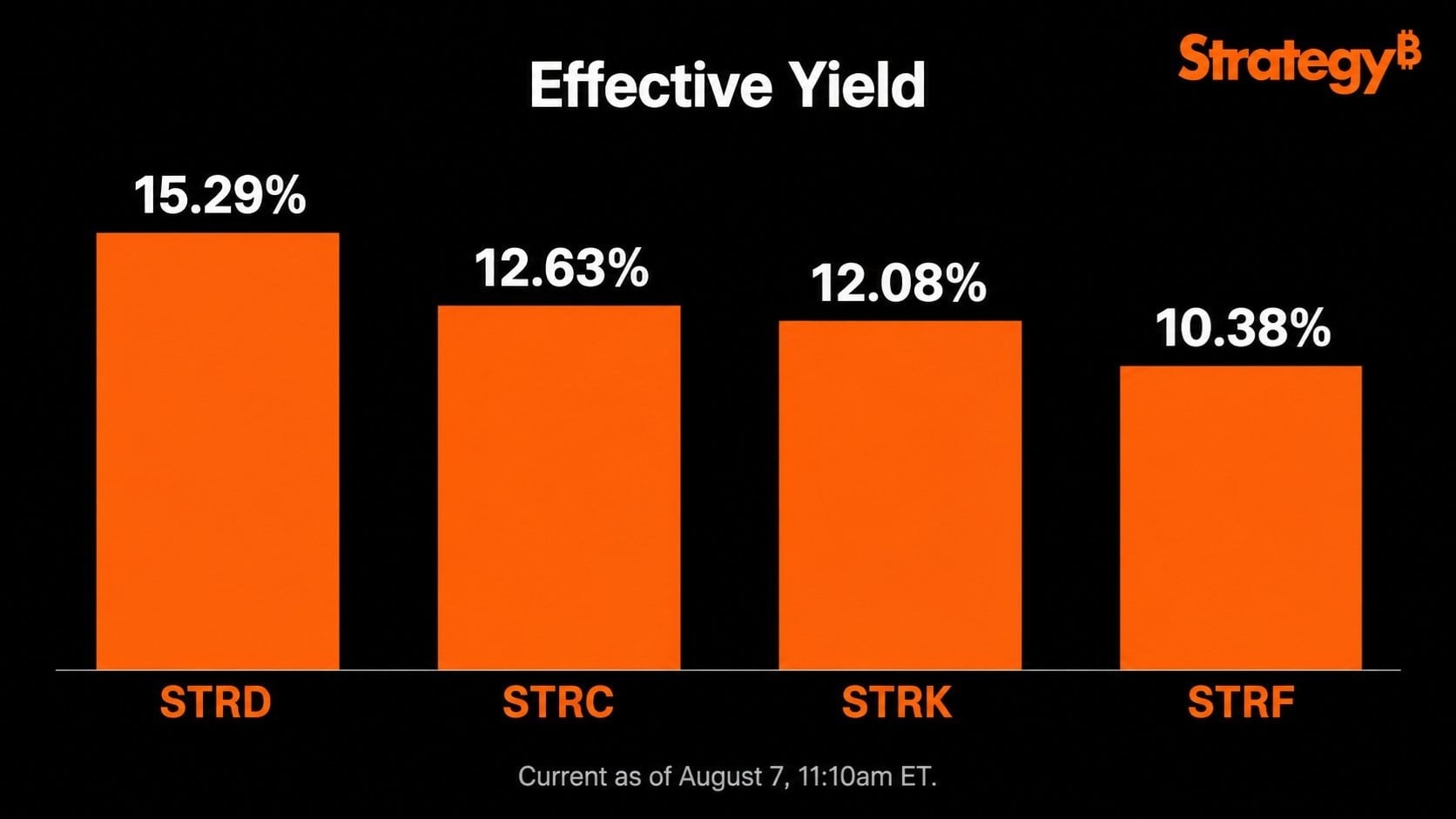
Effective yields of Strategy's credit products. Source: Strategy Inc.

Collectively, these four types of preferred securities allow Strategy to raise capital from yield-seeking investors while offering varying dividend rates, risk levels, and positions in the company's capital structure. These securities extend Strategy's financing options beyond common stock and debt obligations.

Strategy Creates Digital Credit Products Based on Capital Markets

Strategy has developed a set of preferred shares which it classifies as digital credit instruments. Its Stretch Preferred Shares (STRC) are perpetual preferred securities with a variable dividend rate, allowing Strategy to adjust payouts while offering investors a yield-oriented instrument.

The broader assortment targets investors with different yield and risk preferences, simultaneously extending familiar preferred share structures into digital asset markets. Preferred securities pay dividends and occupy a different position compared to common shares in a company's capital structure.

Growing dividend obligations have also influenced how Strategy manages its Bitcoin holdings and cash reserves. The company has sold Bitcoin to finance preferred share payments and build a US dollar reserve, ensuring liquidity for its expanding yield securities.

Why Saylor Considers the Digital Credit Market a Billion-Dollar Opportunity

The scale of this opportunity stems from applying established credit market structures to companies and balance sheets underpinned by digital assets. This model connects capital-seeking issuers with yield-seeking investors through securities that resemble familiar Wall Street products.

Saylor has defined these preferred securities as a "digital credit stack," positioning them as fixed-income alternatives built upon Strategy's Bitcoin reserve. These securities are not secured by Strategy's Bitcoin assets. This approach expands the company's access to capital while targeting yield-seeking buyers through publicly listed securities.

This model creates a potentially replicable business: issuers can raise capital using tailored yield securities, and investors can select products based on yield, risk, and capital priority. Strategy is already testing this concept through several offerings.

Digital Credit Extends Beyond a Single Product

Investor interest in Strategy's preferred securities has grown as the company expands its digital lending product line. STRC has become a significant part of this expansion; Saylor highlighted its growth while also outlining the potential scale of the digital lending market.

The broader opportunity lies in creating products for various capital pools rather than relying on a single offering. A scalable structure could give issuers more flexibility to align with market preferences for yield and risk.

For Strategy, this approach allows it to raise capital from buyers who want yield exposure without direct Bitcoin exposure, while maintaining its broader Bitcoin ownership strategy.

end-content

Preguntas relacionadas

QAccording to Michael Saylor, what financial category would he explore for the next billion-dollar business?

AMichael Saylor stated he would explore digital credit for the next billion-dollar business in finance.

QWhich Strategy preferred stock had the highest effective yield according to the chart in the article?

AAccording to the chart, the Stride (STRD) preferred stock had the highest effective yield at 15.29%.

QHow are Strategy's preferred securities classified, and what is one key feature of the Stretch (STRC) preferred stock?

AStrategy classifies its preferred securities as digital credit instruments. The Stretch (STRC) preferred stock is a perpetual preferred security with a variable dividend rate.

QWhy does Michael Saylor believe the digital credit market represents a billion-dollar opportunity?

AHe believes it represents a billion-dollar opportunity because it applies established credit market structures to companies and balance sheets underpinned by digital assets, creating scalable financial products for income-seeking investors.

QHow has the growth of dividend obligations impacted Strategy's management of its Bitcoin reserves and cash?

AThe growing dividend obligations have led Strategy to sell Bitcoin to finance preferred stock payments and build a U.S. dollar reserve, ensuring liquidity for its expanding income securities.

Lecturas Relacionadas

Aleksandr Shojin: los negocios necesitan un tipo de interés inferior al 10% y un dólar en el rango de 90-95 rublos

El presidente de la Unión de Industriales y Empresarios de Rusia, Alexander Shojin, ha planteado la posible utilización de instrumentos "no de mercado" para mantener el rublo dentro de un determinado rango cambiario. Este enfoque, según declaró el 21 de agosto, ayudaría a evitar una excesiva volatilidad de la moneda nacional. La idea de un corredor cambiario para el rublo no es nueva; Shojin ya la había mencionado en mayo, argumentando que el tipo de cambio actual no es completamente de mercado debido al limitado volumen del segmento de divisas. El líder empresarial también ha definido los objetivos que el sector espera ver para finales de 2026: una tasa de interés clave del Banco de Rusia del 12%, una inflación entre el 4% y el 5%, y un tipo de cambio del dólar entre 90 y 95 rublos. No obstante, aclaró que el nivel realmente cómodo para los negocios sería una tasa clave por debajo del 10%, subrayando la importancia crucial de la previsibilidad del rublo para las decisiones de inversión. Su postura conecta directamente estos tres elementos —tasa de interés, inflación y tipo de cambio— con la disposición del sector empresarial a invertir en nuevos proyectos. El análisis de datos señala que un mecanismo similar de corredor cambiario se aplicó en Rusia entre 1995 y 1998, pero su rigidez demostró ser frágil ante shocks externos, culminando en la crisis de agosto de 1998. La viabilidad de una medida así dependería de la disponibilidad de reservas suficientes para defender el corredor en momentos de presión sobre la moneda.

cryptonews.ruHace 1 hora(s)

Aleksandr Shojin: los negocios necesitan un tipo de interés inferior al 10% y un dólar en el rango de 90-95 rublos

cryptonews.ruHace 1 hora(s)

Trading

Spot
活动图片