Pennsylvania Bill Could Bar Sportsbooks from Participating in Prediction Market-Making

cryptonews.ruPublicado a 2026-07-28Actualizado a 2026-07-28

Resumen

A bipartisan group of lawmakers in Pennsylvania introduced House Bill 2711, which could prohibit gambling companies, including sportsbooks, from serving as liquidity providers or market makers on prediction market platforms. The bill aims to separate prediction market infrastructure from gambling entities. It would ban platforms from contracting or sharing revenue with companies engaged in gambling and imposes consumer protections, including age restrictions and bans on markets related to minors, health, and death. Unlike proposals in other states, it seeks to regulate rather than ban prediction markets, focusing on restricting liquidity sources. The bill contrasts with another Pennsylvania proposal (HB 2497) that would license and tax such platforms. This legislative push occurs amid a national debate over whether prediction contracts are gambling or financial derivatives, following a recent federal court ruling that federal commodity law preempts state gambling laws for CFTC-registered exchanges.

A group of bipartisan Pennsylvania legislators has introduced a bill that could prohibit sportsbooks and other gambling companies from serving as liquidity providers or market makers on prediction platforms. House Bill 2711 was introduced on July 22 by Representative Tarik Khan and referred to the House Consumer Protection, Technology and Utilities Committee. It has a total of 24 co-sponsors—20 Democrats and four Republicans.

The bill would ban a provider from offering a prediction market in Pennsylvania if its liquidity provider or market maker knowingly engages in gambling activities in the course of regular business, both within and outside the state. The restriction applies to parent companies, subsidiaries, affiliates, joint ventures, employees, and legal entities operating for the financial interest of another company.

Prediction platforms would also be barred from entering into contracts or sharing revenue with companies ordinarily engaged in gambling. A new chapter in the bill dedicated to prediction markets does not define the term “gambling activity” nor clarify how these provisions would apply to platforms affiliated with sports betting operators, leaving uncertainty about how broadly courts or regulators would apply this restriction.

This provision emerges as traditional sports betting groups move beyond consumer-facing prediction apps to the infrastructure underpinning their contracts. Companies like DraftKings and Flutter engage in market-making activities, and DraftKings recently launched its own DKeX exchange after acquiring CFTC-registered firm Railbird Technologies.

If HB 2711 is passed and applied broadly, it could prevent sportsbook-controlled market makers from supporting contracts offered to Pennsylvania residents. It could also complicate partnerships where a prediction exchange shares revenue with a casino, sportsbook, or gambling-affiliated company. Furthermore, unlike proposals in several other states, this bill treats prediction markets as an activity to be regulated, not banned. Thus, the focus of the restrictions imposed on gambling operators is limiting liquidity, not an outright prohibition.

The bill sets a minimum age of 21 and requires platforms to exclude self-excluded users, company employees, employees of settling organizations, and individuals with insider information. Providers would need to implement commercially reasonable safeguards against fraud, manipulation, and misuse of material nonpublic information. Additionally, the bill prohibits markets related to scholastic sports, sporting events involving minors, individual health conditions, and so-called “death markets”—contracts tied to a person’s death, attempted murder, assassination, or mass casualty events. Athletes, coaches, officials, candidates, campaign staff, and others capable of influencing an event’s outcome could be held liable for trading related contracts.

Since this proposal does not establish a licensing regime, enforcement functions are assigned to the Attorney General, who would gain powers to investigate, impose fines, and shut down platforms operating in violation. This distinguishes it from House Bill 2497, introduced on May 8 by Representative Danilo Burgos and co-sponsored by Khan, which is before the House Gaming Oversight Committee. The earlier bill proposed licensing by the Pennsylvania Gaming Control Board, with fees of $1 million for an initial permit and $1 million annually, a tax of 20% on prediction betting gross revenue plus a 2% local assessment, and fines for unlicensed operators of up to $25,000.

A combined 22% rate would be significantly lower than what Pennsylvania already charges its licensed operators, who pay 36% on sports betting revenue and 54% on online slots revenue—among the highest rates in the nation. Burgos framed his bill around what he calls “regulatory arbitrage,” arguing that platforms claiming to offer financial derivatives rather than gambling products circumvent safeguards established for casinos and sportsbooks.

These two measures did not emerge as competing initiatives but developed in parallel: in March, Burgos circulated a memo on licensing and taxation, and in late April, Khan filed his insider trading bill. Khan is a co-sponsor of both bills, and in contemporary publications they are described as complementary measures: HB 2497 treats sports event contracts as bets regulated by the state, while HB 2711 supplements them with conduct and consumer protection rules.

Pennsylvania’s gambling regulator has taken a more confrontational stance. In May, the PGCB informed the Commodity Futures Trading Commission (CFTC) that sports event contracts constitute illegal wagers under state law and accused federally regulated exchanges of operating as unlicensed sportsbooks accessible to individuals under 21. Pennsylvania also joined a coalition of 40 states arguing that sports event contracts should fall under state gambling oversight.

On April 6, the Third Circuit Court of Appeals in KalshiEX LLC v. Flaherty ruled 2–1 that the Commodity Exchange Act preempts state gambling laws concerning sports event contracts on CFTC-registered exchanges and upheld an injunction preventing New Jersey from taking enforcement action against Kalshi. This precedent is binding on federal courts in Pennsylvania. In her dissent, Judge Jane Roth argued that Kalshi’s contracts are “virtually indistinguishable” from products offered by DraftKings and FanDuel—the very intersection targeted by HB 2711’s liquidity provisions, but from the opposite side.

Neither Pennsylvania bill has received a committee vote or hearing. Nevertheless, HB 2711 introduces a new fault line in the nationwide struggle: states may not only challenge whether prediction markets can function but also attempt to separate their trading infrastructure from the gambling companies increasingly seeking to control it.

end-content

Criptos en tendencia

Preguntas relacionadas

QWhat is the main objective of Pennsylvania House Bill No 2711?

AThe bill aims to prohibit sportsbooks and other gambling companies from serving as liquidity providers or market makers on prediction markets platforms in Pennsylvania.

QHow might HB 2711 affect companies like DraftKings if passed broadly?

AIt could prevent their affiliated market makers from supporting contracts offered to Pennsylvania residents and complicate revenue-sharing partnerships between prediction exchanges and gambling entities.

QHow does HB 2711 differ from the earlier Pennsylvania bill HB 2497 in its regulatory approach?

AHB 2711 focuses on consumer protection rules and conduct, granting enforcement power to the Attorney General without a licensing regime, while HB 2497 proposes a state licensing and taxation system for prediction markets as gambling activities.

QWhat significant legal precedent is mentioned that could impact Pennsylvania's ability to regulate prediction markets?

AThe Third Circuit Court's ruling in KalshiEX LLC v. Flaherty, which held that the Commodity Exchange Act preempts state gambling laws for event contracts on CFTC-registered exchanges, setting a binding precedent for federal courts in Pennsylvania.

QWhat key consumer protection measures are outlined in HB 2711?

AIt sets a minimum age of 21, requires platforms to exclude certain individuals (like those self-excluded or with insider information), mandates fraud protections, and bans markets on topics like youth sports, individual health, and 'death markets'.

Lecturas Relacionadas

3% de cashback, 6% de interés anual y una tarjeta de débito: Elon Musk lanza X Money en EE.UU.

La red social X (anteriormente Twitter) anunció el 27 de julio de 2026 el lanzamiento de su servicio financiero integrado, X Money. De momento, solo está disponible para suscriptores Premium y Premium+ en Estados Unidos. Los residentes estadounidenses mayores de 18 años con cuenta verificada pueden registrarse. Los fondos se custodian en Cross River Bank, con seguro FDIC estándar de hasta $250,000, pudiendo extenderse hasta $10 millones mediante el programa Cash Sweep. El producto central es la tarjeta de débito X Card (virtual o física de metal), que funciona con la red Visa. Sus funciones incluyen: transferencias instantáneas y gratuitas entre usuarios de X, cashback del 3% en la mayoría de compras, retiros de efectivo sin comisión en cajeros a nivel mundial, sin comisiones por operaciones en el extranjero, y compatibilidad con Apple Pay y Google Pay. El servicio también ofrece hasta un 6.00% de interés anual (APY) sobre el saldo. Los usuarios Premium+ lo obtienen directamente, mientras que los de Premium deben cumplir condiciones como depósito directo de nómina. Además, permite recibir el salario hasta dos días antes y realizar transferencias bancarias o pagar facturas. En cuanto a seguridad, utiliza claves de acceso (biometría o PIN) en lugar de contraseñas, permite configurar límites de transacción e incluye la política de responsabilidad cero de Visa. El lanzamiento siguió a una fase beta limitada a finales de junio de 2026. Este movimiento busca transformar X de una red social pura a una plataforma digital que integra comunicación y operaciones financieras cotidianas.

cryptonews.ruHace 2 min(s)

3% de cashback, 6% de interés anual y una tarjeta de débito: Elon Musk lanza X Money en EE.UU.

cryptonews.ruHace 2 min(s)

Se evaporan posiciones largas de Bitcoin por valor de 134 millones de dólares al caer el precio por debajo de 63,000 dólares antes de la crucial reunión de la Fed

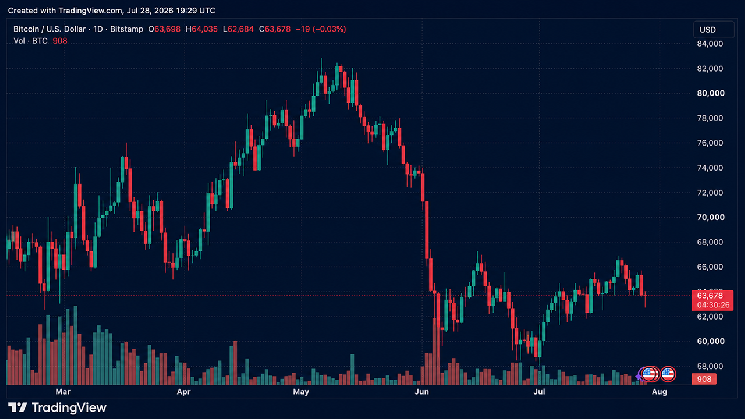
Tras un día de movimiento lateral, el precio del bitcoin se desplomó bruscamente el martes, cayendo brevemente por debajo de los 63 000 dólares en preparación para una semana crucial. La criptomoneda tocó un mínimo intradía de 62 684 dólares antes de recuperarse parcialmente, cotizando cerca de los 63 660 dólares con una pérdida diaria del 2%. Esta caída provocó la liquidación de posiciones largas apalancadas en bitcoin por valor de 134 millones de dólares, elevando el total de liquidaciones relacionadas con BTC a más de 156 millones. Aunque bitcoin sigue en camino de cerrar julio con ganancias, los expertos señalan que la última semana del mes, llena de eventos clave, podría determinar su trayectoria para gran parte del segundo semestre del año. Los factores decisivos incluyen la reunión del Comité Federal de Mercado Abierto (FOMC), los datos del índice de precios de consumo personal (PCE) básico y los resultados de gigantes tecnológicos como Apple y Amazon. Mike McClasky, experto de TX y ex ejecutivo de Fidelity, destacó que la conferencia de prensa del presidente de la Fed, Kevin Warsh, ofrecerá pistas cruciales sobre la inflación y la posible relajación de la política monetaria. Un escenario favorable, con un PCE básico en descenso y un crecimiento del PIB acorde a las expectativas, podría permitir a la Fed mantener las tasas y reactivar la narrativa desinflacionaria, impulsando a bitcoin hacia el rango de 68 000-70 000 dólares en agosto. Por el contrario, datos más fuertes de lo esperado o un tono "halcón" de la Fed, junto con resultados empresariales decepcionantes, podrían hacer que bitcoin vuelva a probar el soporte de 58 000-60 000 dólares.

cryptonews.ruHace 22 min(s)

Se evaporan posiciones largas de Bitcoin por valor de 134 millones de dólares al caer el precio por debajo de 63,000 dólares antes de la crucial reunión de la Fed

cryptonews.ruHace 22 min(s)

Trading

Spot

Artículos destacados

Cómo comprar BILL

¡Bienvenido a HTX.com! Hemos hecho que comprar Billions Network (BILL) sea simple y conveniente. Sigue nuestra guía paso a paso para iniciar tu viaje de criptos.Paso 1: crea tu cuenta HTXUtiliza tu correo electrónico o número de teléfono para registrarte y obtener una cuenta gratuita en HTX. Experimenta un proceso de registro sin complicaciones y desbloquea todas las funciones.Obtener mi cuentaPaso 2: ve a Comprar cripto y elige tu método de pagoTarjeta de crédito/débito: usa tu Visa o Mastercard para comprar Billions Network (BILL) al instante.Saldo: utiliza fondos del saldo de tu cuenta HTX para tradear sin problemas.Terceros: hemos agregado métodos de pago populares como Google Pay y Apple Pay para mejorar la comodidad.P2P: tradear directamente con otros usuarios en HTX.Over-the-Counter (OTC): ofrecemos servicios personalizados y tipos de cambio competitivos para los traders.Paso 3: guarda tu Billions Network (BILL)Después de comprar tu Billions Network (BILL), guárdalo en tu cuenta HTX. Alternativamente, puedes enviarlo a otro lugar mediante transferencia blockchain o utilizarlo para tradear otras criptomonedas.Paso 4: tradear Billions Network (BILL)Tradear fácilmente con Billions Network (BILL) en HTX's mercado spot. Simplemente accede a tu cuenta, selecciona tu par de trading, ejecuta tus trades y monitorea en tiempo real. Ofrecemos una experiencia fácil de usar tanto para principiantes como para traders experimentados.

569 Vistas totalesPublicado en 2026.05.07Actualizado en 2026.06.02

Cómo comprar BILL

Discusiones

Bienvenido a la comunidad de HTX. Aquí puedes mantenerte informado sobre los últimos desarrollos de la plataforma y acceder a análisis profesionales del mercado. A continuación se presentan las opiniones de los usuarios sobre el precio de BILL (BILL).

活动图片