Jito jumps 12% after JIP-38 buyback proposal – Can JTO reach $0.80?

ambcryptoPublicado a 2026-07-21Actualizado a 2026-07-21

Resumen

Jito (JTO) surged 12% following the introduction of JIP-38, a proposal to use Jito DAO's revenue from JTX Trade for programmatic JTO buybacks and burns for at least one year. The token's price rose to $0.6087 with market cap reaching $304.67 million, supported by increased trading volume and positive sentiment around Solana's ecosystem. Derivatives activity grew as Open Interest increased, indicating fresh capital entering the market. Spot market data also showed sustained buyer dominance. Technically, JTO rebounded from the $0.5332 support level, with the next key resistance at $0.65. A break above this level could pave the way for a move toward $0.80, while failure to hold support may lead to a retest of lower levels. The rally is viewed as driven by improving fundamentals and broader participation rather than mere speculation.

Jito [JTO] climbed 11.59% over the previous 24 hours to $0.6087 as of writing, while its market capitalization reached $304.67 million as investor interest strengthened. Trading activity also accelerated, with daily volume surging 142.17%, indicating that buyers returned aggressively after recent weakness.

The rally followed growing optimism surrounding JIP-38, a proposal that established Jito as a token-centric network by directing 100% of the Jito DAO’s revenue share from JTX Trade toward programmatic JTO buybacks and burns for at least one year.

Positive sentiment surrounding Solana’s [SOL] institutional adoption and capital rotation into Solana ecosystem tokens further supported the move. As a result, market participants increasingly viewed the proposal as a long-term value driver rather than a short-lived catalyst.

JTO’s leveraged traders return

Derivatives traders also increased their exposure as Open Interest (OI) rose 14.53% to $52.05 million at press time, during the rally. The increase suggested that fresh positions entered the market instead of existing contracts simply closing.

Rising OI alongside double-digit price gains often reflected stronger market conviction because both spot and futures participants committed additional capital.

Unlike rallies driven by declining derivatives exposure, JTO‘s advance attracted broader participation across multiple trading segments. The combination suggested traders expected the bullish narrative surrounding JIP-38 to continue influencing price action.

However, expanding leveraged exposure also increased the probability of sharper volatility should sentiment reverse or profit-taking accelerate after the recent advance.
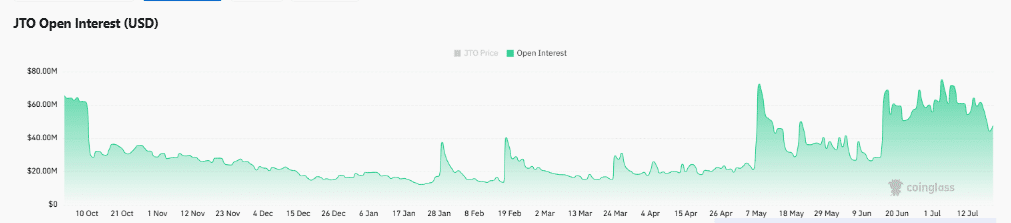
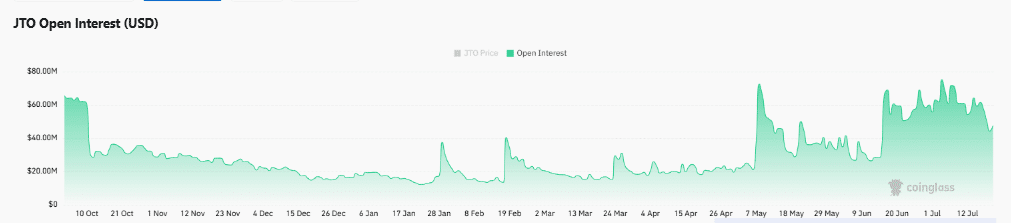
Source: CoinGlass

Buyers maintained control across spot markets

Spot market activity also favored buyers throughout the latest recovery.

At the time of writing, the 90-day Futures Taker CVD remained buy dominant, showing that aggressive market buyers consistently absorbed available sell orders. The behavior aligned with the sharp increase in trading volume, which expanded 142.17% over the previous day.

Stronger buying pressure supported the price recovery instead of allowing sellers to regain control after recent weakness.

In addition, the sustained demand complemented improving sentiment surrounding Jito’s revised tokenomics and the broader Solana ecosystem. Although buyers held the advantage, continued demand would remain necessary to absorb future profit-taking as speculative participation increased across both spot and derivatives markets.
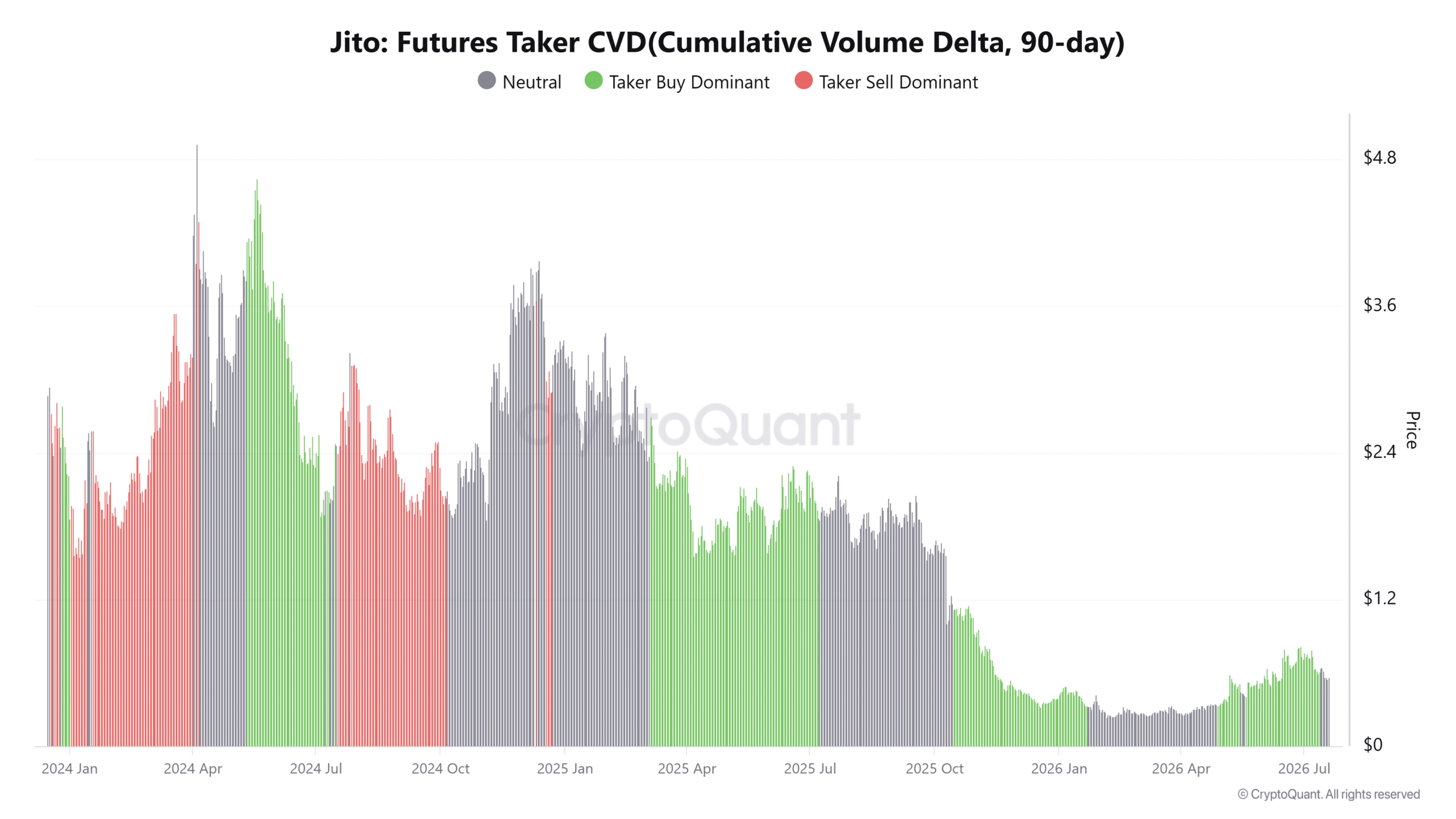
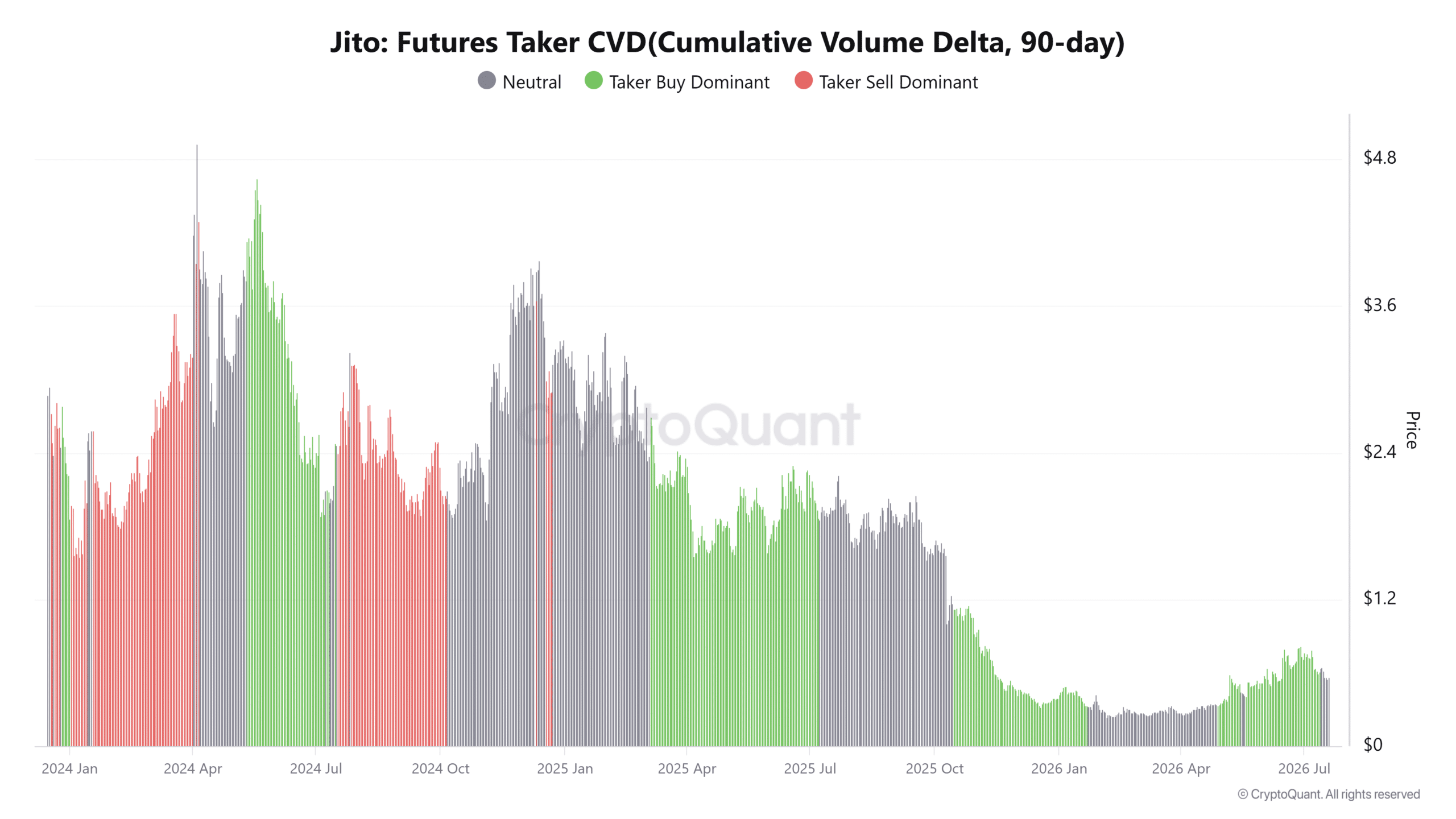
Source: CryptoQuant

Can JTO reclaim $0.80 next?

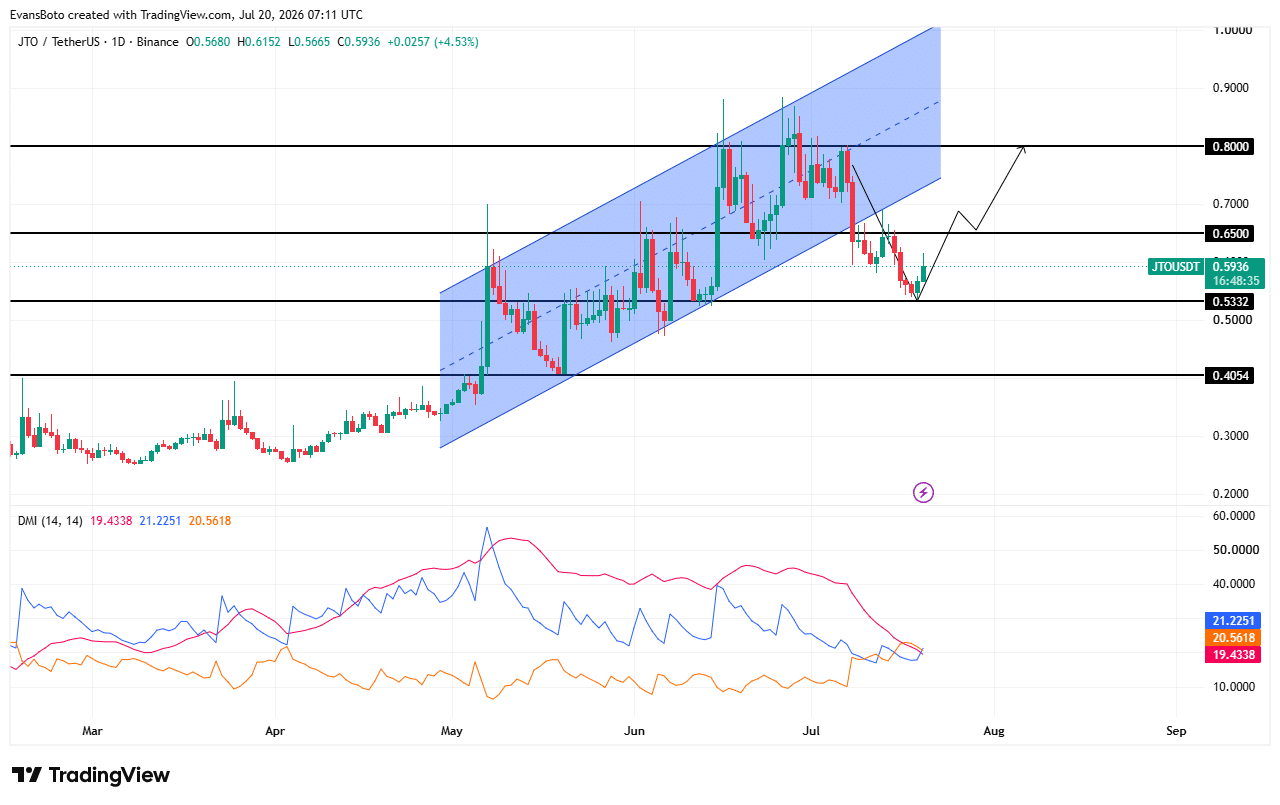
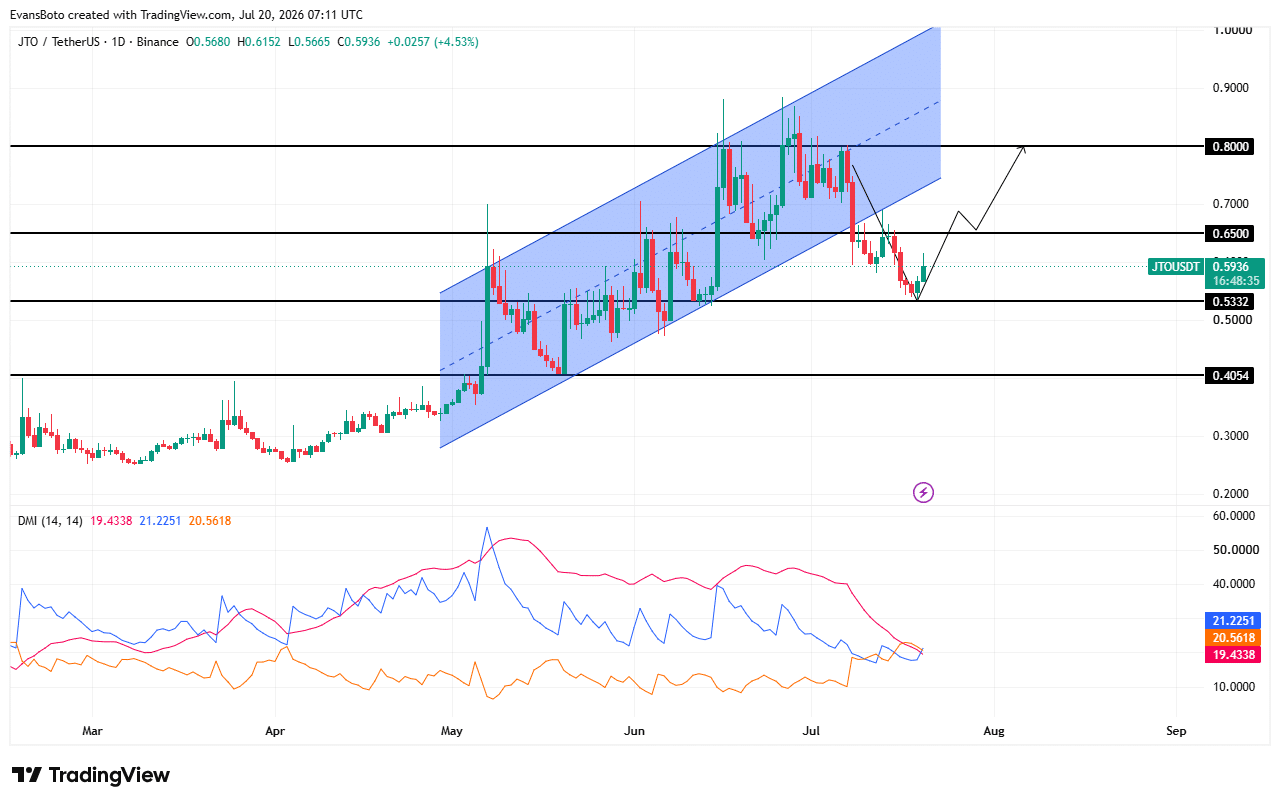
JTO rebounded from the $0.5332 support area after breaking below its broader ascending channel earlier.

Buyers pushed the token back toward $0.6500, which now represented the nearest resistance before a possible move toward $0.8000. The Directional Movement Index (DMI) also reflected improving conditions.

At press time, the +DI stood at 21.23, remaining above the -DI at 20.56, while the ADX measured 19.43, suggesting bullish strength had started improving but remained below the threshold associated with a strong trend.

If buyers reclaimed $0.6500, the chart suggested a retest of $0.8000 could follow. However, failure to hold above $0.5332 would likely expose JTO to another test of the $0.4054 support level.
Source: TradingView

Conclusively, JTO’s rally reflected improving fundamentals, stronger buying pressure, and increasing trader participation rather than a purely speculative bounce.

If buyers continue defending support and overcome the $0.6500 barrier, the token could challenge $0.8000 in the sessions ahead. However, weakening demand would likely delay that recovery and shift attention back toward the $0.5332 support zone.


Final Summary

  • JTO’s rally gained support from stronger buying activity and growing confidence after the JIP-38 proposal.
  • Rising Open Interest and steady spot demand kept bullish pressure intact, though $0.6500 remains the next key hurdle.


Criptos en tendencia

Preguntas relacionadas

QWhat is the JIP-38 proposal and how did it affect Jito (JTO)?

AThe JIP-38 proposal established Jito as a token-centric network by directing 100% of the Jito DAO's revenue share from JTX Trade toward programmatic JTO buybacks and burns for at least one year. This proposal sparked investor optimism, leading to a significant price rally for JTO, with the token climbing 11.59% in 24 hours as the market viewed it as a long-term value driver.

QWhat were the key indicators of increased trading activity and market conviction for JTO during the rally?

AThe key indicators were a surge in daily trading volume by 142.17% and a rise in Open Interest (OI) by 14.53% to $52.05 million. The increase in OI indicated the entry of fresh long positions rather than just the closing of old contracts, showing broader market participation and stronger conviction among both spot and derivatives traders.

QWhat does the 90-day Futures Taker CVD data indicate about the market sentiment for JTO?

AThe 90-day Futures Taker CVD data showed a buy-dominant trend, indicating that aggressive market buyers were consistently absorbing available sell orders. This behavior aligned with the sharp increase in trading volume and demonstrated sustained buying pressure, supporting the price recovery and indicating positive sentiment.

QAccording to the article, what are the key price levels JTO needs to overcome for a potential move towards $0.80?

AAccording to the article, the key resistance level JTO needs to overcome is $0.6500. If buyers successfully reclaim this level, a retest of the $0.8000 target could follow. However, failure to hold above the $0.5332 support level could lead to a test of the lower $0.4054 support.

QHow did the Directional Movement Index (DMI) reflect the market conditions for JTO at the time of writing?

AAt the time of writing, the DMI showed the +DI at 21.23, remaining above the -DI at 20.56, indicating bullish strength was improving. However, the ADX (Average Directional Index) measured 19.43, which is below the threshold commonly associated with a strong, established trend, suggesting the bullish momentum was present but not yet extremely strong.

Lecturas Relacionadas

El apogeo ha pasado, ¿qué está experimentando el capital riesgo en cripto?

**Resumen en español europeo:** Los fondos de capital riesgo (VC) especializados exclusivamente en criptomonedas están atravesando una transición crítica. Su ventaja competitiva original—la profunda experiencia y conocimiento especializado del sector—se está erosionando a medida que la tecnología blockchain se integra en la corriente principal financiera. Grandes actores tradicionales (como BlackRock, Stripe, Visa) ahora comprenden y adoptan la infraestructura cripto, y los grandes fondos generalistas (como Sequoia, a16z) evalúan proyectos cripto con la misma lógica que otras empresas fintech. Esto está provocando una polarización en el ecosistema de VC. Los fondos de tamaño medio (en la "zona de la muerte") ya no pueden sobrevivir solo con inversiones en cripto, ya que no pueden generar retornos suficientes ni competir por rondas de crecimiento con los gigantes generalistas. Ejemplos como Paradigm (que diversifica hacia IA y robótica) o Framework Ventures ilustran esta expansión forzada. La tendencia está impulsada por la presión de los inversores (LP) que, tras malos resultados en cripto (DPI bajo), exponen exposición a sectores más calientes como la IA. Para los emprendedores cripto, esto significa una reducción de fondos especializados dispuestos a apostar por ellos y una mayor competencia por la atención dentro de los fondos generalistas, que priorizan proyectos con lógica comercial clara y no suelen financiar infraestructura pública o investigación básica para el ecosistema. El futuro, según la teoría de los ciclos tecnológicos, apunta a que la criptografía se convierta en una infraestructura subyacente, no en una categoría de inversión independiente. El panorama se reconfigurará en forma de "pesas": los grandes cheques de crecimiento los pondrán los fondos generalistas, mientras que pequeñas apuestas especializadas en nichos emergentes (tokenización, valores on-chain) quedarán para pequeños fondos boutique. Los fondos cripto de tamaño medio puro están en declive.

Foresight NewsHace 1 hora(s)

El apogeo ha pasado, ¿qué está experimentando el capital riesgo en cripto?

Foresight NewsHace 1 hora(s)

¿En qué están apostando los jóvenes inversores cuando el consenso se acelera?

En el ámbito de las inversiones tecnológicas, los inversores más jóvenes están adaptando sus estrategias al rápido cambio de paradigma. Con avances simultáneos en IA, robótica, aeroespacial y computación cuántica, el modelo tradicional de inversión ya no es suficiente. Ahora, comprender el lenguaje técnico y evaluar rutas tecnológicas aún inmaduras antes de que se forme un consenso es crucial. La inversión se está desplazando de la simple especulación con conceptos hacia la identificación de caminos reales de adopción industrial. Se destacan cuatro tendencias principales: Primero, la IA está abandonando las pantallas para integrarse en el mundo físico, impulsando áreas como la inteligencia encarnada, los robots humanoides y los dispositivos inteligentes de borde. El desafío ya no es solo una demostración técnica, sino la capacidad de entrega fiable y rentable a gran escala, como se ve en sectores como la entrega autónoma. Segundo, el enfoque en los modelos de lenguaje grandes (LLM) está cambiando. Más allá de buscar el próximo avance arquitectónico, el foco está en las empresas que pueden integrar estas capacidades en flujos de trabajo reales para crear un "volante de inercia de inteligencia": un ciclo virtuoso donde el uso genera datos que mejoran el modelo, lo que atrae a más usuarios y refuerza su ventaja. La creación de valor sostenible y profundo en la cadena de valor de la IA es clave. Tercero, frente al posible cuello de botella en datos de alta calidad para entrenar LLMs, surgen nuevas direcciones como los modelos de base científica. Estos modelos, entrenados con datos científicos rigurosos y capaces de generar conocimiento o simulaciones, podrían ser la próxima frontera para expandir las capacidades de la IA más allá de los datos disponibles en Internet. Finalmente, en áreas de tecnología profunda como el espacio comercial, la computación cuántica o la energía avanzada, se requiere un "capital paciente". Estos campos tienen ciclos de validación más largos y mayor incertidumbre técnica, pero son fundamentales para la infraestructura futura. La inversión aquí implica apostar por la capacidad de ingeniería, la resiliencia del equipo y la demanda a largo plazo, aceptando horizontes de retorno más extensos. En resumen, los jóvenes inversores están navegando un panorama donde el éxito depende de una comprensión técnica profunda, la identificación temprana de tendencias industriales genuinas y la voluntad de realizar apuestas a largo plazo en tecnologías transformadoras, tanto en el mundo digital como en el físico.

marsbitHace 1 hora(s)

¿En qué están apostando los jóvenes inversores cuando el consenso se acelera?

marsbitHace 1 hora(s)

Trading

Spot

Artículos destacados

Cómo comprar JTO

¡Bienvenido a HTX.com! Hemos hecho que comprar Jito (JTO) sea simple y conveniente. Sigue nuestra guía paso a paso para iniciar tu viaje de criptos.Paso 1: crea tu cuenta HTXUtiliza tu correo electrónico o número de teléfono para registrarte y obtener una cuenta gratuita en HTX. Experimenta un proceso de registro sin complicaciones y desbloquea todas las funciones.Obtener mi cuentaPaso 2: ve a Comprar cripto y elige tu método de pagoTarjeta de crédito/débito: usa tu Visa o Mastercard para comprar Jito (JTO) al instante.Saldo: utiliza fondos del saldo de tu cuenta HTX para tradear sin problemas.Terceros: hemos agregado métodos de pago populares como Google Pay y Apple Pay para mejorar la comodidad.P2P: tradear directamente con otros usuarios en HTX.Over-the-Counter (OTC): ofrecemos servicios personalizados y tipos de cambio competitivos para los traders.Paso 3: guarda tu Jito (JTO)Después de comprar tu Jito (JTO), guárdalo en tu cuenta HTX. Alternativamente, puedes enviarlo a otro lugar mediante transferencia blockchain o utilizarlo para tradear otras criptomonedas.Paso 4: tradear Jito (JTO)Tradear fácilmente con Jito (JTO) en HTX's mercado spot. Simplemente accede a tu cuenta, selecciona tu par de trading, ejecuta tus trades y monitorea en tiempo real. Ofrecemos una experiencia fácil de usar tanto para principiantes como para traders experimentados.

269 Vistas totalesPublicado en 2024.12.11Actualizado en 2026.06.02

Cómo comprar JTO

Discusiones

Bienvenido a la comunidad de HTX. Aquí puedes mantenerte informado sobre los últimos desarrollos de la plataforma y acceder a análisis profesionales del mercado. A continuación se presentan las opiniones de los usuarios sobre el precio de JTO (JTO).

活动图片












