Robinhood Chain Goes Viral in One Week: Memes Bring Traffic, Stablecoins Boost TVL

marsbitPublicado a 2026-07-10Actualizado a 2026-07-10

Resumen

Robinhood Chain, a new Arbitrum-based Layer 2 blockchain, has seen explosive growth in its first week. This surge was driven by a combination of viral memecoin trading and a major stablecoin deposit, though the latter contributes the most to its Total Value Locked (TVL). Active addresses soared from near zero to nearly 200,000, with daily DEX volume peaking at nearly $400 million. The integration of the Solana-based launchpad Pump.fun significantly lowered the barrier for memecoin trading, fueling activity with tokens like CASHCAT, which saw a 1320% price surge. Contrary to the public focus on memes, the primary driver of the chain's TVL, which reached approximately $234 million, was a ~$50 million deposit of Ethena's USDG stablecoin into the Morpho lending protocol. This single event caused a 160% TVL increase. Morpho underpins Robinhood's Earn product, offering yield on stablecoins. While the chain was originally launched with a focus on tokenized Real-World Assets (RWAs), this segment remains a minor part of the ecosystem at around $12.8 million. The initial growth is thus characterized by speculative memecoin trading and yield-seeking stablecoin deposits, while its core RWA narrative is still in early development.

Written By: The Defiant Team

Compiled By: Saoirse, Foresight News

This week, a combination of Memecoin hype, integration with the Pump.fun platform, and an application announcing its migration from Solana to this new, just-week-old blockchain have collectively driven a surge in on-chain activity for Robinhood Chain. Notably, however, the largest single inflow of funds on the chain came from stablecoin staking, not Memecoin trading.

According to a network dashboard data published by Entropy Advisors on Dune Analytics: this Layer-2 network built on Arbitrum has seen its cumulative address count approach 200,000, with a total protocol value locked (TVL) of approximately $234 million.

The public chain officially opened mainnet access to the public on July 1st, meaning nearly all of this growth has occurred within its first week of operation, and on-chain activity has continued to accelerate in recent days.
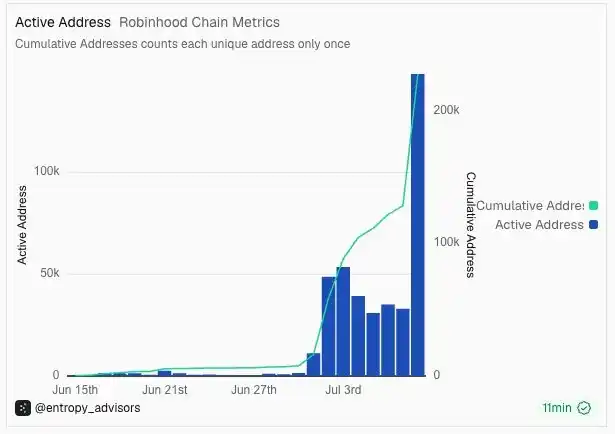
Robinhood Active Address Count. Data Source: Dune Analytics

CEO Makes a Complete 180-Degree Turn in Official Stance

The strategic shift began at the highest level of management. On the evening of July 7th, CEO Vlad Tenev posted on platform X: 'We built Robinhood Chain to be the best public chain for real-world assets (RWA)... But this chain is also great for memecoins.'

This statement overturned his view from just days earlier. On July 2nd, the day the mainnet launched, he stated in a CNBC interview that memecoins were largely a dead end. In his view, tokens lacking practical application value struggle to sustain long-term, and tokenized real-world assets represent a more sustainable path for the crypto industry.

When Robinhood formally launched the mainnet at its London keynote presentation 'Robinhood Presents: The World is Flat,' it consistently positioned the chain as infrastructure for tokenized stocks and various real-world assets; integrations with Uniswap, Chainlink, Alchemy, and BitGo were completed on launch day.

Pump.fun Channels a Large Number of Traders

On July 8th, the token launch platform Pump.fun, born in the Solana ecosystem, announced support for trading Robinhood Chain tokens, significantly lowering the barrier for traders to participate in the chain's Memecoins.

The platform's official account posted on platform X: 'You can now trade Robinhood Chain tokens on the Pump.fun app! No cross-chain bridge needed, seamless trading with SOL, the platform supports all popular Robinhood chain tokens.'

Pump.fun co-founder Alon Cohen stated that this update was merely an extension of the platform's existing multi-chain trading tools, not an independent new business line. He posted: 'Pump.fun is not just for launching platform-native tokens, it supports all cross-chain trading. You can trade Robinhood tokens now, zero fees via the Solana route.'

World Project Migrates Out of Solana Ecosystem

Robinhood Chain successfully lured project resources from the Solana ecosystem. The on-chain prediction market World launched on Solana on July 1st, usable directly within the Phantom wallet. Now, the project's official team has announced a full migration to this new public chain.

The project team announced on platform X on July 8th: 'World has decided to migrate from Solana to Robinhood Chain.' The team stated this strategic adjustment was made after careful evaluation over the past 24 hours and expressed gratitude to the Solana Foundation and community.

CASHCAT Ignites Memecoin Rally

The hottest token currently is CASHCAT, named after Robinhood's early stock trading-era mascot 'Cash Cat,' with the token trading on Uniswap V3 deployed on Robinhood Chain.

CoinGecko data shows that on July 8th, CASHCAT traded around $0.1373, marking a 24-hour surge of 1320%, with a market cap approaching $137 million and a 24-hour trading volume of approximately $194 million; the price fluctuated between $0.0089 and $0.1475 during the day.

User Base Expands Rapidly from Zero

Setting aside the Memecoin rally, on-chain monitoring data shows growth across all fronts of the ecosystem. Active addresses during the June testnet phase were nearly zero, but daily active addresses surged to tens of thousands in early July, with cumulative unique addresses nearing 200,000.

Decentralized exchange trading volume has performed impressively, with the single-day peak on July 7th approaching $400 million, with the vast majority of trades executed via Uniswap V3, V4, and PancakeSwap V3. Simultaneously, on-chain fees remain low, with Gas prices around 0.021 Gwei and an average transaction fee of just $0.005.
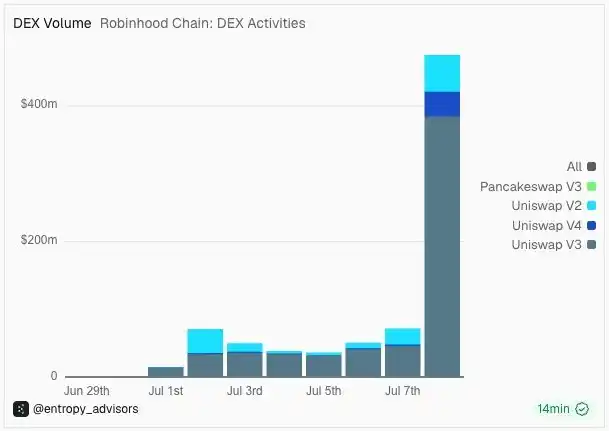
Robinhood Chain DEX Trading Volume. Data Source: Dune Analytics

Core Driver of TVL Surge is Ethena Stablecoin, Not Memecoins

Although market attention is focused on Memecoin speculation, the most critical factor driving the surge in Robinhood Chain's total value locked (TVL) was a deposit of stablecoin funds. Ethena injected approximately $50 million into the USDG pool managed by Steakhouse Financial within the lending protocol Morpho. Morpho is the underlying protocol for Robinhood's on-chain savings product, Robinhood Earn, which can offer an annualized yield of about 7% for USDG.

DefiLlama data shows this capital inflow directly propelled the protocol's TVL to a single-day increase of over 160%. Morpho hosts the vast majority of statistically trackable DeFi liquidity on the chain, with stablecoins (primarily USDG) constituting the bulk of on-chain asset value.
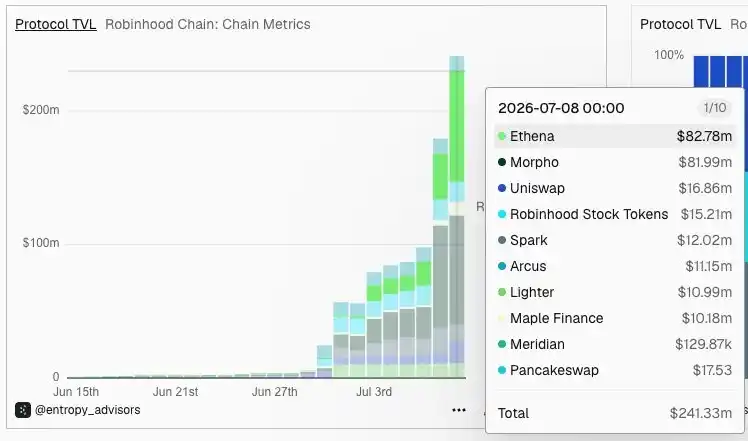
Robinhood Chain Total Value Locked. Data Source: Dune Analytics

The data reflects two parallel development paths for the public chain: institutional stablecoin capital and lending business solidify the underlying capital base; the retail Memecoin frenzy fueled by Pump.fun continues to drive up transaction counts and active users. Confusing the relationship between the two would severely overstate the contribution of Meme trading to the total value locked metric.

RWA Business Remains a Minimal Proportion

Despite Robinhood Chain's emphasis on the RWA narrative, the current scale of its tokenized real-world asset business is extremely low. The total value of tokenized assets like U.S. Treasuries, stocks, ETFs, and commodities is only about $12.8 million, far less than the TVL supported by stablecoins and lending funds.

The stock tokens launched by Robinhood are tokenized debt certificates that track the price of U.S. stocks and ETFs but do not grant holders shareholder voting rights. The products are available in over 120 countries globally and are not offered to users within the United States.

This gap summarizes the state of Robinhood Chain in its first week: speculative trading and stablecoin deposits seeking yield provide the initial liquidity and on-chain activity, while the chain's initially planned core sector—tokenized securities business—remains in a slow starting phase.


Criptos en tendencia

Preguntas relacionadas

QWhat are the key factors driving the rapid increase in activity on Robinhood Chain within a week of its launch?

AThe key factors are the Meme coin trading frenzy, integration with the Pump.fun platform, and the migration of the World project from Solana. Additionally, a significant inflow of stablecoin capital into the Morpho lending protocol provided a major boost to Total Value Locked (TVL).

QHow did CEO Vlad Tenev's public stance on Meme coins change after the launch of Robinhood Chain?

AInitially, shortly after the mainnet launch on July 2nd, Vlad Tenev stated on CNBC that Meme coins were 'basically dead' and emphasized tokenized real-world assets (RWA) as a more sustainable path. However, by July 7th, he reversed this stance on X, declaring that Robinhood Chain was also 'really good for Meme coins.'

QWhat is the significance of the integration with Pump.fun for the Robinhood Chain ecosystem?

AThe integration with Pump.fun significantly lowered the barrier for traders to participate in Meme coin trading on Robinhood Chain. It allows users to trade Robinhood Chain tokens directly on Pump.fun without needing a cross-chain bridge, using SOL with zero transaction fees through Solana channels.

QAccording to the data, what is the primary driver behind the surge in Robinhood Chain's Total Value Locked (TVL), and why is this distinction important?

AThe primary driver of the TVL surge was a large stablecoin deposit, specifically around $50 million from Ethena into the USDG pool on the Morpho lending protocol. This is important because it highlights that the foundational capital and scale of the chain come from institutional stablecoin and lending activity, not from the more visible Meme coin trading frenzy, which would otherwise exaggerate the contribution of speculation to the TVL metric.

QWhat does the current data reveal about the state of Robinhood Chain's originally intended core business of Real World Assets (RWA) compared to its current activity?

AThe data shows that the tokenized real-world asset (RWA) business, such as tokenized US treasuries, stocks, and ETFs, is currently minimal, with a total value of only about $12.8 million. This is vastly overshadowed by the capital from stablecoin deposits and lending. The article concludes that while speculative trading and yield-seeking stablecoins are driving initial liquidity and activity, the chain's core RWA narrative is still in its very early stages.

Lecturas Relacionadas

Tras tres trimestres consecutivos de caída, ¿puede el mercado cripto encontrar una ventana de estabilización en el tercer trimestre?

El mercado cripto sufrió su peor trimestre desde 2022, con una caída del 12.6% en la capitalización total (ahora en $2.1 billones). El volumen de operaciones y el valor de las stablecoins también disminuyeron, señalando una salida generalizada de capitales. Bitcoin y Ethereum cayeron un 14.2% y 25.4% respectivamente, rompiendo su correlación con los mercados de riesgo tradicionales. Los ETFs de Bitcoin en EE.UU. registraron importantes salidas netas ($4.67 mil millones en Q2), aunque datos sugieren que el ciclo de ventas podría estar cerca de su fin. La atención del mercado se centra ahora en la reunión de la FED a finales de julio, cuya postura (halcón o paloma) podría definir el rango de trading de Bitcoin para el trimestre. El avance de la ley CLARITY en el Senado estadounidense se ha estancado, reduciendo la probabilidad de aprobación en 2026 y manteniendo una prima de riesgo regulatorio alta. Solo dos sectores mostraron crecimiento: los mercados de predicción (volumen +48.7%) y los coleccionables tokenizados (volumen +143% vs. Q1). El sentimiento general es de cautela. La lógica del mercado ha cambiado, priorizando fundamentos como la política monetaria y la regulación frente a los simples impulsos narrativos. Aunque las bases para una caída extrema parecen limitadas, la recuperación sostenida en Q3 depende críticamente de la FED y de un posible progreso regulatorio.

marsbitAyer 08:41

Tras tres trimestres consecutivos de caída, ¿puede el mercado cripto encontrar una ventana de estabilización en el tercer trimestre?

marsbitAyer 08:41

BIT Trading Moments: BTC aún presionado por la EMA 200 semanal, tras el rechazo podría reiniciar la caída, los valores de almacenamiento y semiconductores que subieron fuertemente anoche comenzaron a caer en la sesión nocturna

**BIT Trading Moments: BTC aún presionado por la EMA 200 semanal; almacenamiento y semiconductores caen en el after-hours** El mercado de cripto continúa su recuperación, con **Bitcoin** manteniéndose cerca de los $66,000. Enfrenta una fuerte resistencia en la zona de los $68,000, nivel que coincide con el costo promedio de los inversores en los últimos cinco meses y un punto de fallo anterior. Los analistas señalan que se encuentra atrapado entre la media móvil simple (MA) de 200 semanas (~$63,333) y la media exponencial (EMA) de 200 semanas (~$68,328). Se necesitaría un cierre semanal por debajo de $55,000 o por encima de $70,000 para confirmar una dirección de mayor alcance. Los ETF de Bitcoin registran entradas netas por sexto día consecutivo. En Wall Street, los **futuros de los principales índices** caen. Después de fuertes ganancias el martes, las acciones de **semiconductores y almacenamiento** retroceden en el after-hours: el ETF de semiconductores cae un 2.22%, Micron un 2.29% y SK Hynix casi un 5%. Sin embargo, **Super Micro Computer (SMCI)** se dispara más de un 20% tras el cierre, impulsada por sólidos pedidos. Otras noticias positivas incluyen un contrato de $266M de la Fuerza Aérea para **Rocket Lab**. A pesar del repunte bursátil, factores como el **crudo Brent por encima de $91** y el **rendimiento del bono estadounidense a 10 años subiendo a ~4.64%** generan preocupaciones inflacionarias y enfrían el optimismo. Las acciones relacionadas con cripto, como Coinbase y Robinhood, tuvieron un buen desempeño apoyadas por avances regulatorios. En Asia, los mercados siguieron la recuperación tecnológica. El **índice KOSPI de Corea del Sur** subió un 0.74%, con acciones de semiconductores mostrando volatilidad. El principal riesgo es el **yen japonés**, que tocó su nivel más bajo desde 1986, lo que genera temores a una intervención del gobierno. **Próximos eventos clave:** Este miércoles 22 de julio, el enfoque está en los eventos de **AMD AI** y los resultados financieros de **Alphabet (Google), Tesla e IBM** después del cierre. El jueves 23, la **decisión de tasas del BCE** y los resultados de **Intel** serán cruciales para el sentimiento del mercado.

marsbitAyer 08:33

BIT Trading Moments: BTC aún presionado por la EMA 200 semanal, tras el rechazo podría reiniciar la caída, los valores de almacenamiento y semiconductores que subieron fuertemente anoche comenzaron a caer en la sesión nocturna

marsbitAyer 08:33

Trading

Spot

Artículos destacados

Cómo comprar ONE

¡Bienvenido a HTX.com! Hemos hecho que comprar Harmony (ONE) sea simple y conveniente. Sigue nuestra guía paso a paso para iniciar tu viaje de criptos.Paso 1: crea tu cuenta HTXUtiliza tu correo electrónico o número de teléfono para registrarte y obtener una cuenta gratuita en HTX. Experimenta un proceso de registro sin complicaciones y desbloquea todas las funciones.Obtener mi cuentaPaso 2: ve a Comprar cripto y elige tu método de pagoTarjeta de crédito/débito: usa tu Visa o Mastercard para comprar Harmony (ONE) al instante.Saldo: utiliza fondos del saldo de tu cuenta HTX para tradear sin problemas.Terceros: hemos agregado métodos de pago populares como Google Pay y Apple Pay para mejorar la comodidad.P2P: tradear directamente con otros usuarios en HTX.Over-the-Counter (OTC): ofrecemos servicios personalizados y tipos de cambio competitivos para los traders.Paso 3: guarda tu Harmony (ONE)Después de comprar tu Harmony (ONE), guárdalo en tu cuenta HTX. Alternativamente, puedes enviarlo a otro lugar mediante transferencia blockchain o utilizarlo para tradear otras criptomonedas.Paso 4: tradear Harmony (ONE)Tradear fácilmente con Harmony (ONE) en HTX's mercado spot. Simplemente accede a tu cuenta, selecciona tu par de trading, ejecuta tus trades y monitorea en tiempo real. Ofrecemos una experiencia fácil de usar tanto para principiantes como para traders experimentados.

594 Vistas totalesPublicado en 2024.12.12Actualizado en 2026.06.02

Cómo comprar ONE

Discusiones

Bienvenido a la comunidad de HTX. Aquí puedes mantenerte informado sobre los últimos desarrollos de la plataforma y acceder a análisis profesionales del mercado. A continuación se presentan las opiniones de los usuarios sobre el precio de ONE (ONE).

活动图片












