US CFTC Launches Broad Investigation into Polymarket, Is the Prediction Market Party Coming to an End?

marsbitPublicado a 2026-06-30Actualizado a 2026-06-30

Resumen

The U.S. Commodity Futures Trading Commission (CFTC) is conducting a broad investigation into the prediction market platform Polymarket, focusing on its business practices including social media promotions. This follows a bipartisan letter from U.S. senators urging the CFTC to probe alleged fraudulent marketing tactics used to promote gambling-like products. The action coincides with a period of explosive growth for the prediction market sector, driven by events like the World Cup, with platforms like Kalshi and Robinhood reporting record trading volumes and revenue. The investigation signals a potential end to the sector's unregulated expansion and may lead to clearer federal oversight, particularly regarding investor protection and distinguishing prediction markets from traditional sports betting. The CFTC's move has also intensified a jurisdictional conflict with multiple U.S. states (including Kentucky and New York), which have sued platforms like Polymarket and Kalshi, accusing them of operating illegal sports betting and threatening state gambling tax revenues. Furthermore, the CME Group has sued the CFTC, challenging its approval of certain prediction market products. The report also highlights the political and capital interests intertwined with the industry. Donald Trump Jr. holds advisory and investment roles in both Kalshi and Polymarket, and the Trump administration has previously emphasized federal regulatory authority over these markets. The CFTC's investigati...

Original | Odaily Planet Daily (@OdailyChina)

Author | Wenser(@wenser2010 )
Polymarket's deceptive marketing has finally caught the attention of regulatory authorities.

Recently, the U.S. Commodity Futures Trading Commission (CFTC) has initiated a broad investigation into the prediction market platform Polymarket, covering its business activities including social media campaigns. Previously, U.S. Republican Senator John Curtis and Democratic Senator Adam Schiff co-signed a letter to CFTC Chairman Mike Selig, urging an investigation into Polymarket's practices of paying KOLs for deceptive marketing and using fraudulent marketing tactics to promote gambling-like products to American audiences.

At a time when the World Cup is driving a surge in prediction market trading volumes, this move may pour cold water on the development of this sector. More importantly, the CFTC's investigation into Polymarket has brought to light conflicts of interest between U.S. federal and state authorities, as well as between officials and capital. (Recommended reading: "WSJ: Fake Websites, Fake Trades, Real Promotion, Polymarket's Traffic Scam").

End of the Wild West Era for Prediction Market Marketing, Regulatory Policies May Enter Deep Waters

If the earlier incidents involving Polymarket—such as university students posting fake profit videos and paid KOLs exaggerating prediction profits—were seen as the wild attempts of the early expansion phase of prediction markets, then the formal CFTC investigation is clear proof that this wild growth period is over.

Prediction Market Platform Data Sees Explosive Growth, Attracting Strong Attention from Traditional Internet Giants

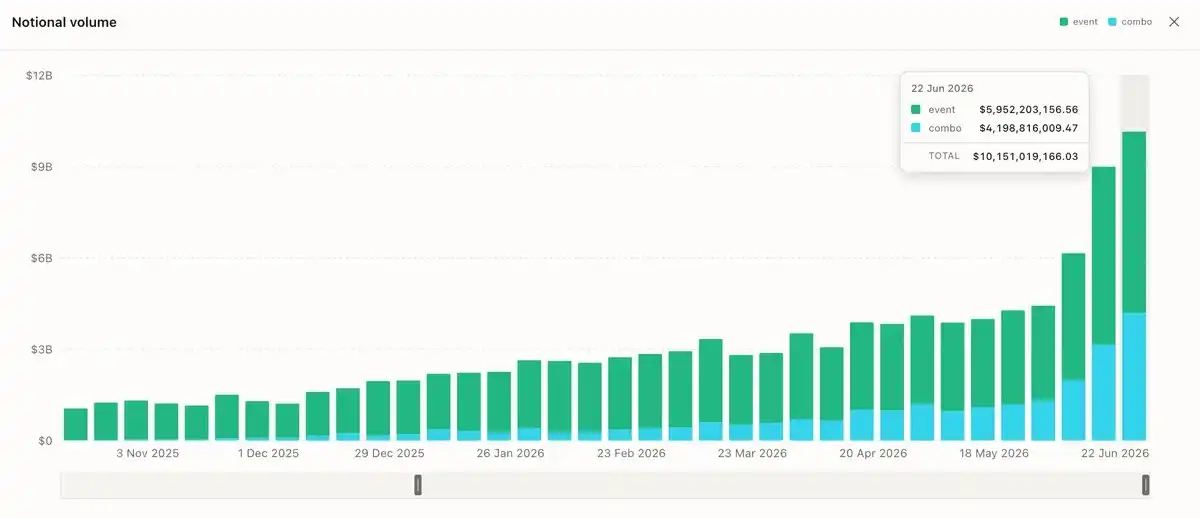
As we entered June 2026, with the official start of the World Cup, prediction markets have received unprecedented attention, leading to a continuous rise in trading volumes.

Data from a16z crypto shows that prediction market trading volume has hit record highs for three consecutive weeks. The total market trading volume reached a historic first of $144 billion last week, a significant increase from approximately $50–60 billion at the beginning of the year. The previous record high of around $100 billion was set just the week before. From the platform side, the data has also seen substantial growth:

  • Latest data shows Kalshi's weekly notional trading volume surpassed $100 billion for the first time.
  • Polymarket officially stated that its annualized revenue has significantly exceeded $1 billion, a development occurring just six weeks after the removal of the waitlist for its U.S. trading platform; data shows that the U.S. platform's daily trading volume grew from about $50 million in mid-May to over $200 million on June 20 (based on Dune Analytics data).
  • Robinhood's prediction market platform business is growing rapidly, with annualized revenue reaching $500 million. In Q2 as of June 25, Robinhood's active contract trading volume was approximately 12.3 billion contracts. Based on a standard rate of 1 cent per contract, the prediction market revenue for this quarter is estimated to be at least $123 million. Its recently launched Rothera prediction market platform achieved over 900 million contract trades in its first week, contributing nearly 60% growth in active contract trading volume for Robinhood.
Such impressive data has also attracted the attention of stock market giant Meta. According to media reports, Meta CEO Mark Zuckerberg has urged the company to explore partnerships with prediction markets Polymarket and Kalshi. Meanwhile, Meta is developing a similar prediction market application called Arena.

All signs indicate that prediction markets have leapt from a niche sector a few years ago to a hot industry experiencing exponential expansion. In the face of this trend, regulatory authorities are unlikely to stand idly by. The recent deceptive marketing incidents at Polymarket serve as a timely and fitting 'soft knife,' providing an opportunity for regulatory intervention. The author believes that subsequent regulations may gradually clarify the boundaries for prediction market platforms regarding marketing, event contract content, and trading fees, aiming to strengthen investor protection and clearly distinguish them from traditional gambling businesses.

Simultaneously, as the investigation deepens, the power struggle between federal regulatory agencies represented by the U.S. CFTC and state-level regulators is also coming to light.

When U.S. CFTC and Nine U.S. States Lock Horns: The Battle for Prediction Market Regulatory Power

Last Tuesday, the U.S. CFTC formally filed a lawsuit against Kentucky, attempting to reaffirm the agency's jurisdiction over prediction market platforms.

In the complaint filed with the U.S. District Court for the Eastern District of Kentucky, the CFTC stated that Kentucky's attempt to shut down federally regulated designated contract markets interferes with the federal regulatory system Congress established for the national swaps market. It claims "exclusive jurisdiction" over related event contracts and prediction market products.

Previously, Kentucky sued platforms like Kalshi and Polymarket, accusing them of operating unlicensed illegal sports betting and gambling businesses within the state. As of June, over 12 U.S. states, including Kentucky and New York, have taken legal action against Polymarket and Kalshi, alleging they operate illegal sports betting. Kentucky has become the ninth state sued by the CFTC in the prediction market regulatory dispute.

This action highlights the escalating conflict between federal derivatives regulation and state-level gambling regulation.

There are two main reasons behind this dispute:

  • First, the practical interests of state and local gambling industries, such as tax revenue. Traditional sports betting previously brought significant tax revenue to various states (e.g., high-tax-rate online gambling). If prediction markets completely replace the gambling industry, potential tax losses for states could amount to hundreds of millions of dollars annually (one estimate is around $600 million).
  • Second, the definition of the regulatory boundary between the gambling industry and prediction markets as an emerging industry. The CFTC seeks to maintain the classification of "event contracts" as commodity derivatives, futures, or swaps, enforcing a policy of federal law preemption.

The final outcome and specific definitions may depend on the interpretation and rulings by state courts, and potentially the U.S. Supreme Court, regarding the Commodity Exchange Act (CEA).

Furthermore, the battle between exchanges and the U.S. CFTC has also ignited. The CFTC's previous approval of Kalshi's application for perpetual futures trading triggered CME's lawsuit—

Reportedly, CME has sued the U.S. Commodity Futures Trading Commission and its Chairman Michael Selig in the U.S. District Court for the District of Columbia. Regarding the CFTC's May 29th approval for prediction market platform Kalshi to launch perpetual futures contracts linked to the Bitcoin spot price, among other actions, the CFTC's treatment of "futures" with expiration dates as "swaps" violates U.S. Congressional directives and the Commodity Exchange Act. CME requests the court to overturn the related perpetual futures actions. CME also claimed that Selig acted unilaterally without the presence of the full five-member panel of commissioners.

A CFTC spokesperson responded that CME is waging a "legal war" against the agency and the government's crypto policy, stating that "the act of filing the lawsuit is extremely imprudent." (Essentially saying "your lawsuit is filed too hastily" right on its forehead.)

Of course, it's no wonder CME is so agitated. The CFTC's move to allow Kalshi to trade crypto perpetual futures contracts essentially lets prediction market platforms like Kalshi, along with crypto exchanges like Coinbase and Kraken, encroach upon CME's "trading territory." As for the driving force behind this, it might have some connection to the Trump family.

The Trump Family's Prediction Market 'Double-Down Strategy': Don Jr. Bets on Kalshi and Polymarket

Recently, it was revealed that Kalshi is negotiating a new round of funding at a valuation of approximately $40 billion, with the deal potentially closing as early as Q3. Following a $10 billion financing round in May (investors included Sequoia Capital, Andreessen Horowitz, Coatue, and Morgan Stanley), Kalshi's valuation rose from its previous $12 billion to $22 billion. Now, that number is about to double.

Kalshi CEO Tarek Mansour stated that the company is considering an IPO no earlier than late 2027 or 2028. Kalshi officially stated that as of April 2026, its annualized trading volume reached $178 billion, a 32-fold increase year-over-year.

Such remarkable market data and the high enthusiasm from capital markets are hard to separate from one of the Trump family's prominent figures, Donald Trump Jr.

It is understood that Don Jr. is essentially "hedging his bets" in the prediction market sector:

On one hand, he served as a paid strategic advisor for Kalshi in early 2025, receiving approximately $300,000 worth of company equity at a time when Kalshi's valuation was less than $2 billion. That investment alone has yielded over a 10x return;

On the other hand, he also serves as an advisor to Polymarket and has made a strategic investment in the latter through his venture capital firm, 1789 Capital, where he is a partner.

Coupled with Trump's previous emphasis on federal government regulatory authority over prediction markets, and his mention that "Kalshi and Polymarket will thrive under his leadership,"

To some extent, the conflict of interest between capital and official regulatory agencies has been eased; and the Trump family serves as the "best lubricant" in this contradictory situation.

Thus, a network of interests connecting the U.S. CFTC and other federal regulatory agencies, U.S. state governments, and Trump family investment entities gradually takes shape.

As for the U.S. CFTC's investigation into Polymarket, it may just be an inevitable step in regulating the prediction market industry.

The era of wild growth, the 'Spring of Prediction Markets,' is coming to an end, while the 'Prosperous Summer' for the prediction market industry is slowly approaching.


Criptos en tendencia

Preguntas relacionadas

QWhat is the US CFTC investigating regarding Polymarket?

AThe US Commodity Futures Trading Commission (CFTC) is conducting a broad investigation into the prediction market platform Polymarket, covering aspects of its business including social media activities. The investigation is prompted by concerns over paid KOLs engaging in deceptive marketing, using fraudulent methods to promote gambling-like products to a US audience.

QWhat is the core conflict highlighted between the US CFTC and certain US states in the article?

AThe core conflict is a jurisdictional battle between federal regulatory authority (the CFTC) and state-level power. The CFTC asserts exclusive federal jurisdiction over event contracts and prediction market products under the Commodity Exchange Act. However, states like Kentucky and New York are suing platforms like Polymarket and Kalshi, accusing them of operating illegal sports betting and gambling businesses within their borders, which are traditionally regulated by the states. This conflict involves both regulatory boundaries and potential state tax revenue losses from the traditional gambling industry.

QWhat role does Donald Trump Jr. play in the prediction market sector according to the article?

AAccording to the article, Donald Trump Jr. is involved with both major prediction market platforms. He serves as a paid strategic advisor for Kalshi, receiving company equity, and also acts as an advisor for Polymarket through his venture capital firm, 1789 Capital, which made a strategic investment in the platform. His involvement is presented as part of a network connecting capital, political influence, and regulatory bodies.

QWhat significant legal action did the CME Group take against the CFTC, and why?

AThe CME Group filed a lawsuit against the US CFTC and its Chairman, Michael Selig, in the US District Court for the District of Columbia. The lawsuit challenges the CFTC's approval for Kalshi to launch perpetual futures contracts tied to Bitcoin's spot price. CME argues the CFTC violated the Commodity Exchange Act by treating futures with expiration dates as 'swaps' and that Chairman Selig acted unilaterally without a full commission. The move is seen as CME protecting its trading turf from encroachment by prediction market and crypto exchanges.

QHow does the article characterize the current stage and future of the prediction market industry?

AThe article characterizes the current massive growth, driven by events like the World Cup, as the end of a 'wild spring' or野蛮生长期 (barbaric growth period) for prediction markets, marked by early expansion tactics like deceptive marketing. The CFTC's investigation is seen as the start of increased regulatory scrutiny. However, the conclusion suggests this is a necessary step, and a 'prosperous summer' for a more regulated and mature prediction market industry is slowly approaching.

Lecturas Relacionadas

Confirmado: Claude Code espía a los usuarios, la zona horaria y los laboratorios de IA chinos son palabras clave

Anthropic experimenta un día de contrastes: mientras anuncia la liberación de las restricciones de exportación estadounidenses para sus modelos Claude Fable 5 y Mythos 5, se enfrenta a una polémica por prácticas de seguimiento encubiertas en su herramienta Claude Code. Una investigación revela que Claude Code incorporaba un mecanismo oculto que detectaba automáticamente si los usuarios configuraban un proxy personalizado (verificando la variable ANTHROPIC_BASE_URL) y comprobaba su zona horaria, especialmente si estaba configurada en Asia/Shanghái o Asia/Ürümqi. Esta información, junto con la posible detección de conexiones a dominios asociados con laboratorios de IA chinos (como Baidu, Alibaba o ByteDance), se codificaba de forma encubierta (esteganografía) en el prompt del sistema enviado a los servidores de Anthropic. La marca se realizaba mediante sutiles variaciones en caracteres Unicode, como cambiar el apóstrofo en "Today's date" o usar barras inclinadas en lugar de guiones en la fecha, haciéndola prácticamente indetectable para el usuario. La comunidad de desarrolladores ha criticado esta práctica por vulnerar la transparencia y la confianza esenciales en una herramienta con acceso a código y permisos de ejecución. Aunque la telemetría para prevenir abusos es común, su implementación encubierta en el prompt del sistema plantea serias dudas éticas. Tras la exposición, un miembro del equipo de Anthropic confirmó que el código responsable sería eliminado en una próxima actualización.

marsbitHace 36 min(s)

Confirmado: Claude Code espía a los usuarios, la zona horaria y los laboratorios de IA chinos son palabras clave

marsbitHace 36 min(s)

Grayscale: Tras reducirse a la mitad, el BTC se acerca al fondo de este ciclo

El bitcoin ha caído por debajo de los 60.000 dólares esta semana, un descenso de más del 50% desde su máximo de 125.000 dólares en octubre. Según el análisis de Grayscale, esta corrección parece ser otro retroceso cíclico dentro de la tendencia alcista a largo plazo del activo, en lugar de un cambio de tendencia. Varios factores presionan el precio actualmente. El más importante es el cambio en las expectativas de la política de la Fed, con el mercado anticipando posibles subidas de tipos bajo el nuevo presidente Kevin Warsh, lo que afecta a la narrativa de "hedge contra la devaluación monetaria". Otros factores son la incertidumbre sobre la aprobación de la ley CLARITY en el Senado de EE. UU., la presión sobre los balances apalancados de algunas empresas del sector (como Strategy) y las preocupaciones sobre la seguridad de los activos digitales frente a la computación cuántica. El informe plantea dos escenarios clave para salir de este mercado bajista: - **Escenario base/optimista:** Aprobación de la ley CLARITY, fortalecimiento de los balances de las empresas clave y que la Fed no suba los tipos. En este caso, el bitcoin podría estar cerca de su mínimo del ciclo. - **Escenario pesimista:** Fracaso de la ley CLARITY, más desapalancamiento en el sector y subidas de tipos por parte de la Fed. Esto podría llevar a una caída adicional del precio, aunque se espera que sea menos severa que en ciclos anteriores (80%) debido a la demanda institucional más estable. A pesar de los desafíos a corto plazo, Grayscale mantiene una visión estructuralmente optimista a largo plazo para los activos digitales, respaldada por la mayor adopción institucional de la tecnología blockchain, los altos niveles de deuda pública y el auge de la IA. La conclusión es que si los próximos catalizadores (decisión de la Fed y ley CLARITY) son favorables, el fondo del ciclo podría estar cerca, ofreciendo un punto de entrada atractivo para inversores de largo plazo.

marsbitHace 59 min(s)

Grayscale: Tras reducirse a la mitad, el BTC se acerca al fondo de este ciclo

marsbitHace 59 min(s)

Guía de supervivencia en el mercado bajista de Web3: Diez libros que te ayudarán a atravesar el ciclo

**Guía de supervivencia en el mercado bajista de Web3: Diez libros clave para navegar los ciclos** El mercado de criptomonedas ha experimentado múltiples ciclos alcistas y bajistas. En los períodos bajistas, la industria se reconfigura y emerge fortalecida. Lejos de ser solo una espera pasiva, estas fases son un tiempo crucial para acumular conocimiento y profundizar la comprensión del sector. Esta lista de diez libros, que trascienden las finanzas para abordar historia, tecnología, filosofía y dinámicas de poder, ofrece una brújula intelectual para navegar la incertidumbre y construir resiliencia a largo plazo. Desde la visión a 10.000 días de Kevin Kelly sobre el futuro de la tecnología y las criptomonedas en *"2049: Posibilidades para los próximos 10.000 días"*, hasta la defensa filosófica de la acción humana de Ludwig von Mises en *"La Acción Humana"*, estos textos ayudan a consolidar la convicción y a entender las dinámicas subyacentes. *"La naturaleza de la tecnología"* de Brian Arthur explica cómo tecnologías como la blockchain evolucionan mediante la recombinación constante, mientras que *"El salvaje lejano"* plantea una reflexión sobre la cultura de dependencia frente a la iniciativa propia, crucial en Web3. *"El individuo soberano"*, visionario libro de 1997, anticipó la descentralización del poder y el auge de las criptomonedas. *"Mirando a Japón: Una guía de supervivencia para la era del declive"* muestra cómo incluso en economías en recesión existen oportunidades, una lección aplicable a los mercados globales de cripto. *"La desnacionalización del dinero"* de Friedrich Hayek sienta las bases teóricas para la competencia monetaria que Bitcoin encarna. La sabiduría práctica de *"Registro de inversiones de Duan Yongping"* recuerda la importancia de hacer "lo correcto" con disciplina. *"La profecía de Balaji"* de Balaji Srinivasan ofrece predicciones audaces y una visión de un futuro construido sobre blockchain. Finalmente, *"Obras Escogidas de Mao Zedong"* proporciona un marco estratégico para analizar luchas de poder a largo plazo, relevante para una industria disruptiva como Web3. Estos libros, en conjunto, no ofrecen atajos hacia ganancias, sino herramientas para cultivar la claridad mental, la fortaleza de convicción y una comprensión profunda necesarias para construir y perseverar más allá de los ciclos del mercado.

Foresight NewsHace 1 hora(s)

Guía de supervivencia en el mercado bajista de Web3: Diez libros que te ayudarán a atravesar el ciclo

Foresight NewsHace 1 hora(s)

Trading

Spot

Artículos destacados

Cómo comprar POL

¡Bienvenido a HTX.com! Hemos hecho que comprar Polygon Ecosystem Token (POL) sea simple y conveniente. Sigue nuestra guía paso a paso para iniciar tu viaje de criptos.Paso 1: crea tu cuenta HTXUtiliza tu correo electrónico o número de teléfono para registrarte y obtener una cuenta gratuita en HTX. Experimenta un proceso de registro sin complicaciones y desbloquea todas las funciones.Obtener mi cuentaPaso 2: ve a Comprar cripto y elige tu método de pagoTarjeta de crédito/débito: usa tu Visa o Mastercard para comprar Polygon Ecosystem Token (POL) al instante.Saldo: utiliza fondos del saldo de tu cuenta HTX para tradear sin problemas.Terceros: hemos agregado métodos de pago populares como Google Pay y Apple Pay para mejorar la comodidad.P2P: tradear directamente con otros usuarios en HTX.Over-the-Counter (OTC): ofrecemos servicios personalizados y tipos de cambio competitivos para los traders.Paso 3: guarda tu Polygon Ecosystem Token (POL)Después de comprar tu Polygon Ecosystem Token (POL), guárdalo en tu cuenta HTX. Alternativamente, puedes enviarlo a otro lugar mediante transferencia blockchain o utilizarlo para tradear otras criptomonedas.Paso 4: tradear Polygon Ecosystem Token (POL)Tradear fácilmente con Polygon Ecosystem Token (POL) en HTX's mercado spot. Simplemente accede a tu cuenta, selecciona tu par de trading, ejecuta tus trades y monitorea en tiempo real. Ofrecemos una experiencia fácil de usar tanto para principiantes como para traders experimentados.

394 Vistas totalesPublicado en 2024.12.11Actualizado en 2026.06.02

Cómo comprar POL

Discusiones

Bienvenido a la comunidad de HTX. Aquí puedes mantenerte informado sobre los últimos desarrollos de la plataforma y acceder a análisis profesionales del mercado. A continuación se presentan las opiniones de los usuarios sobre el precio de POL (POL).

活动图片