AAVE Rallies 30% in a Week, Is It Back on Track?

Foresight NewsPublicado a 2026-06-30Actualizado a 2026-06-30

Resumen

Over the past week, the price of AAVE surged from around $70 to nearly $100, a rebound exceeding 30%. This occurred despite Aave's TVL continuing to decline following the Kelp DAO security incident. The price movement was partly driven by market rumors, first reported by CoinDesk, that Kraken was negotiating to acquire a stake in Aave. While Aave founder Stani Kulechov denied the specific terms, he confirmed discussions with multiple parties about purchasing Aave Labs' AAVE tokens. He also revealed ongoing work on Tokenomics 3.0, featuring an automated buyback mechanism, and plans to expand into securities-backed lending. Analysts remain optimistic about Aave's long-term prospects. Standard Chartered gave an extremely bullish $3,500 price target for 2030, citing DeFi revival and RWA tokenization. Grayscale offered a more conservative one-year target of $175. However, competitors like Morpho are gaining traction, with recent reports highlighting its advantages in capital efficiency and customization. Morpho also secured a massive $175 million funding round. Fundamentally, Aave maintains its dominance as the leading DeFi lending protocol. Its TVL is nearly double that of second-place Morpho and rivals the combined total of the next several competitors. Key metrics like active borrowing, total supply, and revenue significantly outpace rivals. While Aave faces challenges from newer, more flexible protocols, its deep liquidity and established position make it a preferred choice ...


Written by: Eric, Foresight News


In the past week, the price of AAVE surged from around $70 to nearly $100, marking a rebound of over 30%.
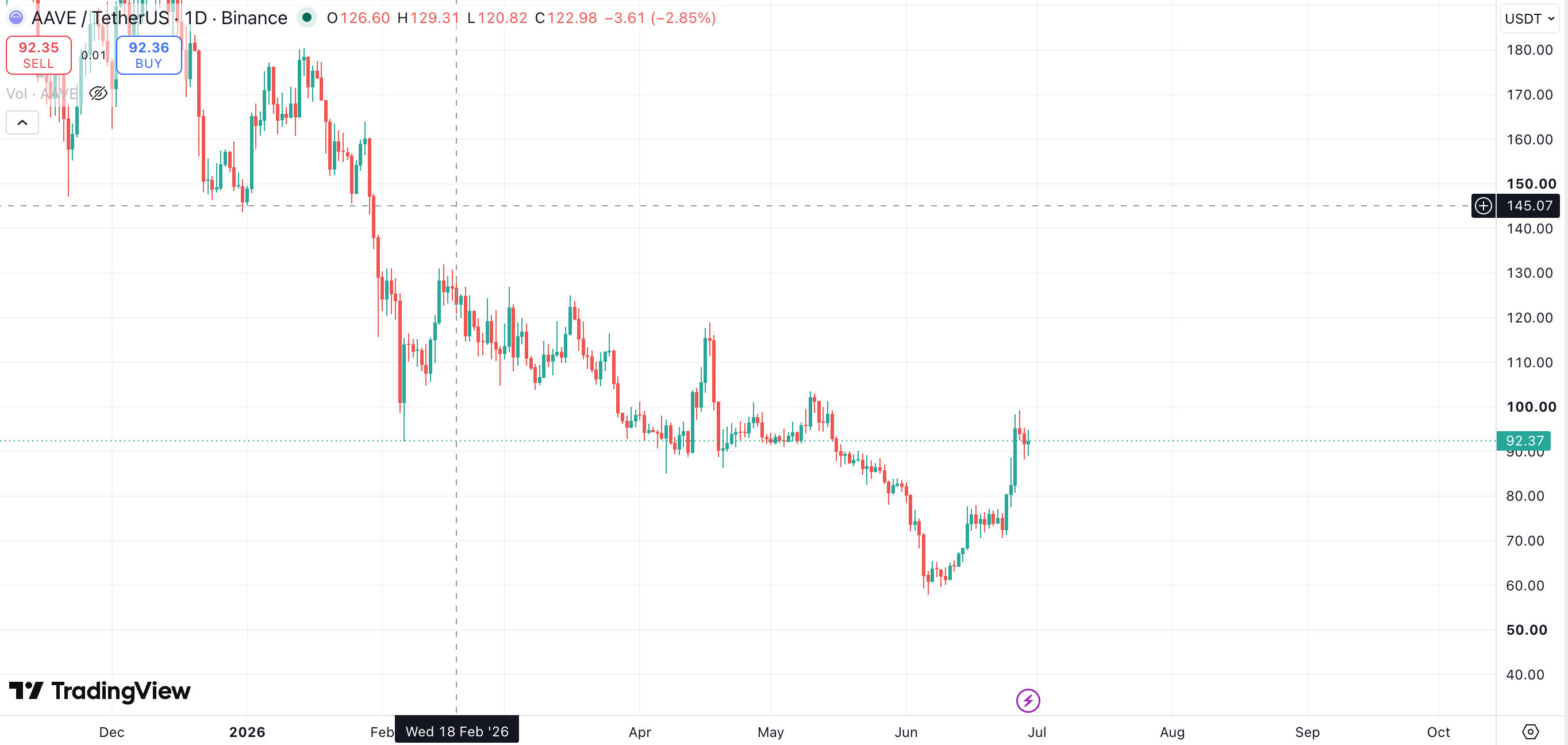


Looking solely at the TVL data, Aave still hasn't recovered from the Kelp DAO attack incident. In fact, its TVL has declined further compared to the panic-driven levels seen during that period.
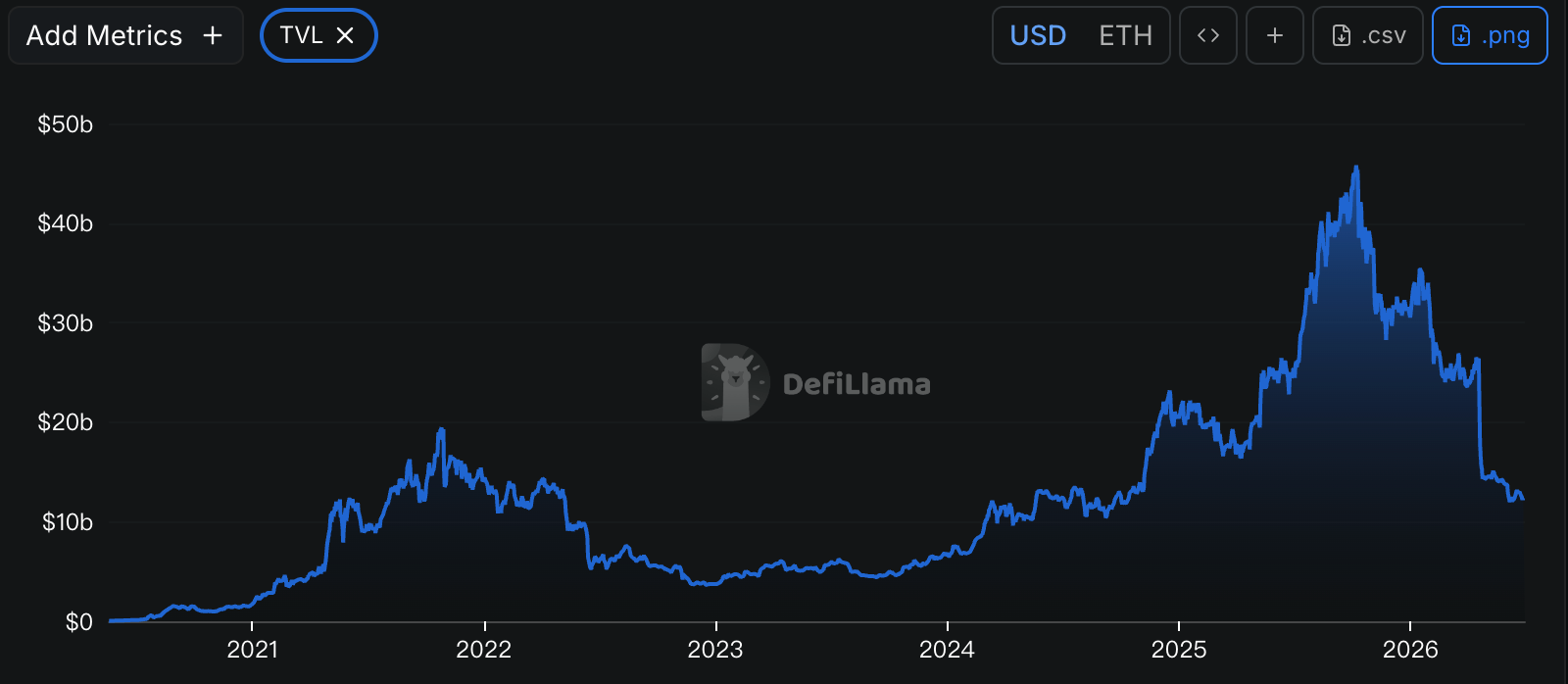


Despite the underwhelming data, Aave continues to attract capital interest. In the early hours of June 26, CoinDesk, citing sources, reported that Kraken was in talks to acquire a stake in Aave. The potential deal involved exchanging 35,000 ETH for 250,000 AAVE tokens and 15% equity in Aave Group, valuing the entire transaction at $71 million.


This report from sources was quickly refuted by Aave founder Stani Kulechov, as the reported valuation would imply Kraken valuing Aave at less than one-third of its token's market capitalization. Stani denied any intention to "sell tokens at a 70% discount" but acknowledged that "multiple market participants have discussed directly or indirectly purchasing AAVE tokens held by Aave Labs through deeper, long-term partnerships."


The prospect of someone buying the dip naturally spurred others to front-run. Aave's price rose for three consecutive days on June 24, 25, and 26, with the peak gain on the 26th exceeding 20%. Beyond the acquisition rumors, Stani also revealed, while refuting the report, that research is underway for Tokenomics 3.0, which would introduce an automated buyback mechanism. Furthermore, on the evening of the 26th, he stated that Aave is expanding its target market from crypto assets to all asset classes through securities-backed lending and securities lending operations.


Standard Chartered Bank has given an extremely optimistic price prediction of $3,500 for Aave by 2030, citing bullishness on a future DeFi revival and the development of RWA tokenization. While more conservative, Grayscale also believes that, catalyzed by RWA tokenization, AAVE's price could reach $175 within a year.


Explicitly bearish views on Aave in the market are relatively few. However, reports released this year by Eco, Fensory, Coinstancy, among others, have pointed out that Morpho Blue surpasses Aave in rate optimization, capital efficiency, and custom market creation. Tiger Research went even further, suggesting that Morpho represents the "modular" trend, while Aave resembles a "traditional unified pool," lagging in flexibility.


From the initial source leak, to implicitly confirming the existence of potential AAVE token investors during the refutation, followed by successive revelations of protocol developments, the sequence carries a sense of strategic pacing. Setting these aside and looking purely at fundamentals, despite experiencing community division, security concerns, capital outflows, and other setbacks, Aave's TVL still firmly holds the top position among DeFi lending protocols. It is not only nearly double that of the second-place Morpho but also almost equal to the combined TVL of the 2nd, 3rd, and 4th place protocols.
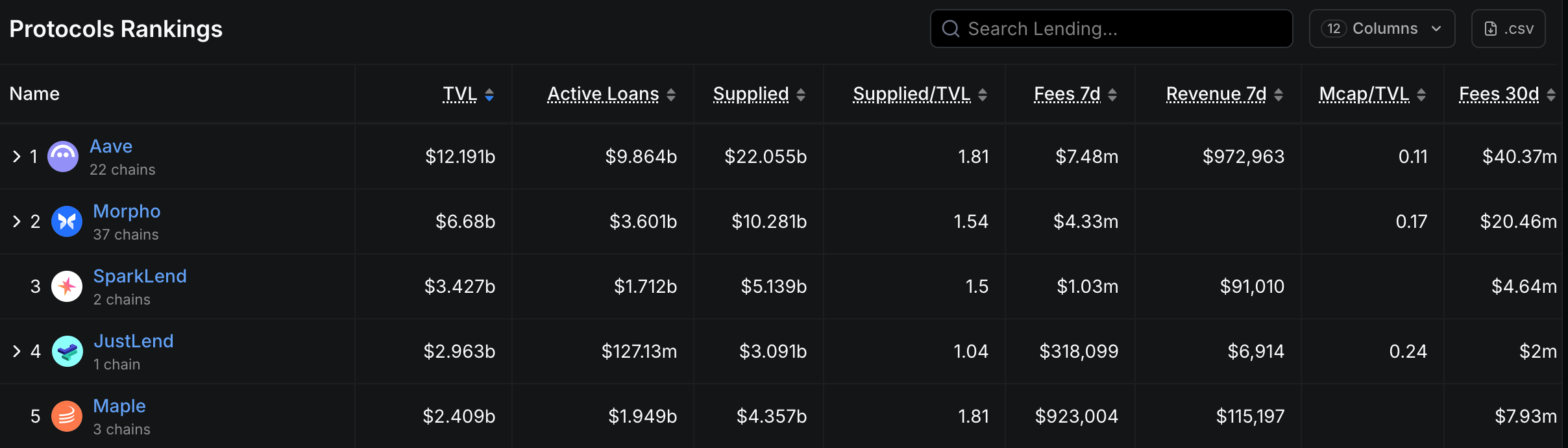


It's not just TVL; metrics like active borrowing, total supply, revenue, and fees also show significant leads. It has been nearly 9 years since ETHLend launched. Conflicts within the team and community, along with protocol risks, are not unforeseen, especially during an overall industry downturn. For a protocol whose code is immutable on-chain, as long as the protocol's core fundamentals haven't suffered a severe decline, the advantages accumulated over years are difficult to be fully eroded in a short period.


On the other hand, Morpho indeed shows a rising momentum. On June 9th, Morpho raised $175 million in a funding round led by Paradigm, Ribbit Capital, and a16z crypto, valuing the project at $2 billion, making it one of the largest single fundraising events in DeFi history. However, some also argue that Morpho and Aave have taken different paths, not competing directly on the same dimension, as each possesses core strengths that are difficult for the other to challenge.


Aave's lending depth makes it the preferred choice for whale users, and its not-high-but-stable yields are favored by many stablecoin holders—at least, this remained true before the Kelp DAO incident. Projects inevitably encounter bumps along the road. In a cryptocurrency market where quality investment targets are becoming increasingly scarce, projects that have withstood the test of time deserve sustained attention.


Criptos en tendencia

Preguntas relacionadas

QWhat is the main reason for the recent 30% price surge of AAVE, according to the article?

AThe main reason for the surge is reportedly a combination of rumors about a potential investment from Kraken and strategic announcements from the Aave team, such as working on Tokenomics 3.0 and expanding into securities-backed lending.

QWhat event significantly impacted Aave's TVL, and how is its TVL currently positioned compared to competitors?

AAave's TVL was significantly impacted by the Kelp DAO hack. Despite this, it remains the top DeFi lending protocol by TVL, holding nearly double the TVL of its closest competitor (Morpho) and almost the combined total of the second, third, and fourth places.

QHow did Aave founder Stani Kulechov respond to the Kraken acquisition rumors, and what key information did he confirm?

AStani Kulechov denied the specific details of the Kraken acquisition rumor, particularly the valuation at a 70% discount. However, he confirmed that discussions have been held with multiple market participants regarding potential long-term partnerships involving the purchase of AAVE tokens held by Aave Labs.

QWhat are the key future catalysts for AAVE's price mentioned by financial institutions in the article?

AFinancial institutions like Standard Chartered and Grayscale cite the revival of DeFi and the growth of Real World Asset (RWA) tokenization as key future catalysts for AAVE's price. Standard Chartered gave an extremely optimistic long-term target, while Grayscale provided a more conservative one-year target.

QWhat is the primary competitive challenge to Aave mentioned in the article, and how do their approaches differ?

AThe primary competitive challenge mentioned is Morpho. The article notes that reports highlight Morpho's advantages in interest rate optimization, capital efficiency, and custom markets. However, it also presents a view that Aave and Morpho operate on different dimensions: Aave excels in liquidity depth for large users, while Morpho represents a more flexible, 'modular' trend.

Lecturas Relacionadas

Observaciones de esta semana en cripto | 7 proyectos como Jupiter, NEAR y Jito concentran sus movimientos, un 'calendario de catalizadores' para entender a quién vigilar

**Resumen de los Eventos Clave en Cripto Esta Semana** Esta semana está llena de acontecimientos importantes para varios proyectos cripto, que podrían influir en sus respectivos tokens. Aquí los puntos principales: * **Jupiter (JUP):** Lanza el 6 de julio la versión beta privada de GUM (Mercado Unificado Gigante), un paso clave hacia su visión de intercambiar múltiples tipos de activos. El token JUP ha reaccionado positivamente, pero se deben considerar futuros desbloqueos de oferta en 2026. * **NEAR Protocol (NEAR):** El 7 de julio celebra una transmisión en vivo llamada "The Big Reveal" ("La Gran Revelación"), centrada en soluciones empresariales y "caja negra". El anuncio probablemente se relacione con la próxima actualización SPICE o tecnologías de computación confidencial. * **Berachain (BERA):** Realiza una bifurcación dura los días 7 y 8 de julio (PoL Next) para simplificar su modelo económico. Eliminará el token BGT y unificará el valor en BERA, lo que es una mejora estructural, pero podría generar volatilidad durante la transición. * **Zcash (ZEC):** Su actualización Ironwood, prevista para el 21 de julio, es crucial para solucionar una vulnerabilidad de privacidad descubierta recientemente y restaurar la confianza. Cualquier "buena noticia" antes de esa fecha es principalmente un catalizador de sentimiento. * **Lighter (LIT):** Se espera que lance acciones tokenizadas la próxima semana. Su gran ventaja es ser el DEX de contratos perpetuos por defecto en Robinhood Chain (L2 de Robinhood), lo que podría generar un volumen significativo gracias a la base de usuarios de Robinhood. * **Jito (JTO):** Se rumorea que lanzará su nueva plataforma de negociación, JTX, a mediados de julio. Esta plataforma dirigirá hasta el 80% de sus ingresos a los poseedores de JTO a través de recompras, siempre que logre atraer volumen de operaciones suficiente. * **Ether.fi (ETHFI):** Ha presentado una propuesta para que Aave V4 sea el backend de su producto EtherFi Cash (una tarjeta Visa respaldada por criptoactivos). Sin embargo, esto se encuentra en una etapa muy inicial, pendiente de aprobación por gobernanza, por lo que es más una señal de dirección que un catalizador inmediato. **En resumen:** Esta semana concentra actualizaciones de productos (Jupiter, Jito), cambios económicos fundamentales (Berachain), intentos de recuperación de confianza (Zcash) y potenciales impulsos de adopción masiva (Lighter). Los inversores deben distinguir entre anuncios de desarrollo tangible y meros catalizadores de sentimiento a corto plazo.

marsbitHace 14 min(s)

Observaciones de esta semana en cripto | 7 proyectos como Jupiter, NEAR y Jito concentran sus movimientos, un 'calendario de catalizadores' para entender a quién vigilar

marsbitHace 14 min(s)

¿Cómo está reescribiendo la economía de tokens las reglas comerciales del 'sistema métrico' de la IA? | Observación de la industria ToB

La economía de los tokens está redefiniendo las reglas comerciales de la IA al actuar como una nueva "unidad de medida" para su valor. El uso diario de tokens en China creció más de mil veces en dos años, alcanzando los 140 billones en marzo de 2026, lo que plantea la pregunta crítica: ¿cuánto vale un token y quién lo determina? Expertos como Huang Wei desglosan su valor en cinco dimensiones: coste de producción, eficiencia, precisión, valor ecológico y seguridad. Sin embargo, la realidad muestra una gran disparidad: un millón de tokens puede valer 1.000 dólares en investigación farmacéutica, pero solo 0,01 dólares en un chat informal. La clave, según Abulikemu (A Mu) de Lenovo, reside en el "nivel de inteligencia" que genera cada token, no solo en la unidad de medida. Para abordar la ansiedad empresarial sobre el costo y el ROI de la IA, A Mu propone las "Tres Leyes" de la economía de los tokens: 1. **Ley de la Inercia:** El coste por token disminuirá constantemente gracias a la innovación en chips, la optimización de sistemas y la programación inteligente. 2. **Ley de la Aceleración:** El valor generado por token se acelerará según la profundidad de integración en los procesos empresariales, el nivel de ingeniería aplicado y la madurez de los ecosistemas de apoyo. 3. **Ley del Punto Singular:** Existe un punto de inflexión donde la curva de valor supera a la de coste, pasando de ahorrar costes existentes a generar valor innovador a escala. Empresas como Uber y Meta ya enfrentan facturas de tokens inesperadamente altas, impulsadas por la "inflación" causada por los agentes de IA y la falta de transparencia en los precios. La solución radica en dirigir los tokens hacia aplicaciones de alto valor y en establecer estándares de calidad, como el sistema propuesto por CAICT. En la práctica, surgen modelos como las "Fábricas de Tokens" (Token Factory) de Lenovo y los paquetes de tokens de los operadores de telecomunicaciones. El futuro no se trata de reducir costes laborales, sino de utilizar los tokens para hacer que la innovación en sí misma sea escalable, de manera similar a cómo la electricidad permitió innumerables aplicaciones más allá del simple costo por kilovatio-hora.

marsbitHace 27 min(s)

¿Cómo está reescribiendo la economía de tokens las reglas comerciales del 'sistema métrico' de la IA? | Observación de la industria ToB

marsbitHace 27 min(s)

Trading

Spot

Artículos destacados

Cómo comprar AAVE

¡Bienvenido a HTX.com! Hemos hecho que comprar Aave Protocol (AAVE) sea simple y conveniente. Sigue nuestra guía paso a paso para iniciar tu viaje de criptos.Paso 1: crea tu cuenta HTXUtiliza tu correo electrónico o número de teléfono para registrarte y obtener una cuenta gratuita en HTX. Experimenta un proceso de registro sin complicaciones y desbloquea todas las funciones.Obtener mi cuentaPaso 2: ve a Comprar cripto y elige tu método de pagoTarjeta de crédito/débito: usa tu Visa o Mastercard para comprar Aave Protocol (AAVE) al instante.Saldo: utiliza fondos del saldo de tu cuenta HTX para tradear sin problemas.Terceros: hemos agregado métodos de pago populares como Google Pay y Apple Pay para mejorar la comodidad.P2P: tradear directamente con otros usuarios en HTX.Over-the-Counter (OTC): ofrecemos servicios personalizados y tipos de cambio competitivos para los traders.Paso 3: guarda tu Aave Protocol (AAVE)Después de comprar tu Aave Protocol (AAVE), guárdalo en tu cuenta HTX. Alternativamente, puedes enviarlo a otro lugar mediante transferencia blockchain o utilizarlo para tradear otras criptomonedas.Paso 4: tradear Aave Protocol (AAVE)Tradear fácilmente con Aave Protocol (AAVE) en HTX's mercado spot. Simplemente accede a tu cuenta, selecciona tu par de trading, ejecuta tus trades y monitorea en tiempo real. Ofrecemos una experiencia fácil de usar tanto para principiantes como para traders experimentados.

552 Vistas totalesPublicado en 2024.12.11Actualizado en 2026.06.02

Cómo comprar AAVE

Discusiones

Bienvenido a la comunidad de HTX. Aquí puedes mantenerte informado sobre los últimos desarrollos de la plataforma y acceder a análisis profesionales del mercado. A continuación se presentan las opiniones de los usuarios sobre el precio de AAVE (AAVE).

活动图片