When the World Cup Collides with Agents: From Web2 to Web3, How Are Wallets Evolving into Agentic Wallets?

marsbitPublicado a 2026-06-19Actualizado a 2026-06-19

Resumen

World Cup as a Catalyst for Agentic Wallets: From Web2 to Web3 This article explores how the World Cup provides a real-world scenario for observing the evolution of digital wallets from simple asset managers towards "Agentic Wallets"—intelligent, AI-powered interfaces. Using the example of prediction markets like Polymarket, it illustrates how AI Agents can lower the barrier to Web3 interaction. Instead of navigating complex DApps, users can express intent in natural language (e.g., "I think Portugal will win") within platforms like Discord or web pages. The Agent then interprets this intent, finds the relevant market, and seamlessly guides the user through the on-chain transaction via their wallet. The core shift is from wallets as mere "function menus" for signing transactions to "intent interpreters" that understand user goals. The article highlights parallel developments in traditional finance, such as Mastercard's "Agent Pay" and WeChat Pay's AI tests, which focus on granting AI controlled, authorized, and auditable payment capabilities. This underscores a broader trend of AI entering the financial layer. However, the article emphasizes that the primary challenge for Agentic Wallets in Web3 is not automation but establishing clear security boundaries. Unlike traditional systems with chargebacks, on-chain transactions are often irreversible. Therefore, future wallets must ensure users retain ultimate control and comprehension. They need to transparently communicate an ...

The World Cup is an excellent scenario for observing changes in wallets.

Daily fan discussions about team qualifications, changes in championship odds, etc., become tradable, priced behaviors in prediction markets like Polymarket. Therefore, World Cup prediction events integrated by mainstream Web3 wallets, viewed over a longer timeline, can indeed be considered a lightweight entry point and starting point for users to engage with on-chain interactions (Extended reading: The World Cup Frenzy, Prediction Markets Take the Stage: How Are Polymarkets Tearing Open a Portal for Mass Adoption?).

Simultaneously, another earlier but more imaginative change is worth noting: when AI Agents begin to enter the wallet scenario, the way users interact with the on-chain world is also poised to change.

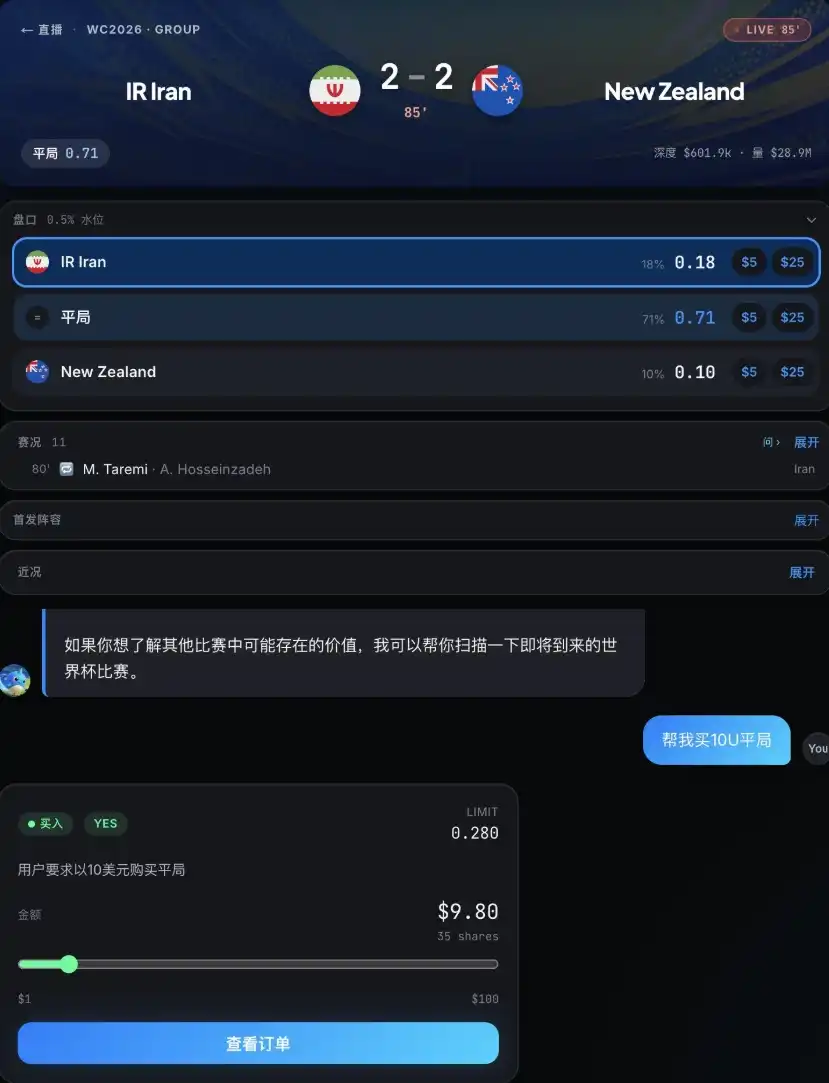
For instance, in this World Cup-related exploration, imToken started experimenting with integrating AI Agents into actual use cases. Features like the web-based proxy and the one in Discord can help users more naturally complete betting transactions based on specific prediction needs, allowing users to no longer operate solely within the wallet app but to easily participate in prediction markets in scenarios like Discord or web pages, seamlessly guided back on-chain by the Agent.

This could very well be an early form of the Agentic Wallet—the future Web3 wallet might not be limited to a wallet application but will likely be an 'AI wallet form' that is as ubiquitous as possible.
I. The World Cup Experiment: When Agents Start Understanding 'Intent'

Returning to our perennial question, over the past decade, the core problem wallets solved was clear: where assets are stored, who controls the private key, and who signs transactions.

For example, when users open imToken, it's mainly to check balances, perform transfers/interactions, and manage multi-chain assets. Consequently, wallets at this stage resemble asset and signature gateways. It's sufficient for users to know what they plan to do and then use the wallet to complete the final step.

But the change in the Agentic era lies in the fact that users might not initially know what they need to click.

In a World Cup scenario, an average user might not first think, 'I need to open Polymarket, find a specific market, evaluate the odds, and complete the transaction.' They are more likely to say, 'What are the highlights of tonight's match?', 'I'm confident Portugal will qualify; are there relevant markets?', 'Is this betting line already too low?', or 'If I just want to participate with a small amount, what's the process?'

Previously, these questions might have been scattered across WeChat groups, social media discussions, or search engines, requiring users to piece information together and execute step by step. However, with Agent intervention, the interaction method has changed significantly: users only need to express a general intent, and the Agent will proactively break it down into a path, with the wallet then responsible for turning that path into a series of on-chain actions.

So, this is definitely not as simple as adding a chat box to the wallet.

The real change is that wallets are starting to evolve from 'function menus' into 'intent interpreters.' Previously, wallets primarily required users to decide whether to transfer, swap, stake, or connect to a DApp? Future wallets might be more straightforward, requiring users to simply tell them in natural language what they want to accomplish.

This is why a mass event like the World Cup is well-suited as an entry point for Agentic Wallets. It naturally provides context, users naturally have the desire to express themselves, and they naturally need to make judgments. The Agent doesn't need to start by managing complex asset portfolios for users, especially those involving intricate asset management with higher risks. It can first help users find interaction paths within a specific scenario before handing final control back to the wallet and the user.

The web-based and Discord-based proxies capable of on-chain interaction mentioned at the beginning of the article, which imToken piloted, are typical examples. They bring wallet capabilities to a lighter-weight entry point, allowing users to find interaction paths through an Agent on an event page, within a World Cup scenario, without necessarily first opening the app or entering the traditional DApp browser.

This indicates that the boundaries of wallets are expanding outward.

Previously, wallet entry points were relatively clear: users opened the app, entered the asset page, clicked functions, and connected to DApps. Future wallet entry points might be scattered across more places, such as web pages, Discord, Telegram, AI chat boxes, event pages, developer tools, or even a lightweight wallet interface generated by the user.

From this perspective, World Cup predictions are not the main point; the key is that they allow wallets, for the first time, to more naturally position themselves ahead of 'user intent.'

II. From Agent Pay: AI is Entering the Payment Layer

If viewed only within the Crypto sphere, Agentic Wallets might still be easily understood as a narrative concept—AI helping users watch markets, find opportunities, and make trades, sounding reminiscent of the last wave of AI Agent hype.

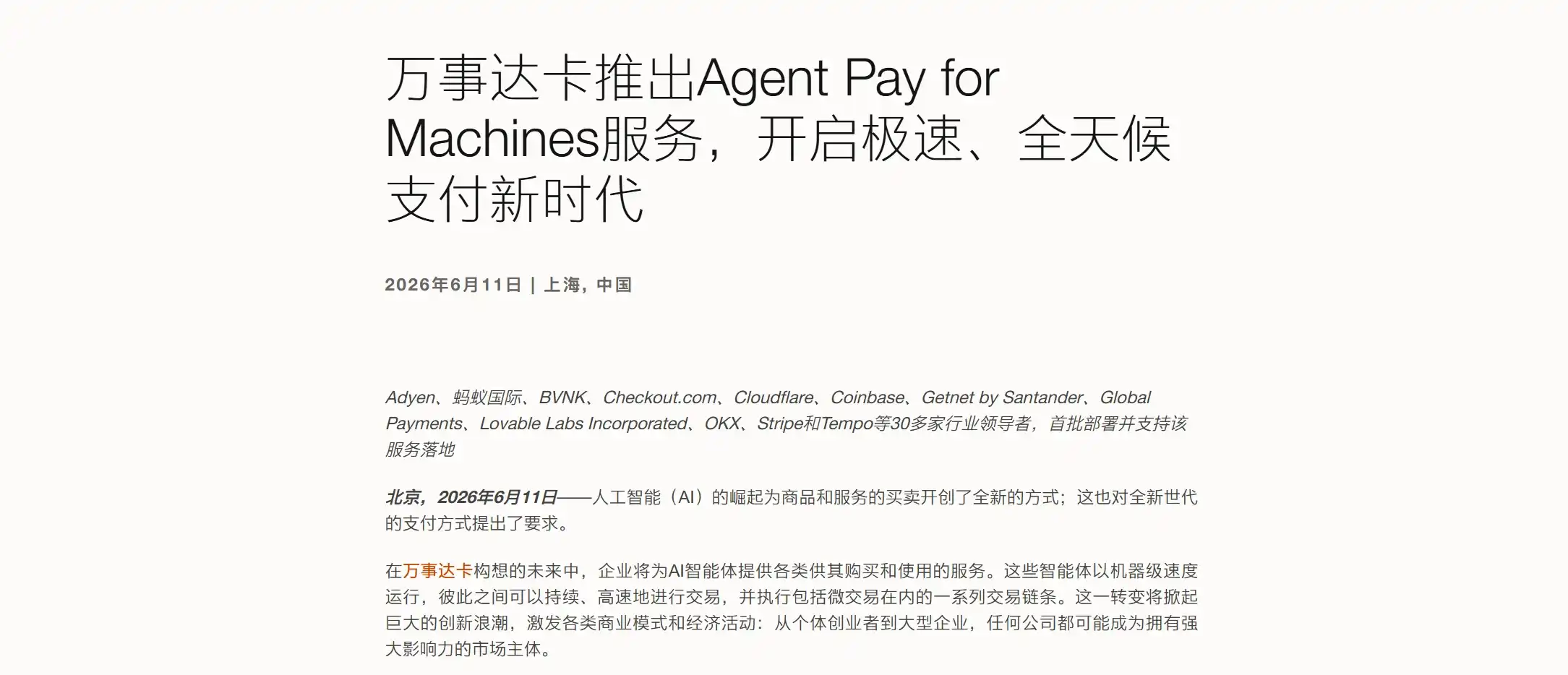
But Mastercard's launch of Agent Pay for Machines on June 10th suddenly made this matter extend beyond Web3.

Mastercard's definition of Agent Pay is clear: enabling trusted AI Agents to participate in payments with user authorization, including how Agents are identified, authorized, verified within the payment network, and how merchants, issuers, and users know a transaction was assisted by an Agent.
This is highly similar to the problems faced by Web3 wallets.

When AI only helps you write copy, the cost of errors is usually manageable. But once AI starts participating in asset interactions, the problem shifts: does it actually have permission? Is its understanding of user intent accurate? Are the services it calls trustworthy? Does the transaction it initiates exceed boundaries? If the outcome doesn't match user expectations, who provides recourse?

Mastercard's answer is to redesign the 'trusted Agent's' identity, tokens, authorization, risk control, and dispute handling within the payment network.

This signal is crucial. If the Agentic concept in the Web3 circle still carries a bit of geeky imagination, the fact that traditional financial giants are starting to design payment infrastructure for Agentic Commerce indicates this has entered a more realistic business context.

Looking closer, domestic payment giants are also moving in this direction. WeChat Pay is testing AI payment features in collaboration with Tencent's intelligent agent product WorkBuddy, such as launching an 'AI Exclusive Card' within the WeChat wallet. Based on disclosed information, the core of such products is not to let AI spend money arbitrarily but to set boundaries for intelligent agent payments through methods like recharge limits, payment authorization scopes, and password verification confirmations.

This logic aligns with Mastercard's Agent Pay: AI can participate in payments, but it must be identified, authorized, restricted, and audited.

Web3 wallets face the on-chain version of the same problem. The difference is that traditional payment systems emphasize the network, merchants, issuers, and compliance responsibilities; on-chain wallets emphasize private keys, signatures, authorizations, contract calls, and user self-custody.

Precisely because of this, Agentic Wallets cannot simply copy the traditional payment path. After all, in traditional payments, users can rely on banks, card networks, merchants, dispute resolution, and risk control systems. But in the on-chain world, once a transaction is on-chain, there's often no undo button.

The higher the efficiency brought by AI Agents, the more critical the last line of security defense borne by the wallet becomes. Therefore, future wallets cannot just let Agents 'do things'; they must ensure Agents 'can only operate within user-allowed boundaries.'

This is also why Web3 might actually be more suitable for discussing Agentic Wallets.

III. The Agentic Era: How Are Wallets Redefining On-Chain Interaction?

When many discuss AI Agents, they easily drift towards an extreme imagination: in the future, AI will automatically trade for me, manage my finances, find airdrops, and arbitrage.

This direction is certainly attractive, but for wallets, the real difficulty is not 'automation' but 'a sense of boundaries.'

Because a wallet is not an ordinary application. In ordinary apps, if AI recommends the wrong song, writes the wrong passage, or clicks the wrong page, it's at most an experience issue. But in a wallet, if AI misunderstands an instruction, calls the wrong contract, or grants excessive permissions, it could become a real asset risk (Extended reading: Sign Isn't Just Signing: When an AI Agent Signs for You, Who Holds the Control?).

Therefore, the primary question for Agentic Wallets is not 'how much can AI do for the user?' but 'how does the user know what AI is doing?'

This is also why imToken has consistently emphasized control over the past few years. From self-custody wallets to multi-chain asset management, to today's AI co-creation and Agent exploration, the truly continuous thread isn't about having more and more features, but about users always being able to understand, confirm, and control their digital world.

In the Agentic era, this thread becomes more concrete.

Wallets need to let users understand who this Agent is, what capabilities it can call, how long the authorization lasts, whether it can operate across DApps, when it requires my reconfirmation, whether I can pause or revoke it with one click... These questions might sound tedious, but they are the foundation upon which Agentic Wallets can truly be established.

Because the power of an AI Agent lies precisely in its ability to simplify complex processes. The user says one thing, and the Agent can break it down into a dozen-step execution path. This is good for experience but also a challenge for security. The longer the path and the more intermediate steps, the more the wallet needs to bring key nodes back into the user's view.

Good wallet interactions in the future might not involve showing users more technical details, but translating complex transactions into language users can understand:

  • You are authorizing a specific Agent to call a specific contract within the next 24 hours;
  • This operation can use at most a certain amount of USDC;
  • It can only access World Cup-related prediction markets, not touch your other assets;
  • Each transaction exceeding a certain amount requires reconfirmation;
  • Authorization automatically expires after a set period;
  • You can pause this Agent anytime within the wallet;

This might sound like a distant future, but it's already starting from some small scenarios. The World Cup prediction event is one event-based entry point, and imToken's pilot web-based Agent and Discord Agent are community-based entry points.

Especially at times like these, wallets cannot retreat to the background.

Criptos en tendencia

Preguntas relacionadas

QWhat is the main change in the way users interact with the blockchain when AI Agents enter the wallet scene, as discussed in the article?

AThe main change is the shift from users knowing exactly which functions to execute (like transfer, swap, or staking) to users expressing their general intent in natural language. The AI Agent then interprets this intent, breaks it down into actionable steps, and guides the user to complete the corresponding on-chain actions seamlessly.

QAccording to the article, why is the World Cup a suitable entry point for observing the development of Agentic Wallets?

AThe World Cup is suitable because it provides a natural context where users have a strong desire to express opinions, make judgments, and participate in prediction markets. This setting allows AI Agents to help users find interaction paths within a specific, low-risk scenario before tackling more complex asset management, making the transition to Agentic Wallets more user-friendly and gradual.

QWhat key challenge must Agentic Wallets address, as highlighted by the comparison with Mastercard's Agent Pay and traditional payment systems?

AThe key challenge is establishing clear boundaries and control for AI Agents. While AI can enhance efficiency, it must be properly identified, authorized, restricted, and audited, especially when handling financial transactions. Unlike traditional payment systems with built-in safeguards, on-chain transactions are often irreversible, making it crucial for wallets to ensure users understand, confirm, and maintain control over what the Agent is doing.

QWhat is the core principle that should remain consistent for wallets from self-custody to the Agentic era, as emphasized in the article?

AThe core consistent principle is that users must always be able to understand, confirm, and control their digital world. In the Agentic era, this translates to features that let users know who the Agent is, what permissions it has, the duration of its authorization, when reconfirmation is needed, and the ability to pause or revoke its access at any time.

QHow is the physical or conceptual 'entrance' of the wallet changing with the advent of Agentic Wallets?

AThe wallet's 'entrance' is expanding and becoming more ubiquitous. Instead of being confined to a dedicated wallet application, wallet capabilities are beginning to appear in various interfaces like web pages, Discord, Telegram, AI chatboxes, activity pages, and developer tools. This allows users to initiate and complete on-chain interactions from more diverse and lightweight starting points.

Lecturas Relacionadas

Los Oso Mantienen el Control Mientras que el ETH Rechaza la Resistencia de la Línea de Tendencia

El último rebote de Ethereum no ha convencido a todos los analistas de que la tendencia bajista haya terminado. En una idea publicada en TradingView el 20 de junio, TheSignalyst argumenta que ETH se mantiene en territorio bajista. Esto se debe a que continúa cotizando por debajo de una línea de tendencia roja descendente y ha formado una secuencia de máximos y mínimos más bajos. El gráfico del analista muestra que el precio de ETH fue rechazado en una zona de confluencia que incluye dicha línea de tendencia y una zona de resistencia horizontal. Este tipo de resistencia combinada suele atraer a vendedores de forma más agresiva. El fracaso en superar ambos niveles se interpreta como una confirmación de que los vendedores mantienen el control. El área de soporte clave se sitúa entre 1.350 y 1.500 dólares. Una ruptura decisiva por debajo de este rango debilitaría significativamente la estructura general de ETH. Por ahora, el precio está comprimido entre este soporte y la línea de tendencia bajista. El desempeño de Ethereum es crucial para el mercado altcoin en general. Cuando ETH lucha frente al dólar, el apetito por el riesgo en DeFi y activos de menor capitalización suele debilitarse también. Por lo tanto, este análisis sirve como advertencia: los alcistas necesitan una ruptura clara por encima de la resistencia antes de poder hablar de un cambio de tendencia sostenido.

bitcoinistHace 6 hora(s)

Los Oso Mantienen el Control Mientras que el ETH Rechaza la Resistencia de la Línea de Tendencia

bitcoinistHace 6 hora(s)

TechFlow Oficina de Inteligencia: Las probabilidades de que Anthropic realice una OPI superan el 80%, Irán vuelve a cerrar el estrecho de Ormuz y desestabiliza los precios del petróleo

Resumen del informe TechFlow: Los mercados anticipan que Anthropic anunciará su OPV antes de noviembre de 2026, planteando dudas sobre si una valoración billonaria puede coexistir con su promesa central de seguridad en IA. Otras tendencias clave: * **Marketing digital:** Marcas adoptan influencers virtuales generados por IA para promocionar productos. * **Energía y Geopolítica:** Irán anuncia el cierre del estrecho de Ormuz, causando volatilidad en el precio del petróleo, aunque datos de seguimiento muestran cierto tráfico marítimo persistente. Paralelamente, Irán reanuda la carga de crudo en la isla de Kharg. * **Finanzas/Tecnología:** Goldman Sachs advierte que los gastos de capital en IA (5,3 billones de dólares) podrían acercarse al límite de crédito. En Europa, se produce la primera incumplimiento en acciones de CLO desde la crisis financiera. * **Empresas tecnológicas:** Cloudflare introduce cuentas temporales para agentes de IA; el tráfico IPv6 de Google supera el 50%; Hyundai adquiere el control total de Boston Dynamics. * **Mercados:** Inversores minoristas invierten fuertemente en la OPV de SpaceX. Elon Musk especula sobre futuras inversiones astronómicas en antimateria para viajes interestelares. **Conclusión subyacente:** Tres señales (tensión en Ormuz, incumplimiento en CLO y advertencias sobre gasto en IA) apuntan a una creciente restricción de la liquidez global y al aumento de los costes marginales. Mientras tanto, el capital sigue buscando narrativas de crecimiento a gran escala (como la OPV de Anthropic, SpaceX y los proyectos de Musk), indicando una bifurcación entre un "viejo mundo" con creciente presión financiera y un "nuevo mundo" que construye narrativas aún más ambiciosas.

marsbitHace 7 hora(s)

TechFlow Oficina de Inteligencia: Las probabilidades de que Anthropic realice una OPI superan el 80%, Irán vuelve a cerrar el estrecho de Ormuz y desestabiliza los precios del petróleo

marsbitHace 7 hora(s)

El cazador cazado: el bot MEV más rentable fue hackeado

**El cazador cazado: El bot de MEV más rentable es hackeado** El conocido bot de MEV en Ethereum, Jaredfromsubway.eth, sufrió un ataque dirigido el sábado, perdiendo más de 7,5 millones de dólares. Según investigaciones, no fue un phishing tradicional ni una explotación de contrato inteligente, sino un sofisticado "ataque de honeypot contra-MEV" diseñado específicamente para explotar la lógica de comportamiento de estos bots. El atacante desplegó durante semanas 66 contratos de tokens falsos y pools de liquidez, disfrazados como activos principales como WETH, USDC o USDT, para crear rutas de arbitraje falsas. El bot, al detectar la aparente oportunidad, ejecutó una transacción que concedió permisos a un contrato controlado por el atacante. Estos permisos no fueron revocados, permitiendo finalmente que el atacante drenara los fondos del bot en una sola transacción. Jaredfromsubway.eth es uno de los bots de MEV más activos e infames de Ethereum, especializado en ataques de "sándwich" para capturar ganancias de los deslizamientos de precio en las transacciones de usuarios. Se estima que ha acumulado decenas de millones en ganancias y estaba relacionado con alrededor del 70% de estos ataques en un período reciente. Este incidente subraya la creciente sofisticación de las amenazas en cripto, demostrando que incluso los actores más agresivos y automatizados ("depredadores") ahora son vulnerables a ataques multidimensionales que explotan sus propias reglas y automatizaciones. Tras el hackeo, una cuenta no oficial en X se hizo pasar por el bot ofreciendo una recompensa falsa, lo que ha generado advertencias de seguridad adicionales.

marsbitHace 8 hora(s)

El cazador cazado: el bot MEV más rentable fue hackeado

marsbitHace 8 hora(s)

Trading

Spot
Futuros

Artículos destacados

Cómo comprar F

¡Bienvenido a HTX.com! Hemos hecho que comprar Synfutures (F) sea simple y conveniente. Sigue nuestra guía paso a paso para iniciar tu viaje de criptos.Paso 1: crea tu cuenta HTXUtiliza tu correo electrónico o número de teléfono para registrarte y obtener una cuenta gratuita en HTX. Experimenta un proceso de registro sin complicaciones y desbloquea todas las funciones.Obtener mi cuentaPaso 2: ve a Comprar cripto y elige tu método de pagoTarjeta de crédito/débito: usa tu Visa o Mastercard para comprar Synfutures (F) al instante.Saldo: utiliza fondos del saldo de tu cuenta HTX para tradear sin problemas.Terceros: hemos agregado métodos de pago populares como Google Pay y Apple Pay para mejorar la comodidad.P2P: tradear directamente con otros usuarios en HTX.Over-the-Counter (OTC): ofrecemos servicios personalizados y tipos de cambio competitivos para los traders.Paso 3: guarda tu Synfutures (F)Después de comprar tu Synfutures (F), guárdalo en tu cuenta HTX. Alternativamente, puedes enviarlo a otro lugar mediante transferencia blockchain o utilizarlo para tradear otras criptomonedas.Paso 4: tradear Synfutures (F)Tradear fácilmente con Synfutures (F) en HTX's mercado spot. Simplemente accede a tu cuenta, selecciona tu par de trading, ejecuta tus trades y monitorea en tiempo real. Ofrecemos una experiencia fácil de usar tanto para principiantes como para traders experimentados.

302 Vistas totalesPublicado en 2024.12.21Actualizado en 2026.06.02

Cómo comprar F

Discusiones

Bienvenido a la comunidad de HTX. Aquí puedes mantenerte informado sobre los últimos desarrollos de la plataforma y acceder a análisis profesionales del mercado. A continuación se presentan las opiniones de los usuarios sobre el precio de F (F).

活动图片