The Entire Internet Hails Noam's Joining, But OpenAI's Loss Bill Just Got Thicker

marsbitPublicado a 2026-06-19Actualizado a 2026-06-19

Resumen

While the AI community celebrates Noam Shazeer, co-author of the "Attention Is All You Need" paper, joining OpenAI as Head of Architectural Research, the company's audited financials reveal a starkly different reality. In 2025, OpenAI reported $13.07 billion in revenue but a massive $20.92 billion operating loss. Even excluding a one-time accounting charge, the cash burn is severe, with $3.7 billion consumed in Q1 2026 alone. This high-profile hiring occurs against a backdrop of significant internal research talent drain, with key founders and researchers departing as the company's focus shifts from exploratory research to product iteration. Meanwhile, OpenAI's fundamental business model faces a deep crisis. It paid Microsoft $10.59 billion for compute in 2025, while its vast user base of 9 billion weekly actives includes only 50 million paying customers, making growth a direct driver of escalating costs. The article argues Shazeer's recruitment is less about technical necessity and more about crafting a compelling narrative for OpenAI's upcoming IPO, aiming to justify a rumored $1 trillion valuation to future public market investors. It contrasts OpenAI's strategy with Anthropic's reported path to profitability, which relies on a strong enterprise customer base and cost control, rather than star-powered narratives. Ultimately, the piece concludes that while Shazeer's architectural work may take 1-2 years to materialize, OpenAI's financial clock is ticking much faster, wit...

By | AI Chang Fan Tiao

Altman wrote on X: "Noam was one of the people I most wanted to work with when I started OpenAI. It only took 10 years. Worth it."

OpenAI's Chief Research Officer Mark Chen promptly announced: Noam Shazeer joins as Head of Architecture Research.
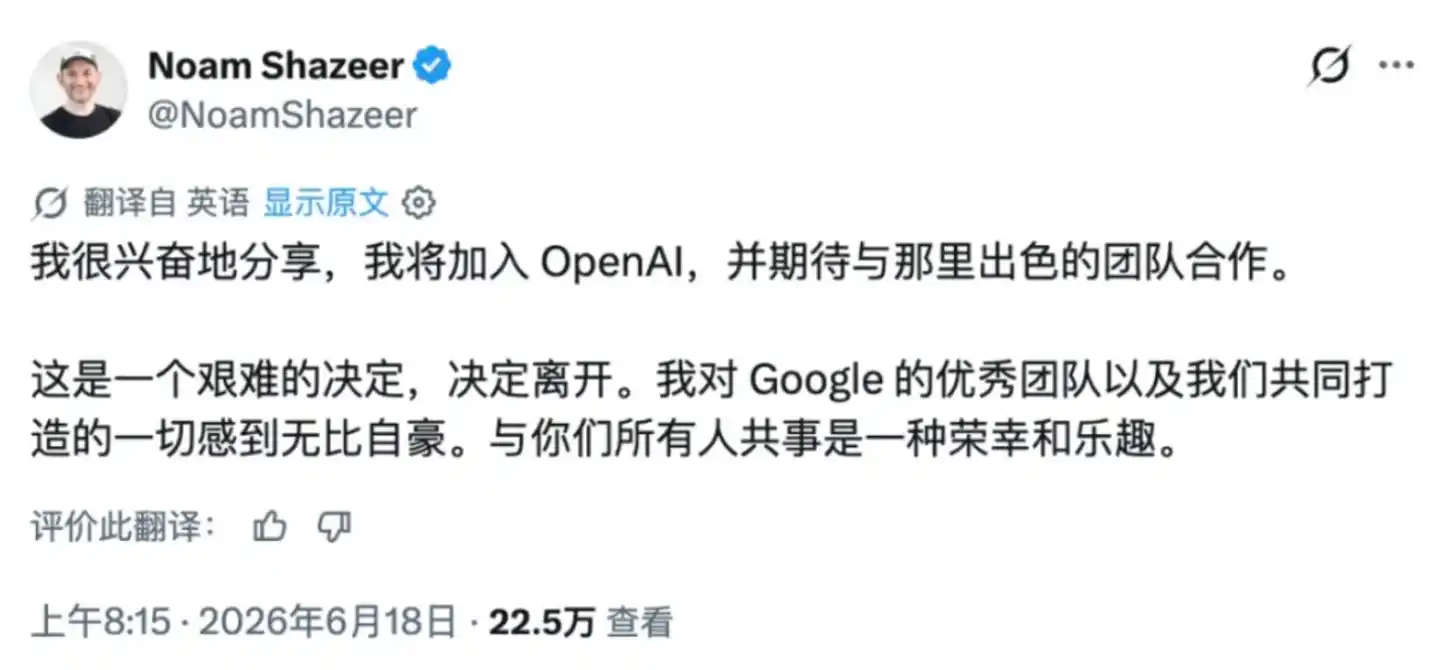
The entire internet lined up to cheer, "With the father of Transformer in charge, the next super-intelligence is guaranteed."

The same week, another document circulated within the industry: the first complete exposure of audited financial data shows OpenAI's 2025 revenue at $13.07 billion, with an operating loss of $20.92 billion. Including a one-time non-cash provision for restructuring, the net loss was nearly $39 billion. Even deducting that non-recurring accounting phantom loss, the real cash flow operating hemorrhage remains a bottomless pit. In Q1 2026, cash burn was $3.7 billion, exceeding half of the revenue for the same period.

So before hastily cheering that "OpenAI is steady," this isn't a technical success story at all—it's merely a check written on the back of $20.92 billion in operating losses. What OpenAI bought has nothing to do with the future; it's just a page in a story for the next round of investors.

Talent Is Leaking, Stars Are Filling In

Noam's resume is indeed dazzling. Core author of the 2017 paper "Attention Is All You Need," key contributor to Transformer, MoE, and T5. He left Google in 2021 to found Character.AI. In 2024, Google brought him back with a $2.7 billion technology licensing agreement, appointing him co-lead of Gemini. Less than two years later, he departed again.

Google proved one thing with $2.7 billion: Money can buy someone's time, but it can't buy the soil that makes them stay. Now OpenAI intends to try again with equity.

But OpenAI's soil isn't necessarily more suitable for pure research than Google's. Over the past three years, this company has been witnessing a talent swap: co-founder Karpathy left, Ilya Sutskever left, John Schulman left, and Jan Leike, head of the superalignment team, left. Large swaths of the core founding team have departed, leaving few in the core decision-making layer.

According to public industry data, research positions accounted for 23% of OpenAI's total hires in 2021 but dropped to 4.4% by 2024. Former internal researchers bluntly stated: The team's focus has shifted entirely from "exploratory research" to "product iteration." A few people jumping ship is just the surface. The truth that the research soil is being inch-by-inch squeezed out by product KPIs can no longer be hidden.

What he's facing is fundamentally not a lab starting from scratch. The system that Karpathy couldn't tolerate—and could only pursue "personal projects" within—is the mess Noam is inheriting. He's merely filling the hole left by the departure of Karpathy and others.

Sky-High Talent Buys Can't Save the Accounting Dilemma

Everyone is discussing what new architecture Noam can bring to OpenAI. But OpenAI's current predicament has nothing to do with "lacking someone who can write Transformer."

The financial figures are laid bare: In 2025 alone, R&D expenses included a $10.59 billion computing power leasing fee paid to Microsoft; total annual R&D cost was $19.18 billion; inference computing costs were $7.5 billion; and sales and marketing investments were $5.73 billion. On the other side are 900 million weekly active users, with only 50 million being paid users. Massive free traffic is a pure cost bottomless pit—the larger the user scale, the heavier the computing bill.

Even OpenAI itself is cutting costs: leaked documents show it has scaled back the Sora video model and trimmed non-core businesses to control costs. Cutting businesses to save money on one hand while spending exorbitantly to hire people on the other is anxious procurement.

The anxiety isn't unique to OpenAI; the industry wind has shifted long ago.

Microsoft's own Copilot Cowork has already abandoned the unlimited pricing model for a pay-per-use system due to high costs, and reportedly even considered integrating DeepSeek V4 as a cost-effective option. Even GitHub, under Microsoft, has turned to AWS for support due to AI computing shortages. If the financier's own computing pool isn't sufficient, who will foot OpenAI's astronomical computing bill next?

Cook publicly warned that the AI boom has driven storage chip prices up fourfold since 2024, a trend expected to continue until 2027, potentially increasing the price of the next iPhone by $270. These numbers serve more as industry indicators; the real hard math is inside OpenAI: computing hardware costs continue to climb, and efficiency gains from model architecture optimization simply can't keep pace with hardware price hikes. Noam can design more efficient model structures, but he can't fix the CFO's nightmare. Every additional free user adds another rigid computing bill.

The technical side offers no answers; the capital side must.

OpenAI is in a critical window of IPO preparation, with valuations touted as high as $1 trillion. Underwriters need sufficiently impactful stories to support the valuation. "The father of Transformer overseeing R&D" is exactly the kind of narrative material capital markets love most. The calculation for this investment isn't about how much model performance improved; the core question is whether it adds another highlight to the roadshow PPT.

Retail investors might get excited about "the father of Transformer joining," feeling the technical moat has thickened. But institutional investors, seeing the $20.92 billion operating loss in 2025, will only ask three practical questions:

Will this person suddenly make free users willing to pay?

Can he get Microsoft to discount the $10.59 billion computing bill?

Can he make departed research veterans return?

If the answer to all is no, then his value is merely a footnote in the valuation story. The biggest winners are always the early shareholders and underwriters. One more "genius in charge" story allows them to gracefully transfer the risk of $20.92 billion in operating losses to secondary market bag holders.

The Winner Between Two Paths Is Already Emerging

What is Anthropic doing during the same period?

In enterprise adoption rate statistics from multiple institutions, Anthropic's share has climbed to the 35%-40% range, significantly narrowing the lead with OpenAI and even surpassing it in some samples. More critically is its customer mix, with about 80% of revenue coming from enterprise clients; many Fortune 100 companies have already listed Claude on their procurement sheets. The company reportedly achieved its first profitable quarter in history and has confidentially filed for an IPO. Anthropic opens an office in Seoul, taking orders from NAVER and Nexon, earning real cash flow.

Anthropic didn't poach the "father of Transformer," nor does it rely on a single genius to prop up valuation. It relies on its enterprise-focused, compliant, neutral positioning, controllable token costs, and deep integration of Claude Code into development scenarios. What enterprise clients want has little to do with parameter counts; they want a "safety net that won't cause trouble" and a ledger that makes sense.

Google DeepMind's Hassabis hasn't moved in a decade, and Google didn't spend $2.7 billion to "redeem" him from outside. True innovative soil, which grows and retains research talent, cannot be bought annually for billions spent on external stars. The soil is only alive when it nurtures and keeps its own talent.

Anthropic has proven one thing: Profitability has little to do with individual genius; the foundation lies in the commercial soil.

OpenAI has also proven one thing: Individual genius cannot mask the hardening of commercial soil. Especially when you're buying talent at sky-high prices while watching your homegrown talent leave.

Conclusion

The next-generation architecture led by Noam will take at least 1 to 2 years to materialize. Yet, extrapolating from the Q1 2026 burn rate of $3.7 billion, annual cash consumption will not be less than $14.8 billion. This hasn't even accounted for the inevitably inflated marketing and compliance costs before the IPO.

Google spent $2.7 billion to rent one person for two years; OpenAI now intends to rent again using equity. The difference isn't the payment method. Google at least had its income statement to cushion it then; OpenAI's money for this is written on the back of $20.92 billion in operating losses, discounted by IPO valuation bubbles.

The ledger doesn't care about genius. The ledger only cares: How many quarters do you have left to wait?


Criptos en tendencia

Preguntas relacionadas

QWhat is the main argument of the article regarding OpenAI's hiring of Noam Shazeer?

AThe article argues that OpenAI's high-profile hiring of Noam Shazeer is primarily a strategic move to create a compelling narrative for its upcoming IPO and to appease investors, rather than a genuine solution to its deep-seated financial and structural problems. It suggests the company is using the 'Transformer co-inventor' story to divert attention from its massive operating losses and ongoing cash burn.

QWhat financial challenges for OpenAI are highlighted in the article?

AThe article highlights severe financial challenges: an operating loss of $20.92 billion in 2025, a net loss nearing $39 billion after accounting adjustments, and a cash burn of $3.7 billion in Q1 2026 alone. Key cost drivers include a $10.59 billion compute rental fee paid to Microsoft, $19.18 billion in total R&D costs, and the burden of serving a massive free user base (900M WAUs) with only 50M paying users.

QHow does the article contrast OpenAI's approach with that of its competitor Anthropic?

AThe article contrasts OpenAI's reliance on star hires and consumer-focused growth with Anthropic's business-oriented, sustainable model. Anthropic is reported to have reached profitability, with around 80% of its revenue from enterprise clients, focusing on compliance, controlled costs, and deep product integration (like Claude Code). This is presented as a more stable path compared to OpenAI's high-burn, narrative-driven strategy.

QWhat point does the article make about the 'research soil' or culture at OpenAI?

AThe article contends that OpenAI's internal 'research soil' has deteriorated, shifting from exploratory research towards product iteration and KPIs. This is evidenced by the exodus of founding researchers (like Karpathy, Sutskever) and a sharp drop in research hiring (from 23% of hires in 2021 to 4.4% in 2024). It suggests Noam Shazeer is entering a system that previously couldn't retain top research talent, questioning the long-term viability of a pure research role there.

QWhat is the article's view on the real value of hiring a top AI researcher like Noam Shazeer for OpenAI's core problems?

AThe article is skeptical, arguing that a brilliant architect like Noam Shazeer cannot solve OpenAI's fundamental business model flaws. His technical optimizations cannot significantly reduce the crippling compute costs, convert free users to paid ones, or lower Microsoft's bills. His primary value, according to the article, is as a 'footnote' in a valuation story to help justify a high IPO price and transfer financial risk to public market investors.

Lecturas Relacionadas

Los Oso Mantienen el Control Mientras que el ETH Rechaza la Resistencia de la Línea de Tendencia

El último rebote de Ethereum no ha convencido a todos los analistas de que la tendencia bajista haya terminado. En una idea publicada en TradingView el 20 de junio, TheSignalyst argumenta que ETH se mantiene en territorio bajista. Esto se debe a que continúa cotizando por debajo de una línea de tendencia roja descendente y ha formado una secuencia de máximos y mínimos más bajos. El gráfico del analista muestra que el precio de ETH fue rechazado en una zona de confluencia que incluye dicha línea de tendencia y una zona de resistencia horizontal. Este tipo de resistencia combinada suele atraer a vendedores de forma más agresiva. El fracaso en superar ambos niveles se interpreta como una confirmación de que los vendedores mantienen el control. El área de soporte clave se sitúa entre 1.350 y 1.500 dólares. Una ruptura decisiva por debajo de este rango debilitaría significativamente la estructura general de ETH. Por ahora, el precio está comprimido entre este soporte y la línea de tendencia bajista. El desempeño de Ethereum es crucial para el mercado altcoin en general. Cuando ETH lucha frente al dólar, el apetito por el riesgo en DeFi y activos de menor capitalización suele debilitarse también. Por lo tanto, este análisis sirve como advertencia: los alcistas necesitan una ruptura clara por encima de la resistencia antes de poder hablar de un cambio de tendencia sostenido.

bitcoinistHace 3 hora(s)

Los Oso Mantienen el Control Mientras que el ETH Rechaza la Resistencia de la Línea de Tendencia

bitcoinistHace 3 hora(s)

TechFlow Oficina de Inteligencia: Las probabilidades de que Anthropic realice una OPI superan el 80%, Irán vuelve a cerrar el estrecho de Ormuz y desestabiliza los precios del petróleo

Resumen del informe TechFlow: Los mercados anticipan que Anthropic anunciará su OPV antes de noviembre de 2026, planteando dudas sobre si una valoración billonaria puede coexistir con su promesa central de seguridad en IA. Otras tendencias clave: * **Marketing digital:** Marcas adoptan influencers virtuales generados por IA para promocionar productos. * **Energía y Geopolítica:** Irán anuncia el cierre del estrecho de Ormuz, causando volatilidad en el precio del petróleo, aunque datos de seguimiento muestran cierto tráfico marítimo persistente. Paralelamente, Irán reanuda la carga de crudo en la isla de Kharg. * **Finanzas/Tecnología:** Goldman Sachs advierte que los gastos de capital en IA (5,3 billones de dólares) podrían acercarse al límite de crédito. En Europa, se produce la primera incumplimiento en acciones de CLO desde la crisis financiera. * **Empresas tecnológicas:** Cloudflare introduce cuentas temporales para agentes de IA; el tráfico IPv6 de Google supera el 50%; Hyundai adquiere el control total de Boston Dynamics. * **Mercados:** Inversores minoristas invierten fuertemente en la OPV de SpaceX. Elon Musk especula sobre futuras inversiones astronómicas en antimateria para viajes interestelares. **Conclusión subyacente:** Tres señales (tensión en Ormuz, incumplimiento en CLO y advertencias sobre gasto en IA) apuntan a una creciente restricción de la liquidez global y al aumento de los costes marginales. Mientras tanto, el capital sigue buscando narrativas de crecimiento a gran escala (como la OPV de Anthropic, SpaceX y los proyectos de Musk), indicando una bifurcación entre un "viejo mundo" con creciente presión financiera y un "nuevo mundo" que construye narrativas aún más ambiciosas.

marsbitHace 4 hora(s)

TechFlow Oficina de Inteligencia: Las probabilidades de que Anthropic realice una OPI superan el 80%, Irán vuelve a cerrar el estrecho de Ormuz y desestabiliza los precios del petróleo

marsbitHace 4 hora(s)

El cazador cazado: el bot MEV más rentable fue hackeado

**El cazador cazado: El bot de MEV más rentable es hackeado** El conocido bot de MEV en Ethereum, Jaredfromsubway.eth, sufrió un ataque dirigido el sábado, perdiendo más de 7,5 millones de dólares. Según investigaciones, no fue un phishing tradicional ni una explotación de contrato inteligente, sino un sofisticado "ataque de honeypot contra-MEV" diseñado específicamente para explotar la lógica de comportamiento de estos bots. El atacante desplegó durante semanas 66 contratos de tokens falsos y pools de liquidez, disfrazados como activos principales como WETH, USDC o USDT, para crear rutas de arbitraje falsas. El bot, al detectar la aparente oportunidad, ejecutó una transacción que concedió permisos a un contrato controlado por el atacante. Estos permisos no fueron revocados, permitiendo finalmente que el atacante drenara los fondos del bot en una sola transacción. Jaredfromsubway.eth es uno de los bots de MEV más activos e infames de Ethereum, especializado en ataques de "sándwich" para capturar ganancias de los deslizamientos de precio en las transacciones de usuarios. Se estima que ha acumulado decenas de millones en ganancias y estaba relacionado con alrededor del 70% de estos ataques en un período reciente. Este incidente subraya la creciente sofisticación de las amenazas en cripto, demostrando que incluso los actores más agresivos y automatizados ("depredadores") ahora son vulnerables a ataques multidimensionales que explotan sus propias reglas y automatizaciones. Tras el hackeo, una cuenta no oficial en X se hizo pasar por el bot ofreciendo una recompensa falsa, lo que ha generado advertencias de seguridad adicionales.

marsbitHace 5 hora(s)

El cazador cazado: el bot MEV más rentable fue hackeado

marsbitHace 5 hora(s)

Trading

Spot
Futuros

Artículos destacados

Cómo comprar BILL

¡Bienvenido a HTX.com! Hemos hecho que comprar Billions Network (BILL) sea simple y conveniente. Sigue nuestra guía paso a paso para iniciar tu viaje de criptos.Paso 1: crea tu cuenta HTXUtiliza tu correo electrónico o número de teléfono para registrarte y obtener una cuenta gratuita en HTX. Experimenta un proceso de registro sin complicaciones y desbloquea todas las funciones.Obtener mi cuentaPaso 2: ve a Comprar cripto y elige tu método de pagoTarjeta de crédito/débito: usa tu Visa o Mastercard para comprar Billions Network (BILL) al instante.Saldo: utiliza fondos del saldo de tu cuenta HTX para tradear sin problemas.Terceros: hemos agregado métodos de pago populares como Google Pay y Apple Pay para mejorar la comodidad.P2P: tradear directamente con otros usuarios en HTX.Over-the-Counter (OTC): ofrecemos servicios personalizados y tipos de cambio competitivos para los traders.Paso 3: guarda tu Billions Network (BILL)Después de comprar tu Billions Network (BILL), guárdalo en tu cuenta HTX. Alternativamente, puedes enviarlo a otro lugar mediante transferencia blockchain o utilizarlo para tradear otras criptomonedas.Paso 4: tradear Billions Network (BILL)Tradear fácilmente con Billions Network (BILL) en HTX's mercado spot. Simplemente accede a tu cuenta, selecciona tu par de trading, ejecuta tus trades y monitorea en tiempo real. Ofrecemos una experiencia fácil de usar tanto para principiantes como para traders experimentados.

281 Vistas totalesPublicado en 2026.05.07Actualizado en 2026.06.02

Cómo comprar BILL

Discusiones

Bienvenido a la comunidad de HTX. Aquí puedes mantenerte informado sobre los últimos desarrollos de la plataforma y acceder a análisis profesionales del mercado. A continuación se presentan las opiniones de los usuarios sobre el precio de BILL (BILL).

活动图片