TON Revives the Gram Brand, a Name That Disappeared Six Years Ago Returns

marsbitPublicado a 2026-06-10Actualizado a 2026-06-10

Resumen

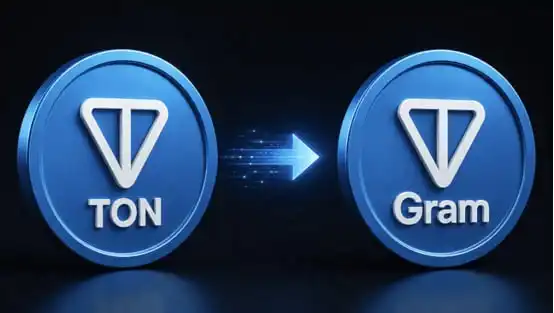
After a community vote with over 81% support, The Open Network (TON) is officially renaming its native token from Toncoin back to Gram (with ticker GRAM), effective June 15. This move reclaims the original name from the project's 2018 inception under Telegram, before regulatory issues forced its halt. The rebrand to Gram is part of the "Make TON Great Again" strategy and is seen as more than a simple logo change. It aims to leverage the historical brand recognition and narrative associated with Telegram’s initial vision of a global blockchain network. Gram evokes the original story of bringing crypto to Telegram's massive user base. This shift comes as TON is experiencing significant growth, driven by Telegram's over 1 billion monthly active users and viral mini-apps like Notcoin. The ecosystem is expanding in wallets, active addresses, and payment use cases. Analysts suggest the name change could strengthen TON's unique identity in a crowded Layer 1 market by deepening its association with Telegram's vast distribution channel. While potentially boosting short-term market attention, the long-term focus remains on Gram's utility within Telegram's evolving ecosystem, particularly for payments, transfers, and mini-app transactions. The ultimate goal is for Gram to become a widely used digital currency within one of the world's largest social platforms.

Author: Winnie, CryptoPulse Labs

On June 9th, the results of the TON Vote community governance were announced. Over 81% of voters supported changing the native token name from Toncoin to Gram, and the token code will also change from TON to GRAM, with the changes scheduled to take effect officially on June 15th.

On the surface, this seems like just a brand upgrade, but for old players who experienced the Telegram token issuance saga, the name "Gram" carries the initial ideals and story of TON.

More importantly, against the backdrop of Telegram's monthly active users exceeding 1 billion, the TON ecosystem re-entering a growth cycle, and the rapid expansion of its on-chain payment and Mini App ecosystem, this renaming may be far more significant than just a logo change.

I. Behind TON's Brand Upgrade: Gram Officially Returns to the Crypto Market

Let's go back to 2018. At that time, Telegram founder Pavel Durov launched the TON (Telegram Open Network) plan, aiming to build a blockchain network covering hundreds of millions of users worldwide.

The project's whitepaper explicitly stated that the name of the network's native currency would be "Gram."
During the fervent ICO era, TON once set a fundraising record of $1.7 billion and was seen as one of the blockchain projects with the greatest potential for mass adoption.

However, in 2020, the U.S. SEC sued Telegram for allegedly conducting an unregistered securities offering. Ultimately, Telegram was forced to halt project development and refund investors.

Many thought TON was over, but the story didn't end there.

Subsequently, the open-source community took over the code and continued development. The project gradually evolved into today's The Open Network. To distinguish it from the original project, the community renamed the token to Toncoin, while keeping the token code as TON.

After several years of development, TON has re-emerged as a mainstream public chain. And now, with the token officially renamed to Gram, this name that had been dormant for years finally returns to the market's view.

An important step in the "Make TON Great Again" plan. Officials stated that this renaming is the fourth step in the "Make TON Great Again (MTGA)" seven-step strategy.

Based on public information, the TON team is driving a comprehensive brand overhaul. This upgrade mainly includes changing Toncoin to Gram, changing the TON code to GRAM, launching a new logo and visual system, synchronizing updates to wallets and ecosystem applications, and gradual adaptation by trading platforms.

It's noteworthy that only the token brand is changing; the blockchain network will maintain the name "The Open Network." In other words, the TON chain remains the TON chain, but the currency on the chain is once again called Gram.

This is similar to the Ethereum network keeping its name while ETH suddenly changes. Therefore, this is not a technical upgrade but a brand strategy adjustment.

In the crypto market, narrative is often more important than technology. For many veteran players, Gram represents TON's original dream. It is the story from 2018 that attempted to bring blockchain to hundreds of millions of global users; it is also a significant symbol of Telegram's challenge to the traditional financial system.

II. From Public Chain Competition to Brand Competition, TON is Seeking Differentiation

If we rewind two years, TON might not have had the conditions to rename, but the situation today is completely different.

Over the past year, Telegram has become one of the fastest-growing Web3 traffic portals globally. Especially after the explosion of hit applications like Notcoin and Hamster Kombat, a large number of users were exposed to on-chain assets for the first time.
The TON ecosystem's user base has rapidly expanded, with continuous growth in wallet numbers, on-chain active addresses, payment scenarios, and developer numbers.

For TON, it is no longer an experimental project; it has begun to become a large-scale ecosystem with a real user base. Against this backdrop, the timing for a brand upgrade has matured. Reviving "Gram" may be about strengthening the Telegram DNA.

In fact, "Toncoin" has always had a problem. Although it is highly aligned with the TON network name, it lacks a sufficiently distinct brand memory point.

Gram is different. This name is deeply tied to Telegram's history. Just mentioning Gram will remind veteran users of a series of keywords: Telegram, Pavel Durov, the $1.7 billion fundraising, the vision for global payments, Web3 super apps, etc. This brand equity is something Toncoin cannot provide.

For TON, re-adopting Gram is equivalent to reactivating brand value that has been dormant for years. This can help TON establish a more unique cognitive label in the fiercely competitive public chain market.

Currently, competition in the Layer1 track is intensifying. Besides Ethereum, new public chains like Solana, Sui, and Aptos are all vying for users and developers.

The technological gap is gradually narrowing, and what can truly create a difference is starting to become brand and traffic.

From this perspective, TON's biggest advantage is not TPS or gas fees, but the Telegram behind it. A global user base exceeding 1 billion is a moat difficult for other public chains to replicate. And the name Gram can further strengthen this association.

In the future, when users mention Gram, they will think not just of a token, but of the entire Telegram ecosystem. This is precisely the effect TON hopes to achieve.

III. From Token Upgrade to Ecosystem Expansion, Can Gram Open Up New Space?

Looking at historical experience, the crypto community often reacts positively to brand upgrades. Whether it's a project name change, token split, or visual upgrade, it can become a focus of short-term capital attention.

The reason is simple: a brand upgrade means a new story. And the market loves stories the most. Gram's return also possesses this attribute.
For a period of time in the future, "Gram's Revival" is likely to become a new communication theme for the TON ecosystem. For the trading market, this narrative has the potential to increase attention and capital inflows.

Of course, a name change alone cannot support prices long-term. What truly determines value remains ecosystem development. The Telegram payment system may be further improved

Compared to short-term price fluctuations, TON's future payment layout is more worthy of attention. From its inception, Gram was positioned as a digital payment currency. Its goal is not merely as an investment asset, but to become a medium of value exchange within the Telegram ecosystem.

Now, with the development of the Telegram Stars system, the expansion of the Mini App ecosystem, and the increase in on-chain payment scenarios, Gram's application space is gradually opening up.

If Telegram further integrates its payment system in the future, Gram may take on an even more central role, which is also one of the long-term logics the market is most concerned about.

Over the past few years, most public chains have been competing for developers. TON seems to have chosen a different path; it attempts to embed blockchain directly into the social platform users are already accustomed to using.

This model is somewhat similar to the development path of WeChat Pay. Users don't need to understand the underlying technology; they just need to complete payments, transfers, tipping, or game operations, with the blockchain hidden in the background.

If this model ultimately proves successful, TON could become the first Web3 network to truly achieve mass adoption by hundreds of millions of users. And Gram would be the core value carrier within this ecosystem.

Therefore, the significance of this renaming may far exceed market imagination. It is not just a brand return, but could be the beginning of TON redefining its own positioning.

Conclusion

For the market, Gram is not just a token name; it represents the dream Telegram once had of building a global digital economic network.

And now, against the backdrop of Telegram's traffic, on-chain payments, the Mini App ecosystem, and the continuous integration of AI applications, this dream may be getting a second chance.

In the coming years, what's truly worth watching may not be that TON changed its name. It is whether Gram can leverage Telegram's vast user network to grow into the crypto industry's first genuinely global internet currency.

Preguntas relacionadas

QWhat was the result of the TON Vote community governance on June 9th regarding the native token's name?

AThe result of the TON Vote community governance on June 9th showed that over 81% of voters supported changing the native token name from Toncoin to Gram, with the token code changing from TON to GRAM. This change was planned to take effect officially on June 15th.

QWhat is the historical significance of the name 'Gram' for the TON project?

AThe name 'Gram' holds historical significance as it was the original name for the native currency in the 2018 whitepaper of the TON (Telegram Open Network) project launched by Telegram founder Pavel Durov. It represents the initial vision and story of TON, which was later halted due to a lawsuit from the U.S. SEC in 2020, before being revived by the open-source community.

QAccording to the article, what is the 'Make TON Great Again (MTGA)' plan and where does the token rename fit into it?

AThe 'Make TON Great Again (MTGA)' plan is a seven-step strategic initiative by the TON team. The token rename from Toncoin to Gram is the fourth step in this plan, which is part of a broader brand reshuffling effort that also includes a new logo, visual identity, and updates across wallets, ecosystem applications, and trading platforms.

QHow does the article describe the current competitive advantage of TON compared to other Layer1 blockchains?

AThe article states that TON's biggest competitive advantage is not its TPS or gas fees, but its association with Telegram and its user base of over 1 billion monthly active users. This provides a massive, unique traffic moat that other Layer1 blockchains like Solana, Sui, and Aptos cannot easily replicate. The rebranding to 'Gram' is seen as a way to further strengthen this association.

QWhat potential long-term role does the article suggest for Gram within the Telegram ecosystem?

AThe article suggests that Gram has the potential to become a core medium of value exchange within the Telegram ecosystem, similar to how WeChat Pay functions. As Telegram expands its payment systems (like Telegram Stars), Mini App ecosystem, and on-chain payment scenarios, Gram could evolve into the first truly global internet currency for the crypto industry, facilitated by Telegram's vast user network.

Lecturas Relacionadas

Los halcones del Fed se reagrupan: el difícil debut de Warsh

Funcionarios de la Reserva Federal, incluidos los más "dovish" como Christopher Waller, han cambiado su postura y ahora no descartan una subida de tipos, reflejando un giro general hacia posturas más "hawkish". El nuevo presidente, Kevin Warsh, quien fue nombrado por Trump por su postura partidaria de bajadas, se enfrenta a su primera reunión en un momento incómodo: la inflación se mantiene por encima del 3%, el mercado laboral es fuerte, y la discusión interna ya no es cuándo recortar, sino si es necesario subir los tipos. El cambio es notable en figuras como Waller, que pasó de abogar por recortes a admitir la posibilidad de subidas. Incluso miembros más centrados, como Lisa Cook, ahora condicionan su postura. Los "halcones" del comité, como Hammack, Logan y Kashkari, llevan tiempo argumentando en esta dirección y piden eliminar cualquier sesgo a la baja en la comunicación. Se espera que la Fed mantenga los tipos este miércoles, pero el enfoque estará en la eliminación del "sesgo a la baja" en su comunicado y en el "dot plot", que probablemente mostrará que la mayoría de los funcionarios prevén tipos estables o incluso alguna subida este año. Warsh, crítico con estas herramientas de orientación, debe dirigir este mensaje de posible endurecimiento, que va en contra de los deseos del presidente que lo nombró. La señal es clara: el próximo movimiento de la Fed podría ser una subida de tipos.

marsbitHace 50 min(s)

Los halcones del Fed se reagrupan: el difícil debut de Warsh

marsbitHace 50 min(s)

¿Quién es el rey de la relación calidad-precio en el "Yi Zhong Tian" de un billón de dólares de capitalización?

El artículo analiza y compara a las tres principales empresas chinas de módulos ópticos, apodadas "Yi Zhong Tian": XSGS (Nueva Yisheng), ZKXC (Zhongji Innolight) y TFC (Tianfu Communications). Tras un crecimiento exponencial en 2025, el mercado en junio de 2026 experimentó una corrección, planteando la pregunta sobre cuál ofrece mejor valor. Se evalúan con tres criterios: PEG (precio/crecimiento), calidad de ganancias y prima por certidumbre. * **XSGS** es la más barata en PEG (0.30) y tiene alta calidad de ganancias (márgenes >47%). Su descuento refleja riesgos como alta dependencia de clientes clave y exposición geopolítica. * **ZKXC** es la más cara, con una prima pagada por su **certidumbre** como líder. Controla más del 50% del mercado de módulos 800G para Nvidia y tiene ventaja en 1.6T. Su principal riesgo son las tensiones geopolíticas (lista 1260H de EE.UU.). * **TFC** es diferente: es proveedor de componentes (motores ópticos), no de módulos terminados. Tiene los márgenes más altos (>50%) y se beneficia de la transición a arquitecturas CPO/NPO. Sin embargo, su crecimiento es más estable, su valoración muy alta (~122x P/E) y su desempeño reciente decepcionó expectativas excesivas. El análisis concluye con una variable crítica: el verdadero poder y los márgenes más altos están **río arriba**, en los fabricantes de chips láser (como Lumentum, Coherent). El valor a largo plazo de "Yi Zhong Tian" dependerá de que la industria china pueda ascender en la cadena de valor y capturar esa parte de la ganancia, un esfuerzo simbolizado por empresas como YJTech (Yuanjie). La "relación calidad-precio" final no se mide solo en números, sino en la capacidad de controlar la tecnología central.

marsbitHace 58 min(s)

¿Quién es el rey de la relación calidad-precio en el "Yi Zhong Tian" de un billón de dólares de capitalización?

marsbitHace 58 min(s)

La 'Acidez' y la Búsqueda de Soluciones de la Cadena de la Industria Óptica Doméstica

En la carrera global de la IA, el chip de computación es el protagonista, pero la luz, un elemento más fundamental, está determinando silenciosamente el límite de la escala de los clústeres de IA. Los módulos ópticos actúan como la red de carreteras de alta velocidad para estos clústeres, traduciendo señales eléctricas y ópticas para que los datos fluyan entre miles de GPU. Para los módulos de gama alta (800G, 1.6T), el chip DSP es el componente clave que garantiza su funcionamiento estable. Dos gigantes estadounidenses, Marvell y Broadcom, dominan el mercado global de chips DSP de alta gama, controlando conjuntamente más del 90% del mercado. Empresas chinas líderes en módulos ópticos como Zhongji Innolight y Eoptolink dependen de sus chips para los productos que exportan a los grandes fabricantes de IA de América del Norte, lo que crea un riesgo potencial de interrupción del suministro. Esta dependencia es mutua. Más del 36% de los ingresos de Marvell provienen de China continental, y la cadena de suministro global de ambas empresas incluye componentes y ensamblaje chinos. A diferencia del cuasi monopolio del DSP, el mercado de chips láser de alta velocidad (EML) tiene múltiples proveedores, y el progreso de la sustitución nacional en este campo es más rápido. Para enfrentar los riesgos, la industria china debe: 1) diversificar la cadena de suministro y los mercados a corto plazo, 2) promover la adopción a gran escala de chips nacionales en el mercado interno, y 3) enfocarse en la I+D y sustitución nacional de DSP de alta velocidad a mediano y largo plazo. El desarrollo de nuevas tecnologías como la óptica en silicio y CPO también puede reducir la dependencia a largo plazo. En resumen, aunque existe una interdependencia, la industria china debe acelerar la innovación en componentes clave como el DSP para tomar realmente la iniciativa en el desarrollo de la cadena de la fotónica.

marsbitHace 1 hora(s)

La 'Acidez' y la Búsqueda de Soluciones de la Cadena de la Industria Óptica Doméstica

marsbitHace 1 hora(s)

Trading

Spot
Futuros
活动图片