Zcash Bug Could Have Minted Unlimited ZEC Undetected

bitcoinistPublicado a 2026-06-05Actualizado a 2026-06-05

Resumen

A critical vulnerability in Zcash's Orchard shielded pool, discovered by researcher Taylor Hornby on May 29, 2026, could have allowed an attacker to create an unlimited amount of undetectable counterfeit ZEC. The flaw, involving an under-constrained element in the Orchard circuit, existed from the pool's 2022 activation until an emergency fix was deployed by June 2, 2026. Hornby identified the bug using AI-assisted auditing tools and confirmed its exploitability in a test environment. Due to Orchard's privacy features, which hide transaction amounts and history, there is no cryptographic way to prove whether the vulnerability was exploited before the fix. While Shielded Labs assesses prior exploitation as unlikely, this uncertainty has sparked a debate on proving supply integrity in privacy-preserving systems. In response, Shielded Labs and other developers are exploring a network upgrade, potentially involving a new shielded pool and formal verification of the circuit rules to prevent future vulnerabilities and allow verification of the ZEC supply's integrity. ZEC's price fell nearly 45% following the disclosure.

A critical vulnerability in Zcash’s Orchard shielded pool could have allowed an attacker to create an unlimited amount of counterfeit ZEC without detection, according to a new disclosure from Zooko Wilcox, Jason McGee and security researcher Taylor Hornby. The flaw was discovered on May 29, remediated through an emergency ecosystem response completed by June 2, and has now triggered a broader debate over how Zcash can prove supply integrity in a privacy-preserving system.

Orchard Flaw Puts Zcash Supply Integrity Under Scrutiny

The vulnerability was found by Hornby, an experienced security engineer hired by Shielded Labs in April 2026 to conduct ongoing security research on the Zcash protocol. According to the disclosure, the mandate was straightforward: find protocol-level weaknesses before adversaries did. Hornby began reviewing Zcash with a combination of traditional security research and newer AI-assisted auditing methods.

The timing was unusually compressed. Shortly after Anthropic released its Opus 4.8 model on May 28, Hornby used it in a targeted review of the Orchard circuit. One day later, he found a critical counterfeiting flaw and disclosed it to Zcash Open Development Lab, or ZODL, whose engineers coordinated the emergency response with other ecosystem participants.

“The vulnerability could have been exploited to undetectably create an unlimited amount of counterfeit ZEC within Orchard,” the Shielded Labs post said. “Because of the privacy properties of Orchard, there is no way to cryptographically prove whether the vulnerability was exploited before it was remediated. However, a network upgrade can be deployed to protect users and prove the integrity of the Zcash supply.”

The disclosure states that the bug was “real and exploitable.” Hornby, with the help of Opus 4.8, wrote a complete exploit and tested it in a local regtest environment, where it generated unlimited counterfeit ZEC that could not be detected. The authors said that had the same tool been run on mainnet, it would have generated unlimited, undetectable counterfeit ZEC in Hornby’s mainnet wallet.

Technically, the issue involved an under-constrained element of the Orchard circuit. That made it possible to feed arbitrary false inputs into an elliptic curve multiplication while still passing the multiplication check. The vulnerability existed from Orchard’s activation in May 2022 until the emergency fix was deployed on June 1, 2026.

That timeline is central to the concern. In a transparent ledger, supply irregularities can generally be audited by inspecting public balances and transaction values. Orchard is different by design: it hides amounts and transaction history. That privacy model means the system depends heavily on the correctness of the circuit rules that define valid shielded transactions.

Josh Swihart, founder and CEO of Zcash Open Development Lab, the team behind the creation and launch of Zcash and builder of the Zodl wallet, framed the issue in those terms in a separate post. “A shielded Zcash transaction includes a proof that it followed the protocol’s rules, as defined in the rulebook (the circuit) that defines what constitutes a valid transaction. The Orchard vulnerability was in one of the rules, written loosely enough that it would accept false information and still pass. As a result, the engine could be convinced that a fake transaction was valid.”

Swihart added that the flaw was not in Zcash’s underlying cryptography or the proof engine itself, but in the handwritten rules. In his words, “This was a flaw in the handwritten rules, not in the underlying cryptography or the engine that creates proofs.”

Shielded Labs said prior exploitation appears unlikely, while emphasizing that users should not be asked to rely on that assessment alone. The authors pointed to several reasons for their view: the flaw had evaded years of scrutiny by leading cryptographers, Hornby was specifically hired to find such vulnerabilities, and the response window after discovery was sharply narrowed by the speed of ZODL and the broader Zcash ecosystem.

“The discovery was not accidental—it was the result of a deliberate effort to identify vulnerabilities of this kind before malicious actors could,” the post said. “Taylor is one of the most skilled people in the world at this. He used the most recent AI tools, available only to white-hat security researchers, along with a sophisticated custom-built AI harness and prompts, and worked hard to outrace the attackers. We think he probably succeeded.”

Still, the authors acknowledged the unresolved cryptographic uncertainty. Because of Orchard’s privacy properties and the nature of the bug, they said there is no definitive way to prove solely through cryptography whether the vulnerability was exploited before the fix.

Shielded Labs Eyes New Pool And Formal Verification

To address that, Shielded Labs is exploring a proposed network upgrade with other Zcash developers. The plan would deploy a new shielded pool and enforce turnstile accounting on coins moving from the existing Orchard pool, with the goal of allowing anyone to verify the integrity of the Zcash supply and prove the non-existence of counterfeit ZEC in Orchard. A follow-up post is expected next week with more details, including tradeoffs and implementation mechanics. Any major upgrade would still need community support and the standard governance process before activation.

Swihart said a second Orchard pool could, in principle, be targeted for NU7 at the end of July, though he did not take a fixed position on whether that path should be pursued. He argued that the larger issue is preventing this class of failure from recurring, with formal verification as the strongest answer.

“Formal verification fixes this,” Swihart wrote. “A mathematical proof can be constructed to reduce the parts humans must review to a concise, readable statement of the rules. A computer then checks the entire rulebook to ensure it matches. AI tools can now do the work of writing these proofs.”

Shielded Labs said it is already accelerating proactive security work with Hornby and Anthropic, initiating a project to formally verify the Orchard circuit, and opening searches for a Head of Security and a Cryptographer. The episode leaves Zcash with a difficult but clear path: repair the trust assumptions around Orchard, prove supply integrity where possible, and move future shielded design closer to machine-checked guarantees rather than human-reviewed complexity.

Over the past 24 hours, ZEC has fallen nearly 45% amid the uncertainty. At press time, it was trading at $337.
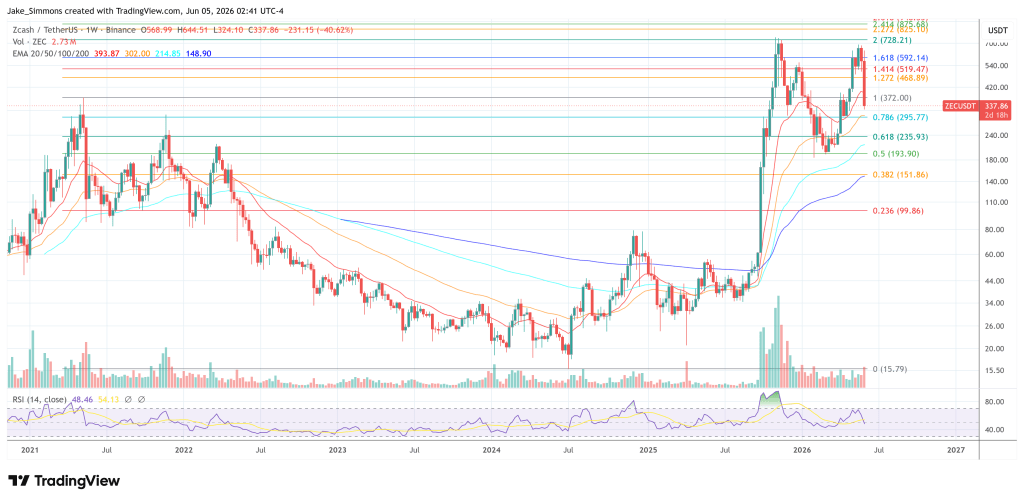
ZEC trades below the 1.618 Fib again, 1-week chart | Source: ZECUSDT on TradingView.com

Preguntas relacionadas

QWhat was the nature of the critical vulnerability discovered in Zcash's Orchard shielded pool?

AThe vulnerability was a critical counterfeiting flaw. An under-constrained element in the Orchard circuit allowed an attacker to feed arbitrary false inputs into an elliptic curve multiplication while still passing the multiplication check, potentially enabling the creation of an unlimited amount of counterfeit ZEC that could not be detected.

QWho discovered the vulnerability, and what tools aided in its discovery?

AThe vulnerability was discovered by security researcher Taylor Hornby, who was hired by Shielded Labs. He used a combination of traditional security research and newer AI-assisted auditing methods, specifically employing Anthropic's Opus 4.8 model released on May 28 in a targeted review of the Orchard circuit, which led to the discovery the next day.

QWhy is it impossible to cryptographically prove whether the Orchard vulnerability was exploited before it was fixed?

ADue to the privacy properties of the Orchard shielded pool, which hides transaction amounts and history by design. This means supply irregularities cannot be audited by inspecting public data, unlike transparent ledgers. The system relies on the correctness of the circuit rules, and the bug's nature leaves no definitive cryptographic trace of prior exploitation.

QWhat proposed solution is Shielded Labs exploring to address the supply integrity concerns raised by the Orchard bug?

AShielded Labs is exploring a proposed network upgrade to deploy a new shielded pool. This plan would enforce turnstile accounting on coins moving from the existing Orchard pool, with the goal of allowing anyone to verify the integrity of the Zcash supply and prove the non-existence of counterfeit ZEC in Orchard.

QAccording to Josh Swihart, what is the strongest long-term solution to prevent this class of failure from recurring?

AJosh Swihart identified formal verification as the strongest answer. This involves constructing a mathematical proof to reduce the human-reviewed parts to a concise statement of the rules, and then using a computer to check that the entire rulebook matches those rules, with AI tools now capable of writing these proofs.

Lecturas Relacionadas

El veredicto está listo para Bitcoin: La mayoría de los inversores dicen que el precio de BTC irá a la baja, aquí están los números

A través de mercados de predicción, paneles on-chain y rastreadores de sentimiento, una clara mayoría de inversores de Bitcoin se ha posicionado para una mayor caída. Aunque BTC se recuperó por encima de los 60.000 dólares, el reciente desplome por debajo de ese nivel ha llevado a muchos operadores a creer que habrá otra caída hasta el fondo definitivo. Según el analista Winter Soldier, el 64% de las órdenes en mercados de predicción apuestan ahora a que BTC caerá por debajo de los 50.000 dólares este año. Polymarket está valorando en un 64% la probabilidad de que Bitcoin alcance los 55.000 dólares o menos antes de finales de 2026. El analista compara la situación actual con el ciclo anterior, donde muchos creyeron que los 28.000 dólares serían el suelo, pero BTC cayó hasta los 15.000. Por ello, no se puede descartar una caída al rango de 35.000-38.000 dólares. Si bien este ciclo podría ser menos profundo debido a los ETF y la participación institucional, asumir los 50.000 dólares como suelo automático es riesgoso. El gráfico arcoíris muestra que Bitcoin está en la banda de "COMPRAR", con un precio que parece descontado respecto a su tendencia logarítmica a largo plazo. Sin embargo, la estructura de precio aún no confirma una reversión: hay velas rojas, máximos y mínimos más bajos, y volumen de venta persistente. Si el precio rebota hacia los 65.000-66.000 dólares, podría ser una trampa alcista para impulsar una caída posterior. El veredicto general del campo bajista es que Bitcoin podría tener una última etapa dolorosa hacia los 50.000 dólares, o incluso por debajo, antes de formar un suelo duradero.

bitcoinistHace 8 min(s)

El veredicto está listo para Bitcoin: La mayoría de los inversores dicen que el precio de BTC irá a la baja, aquí están los números

bitcoinistHace 8 min(s)

Anthropic lanza el 'modelo más potente', pero la mayoría de la gente no podrá utilizarlo

En abril, Anthropic lanzó la versión preliminar del modelo Mythos, que no se abrió al público debido a su excepcional capacidad para descubrir vulnerabilidades de ciberseguridad. Para controlar este poder, la empresa inició el "Proyecto Glasswing", limitando el acceso a socios de seguridad clave y proveedores de infraestructura crítica. El 10 de junio, Anthropic presentó oficialmente los modelos Fable 5 y Mythos 5. Comparten la misma arquitectura subyacente, pero Fable 5 está disponible para usuarios generales, mientras que Mythos 5 permanece restringido a socios de confianza. Fable 5 incluye un clasificador de seguridad que, al detectar consultas sensibles (como ciberseguridad o bioquímica), cambia automáticamente al modelo anterior Opus 4.8. En pruebas técnicas, Fable 5 obtuvo resultados destacados, especialmente en ingeniería de software y tareas largas, superando a modelos anteriores y competidores en la generación de código de calidad productiva. Sin embargo, su velocidad de respuesta es menor y el mecanismo de degradación automática puede afectar la experiencia del usuario. El precio de la API de Fable 5 es el doble que el de Opus 4.8. A partir del 23 de junio, se eliminará de los planes de suscripción estándar, requiriendo el uso de créditos adicionales bajo un modelo de pago por uso. Esto refleja una estrategia para segmentar el mercado: ofrecer capacidades avanzadas a usuarios de alto valor dispuestos a pagar más, mientras que otros proveedores, especialmente en China, están reduciendo precios para ganar cuota de mercado. En resumen, Anthropic está priorizando la seguridad y la monetización de capacidades de vanguardia, lo que podría llevar a una creciente brecha entre modelos accesibles y aquellos de élite, cada vez más costosos.

marsbitHace 15 min(s)

Anthropic lanza el 'modelo más potente', pero la mayoría de la gente no podrá utilizarlo

marsbitHace 15 min(s)

Trading

Spot
Futuros

Artículos destacados

Cómo comprar ZEC

¡Bienvenido a HTX.com! Hemos hecho que comprar Zcash (ZEC) sea simple y conveniente. Sigue nuestra guía paso a paso para iniciar tu viaje de criptos.Paso 1: crea tu cuenta HTXUtiliza tu correo electrónico o número de teléfono para registrarte y obtener una cuenta gratuita en HTX. Experimenta un proceso de registro sin complicaciones y desbloquea todas las funciones.Obtener mi cuentaPaso 2: ve a Comprar cripto y elige tu método de pagoTarjeta de crédito/débito: usa tu Visa o Mastercard para comprar Zcash (ZEC) al instante.Saldo: utiliza fondos del saldo de tu cuenta HTX para tradear sin problemas.Terceros: hemos agregado métodos de pago populares como Google Pay y Apple Pay para mejorar la comodidad.P2P: tradear directamente con otros usuarios en HTX.Over-the-Counter (OTC): ofrecemos servicios personalizados y tipos de cambio competitivos para los traders.Paso 3: guarda tu Zcash (ZEC)Después de comprar tu Zcash (ZEC), guárdalo en tu cuenta HTX. Alternativamente, puedes enviarlo a otro lugar mediante transferencia blockchain o utilizarlo para tradear otras criptomonedas.Paso 4: tradear Zcash (ZEC)Tradear fácilmente con Zcash (ZEC) en HTX's mercado spot. Simplemente accede a tu cuenta, selecciona tu par de trading, ejecuta tus trades y monitorea en tiempo real. Ofrecemos una experiencia fácil de usar tanto para principiantes como para traders experimentados.

670 Vistas totalesPublicado en 2024.12.12Actualizado en 2026.06.02

Cómo comprar ZEC

Discusiones

Bienvenido a la comunidad de HTX. Aquí puedes mantenerte informado sobre los últimos desarrollos de la plataforma y acceder a análisis profesionales del mercado. A continuación se presentan las opiniones de los usuarios sobre el precio de ZEC (ZEC).

活动图片