Solana Takes Aim At Hyperliquid With Push For Fully Onchain Perps

bitcoinistPublicado a 2026-06-02Actualizado a 2026-06-02

Resumen

The Solana Foundation has announced a new initiative to actively support teams building fully onchain perpetual futures (perps) on Solana. This move directly challenges the current market structure, exemplified by platforms like Hyperliquid, where much of the derivatives volume still relies on centralized exchanges or hybrid models with offchain components. Solana argues that its high-performance blockchain makes fully onchain perps viable without sacrificing speed or user experience, aiming to shift a lucrative trading segment entirely onchain. The Foundation seeks to back projects that prioritize onchain price discovery (like order books or RFQ systems) over pool-based models, require projects to be "Solana-first" with revenue routed back to the chain, and mandate open-source development. The support includes distribution, technical assistance, and capital for core perps protocols as well as complementary infrastructure.

Solana Foundation is moving to back teams building fully onchain perpetual futures, setting up a clear challenge to the market structure that has powered Hyperliquid’s rapid rise. The initiative targets one of crypto’s most lucrative trading segments: perps, where volume still sits largely on centralized exchanges or hybrid venues.

Solana Vs. Hyperliquid

The Foundation framed the push as a bid to move derivatives execution more fully onto Solana, without relying on the offchain components that still underpin much of the sector. “Perpetuals are one of the most important financial primitives in crypto,” the Foundation wrote on X. “Solana makes it viable to run them fully onchain, without sacrificing the performance real participants and institutions require.”

The timing is notable. Hyperliquid has become the reference point for onchain derivatives, turning perpetual futures into one of the strongest product-market-fit stories in crypto. While Solana did not name Hyperliquid in its announcement, the competitive subtext is hard to miss.

In its post, the Foundation argued that most perp volume still flows through centralized exchanges or through hybrid architectures that use offchain sequencers and matching engines. “We view that as a transitional state, not a permanent one,” the Foundation said. “We want to support teams building onchain perps, other derivatives, and the applications around them, that prioritize price discovery infrastructure. Our support takes several forms: distribution, technical assistance, and above all, capital.”

That language matters because it draws a line between merely settling crypto trades onchain and running the entire execution path onchain. The foundation said it wants to support systems where every order submission, oracle update, match, cancellation and settlement happens onchain. For a chain that has long marketed itself around high throughput and low latency, perps are an obvious stress test: the product requires fast updates, deep liquidity, competitive market making and credible settlement.

The Foundation also made clear that it is not looking for pool-based pricing models as the center of this effort. It said it is interested in “models where price is set based on two-sided flow, not pool-based or as a function of deposits,” including orderbooks, RFQ systems with genuinely competing makers, or alternative designs where active participants set bids and offers against each other.

That is where the Hyperliquid comparison becomes especially relevant. Hyperliquid’s success has shown that crypto traders will use onchain or semi-onchain derivatives venues when the trading experience is fast, liquid and expressive enough.

Solana Wants Revenue Back Onchain

The announcement also included a more ecosystem-specific requirement: teams should build “Solana-first.” The Foundation said it wants projects optimized for SOL’s design and culture, with application revenue structurally routed back to the chain, preferably at the protocol level from launch rather than left to future governance decisions.

That is a pointed detail. In the current perps market, the battle is not only over where traders execute, but where fees, order flow and liquidity incentives accrue. A successful Solana-native perps venue would not merely add another DeFi app; it could become a recurring source of transaction activity, MEV-adjacent flow, validator economics and ecosystem-level liquidity.

The Foundation also said it is open to teams that have already built offchain or hybrid perps products and want to migrate to a fully onchain model. “We’ll support existing teams with a live product that are willing to explore a fully onchain, on-Solana model,” it said.

Open source is another filter. “Onchain integrity means little if the code behind it can’t be inspected,” Solana Foundation wrote. “Contributing to Solana culturally means contributing in the open.”

The initiative is not limited to core perps protocols. Solana said it also wants complementary infrastructure, including frontend integrations, vaults, structured products, aggregators, advanced trading interfaces, market making operations and social trading applications. Grants may be available through Solana Foundation funding channels or local Superteam chapters.

At press time, SOL traded at $79.54.
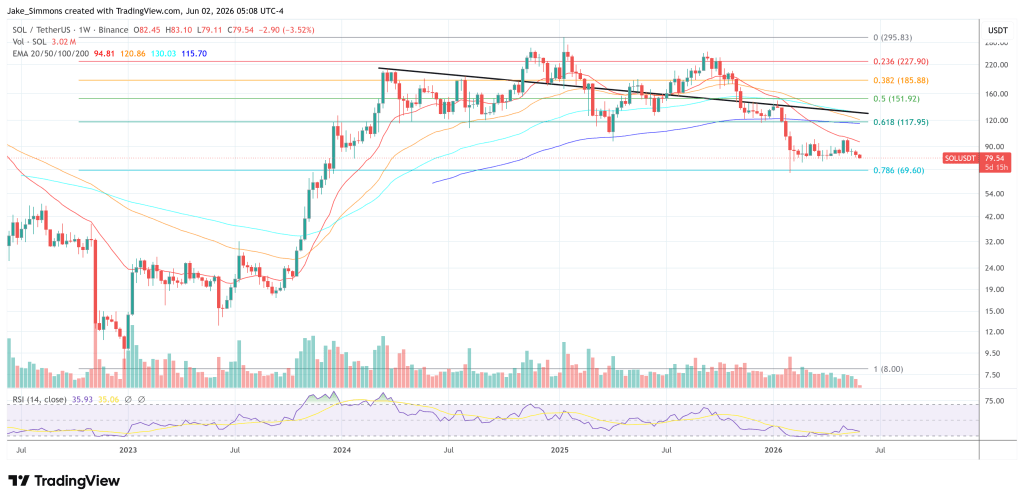
SOL remains in sideways trend, 1-week chart | Source: SOLUSDT on TradingView.com

Criptos en tendencia

Preguntas relacionadas

QWhat is the primary goal of the Solana Foundation's new initiative as described in the article?

AThe primary goal of the Solana Foundation's initiative is to support teams building fully onchain perpetual futures and other derivatives on Solana. It aims to move derivatives execution more fully onto the blockchain without relying on offchain components, capturing revenue for the Solana ecosystem, and supporting models based on two-sided flow for price discovery.

QAccording to the article, which platform is positioned as the main competitive reference point for Solana's onchain perps push?

AThe main competitive reference point is Hyperliquid. The article states that Hyperliquid has become the reference point for onchain derivatives, and Solana's initiative sets up a clear challenge to the market structure that powered Hyperliquid's rapid rise.

QWhat specific type of pricing models is the Solana Foundation NOT interested in supporting for this initiative?

AThe Solana Foundation is not looking for pool-based pricing models as the center of this effort. It is interested in models where price is set based on two-sided flow, such as orderbooks, RFQ systems with competing makers, or designs where active participants set bids and offers against each other.

QBesides the core perps protocols, what other types of complementary infrastructure does Solana want to support through this initiative?

ASolana also wants to support complementary infrastructure including frontend integrations, vaults, structured products, aggregators, advanced trading interfaces, market making operations, and social trading applications.

QWhat are the key requirements or filters mentioned for teams interested in the Solana Foundation's support?

AKey requirements include building 'Solana-first' (optimized for SOL's design and culture), structuring application revenue to route back to the chain, being open to teams migrating from offchain/hybrid models, and committing to open-source development ('contributing in the open').

Lecturas Relacionadas

¿Por qué está todo el mundo nervioso por la subida de tipos de Japón?

En junio de 2026, el Banco de Japón elevó los tipos de interés al 1%, su primer aumento significativo desde 1995. Aunque esta cifra sigue siendo baja comparada con Estados Unidos o Europa, marca un cambio de rumbo crucial para la economía global. Japón, tras casi tres décadas de tipos cero o negativos, había actuado como el principal centro de financiación barata del mundo. A través del conocido "carry trade del yen", los inversores internacionales tomaban préstamos en yenes de bajo coste para invertir en activos de mayor rendimiento en todo el mundo, impulsando así mercados bursátiles, bonos y bienes inmuebles a nivel global. La decisión del banco central japonés responde a un cambio estructural interno: una inflación sostenida por encima del objetivo del 2%, un crecimiento salarial notable tras décadas de estancamiento, y la presión del yen débil. Sin embargo, la preocupación global no se centra en el nivel del 1%, sino en la tendencia. Si Japón abandona permanentemente su política de dinero ultrabarato, podría desencadenar un proceso de desapalancamiento a escala mundial. Los inversores que dependían de financiación barata en yenes podrían verse forzados a revaluar sus estrategias y reducir riesgo, lo que contraería la liquidez global y afectaría a la valoración de los activos de riesgo. No obstante, la dirección final de los flujos de capital la marcará principalmente la política de la Reserva Federal de EE.UU. Mientras persista un amplio diferencial de tipos entre EE.UU. y Japón, el atractivo del dólar seguirá siendo fuerte. El verdadero punto de inflexión se produciría si la Fed inicia un ciclo de recortes mientras Japón sigue subiendo los tipos. En definitiva, el movimiento del Banco de Japón simboliza el posible fin de una era de financiación ilimitada y barata, lo que obligaría a los mercados globales a redefinir sus lógicas de inversión y riesgo.

marsbitHace 5 hora(s)

¿Por qué está todo el mundo nervioso por la subida de tipos de Japón?

marsbitHace 5 hora(s)

El Congreso Aplaza la Prohibición de la CBDC hasta 2030 mediante una Importante Ley de Reforma de Vivienda

Los legisladores han aprobado un proyecto de ley de reforma de vivienda, la "Ley del Camino a la Vivienda del Siglo XXI", que incluye una prohibición temporal hasta el 31 de diciembre de 2030 para que la Reserva Federal emita un dólar digital (CBDC). La medida, integrada en esta legislación bipartidista más amplia, define el CBDC como un activo digital denominado en dólares y accesible para todos los estadounidenses. Sus defensores argumentan que esta pausa permite más tiempo para evaluar los impactos potenciales, reflejando preocupaciones sobre privacidad, vigilancia financiera y el papel del gobierno en los pagos digitales. La prohibición se aplicaría a cualquier CBDC minorista, ya sea emitida directamente por la Fed o a través de intermediarios, aunque se contemplan excepciones para dólares digitales privados que mantengan un nivel de privacidad comparable al efectivo físico. Aunque el foco del proyecto de ley son las reformas para mejorar la vivienda asequible y la oferta, la cláusula sobre el CBDC ha captado una atención significativa en la comunidad cripto, ya que podría influir en el futuro de los pagos digitales y en el debate sobre el lugar de los activos digitales en el sistema financiero del país. El desarrollo del proceso legislativo determinará si la prohibición entra en vigor durante la próxima década.

TheNewsCryptoHace 6 hora(s)

El Congreso Aplaza la Prohibición de la CBDC hasta 2030 mediante una Importante Ley de Reforma de Vivienda

TheNewsCryptoHace 6 hora(s)

Trading

Spot
Futuros

Artículos destacados

Cómo comprar PUSH

¡Bienvenido a HTX.com! Hemos hecho que comprar Push Protocol (PUSH) sea simple y conveniente. Sigue nuestra guía paso a paso para iniciar tu viaje de criptos.Paso 1: crea tu cuenta HTXUtiliza tu correo electrónico o número de teléfono para registrarte y obtener una cuenta gratuita en HTX. Experimenta un proceso de registro sin complicaciones y desbloquea todas las funciones.Obtener mi cuentaPaso 2: ve a Comprar cripto y elige tu método de pagoTarjeta de crédito/débito: usa tu Visa o Mastercard para comprar Push Protocol (PUSH) al instante.Saldo: utiliza fondos del saldo de tu cuenta HTX para tradear sin problemas.Terceros: hemos agregado métodos de pago populares como Google Pay y Apple Pay para mejorar la comodidad.P2P: tradear directamente con otros usuarios en HTX.Over-the-Counter (OTC): ofrecemos servicios personalizados y tipos de cambio competitivos para los traders.Paso 3: guarda tu Push Protocol (PUSH)Después de comprar tu Push Protocol (PUSH), guárdalo en tu cuenta HTX. Alternativamente, puedes enviarlo a otro lugar mediante transferencia blockchain o utilizarlo para tradear otras criptomonedas.Paso 4: tradear Push Protocol (PUSH)Tradear fácilmente con Push Protocol (PUSH) en HTX's mercado spot. Simplemente accede a tu cuenta, selecciona tu par de trading, ejecuta tus trades y monitorea en tiempo real. Ofrecemos una experiencia fácil de usar tanto para principiantes como para traders experimentados.

458 Vistas totalesPublicado en 2024.12.13Actualizado en 2026.06.02

Cómo comprar PUSH

Discusiones

Bienvenido a la comunidad de HTX. Aquí puedes mantenerte informado sobre los últimos desarrollos de la plataforma y acceder a análisis profesionales del mercado. A continuación se presentan las opiniones de los usuarios sobre el precio de PUSH (PUSH).

活动图片