Trump Signs Executive Order, Kraken, Coinbase and Others May Gain Access to Fed Payment Channels

marsbitPublicado a 2026-05-21Actualizado a 2026-05-21

Resumen

President Trump has signed an executive order, "Incorporating Financial Technology Innovation into the Regulatory Framework," pressuring the Federal Reserve to reassess its rules on granting non-bank financial companies—including crypto and fintech firms—access to its payment systems, specifically master accounts that connect to the Fedwire settlement system. Currently, such accounts are primarily reserved for depository institutions. The order mandates a review to determine if broader access is permissible and to establish an application process. This move, supported by figures like Senator Cynthia Lummis, aims to reduce barriers to innovation and lower public payment costs by fostering fairer competition. It does not grant immediate access but could pave the way for companies like Kraken, Coinbase, Ripple, and Circle to reduce reliance on intermediary banks, lowering costs and speeding up settlements. A key precedent is the Kansas City Fed granting Kraken's parent company a restricted master account in March, offering limited payment services without interest or credit privileges. This model is seen as a potential template for allowing controlled access while mitigating systemic risk. Other firms like Anchorage, Paxos, and BitGo, which hold specialized banking charters, are also well-positioned to apply. The banking industry, represented by the American Bankers Association, opposes easing access, arguing any institution handling bank-like payments must meet the same stri...

Written by: Oluwapelumi Adejumo

Compiled by: Luffy, Foresight News

U.S. President Trump has formally pressured the Federal Reserve to re-evaluate the highly controversial access rules within the U.S. financial sector, escalating the industry battle over whether crypto firms and fintech companies can directly connect to the central bank's payment systems.

On May 19, Trump signed an executive order directing the Federal Reserve to assess its policies regarding granting payment account access to nonbank financial companies, including those engaged in digital assets, blockchain services, and other fintech businesses.

Titled "Modernizing the Regulatory Framework to Facilitate Financial Innovation," the order requires major federal regulatory agencies to review existing rules and eliminate redundant regulatory provisions that hinder financial innovation.

This order does not immediately grant crypto firms direct access to Federal Reserve payment channels. However, it explicitly authorizes the Federal Reserve to examine whether existing laws permit broader access and, if so, to clarify the application process.

The outcome of this review is crucial, as it will directly determine whether companies like Kraken, Ripple, Coinbase, Circle, Anchorage, Wise, Paxos, and BitGo can reduce their reliance on intermediary banks and move closer to core U.S. dollar wholesale clearing financial infrastructure.

Policy Shift for Fed Master Account Access

The core focus of this executive order is the Federal Reserve master account. Institutions holding such an account gain direct access to the full suite of Federal Reserve payment services, including the interbank large-dollar U.S. funds transfer system, Fedwire.

Under current Fed rules, such accounts are, in principle, only open to depository banking institutions. Consequently, many crypto firms have had to pursue special-purpose banking charters or national trust bank charters in their quest for direct connection eligibility.

Trump's order now requires the Federal Reserve to comprehensively review the access rules for central bank payment accounts, while also clarifying whether the 12 regional Federal Reserve Banks have the statutory authority to independently approve or reject institution account applications.

In March of this year, the Federal Reserve Bank of Kansas City took the lead by approving a restricted master account for Kraken's parent company, Payward, setting the industry's first precedent and making this issue of access increasingly urgent.

In addition, the order instructs regulators to conduct a comprehensive review of barriers to the development of the fintech industry, covering charter licensing rules, third-party risk management guidance, and policies restricting cross-border collaboration between banks and tech companies.

U.S. Senator Cynthia Lummis stated that this new policy corrects the long-standing restricted access situation for the fintech industry. Traditional legacy financial institutions have monopolized core payment channel resources, while emerging tech companies have long been excluded. This order aims to create a level playing field, stimulate industry vitality, and reduce payment costs for the public.

Coinbase Chief Legal Officer Paul Grewal also expressed support for the move. He argued that current payment access rules and third-party risk control guidelines are outdated, favoring traditional financial giants and suppressing innovation, and that regulatory rules urgently need renewal.

This echoes a common demand within the crypto industry: access to the central bank's core payment network has become a competitive barrier. Firms unable to connect directly must rely on bank intermediaries, which not only increases operational costs and slows settlement efficiency but also imposes the additional operational risks of their partner banks.
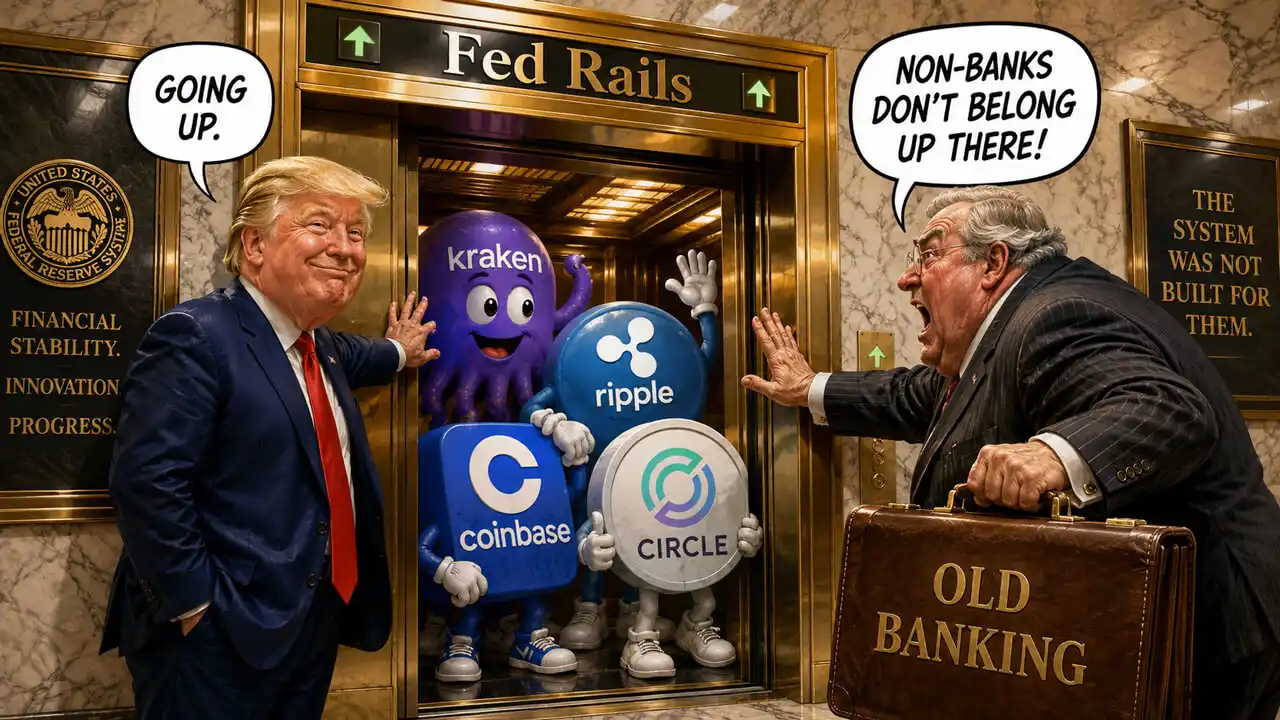
Kraken Provides a Feasible Model for Crypto Companies

Kraken has provided a practical example for the industry to expand access. In March, the Kansas City Fed granted a master account to its financial entity, Kraken Financial, allowing access to the core U.S. dollar large-value clearing payment channels. This enables the platform to handle institutional user deposits and withdrawals more efficiently, particularly facilitating rapid transfers of large funds between the trading platform, custodians, and partner banks.

However, this account comes with clear limitations: it does not offer the full range of financial services available to regular insured banks, does not earn interest on reserve balances, and cannot access Federal Reserve credit facilities.

This restricted design can reduce central bank systemic risk while allowing crypto firms moderate access to mainstream payment infrastructure. It is likely to become a universal template promoted by regulators in the future—granting firms U.S. dollar transfer and clearing permissions while strictly prohibiting access to high-sensitivity financial privileges like overdraft lending, reserve interest, and emergency liquidity assistance.

Custodia Bank CEO Caitlin Long welcomed the new policy. Her institution has sought access to the Federal Reserve system for years but was rejected in 2023, with the Fed ruling that its crypto-focused business model did not meet statutory access requirements, highlighting the extreme difficulty licensed crypto institutions previously faced in gaining full access.

The implementation of Kraken's restricted account has fundamentally shifted the regulatory stance. Regulators no longer have only the options of "full access" or "complete rejection." Through a tiered permission model, they can gradually guide crypto firms into the mainstream payment system while firmly maintaining risk control bottom lines.

Ripple, Coinbase, and Circle are Prepared for the Next Phase

Ripple, Coinbase, and Circle are among the most direct beneficiaries of this policy relaxation. Ripple has already applied for a Federal Reserve master account and actively supports implementing a lightweight restricted account mechanism that allows non-bank institutions to conveniently use basic payment services without touching the Fed's core financial privileges.

Once successfully implemented, this would significantly boost its RLUSD stablecoin business, enabling efficient reserve fund transfers and user redemption operations. For stablecoin issuers, the efficiency of reserve clearing and fund redemption stability directly determine market confidence. Direct or restricted access to a Federal Reserve account would greatly reduce reliance on bank intermediaries, allowing more flexible U.S. dollar liquidity management during periods of concentrated redemptions or market volatility.

Coinbase and Circle, through their USDC stablecoin businesses and own payment ecosystems, also have strong needs for access. Both institutions have established federal trust bank structures, which not only further integrate them into the federal unified regulatory system but also pave the way for applying for Federal Reserve payment accounts.

Meanwhile, other companies are also waiting in line. Anchorage Digital is already a federally chartered crypto bank; Paxos, BitGo, and Fidelity Digital Assets have successively obtained national trust bank-related approvals from the Office of the Comptroller of the Currency. While such qualifications do not directly translate into Federal Reserve payment account access, they significantly narrow the gap between these firms and compliance standards.

Industry demands are clear: crypto exchanges seek fast fiat currency settlement, stablecoin issuers want autonomous control over reserve funds, asset custodians aim to optimize institutional client fund flow efficiency, and payment companies are eager to reduce heavy reliance on cross-border clearing banks.

Galaxy Digital Head of Research Alex Thorn stated bluntly that it is not only deposit-taking and lending banking institutions that are qualified to conduct wire transfer business; this is a threshold set by modern regulation, not an immutable rule of the financial industry. With multiple forces now competing, traditional banks are actually fighting to maintain their monopoly in the payments industry. The prevailing industry view is that payment channel access eligibility should be determined based on a firm's business attributes, compliance and regulatory rigor, and risk management capabilities, rather than rigidly adhering to traditional banking business models.

Traditional Banks Warn: Access Must Meet Bank-Level Standards

Facing calls for industry openness, the American Bankers Association has clearly expressed opposition. The association believes that any institution conducting bank-like business must be subject to the same stringent regulatory standards and consumer protection rules as traditional banks.

ABA President and CEO Rob Nichols stated publicly: "Without full industry-wide high-standard regulation, the entire financial system and ordinary consumers will face direct risks. Regarding this White House financial innovation executive order, we urge regulatory agencies to uphold the bottom line of safety and soundness of the financial system while promoting innovation, and not to lower access thresholds."

This is the core concern of the banking industry. Direct access to the Federal Reserve payment system is not merely a business privilege; it comes with a suite of high-intensity regulations, including deposit insurance systems, capital adequacy assessments, liquidity controls, and regular business reviews. From the banks' perspective, allowing crypto firms with lightweight licenses and limited business scopes, which lack equivalent compliance obligations and risk management capabilities, to connect to the core payment network could easily sow the seeds of systemic risk.

The Fedwire system is the core hub for global U.S. dollar clearing. Any cyber-attacks, operational failures, compliance breaches, or liquidity crises at an接入 institution could cause settlement disruptions with impacts far beyond the firm's own business scope. Simultaneously, banks invest heavily in compliance areas such as anti-money laundering, customer fund monitoring, and suspicious transaction reporting. Regulators also need to confirm that crypto firms possess equivalent compliance capabilities before allowing them to engage in diverse businesses like trading, asset custody, stablecoin issuance, and payments.

Liquidity diversion is another key concern for banks. If stablecoin issuers and fintech firms can efficiently hold and transfer funds through the Federal Reserve system, they will likely divert existing funds from the traditional banking system.

The restricted account rules proposed by the Fed, by removing benefits like interest and credit, somewhat alleviate this concern, but the banking industry will not readily acquiesce to this shift in the industry landscape.

Although specialized restricted accounts can avoid most risks through permission demarcation, they also raise new regulatory questions: At what point does the level of payment business access granted to a non-bank institution make its operations equivalent to those of a formal bank? This will become a core point of contention for regulators in defining future access boundaries.


Preguntas relacionadas

QWhat was the main objective of the executive order signed by former President Trump regarding financial innovation and cryptocurrency companies?

AThe executive order aimed to pressure the Federal Reserve to reassess its policies on granting payment account access to non-bank financial companies, including those in digital assets, blockchain, and fintech. It required federal regulators to review existing rules to eliminate redundant regulations hindering financial innovation and to clarify whether broader access to the Federal Reserve's payment systems is legally permissible for such companies.

QHow does the Federal Reserve's Master Account benefit financial institutions, and what was the previous limitation for crypto companies?

AA Federal Reserve Master Account allows institutions direct access to the Fed's full suite of payment services, including the Fedwire system for large-scale dollar transfers between banks. Previously, such accounts were typically restricted to depository banking institutions, forcing crypto companies to seek special-purpose banking charters or national trust bank licenses to qualify for direct access.

QWhat precedent did the Federal Reserve Bank of Kansas City set for crypto companies in March, and what were the limitations of this account?

AIn March, the Federal Reserve Bank of Kansas City approved a restricted master account for Payward, Inc., the parent company of Kraken. This account, granted to its special-purpose depository institution Kraken Financial, allowed direct access to core dollar payment channels but with key limitations: it did not grant full banking services, did not pay interest on reserves, and did not provide access to Federal Reserve credit facilities.

QWhy are companies like Ripple, Coinbase, and Circle particularly interested in gaining access to Federal Reserve payment channels?

ACompanies like Ripple, Coinbase, and Circle are keen to access Federal Reserve payment channels to reduce reliance on intermediary banks. This would lower operational costs, speed up settlement times, and mitigate risks associated with partner banks. For stablecoin issuers like Circle (USDC) and Ripple (RLUSD), direct access would enhance the efficiency of managing reserve funds and processing redemptions, which is crucial for maintaining market confidence, especially during periods of high volatility or concentrated withdrawals.

QWhat are the primary concerns raised by traditional banks, as represented by the American Bankers Association, regarding expanding access to the Federal Reserve's payment systems?

ATraditional banks, through the American Bankers Association, argue that any institution performing bank-like activities must be subject to the same stringent regulatory standards as traditional banks, including robust consumer protection rules, capital requirements, liquidity management, and anti-money laundering compliance. They warn that allowing crypto firms with lighter regulatory burdens to connect to core payment networks like Fedwire could introduce systemic risks, such as operational failures or compliance gaps, and potentially drain liquidity from the traditional banking system.

Lecturas Relacionadas

Me construí una estación de trabajo de inversión con IA

En los últimos quince días, me he sumergido en la "Vibe Coding" – escribir código mediante lenguaje natural con IA – y he construido mi propia plataforma de inversión. Usando principalmente Codex, Claude Code y la API de DeepSeek, he convertido ideas que antes solo existían en mi mente en herramientas funcionales. He desarrollado cuatro utilidades clave: 1. **Panel de Activos Multimercado:** Una vista unificada de mis inversiones en acciones estadounidenses, criptomonedas, acciones de Hong Kong y China continental, con seguimiento del rendimiento total y por activo. Luego añadí funciones como monitoreo de movimientos bruscos de precios y un "mapa de inversiones" para visualizar las relaciones dentro de un sector. 2. **Monitor de Apuestas en Mercados de Predicción (PM):** Agrega y supervisa apuestas sobre eventos futuros (como valoraciones de empresas o eventos macro), correlacionando sus cambios de probabilidad con noticias y movimientos del mercado para identificar oportunidades, especialmente en dinámicas de Asia Oriental. 3. **Panel de Gestión de Contenidos:** Una herramienta operativa simple, alojada en la nube, para gestionar temas de artículos, progresos de escritura y calendarios de publicación en múltiples plataformas. 4. **Herramienta de Formateo Automático:** Un script que convierte automáticamente un documento en los formatos específicos requeridos por diferentes plataformas de medios, ahorrando tiempo en el proceso de publicación. La conclusión principal es que la IA ha cambiado fundamentalmente la investigación para los inversores minoristas. No se trata de volverse un experto de la noche a la mañana, sino de poder construir progresivamente sistemas básicos personalizados: para observar activos, monitorear señales del mercado, mapear relaciones sectoriales y realizar revisiones de decisiones. El "Vibe Coding" acelera enormemente el ciclo de retroalimentación "idea-implementación-uso-mejora", permitiendo que herramientas rudimentarias pero útiles surjan y evolucionen rápidamente, transformando la manera en que los inversores organizan su información y toman decisiones.

marsbitHace 16 min(s)

Me construí una estación de trabajo de inversión con IA

marsbitHace 16 min(s)

Una vez tokenizados los activos, ¿cómo se sale?

**Tokenización de activos: ¿Cómo retirarse?** La tokenización resuelve cómo llevar los activos a la cadena, pero no cómo los tenedores pueden redimirlos. Este "problema de salida" es crucial, ya que la falta de liquidez instantánea limita la utilidad de los activos tokenizados (RWA) como garantía o en DeFi. Han surgido tres modelos para ofrecer salidas inmediatas, diferenciándose en su estructura de capital: 1. **Modelo de balance (ej. Grove Basin):** Una entidad única (como Sky) proporciona liquidez inmediata desde su propio balance. Es simple pero la capacidad está limitada a ese balance único. 2. **Bóvedas dedicadas por activo (ej. Upshift Clear):** Proveedores de liquidez independientes financian bóvedas separadas para cada activo RWA. Escala con más capital, pero el capital está fragmentado y aislado por activo. 3. **Capa de liquidez compartida (ej. Symbiotic Liquid Lane):** Un fondo de capital compartido (varias bóvedas) financia simultáneamente las redenciones de múltiples activos RWA. El capital es más eficiente, puede generar rendimiento entre redenciones (ej., en préstamos DeFi) y los descuentos de redención se fijan en un mercado competitivo (RFQ) entre market makers. La comparación clave gira en torno a cinco dimensiones: fuente del capital, fijación de precios de redención, eficiencia del capital, escalabilidad a nuevos activos y combinabilidad (composability). **Liquid Lane** busca ser una infraestructura de liquidez compartida, eficiente y flexible que pueda escalar con el mercado, especialmente para activos con ventanas de redención largas (crédito privado, activos estructurados), transformando así cómo se mantienen, financian y utilizan los RWA en la cadena.

marsbitHace 22 min(s)

Una vez tokenizados los activos, ¿cómo se sale?

marsbitHace 22 min(s)

Después de la tokenización de activos, ¿cómo salir?

**Resumen: ¿Cómo salir tras la tokenización de activos?** La tokenización resuelve cómo llevar activos a la cadena, pero la mitad del problema sin resolver es cómo los tenedores pueden redimir (salir). Existen tres modelos principales para proporcionar liquidez inmediata para activos tokenizados del mundo real (RWA), que difieren en su estructura de capital y eficiencia: 1. **Modelo de balance general (ej., Grove Basin):** Una sola entidad (como Sky) proporciona liquidez inmediata desde sus reservas cuando los tenedores redimen. Es rápido, pero la capacidad está limitada por un solo balance. 2. **Modelo de bóveda dedicada (ej., Upshift Clear):** Proveedores de liquidez independientes financian bóvedas separadas para cada activo soportado. Introduce capital externo, pero el capital está aislado y solo sirve a un activo a la vez. 3. **Capa de liquidez compartida (ej., Symbiotic Liquid Lane):** Proveedores de capital financian bóvedas compartidas que pueden apoyar múltiples activos simultáneamente. El capital se reutiliza, genera rendimientos entre redenciones y los precios de redención se fijan en un mercado competitivo de RFQ. La comparación clave se basa en cinco dimensiones: fuente de capital, fijación de precios, eficiencia de capital, escalabilidad a nuevos activos y composibilidad. Liquid Lane apunta a ser una infraestructura compartida y capital-eficiente, particularmente valiosa para activos con ventanas de redención largas (como crédito privado), permitiendo salidas T+0 mientras el capital sigue siendo productivo. Esto transforma la liquidez de un parche aislado en un bien común escalable para el mercado de RWA.

链捕手Hace 35 min(s)

Después de la tokenización de activos, ¿cómo salir?

链捕手Hace 35 min(s)

El Triple Momento de Anthropic: Filtración de Código, Enfrentamiento Gubernamental y Armaización

**Resumen: El Triple Momento de Anthropic: Filtración de Código, Enfrentamiento con el Gobierno y la "Armamentización"** Anthropic lanzó su nuevo modelo Fable (versión "domada" del más potente Mythos), pero apenas dos meses después, el gobierno de EE.UU. ordenó su bloqueo para ciudadanos extranjeros, citando preocupaciones de seguridad nacional por un posible *jailbreak*. Este incidente destapa la guerra latente entre los laboratorios de IA frontera, las grandes tecnológicas y los gobiernos. El artículo argumenta que, más allá de la narrativa de seguridad, Anthropic actúa movida por una **necesidad económica**: evitar que sus modelos se conviertan en una mercancía y acercarse al usuario final para capturar valor y, sobre todo, **datos**. Su cambio en la política de retención de datos (ahora guarda todo durante 30 días incluso para empresas) es un paso clave para alimentar y mejorar sus modelos con uso real, creando un ciclo virtuoso frente a competidores. Este impulso choca directamente con la visión de empresas de software como Microsoft, cuyo CEO, Satya Nadella, advierte de un futuro donde unos pocos modelos de IA capturen todo el valor, vaciando industrias. Sin embargo, para Anthropic, dominar la "pila" completa es una necesidad de supervivencia. El controvertido intento inicial de Anthropic de degradar silenciosamente el rendimiento de Fable para tareas de desarrollo de otros LLMs (retirado luego por las críticas) revela una ambición mayor: la convicción de que **solo ellos deberían construir IA frontera**. Combinado con su creencia de ser los únicos que toman en serio los riesgos de una superinteligencia, esto justifica, bajo el paraguas de la "seguridad", políticas que consolidan su control y ventaja comercial. El artículo concluye que la coherencia interna de Anthropic entre su misión, talento y negocio es poderosa pero preocupante: otorgar un poder potencialmente ilimitado a quienes están convencidos de saber lo que la humanidad necesita tiene un historial peligroso. El enfrentamiento con el gobierno de EE.UU. por Fable es solo el primer capítulo de este conflicto inevitable.

marsbitHace 50 min(s)

El Triple Momento de Anthropic: Filtración de Código, Enfrentamiento Gubernamental y Armaización

marsbitHace 50 min(s)

Trading

Spot
Futuros

Artículos destacados

Cómo comprar ORDER

¡Bienvenido a HTX.com! Hemos hecho que comprar Orderly (ORDER) sea simple y conveniente. Sigue nuestra guía paso a paso para iniciar tu viaje de criptos.Paso 1: crea tu cuenta HTXUtiliza tu correo electrónico o número de teléfono para registrarte y obtener una cuenta gratuita en HTX. Experimenta un proceso de registro sin complicaciones y desbloquea todas las funciones.Obtener mi cuentaPaso 2: ve a Comprar cripto y elige tu método de pagoTarjeta de crédito/débito: usa tu Visa o Mastercard para comprar Orderly (ORDER) al instante.Saldo: utiliza fondos del saldo de tu cuenta HTX para tradear sin problemas.Terceros: hemos agregado métodos de pago populares como Google Pay y Apple Pay para mejorar la comodidad.P2P: tradear directamente con otros usuarios en HTX.Over-the-Counter (OTC): ofrecemos servicios personalizados y tipos de cambio competitivos para los traders.Paso 3: guarda tu Orderly (ORDER)Después de comprar tu Orderly (ORDER), guárdalo en tu cuenta HTX. Alternativamente, puedes enviarlo a otro lugar mediante transferencia blockchain o utilizarlo para tradear otras criptomonedas.Paso 4: tradear Orderly (ORDER)Tradear fácilmente con Orderly (ORDER) en HTX's mercado spot. Simplemente accede a tu cuenta, selecciona tu par de trading, ejecuta tus trades y monitorea en tiempo real. Ofrecemos una experiencia fácil de usar tanto para principiantes como para traders experimentados.

340 Vistas totalesPublicado en 2024.12.10Actualizado en 2026.06.02

Cómo comprar ORDER

Discusiones

Bienvenido a la comunidad de HTX. Aquí puedes mantenerte informado sobre los últimos desarrollos de la plataforma y acceder a análisis profesionales del mercado. A continuación se presentan las opiniones de los usuarios sobre el precio de ORDER (ORDER).

活动图片