Wall Street Capital Enters ARC, Circle Sparks a System-Level Competition for Stablecoins

marsbitPublicado a 2026-05-13Actualizado a 2026-05-13

Resumen

Wall Street Capital Enters the ARC Arena as Circle Launches a System-Level Battle for Stablecoin Dominance On May 11, Circle successfully raised $222 million in a pre-sale funding round for its new blockchain and native token, ARC, giving the network a fully diluted valuation of $3 billion. The investor lineup, featuring Wall Street giants like BlackRock and Intercontinental Exchange alongside top-tier venture capital firms such as a16z and ARK Invest, signaled a collective strategic bet on future financial infrastructure. This move marks Circle's significant evolution from a stablecoin issuer (notably USDC) to a designer of financial systems. While USDC operates on external blockchains like Ethereum, making Circle dependent on their performance, ARC aims to create a dedicated infrastructure for the circulation, payment, and clearing of stablecoins. This would integrate currency issuance and circulation into one system, potentially shifting Circle's business model from asset management to infrastructure provision. The convergence of traditional finance and crypto-native capital in this funding round underscores a broader industry shift: stablecoins are transitioning from being mere trading tools to becoming core components of financial infrastructure. By controlling both the issuance (via USDC) and the流通 pathway (via ARC), Circle could establish a closed-loop system from issuance to settlement. If successful, this infrastructure could optimize costs, lower barriers for in...

Author: Winnie, CryptoPulse Labs

On May 11, Circle successfully raised $222 million in a pre-sale funding round for its new blockchain and native token ARC. Following the completion of the funding, the fully diluted valuation of the ARC network reached $3 billion.

While this figure itself is not staggering, what truly captured market attention was the investor lineup behind it. From the world's top venture capital firm a16z to Wall Street giants like BlackRock and Intercontinental Exchange, and further to crypto and tech capital like ARK Invest and General Catalyst, the consortium nearly covers key institutions across the global financial system.

This makes ARC more than just a blockchain project funding event; it resembles a collective bet on the future financial infrastructure. It also marks a new stage where the stablecoin industry is shifting from product competition to system competition.

I. Circle's Transformation: From Stablecoin Issuer to Financial System Architect

Looking back at Circle's development path, its core identity has long been very clear: it is a stablecoin issuing company, with USDC as its flagship product.
The logic of USDC is not complicated. Its core is to establish a credible digital dollar, providing a relatively stable medium of exchange in the crypto market through transparent reserves, a compliant structure, and a USD peg mechanism.

At this stage, Circle functioned more like an on-chain bank, responsible for issuing, custody, and maintaining user trust in the digital dollar.

However, the problem lies in the fact that this model is inherently dependent. Although USDC is important, it operates on external public chains like Ethereum and Solana. The performance, cost, and congestion of these chains directly impact the user experience of USDC. In other words, Circle controls the issuance of money but not the system through which it circulates.

The emergence of ARC is precisely a response to this structural problem.

From its design logic, ARC is not intended to become another general-purpose public chain, but rather a highly verticalized on-chain infrastructure. Its core objective is to specifically serve the circulation, payment, and settlement system for stablecoins.

In other words, if USDC is the digital dollar, then ARC aims to build the financial highway on which that digital dollar runs. In this system, a stablecoin is no longer just an asset flowing on a chain. It is integrated into a unified settlement network, forming a complete closed loop from issuance to transfer to settlement.

The key significance of this design is that, for the first time, Circle is attempting to integrate currency issuance and currency circulation within the same system, thereby breaking free from dependence on external public chains. At a deeper level, this transformation is essentially a restructuring of the business model.

In the past, Circle relied primarily on interest income from reserve assets, essentially operating as an asset management-style stablecoin company. If ARC successfully operates, it will have the opportunity to shift towards an infrastructure fee model, similar to a payment network or settlement system provider.

This suggests that Circle's role may evolve from issuing dollars to defining how dollars flow in the digital world. The significance of this change is not merely a product upgrade but a leap from the application layer to the protocol layer.

II. Top Investors Gather: A Mutual Embrace of Traditional Finance and Crypto Capital

The primary reason this funding round for ARC garnered widespread attention is not the amount raised, but the signal conveyed by the investor structure itself.

Leading this round is the renowned venture capital firm Andreessen Horowitz (a16z). Its $75 million investment not only provides financial support but, more importantly, confirms ARC's positioning as Web3 infrastructure.

In a16z's investment logic, ARC is clearly not an ordinary application project but appears more like a component of the future internet financial system.

However, what truly shocked the market was the collective entry of traditional financial institutions. Traditional financial giants, including BlackRock, Intercontinental Exchange (parent company of the NYSE), Apollo Funds, Standard Chartered Ventures, SBI Group, and Janus Henderson Investors, participated in various forms.

The commonality among these institutions is very clear: they essentially control or are deeply involved in the global flow of funds and settlement systems.

Simultaneously, crypto-native capital also participated, including institutions like ARK Invest, General Catalyst, Haun Ventures, and Bullish. This structure is quite rare because it signifies that two financial systems, long separate in the past, are reaching a consensus around a single infrastructure project.

If the logic of crypto investment over the past decade has been to find high-growth assets, then this round of funding for ARC is more like searching for the gateway to the future financial system.

Venture capital is betting on technological evolution, Wall Street is betting on settlement efficiency, crypto capital is betting on ecosystem dominance, and Circle happens to stand at the intersection of these three forces.

This kind of simultaneous betting by multiple parties is uncommon in financial history. It resembles more of a system-level alignment in advance: the future of finance may no longer be a fragmented system but may gradually converge towards a unified on-chain settlement layer.

III. From Trading Tool to Financial Infrastructure Reconstruction: Stablecoins Enter a New Era of Infrastructure

ARC's current fully diluted valuation of $3 billion, viewed in isolation, is just a funding figure. But placed within the industry structure, it actually represents a deeper shift: stablecoins are evolving from trading tools into the core layer of financial infrastructure.

In the past, discussions about blockchain focused more on public chain performance, DeFi ecosystems, or exchange liquidity. However, as stablecoins gradually become the unit of account for the on-chain economy, the entire competitive logic is changing.
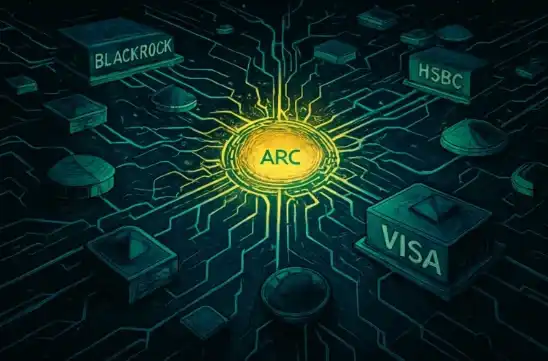
Whoever controls the circulation path of stablecoins holds the key gateway to on-chain finance.

Against this backdrop, Circle's strategy becomes very clear. First, solve the trust problem with USDC; then, solve the circulation problem with ARC; finally, form a complete closed-loop system from issuance to settlement.

If this structure is established, then Circle will no longer be just a stablecoin company but may evolve into an infrastructure operator for the on-chain financial system.

In terms of industry impact, this model could bring about changes at three levels. First, cost structure optimization: cross-chain transfers and settlement of stablecoins will be processed within a unified system, significantly reducing transaction costs and friction. Second, lower barriers for institutional access: banks, funds, and payment companies can directly connect to a unified on-chain system without needing to adapt to multi-chain ecosystems. Third, a strengthening trend of financial standardization: on-chain finance may gradually form foundational standards similar to internet protocol layers, and ARC has the opportunity to become one of the core participants.

More importantly, once such infrastructure is proven successful, its impact will no longer be confined to the crypto industry but may gradually touch the core links of traditional finance, especially cross-border payment and settlement systems.

The existing SWIFT system has operated for decades. If the on-chain stablecoin system establishes advantages in efficiency and cost, then the reconstruction of financial infrastructure is no longer a theoretical question but a matter of time.

Conclusion

The $222 million funding event for ARC is, in essence, not just a simple project funding story but a staged signal of financial system evolution.

When capital from different systems like BlackRock, Intercontinental Exchange, and ARK Invest simultaneously bets on the same chain, it indicates that the market has already begun to acknowledge a trend: stablecoins are no longer just trading tools but are becoming one of the candidate standards for global financial infrastructure.

What's truly worth watching is not how high ARC's valuation can go, but whether it will become one of the default paths for future global capital flow. And if this trend holds true, then today's $222 million may be just a small step in the prologue of the entire financial system's reconstruction.

Preguntas relacionadas

QWhat is the key strategic shift that Circle's launch of the ARC network represents, according to the article?

AThe launch of ARC represents Circle's strategic shift from being solely a stablecoin issuer (of USDC) to becoming a financial system designer. It marks a transition from an application layer company dependent on external public chains to a protocol layer infrastructure provider, aiming to integrate currency issuance and circulation into one unified, closed-loop system.

QWhy does the article consider the ARC funding round significant beyond the $222 million amount raised?

AThe significance lies in the composition of the investor consortium. It includes a rare convergence of top traditional financial giants (like BlackRock, Intercontinental Exchange), elite venture capital (a16z), and major crypto-native funds (ARK Invest, General Catalyst). This signals a collective bet by key players from different financial spheres on a shared future financial infrastructure, indicating a system-level alignment.

QHow does the ARC network aim to change the fundamental business model of Circle, as described in the article?

AARC aims to shift Circle's business model from reliance on interest income from reserve assets (an asset management model) to an infrastructure fee model. By controlling the dedicated network for stablecoin flow and settlement, Circle could become a payment network or clearing system provider, generating revenue from infrastructure usage.

QWhat are the three potential industry-wide impacts the article suggests ARC's model could bring about?

A1. Cost structure optimization: Lowering transaction costs and friction by unifying cross-chain transfers and settlements within one system. 2. Lowering institutional access barriers: Banks and payment companies could directly connect to a single on-chain system instead of adapting to multiple chains. 3. Strengthening financial standardization: Potentially establishing core foundational standards for on-chain finance, similar to internet protocols, with ARC as a key participant.

QWhat broader historical financial system does the article suggest ARC and stablecoins could potentially challenge or impact in the long term?

AThe article suggests that if successful and efficient, the on-chain stablecoin system, with infrastructures like ARC, could potentially challenge or impact the core of traditional cross-border payment and settlement systems, specifically referencing the decades-old SWIFT (Society for Worldwide Interbank Financial Telecommunication) system.

Lecturas Relacionadas

El primer dilema mortal de Warsh: recortes de tipos, inflación y una Fed dividida

**Fuente: Wall Street Journal** El nuevo presidente de la Reserva Federal (Fed), Kevin Warsh, hereda una situación compleja: la inflación está en máximos de tres años (IPC del 4,0%), con presiones que se extienden desde la energía a los servicios. El Comité Federal de Mercado Abierto (FOMC) está profundamente dividido, como mostraron tres votos disidentes en la última reunión que rechazaban incluso insinuar futuros recortes de tipos. Aunque el presidente Trump lo eligió esperando recortes, el historial de Warsh sugiere mayor preocupación por la inflación que por el estímulo. Un riesgo clave es que la tasa neutral de interés (r-star) sea más alta de lo estimado, lo que limitaría el espacio para políticas acomodaticias. Los mercados están ajustándose: los bonos a largo plazo suben (el bono a 30 años ronda el 5,19%) y las valoraciones de las acciones tecnológicas se comprimen. El mayor factor a corto plazo es el resultado de las negociaciones con Irán; un acuerdo que reduzca el precio del petróleo podría aliviar temporalmente la presión inflacionaria. La primera reunión de Warsh al frente de la Fed, el 17 de junio, será crucial. Su lenguaje sobre la inflación y los tipos de interés revelará si priorizará la lucha contra los precios o cederá a las presiones políticas para recortar, poniendo a prueba la independencia de la institución.

marsbitHace 11 min(s)

El primer dilema mortal de Warsh: recortes de tipos, inflación y una Fed dividida

marsbitHace 11 min(s)

Interpretación de la última cartera de Leopold Aschenbrenner, el 'Hijo del Protocolo de Wall Street': ¿Por qué el rey de los toros de la IA dio la vuelta y fue corto en Nvidia?

**Resumen: La gran apuesta contraria del "rey del AI" en bolsa** Leopold Aschenbrenner, el exitoso gestor de fondos y antiguo investigador de OpenAI, ha hecho un movimiento radical en sus inversiones. Según su última presentación 13F, ha establecido posiciones cortas (apuestas a la baja) por valor de 80.000 millones de dólares en el sector de semiconductores, incluyendo a líderes como NVIDIA, AMD, Broadcom y ASML. Es la primera vez en su fondo que las posiciones cortas superan a las largas. **Su tesis central:** El cuello de botella para la inversión en IA está cambiando del diseño de chips a la infraestructura física, concretamente a la **electricidad y la memoria**. Por ello, mantiene o aumenta sus apuestas en empresas de infraestructura energética para centros de datos, como CoreWeave y Bloom Energy, y en mineras de Bitcoin (CleanSpark, Riot Platforms) que poseen acceso privilegiado a la red eléctrica y pueden adaptar sus instalaciones a la computación de IA. En resumen, Aschenbrenner no apuesta *contra* el crecimiento de la IA, sino a un cambio en los beneficiarios: de los fabricantes de chips a los dueños de la capacidad de **electricidad, almacenamiento (memoria)** y construcción física. Considera que la valoración de las empresas de semiconductores refleja un optimismo excesivo y que la próxima fase de la expansión de la IA dependerá de quién pueda alimentarla físicamente. El mayor riesgo de su estrategia es subestimar la sólida ventaja competitiva de NVIDIA, respaldada por su ecosistema de software CUDA.

marsbitHace 11 min(s)

Interpretación de la última cartera de Leopold Aschenbrenner, el 'Hijo del Protocolo de Wall Street': ¿Por qué el rey de los toros de la IA dio la vuelta y fue corto en Nvidia?

marsbitHace 11 min(s)

IOSG | Después de que el número de desarrolladores se redujera a la mitad: Crypto no ha muerto, solo le ha cedido talento a la IA

El ecosistema Crypto ha experimentado una importante 'depuración de talento', con desarrolladores mensuales activos en GitHub cayendo de 45K a 23K entre 2022 y 2026. Sin embargo, este descenso oculta un fortalecimiento del núcleo: los desarrolladores establecidos (con más de 2 años de experiencia) han alcanzado un máximo histórico y ahora contribuyen con el 70% del código, migrando hacia ecosistemas con usuarios y ingresos reales como Bitcoin y Solana. El artículo argumenta que la industria Crypto ha forjado habilidades únicas y cruciales para la era de la IA: diseñar sistemas confiables y mecanismos de incentivos en entornos sin autoridades centrales y con tolerancia cero a fallos (ej. DeFi, DAOs). Estas competencias son precisamente las necesarias para abordar los cuellos de botella estructurales de la IA a escala: la agregación y optimización eficiente de potencia de cálculo (ej. Hyperbolic), el diseño de gobernanza y coordinación para múltiples agentes de IA (ej. mecanismos inspirados en EigenLayer), y la infraestructura de pago autónoma para agentes (ej. protocolos como x402). Por lo tanto, los 'builders' con experiencia en Crypto no están desapareciendo, sino siendo revalorizados. Su rol está evolucionando de escribir contratos inteligentes a diseñar los marcos de confianza y las reglas económicas para los sistemas autónomos de IA. El capital riesgo (ej. Paradigm, a16z) está siguiendo esta convergencia, invirtiendo en la intersección entre ambas tecnologías, lo que señala una oportunidad estructural más que una mera narrativa.

marsbitHace 47 min(s)

IOSG | Después de que el número de desarrolladores se redujera a la mitad: Crypto no ha muerto, solo le ha cedido talento a la IA

marsbitHace 47 min(s)

Harvard y otras instituciones liquidan posiciones, 6 talentos clave se van en un mes: ¿Qué le pasa a Ethereum?

El artículo aborda los recientes desafíos de Ethereum, destacando la salida de al menos 7 miembros clave de la Fundación Ethereum (EF) en pocos meses, incluyendo investigadores principales como Carl Beek y Julian Ma. Este éxodo se atribuye en parte a la polémica suscitada por el nuevo "manifiesto de misión" de la EF, que enfatiza la reducción de su influencia central, pero que generó controversia al requerir la firma de los empleados. La pérdida de talento conlleva riesgo de retrasos en la hoja de ruta técnica, como la actualización Glamsterdam, clave para aumentar la capacidad de la red. Paralelamente, se reporta una disminución en la confianza institucional: Goldman Sachs redujo ~70% su posición en un ETF de Ethereum, el fondo de dotación de Harvard liquidó completamente su holding de ~$87 millones, y un fondo de pensiones coreano registró grandes pérdidas en un ETF apalancado de Ethereum. Además, la EF ha desvinculado 21,271 ETH de Lido y realizado ventas para rebalancear su tesorería, aumentando la percepción de incertidumbre. En el ámbito competitivo, Ethereum ve erosionar su dominio en DeFi (TVL) frente a cadenas como Solana, y enfrenta el surgimiento de blockchains institucionales privadas, como Arc de Circle. A pesar de la visión de Vitalik Buterin de construir un "refugio tecnológico" seguro y descentralizado, el artículo concluye que la ejecución de esta visión se ve amenazada por la fuga de conocimiento experto y la coordinación inestable en un momento crítico.

链捕手Hace 48 min(s)

Harvard y otras instituciones liquidan posiciones, 6 talentos clave se van en un mes: ¿Qué le pasa a Ethereum?

链捕手Hace 48 min(s)

El emprendedor que salió de la granja: después de crear coches voladores, apuesta en la pista de la robótica y crea un gigante de 39.000 millones de dólares

Brett Adcock, un emprendedor criado en una granja de Illinois, ha creado tres empresas en sectores muy diferentes: la plataforma de contratación Vettery (vendida por 110 millones de dólares), la compañía de vehículos aéreos eléctricos Archer Aviation (cotizada en bolsa) y, actualmente, la startup de robots humanoides Figure AI, valorada en 39.000 millones de dólares. Tras abandonar Archer debido a diferencias estratégicas, Adcock fundó Figure AI en 2022 con la visión a 30 años de crear una fuerza laboral robótica generalista. La empresa, respaldada por grandes inversores, ha centrado su narrativa en solucionar la escasez de mano de obra en sectores como la logística. Sin embargo, su elevada valoración contrasta con una comercialización aún temprana y un camino tecnológico complejo, marcado por la ruptura de su colaboración con OpenAI. El patrón de Adcock es identificar mercados ineficientes en un punto de inflexión tecnológica, movilizar capital y talento, y construir una narrativa ambiciosa. Desde el software hasta la aviación y la robótica, su trayectoria representa una apuesta progresiva por problemas más complejos y a más largo plazo. Con Figure AI en el centro del auge de la robótica, su legado ya está escrito, independientemente del resultado final.

marsbitHace 1 hora(s)

El emprendedor que salió de la granja: después de crear coches voladores, apuesta en la pista de la robótica y crea un gigante de 39.000 millones de dólares

marsbitHace 1 hora(s)

Trading

Spot
Futuros
活动图片