From Theft to Re-entry: How Was $292 Million "Laundered"?

marsbitPublicado a 2026-04-26Actualizado a 2026-04-26

Resumen

A sophisticated crypto laundering operation was executed following the $292 million hack of Kelp DAO on April 18. The attack, attributed to the North Korean Lazarus group, began with anonymous infrastructure preparation using Tornado Cash to fund wallets untraceably. The hacker exploited a vulnerability in Kelp’s cross-chain bridge, stealing 116,500 rsETH. To avoid crashing the market, the attacker used Aave and Compound as laundering tools—depositing the stolen rsETH as collateral to borrow $190 million in clean, liquid ETH. This move triggered a bank run on Aave, causing an $8 billion drop in TVL. After consolidating funds, the attacker fragmented them across hundreds of wallets to evade detection. A major breakpoint was THORChain, where over $460 million in volume—30 times its usual activity—was processed in 24 hours, converting ETH into Bitcoin. This shift to Bitcoin’s UTXO model exponentially increased tracing complexity by shattering funds into countless untraceable fragments. The final destination was Tron-based USDT, the primary channel for illicit crypto flows. From there, funds were cashed out via OTC brokers in China and Southeast Asia, using unlicensed underground banks and UnionPay networks outside Western sanctions scope. Ultimately, the laundered money supports North Korea’s weapons programs, which rely heavily on crypto hacking for foreign currency. The incident underscores structural challenges in DeFi: its openness, composability, and lack of central c...

Editor's Note: On April 18, Kelp DAO was attacked, with approximately $292 million in assets stolen. So, in a completely transparent on-chain system, how exactly was this money step-by-step "cleaned" to become liquid assets?

This article uses this incident as a starting point to dissect a highly industrialized path for crypto money laundering: from the preparation of anonymous infrastructure before the attack, to using Tornado Cash to sever on-chain links; from leveraging Aave and Compound to mortgage "toxic assets" and exchange them for clean liquidity, to using THORChain, cross-chain bridges, and the UTXO structure to exponentially increase tracking difficulty, ultimately funneling into the USDT system on Tron and being converted into cash in the real world via over-the-counter (OTC) networks.

Throughout this process, there were no complex black-box operations; almost every step was "playing by the rules." Precisely because of this, what this path reveals is not a single vulnerability, but the structural tension within the DeFi system under its openness, composability, and uncensorability—when the protocol design itself permits these operations, so-called "fund recovery" is no longer a technical problem but a systemic boundary issue.

The Kelp DAO incident is therefore not just a security breach; it's more like a stress test of the crypto world's operating logic: it shows how hackers turn your money into their money, and it also shows why this system, in principle, struggles to prevent this process from happening.

As you know, on April 18, a North Korean hacker stole $292 million from Kelp DAO. Five days later, over half of it had vanished, fragmented across thousands of wallets, exchanged through unstoppable protocols, and ultimately funneled to a very specific destination.
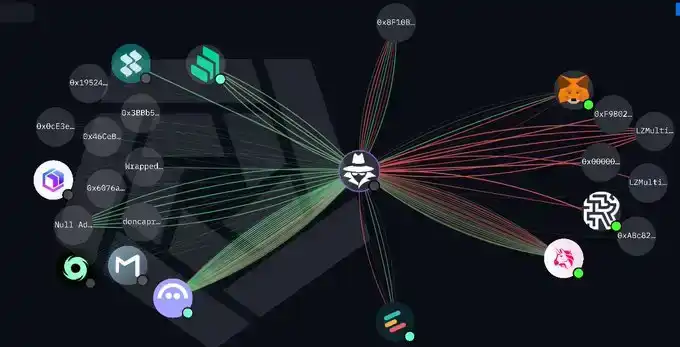
The interesting part is: how to turn $292 million of documented stolen crypto assets, with no one able to stop it, into cash in Pyongyang's pockets.

The purpose of this article is to reveal why the modern crypto money laundering pipeline works, why it is structurally unstoppable, and what each laundered dollar ultimately buys.

Phase 1: Setup (Hours Before the Attack)

The attacker did not start with the direct theft. The Lazarus Group's playbook always begins with infrastructure preparation.

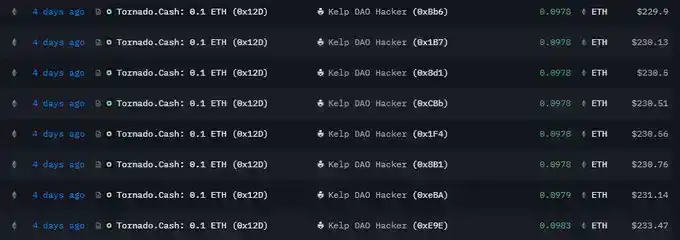
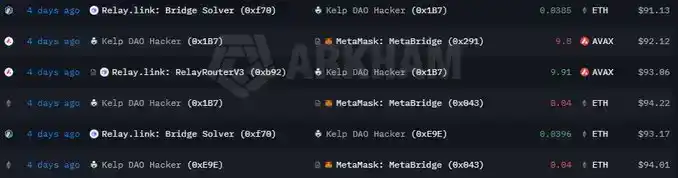
Approximately 10 hours before the attack, 8 brand new wallets were pre-funded via Tornado Cash—a mixer that severs the link between the source and destination of funds.

Each wallet received 0.1 ETH, used to pay for the Gas fees of all subsequent operations. Since these wallets' funds came from a mixer, they had no exchange KYC records, no historical transaction traces, and could not be linked to any known entity. Clean slates.
On the eve of the attack, the attacker initiated 3 cross-chain transfers from Ethereum mainnet to Avalanche and Arbitrum—clearly aiming to pre-fund Gas on these two L2s and test the bridge operations, ensuring smooth large transfers.
Phase 2: Theft

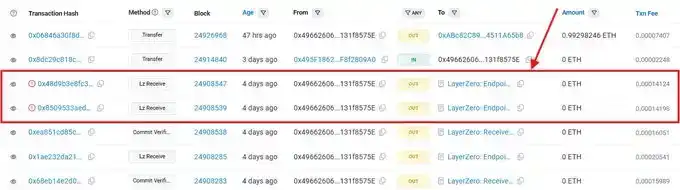
An independent attack initiation wallet (0x4966...575e) called a function named lzReceive on the LayerZero EndpointV2 contract. As the validator had been successfully deceived, this call was treated as a legitimate cross-chain message. Kelp's bridge contract, Kelp DAO: RSETH_OFTAdapter (Etherscan address: 0x85d...), subsequently released 116,500 rsETH to 0x8B1.
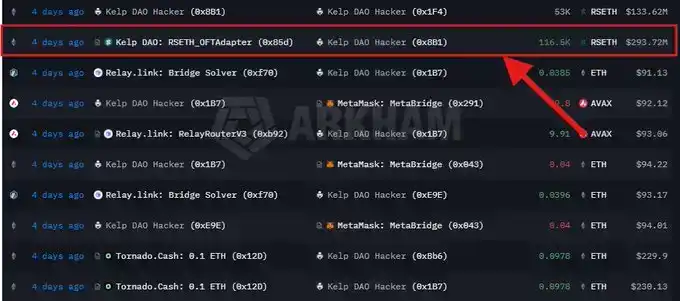
18% of the total circulating rsETH. Gone in one function call.

46 minutes later, at 18:21 UTC, Kelp's emergency multi-signature wallet paused the protocol. At 18:26 and 18:28 UTC, the attacker attempted two more operations in exactly the same way, each trying to steal about 40,000 rsETH (approx. $100 million each). Both were rolled back due to Kelp's timely shutdown. Had this not happened, the total theft could have approached $500 million.
Phase 3: Aave + Compound Operations

rsETH is a receipt token; once Kelp paused the bridge or blacklisted the stolen tokens, its value would immediately drop to zero. The attacker had only minutes to convert it into assets that could not be frozen. Kelp paused 46 minutes after the theft—it was already too late.

Selling $292 million of illiquid restaking tokens on the open market would crash the price by over 30% in minutes. So he did not choose to sell, but instead used DeFi lending protocols as money laundering tools for a quick exit.

The receiving wallet 0x8B1 dispersed the 116,500 stolen rsETH to 7 other branch wallets. Each branch then entered Aave and Compound V3, deposited a portion of the rsETH as collateral, and borrowed ETH.
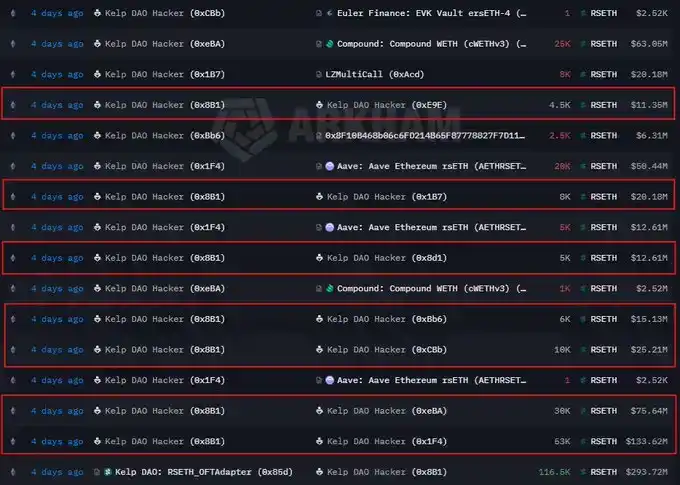
The cumulative positions of the 7 branches were as follows:

· Deposited Collateral: 89,567 rsETH

· Borrowed: approx. 82,650 WETH + 821 wstETH, totaling approx. $190 million in clean, liquid Ethereum assets

· The health factor for each branch was set between 1.01 and 1.03—the absolute upper limit allowed by the protocol before liquidation
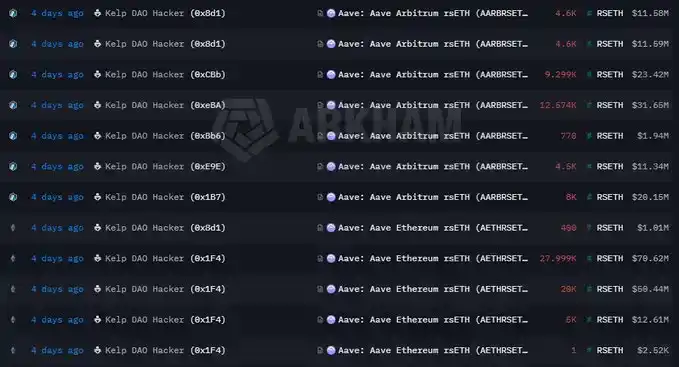
The attacker exchanged this batch of $292 million worth of marked and nearly unsellable rsETH for $190 million worth of ETH. When this rsETH was eventually marked as nearly worthless (because Kelp's bridge became insolvent and unredeemable), the lending protocol's depositors bore the loss.

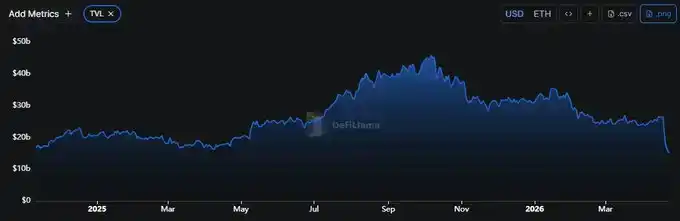
As the market realized Aave was holding over $200 million in bad debt, users panicked and withdrew funds. Aave lost $8 billion in TVL (Total Value Locked) within 48 hours. The largest DeFi lending protocol experienced its first true bank run—triggered by an attacker using it exactly as designed.
Phase 4: Fund Consolidation and Splitting

After completing the Aave/Compound borrowing, the 7 branches pushed the borrowed ETH to a third-layer consolidation wallet (0x5d3).
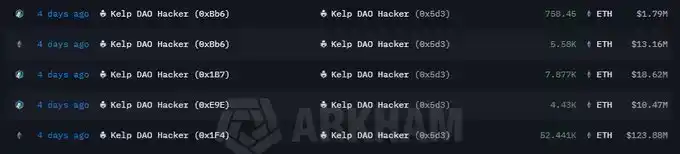
The operational cluster now showed a clear three-tier structure:

1. Receipt: 0x8B1 (also funded via Tornado Cash), received the original theft of 116,500 rsETH

2. Operations: 7 branch wallets funded via Tornado Cash, executed Aave/Compound operations

3. Consolidation: 0x5d3 re-aggregated the borrowed funds, approx. 71,000 ETH, unifying them for the laundering process

The funds were then distributed across two chains:

· 75,700 ETH remained on Ethereum Mainnet

· 30,766 ETH on Arbitrum (approx. $71 million)

The Arbitrum Security Council voted to freeze these assets on Arbitrum, moving the $71 million to a governance-controlled wallet that could only be unlocked by subsequent governance decisions.
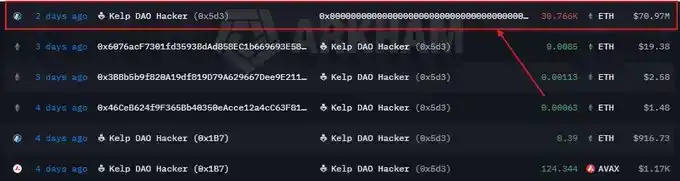
Shortly after the freeze, the hacker moved the remaining ETH on Mainnet and accelerated the laundering process. These actions suggested he clearly did not anticipate Arbitrum taking such action.

Phase 5: First Wave of Laundering

Four days after the attack, 0x5d3 began to empty. Arkham tracked 3 independent transfers within hours.

The timing was deliberately chosen: Tuesday during European trading hours. US investigators were still resting, European compliance departments were dealing with Monday's backlog, and Asian exchanges were nearing close.

Then, the transfer pattern began to explode. Every first-wave destination immediately fragmented further: 0x62c7 pushed to about 60 newly generated wallets, 0xD4B8 pushed to another ~60. Within hours, the neat cluster of 10 wallets expanded to over 100 disposable addresses, all funded in parallel, each holding amounts small enough to evade detection.
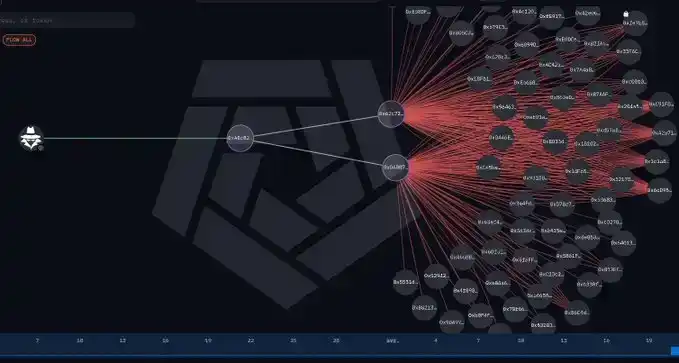
Lazarus runs HD wallet scripts—a single seed phrase can mathematically derive thousands of new addresses in seconds,配合 a worker pool (Python + web3, ethers.js, or their own internal tools) to sign and broadcast the entire address tree in parallel. They have been iterating on this code since 2018.

By the end of this phase, the linearly traceable chain had disappeared. The operational cluster of 10 wallets exploded into over 100 fragmented wallets, with funds entering privacy channels simultaneously from dozens of independent entry points.

Phase 6: THORChain – The Escape Machine

The real breakpoint happened at THORChain.

THORChain is a decentralized protocol supporting cross-chain native asset swaps. You send ETH on Ethereum, it gives you BTC on the Bitcoin network.

On April 22 alone, THORChain's 24-hour swap volume reached $460 million. The protocol's normal daily volume is around $15 million. This single hack accounted for 30 times the protocol's normal usage in one day.
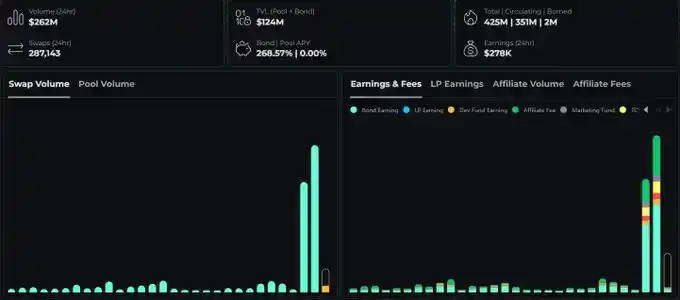
Within the same 24-hour window, the protocol generated $494,000 in revenue, shared among bonders (node operators), liquidity providers, the development fund, alliance integrators, and the marketing fund.

Simultaneously, funds also flowed through a set of smaller but complementary privacy rails:

· Umbra: A stealth address protocol on Ethereum. Allows sending funds to disposable addresses, only the recipient can calculate the address using a shared key. On-chain monitors cannot know the true destination. Initial activity of ~$78,000 was tracked here before tools lost the trail.

· Chainflip: Another cross-chain DEX, similar to THORChain.

· BitTorrent Chain: A low-cost, low-regulation sidechain connected to Tron.

· Tornado Cash: The same mixer used for the initial Gas pre-funding. The US Treasury Department sanctioned it in 2022.

Each layer of protocol increases the tracking cost by roughly a factor of 10. After 5 layers, forensic firms could theoretically still track every fragment, but the economic cost exceeds the recoverable value.

Phase 7: Bitcoin UTXO Fragmentation

Completing the ETH-to-BTC conversion via THORChain essentially turns the money into confetti.

Ethereum uses an account model; your balance is a number attached to an address, simple and direct. Bitcoin is different; it uses a UTXO (Unspent Transaction Output) model—each UTXO is a specific chunk of a coin with a complete transaction history. Every time you spend Bitcoin, these chunks are split and recombined, forming new chunks.
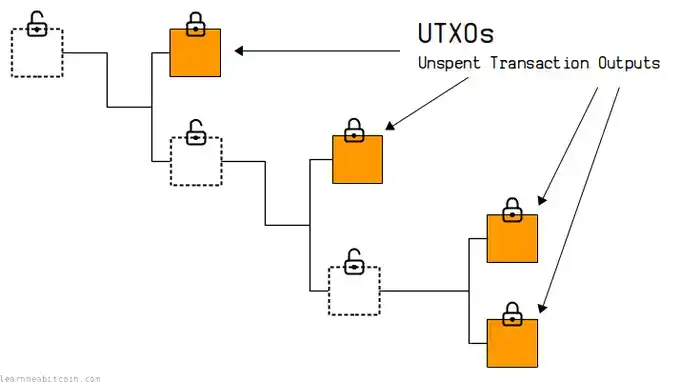
Imagine tearing a $100 bill into 87 pieces, then tearing each piece into another 87 pieces, repeating this cycle 7 times. Technically, every fragment can be traced back to that original bill. Practically, no manual forensic team can track thousands of parallel chains in real-time and piece together the complete picture fast enough to take action.

Thus, THORChain accomplished two things simultaneously: moving funds across a boundary no sanction could cross, and fragmenting the funds into untraceable dust.

Phase 8: Tron USDT Rail

After passing through Bitcoin and privacy layers, the funds reconverged on the same endpoint: USDT on Tron.

Most people assume the main battlefield for money laundering is BTC; this is incorrect. The real main battlefield is USDT on Tron. Data shows USDT-Tron consistently ranks first in annual illicit crypto asset transaction volume, exceeding the sum of all other chains.

In this Kelp fund flow, the specific path was: cross-chain transfer from BTC to Tron, exchange for USDT, then multiple transfers between Tron addresses. Each hop on Tron costs mere pennies, allowing for another 10 layers of fragmentation.

Phase 9: Cashing Out – Crypto to Cash

The endpoint of every hack sees the funds converted into fiat cash through a specific, well-known network of human intermediaries.

A group of over-the-counter (OTC) brokers active in mainland China and Southeast Asia receive USDT-Tron deposits and settle in local currency cash. These brokers are essentially unlicensed underground banks. They aggregate fund flows from multiple clients (compliant and non-compliant), net them internally, and settle in fiat via China's domestic payment network (UnionPay)—which operates completely outside the SWIFT system and Western sanction enforcement.
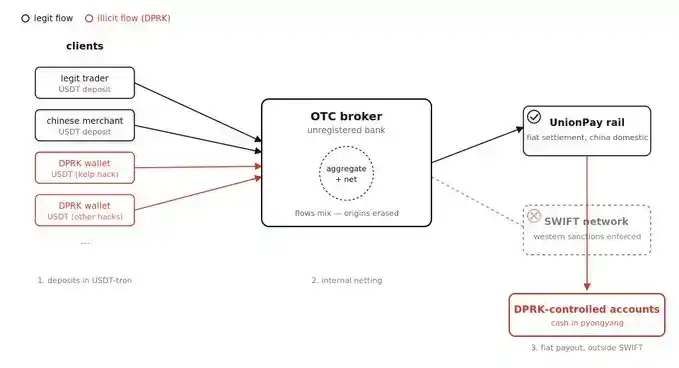
From accounts controlled by these brokers, funds flow into North Korean-controlled bank accounts, often held in the name of shell companies registered in Hong Kong, Macau, or third-party jurisdictions. From these accounts, funds are sent back to Pyongyang through Hawala-style informal clearing, physical cash transport, and procurement front companies.

The UN Security Council, FBI, and US Treasury Department have independently documented the final destination of these funds. North Korea's ballistic missile program, nuclear weapons development, and circumvention of international sanctions rely on the continuous support of such fund flows.

A 2024 UN report estimated that crypto hacks account for about 50% of North Korea's total foreign exchange income, making it the primary funding source for its weapons program—exceeding the sum of coal exports, arms sales, and labor exports.

[Original Title]

Criptos en tendencia

Preguntas relacionadas

QWhat was the total amount stolen in the Kelp DAO attack and what was the primary method used to initially obscure the funds?

AApproximately $292 million was stolen. The primary method used to initially obscure the funds was using Tornado Cash, a cryptocurrency mixer, to fund the initial attack wallets, severing the on-chain link to their source.

QHow did the attacker convert the illiquid, marked rsETH tokens into liquid, 'clean' assets without crashing the market?

AThe attacker used DeFi lending protocols Aave and Compound as a laundering tool. They deposited the stolen rsETH as collateral and borrowed out approximately $190 million worth of liquid ETH and wstETH, effectively swapping the toxic assets for clean, fungible ones.

QWhich decentralized protocol served as the major 'exit vehicle' for the funds, and what two key functions did it perform?

ATHORChain served as the major exit vehicle. It performed two key functions: 1) It enabled cross-chain swaps (e.g., from ETH to BTC), moving funds across jurisdictional boundaries. 2) It exponentially increased tracking difficulty by fragmenting the funds through Bitcoin's UTXO model.

QAccording to the article, what is the final destination for most laundered crypto assets like those from this hack, and what stablecoin is predominantly used?

AThe final destination is the Tron blockchain, where the funds are predominantly converted into USDT (Tether). Tron's USDT is cited as the primary battlefield for illicit crypto asset transactions.

QWhat is the ultimate real-world outcome for the laundered funds, and how do they reportedly benefit the attacker's nation-state?

AThe funds are converted into fiat cash through a network of OTC brokers in Asia and then funneled to North Korea. According to UN reports, such funds are a primary source of foreign currency, supporting the nation's ballistic missile and nuclear weapons programs.

Lecturas Relacionadas

TechFlow Oficina de Inteligencia: Las probabilidades de que Anthropic realice una OPI superan el 80%, Irán vuelve a cerrar el estrecho de Ormuz y desestabiliza los precios del petróleo

Resumen del informe TechFlow: Los mercados anticipan que Anthropic anunciará su OPV antes de noviembre de 2026, planteando dudas sobre si una valoración billonaria puede coexistir con su promesa central de seguridad en IA. Otras tendencias clave: * **Marketing digital:** Marcas adoptan influencers virtuales generados por IA para promocionar productos. * **Energía y Geopolítica:** Irán anuncia el cierre del estrecho de Ormuz, causando volatilidad en el precio del petróleo, aunque datos de seguimiento muestran cierto tráfico marítimo persistente. Paralelamente, Irán reanuda la carga de crudo en la isla de Kharg. * **Finanzas/Tecnología:** Goldman Sachs advierte que los gastos de capital en IA (5,3 billones de dólares) podrían acercarse al límite de crédito. En Europa, se produce la primera incumplimiento en acciones de CLO desde la crisis financiera. * **Empresas tecnológicas:** Cloudflare introduce cuentas temporales para agentes de IA; el tráfico IPv6 de Google supera el 50%; Hyundai adquiere el control total de Boston Dynamics. * **Mercados:** Inversores minoristas invierten fuertemente en la OPV de SpaceX. Elon Musk especula sobre futuras inversiones astronómicas en antimateria para viajes interestelares. **Conclusión subyacente:** Tres señales (tensión en Ormuz, incumplimiento en CLO y advertencias sobre gasto en IA) apuntan a una creciente restricción de la liquidez global y al aumento de los costes marginales. Mientras tanto, el capital sigue buscando narrativas de crecimiento a gran escala (como la OPV de Anthropic, SpaceX y los proyectos de Musk), indicando una bifurcación entre un "viejo mundo" con creciente presión financiera y un "nuevo mundo" que construye narrativas aún más ambiciosas.

marsbitHace 40 min(s)

TechFlow Oficina de Inteligencia: Las probabilidades de que Anthropic realice una OPI superan el 80%, Irán vuelve a cerrar el estrecho de Ormuz y desestabiliza los precios del petróleo

marsbitHace 40 min(s)

El cazador cazado: el bot MEV más rentable fue hackeado

**El cazador cazado: El bot de MEV más rentable es hackeado** El conocido bot de MEV en Ethereum, Jaredfromsubway.eth, sufrió un ataque dirigido el sábado, perdiendo más de 7,5 millones de dólares. Según investigaciones, no fue un phishing tradicional ni una explotación de contrato inteligente, sino un sofisticado "ataque de honeypot contra-MEV" diseñado específicamente para explotar la lógica de comportamiento de estos bots. El atacante desplegó durante semanas 66 contratos de tokens falsos y pools de liquidez, disfrazados como activos principales como WETH, USDC o USDT, para crear rutas de arbitraje falsas. El bot, al detectar la aparente oportunidad, ejecutó una transacción que concedió permisos a un contrato controlado por el atacante. Estos permisos no fueron revocados, permitiendo finalmente que el atacante drenara los fondos del bot en una sola transacción. Jaredfromsubway.eth es uno de los bots de MEV más activos e infames de Ethereum, especializado en ataques de "sándwich" para capturar ganancias de los deslizamientos de precio en las transacciones de usuarios. Se estima que ha acumulado decenas de millones en ganancias y estaba relacionado con alrededor del 70% de estos ataques en un período reciente. Este incidente subraya la creciente sofisticación de las amenazas en cripto, demostrando que incluso los actores más agresivos y automatizados ("depredadores") ahora son vulnerables a ataques multidimensionales que explotan sus propias reglas y automatizaciones. Tras el hackeo, una cuenta no oficial en X se hizo pasar por el bot ofreciendo una recompensa falsa, lo que ha generado advertencias de seguridad adicionales.

marsbitHace 2 hora(s)

El cazador cazado: el bot MEV más rentable fue hackeado

marsbitHace 2 hora(s)

La realidad de los pagos en Latinoamérica es muy distinta a lo que imaginas

La realidad de los pagos en Latinoamérica desafía las percepciones. Tras una investigación de 500 horas, estos son los hallazgos clave: 1. Las tarjetas cripto generan volumen principalmente de profesionales que reciben salarios en dólares o USDT y convierten a moneda local vía Pix, no de compras minoristas pequeñas. 2. Los pagos con código QR (como Pix en Brasil) dominan en mercados emergentes, superando a las tarjetas. Es el sistema de pago principal para la mayoría de la población mundial. 3. Existe una gran oportunidad en la interoperabilidad internacional entre sistemas de pago instantáneo, ya que actualmente están aislados por país. 4. La competencia en pagos ahora se centra en controlar la infraestructura de liquidación, no solo en adquirir clientes. Las empresas líderes buscan licencias bancarias. 5. Latinoamérica no es un mercado único. Brasil, México, Argentina y otros tienen economías, regulaciones y flujos de capital muy diferentes. 6. El negocio de las remesas y el cambio de stablecoins se está commoditizando, con márgenes cayendo hacia cero. El valor está en los productos construidos encima. 7. La próxima generación de empresas de pagos debe tener una marca y tecnología escalable internacionalmente desde el inicio. 8. Brasil y México son mercados saturados ("rojos"). Oportunidades menos exploradas existen en países como Guatemala, Honduras, El Salvador, Nicaragua y República Dominicana. 9. El marketing debe segmentarse finamente según el flujo de fondos del usuario (ej. turistas, nómadas digitales, residentes extranjeros), no tratar a un país como un grupo homogéneo. 10. La regulación en Latinoamérica está más avanzada que en EE.UU. en aspectos como pagos instantáneos y cripto, con marcos más claros y pragmáticos. La conclusión: el futuro de los pagos en la región no está en replicar modelos basados en tarjetas, sino en conectar los sistemas QR locales, resolver la interoperabilidad transfronteriza y construir para segmentos de usuarios específicos.

marsbitHace 2 hora(s)

La realidad de los pagos en Latinoamérica es muy distinta a lo que imaginas

marsbitHace 2 hora(s)

Haciendo música en un mercado bajista: El experimento de supervivencia de una banda de Bitcoin

**Resumen: "Haciendo Música en un Mercado Bajista: El Experimento de Supervivencia de una Banda de Bitcoin"** Orange Pill Jam es una banda única que fusiona géneros como reggae gitano, afrolatino y hip-hop, mientras explora temas de soberanía financiera, privacidad y el declive de sistemas modernos. Aceptan pagos en bitcoin. Nacieron tras una actuación improvisada de la vocalista Mermaid en el Plan B Forum de Lugano en 2022, donde cantó "Dollar Apocalypse", dedicada al influyente podcaster Max Keizer. Este momento planteó la pregunta: ¿dónde está la música en la cultura bitcoin? Su proceso creativo combina las letras y melodías de Mermaid con la producción meticulosa y orientada al ritmo corporal de Michi. Canciones como "Cypherpunks' Manifesto" y "Fire of Freedom" abordan la privacidad digital, la soberanía personal y la adopción del bitcoin, con letras que permanecen intactas tras experiencias como la visita de Mermaid a El Salvador. Frente al auge de la IA generativa musical, Michi ve un paralelismo con la pintura y la fotografía: la IA puede replicar, pero no crear géneros nuevos o capturar la intención humana única. Ellos usan IA para tareas administrativas, no para la creación artística. En pleno mercado bajista de cripto, su modelo es "copyleft" (permite descargas y remezclas gratis) y aceptan donaciones en bitcoin. Su desafío es ser escuchados en un ecosistema como Spotify, saturado por 14.000 canciones diarias y algoritmos que no favorecen su temática. Su proyecto representa una apuesta por la creación humana auténtica e irrepetible en una era de contenido masivo y IA. Mientras los algoritmos se aceleran, Orange Pill Jam persevera, grabando por decimoséptima vez, defendiendo el valor de lo que no se puede generar ni optimizar fácilmente.

marsbitHace 2 hora(s)

Haciendo música en un mercado bajista: El experimento de supervivencia de una banda de Bitcoin

marsbitHace 2 hora(s)

Trading

Spot
Futuros

Artículos destacados

Cómo comprar DAO

¡Bienvenido a HTX.com! Hemos hecho que comprar DAO Maker (DAO) sea simple y conveniente. Sigue nuestra guía paso a paso para iniciar tu viaje de criptos.Paso 1: crea tu cuenta HTXUtiliza tu correo electrónico o número de teléfono para registrarte y obtener una cuenta gratuita en HTX. Experimenta un proceso de registro sin complicaciones y desbloquea todas las funciones.Obtener mi cuentaPaso 2: ve a Comprar cripto y elige tu método de pagoTarjeta de crédito/débito: usa tu Visa o Mastercard para comprar DAO Maker (DAO) al instante.Saldo: utiliza fondos del saldo de tu cuenta HTX para tradear sin problemas.Terceros: hemos agregado métodos de pago populares como Google Pay y Apple Pay para mejorar la comodidad.P2P: tradear directamente con otros usuarios en HTX.Over-the-Counter (OTC): ofrecemos servicios personalizados y tipos de cambio competitivos para los traders.Paso 3: guarda tu DAO Maker (DAO)Después de comprar tu DAO Maker (DAO), guárdalo en tu cuenta HTX. Alternativamente, puedes enviarlo a otro lugar mediante transferencia blockchain o utilizarlo para tradear otras criptomonedas.Paso 4: tradear DAO Maker (DAO)Tradear fácilmente con DAO Maker (DAO) en HTX's mercado spot. Simplemente accede a tu cuenta, selecciona tu par de trading, ejecuta tus trades y monitorea en tiempo real. Ofrecemos una experiencia fácil de usar tanto para principiantes como para traders experimentados.

339 Vistas totalesPublicado en 2024.12.11Actualizado en 2026.06.02

Cómo comprar DAO

Discusiones

Bienvenido a la comunidad de HTX. Aquí puedes mantenerte informado sobre los últimos desarrollos de la plataforma y acceder a análisis profesionales del mercado. A continuación se presentan las opiniones de los usuarios sobre el precio de DAO (DAO).

活动图片