5 in a row! Here’s why monthly perp volumes have been falling since October

ambcryptoPublicado a 2026-04-07Actualizado a 2026-04-07

Resumen

Perpetual trading volumes on decentralized exchanges have declined for five consecutive months, falling nearly 50% from a peak of $1.36 trillion in October 2025 to $699 billion by March 2026. This drop reflects ongoing bear market conditions and cautious trader sentiment following last year's market crash, which erased nearly $1 trillion in value. Open interest also declined by 50% from pre-October levels, indicating reduced speculative activity. While the decline highlights persistent bearish pressure, it also suggests traders are recalibrating risk more strategically. This measured behavior helps stabilize markets, reduce volatility, and may lay a stronger foundation for crypto's next rally.

In crypto trading, market crashes leave marks that investors don’t forget.

Looking back at Q4 last year, things were rough across the board; spot trading and even long-term HODLing all took a hit. Crypto markets lost nearly $1 trillion, triggering massive liquidity sweeps, forcing deleveraging, and sending shocks across the market, which left investors cautious and their sentiment fragile for months.

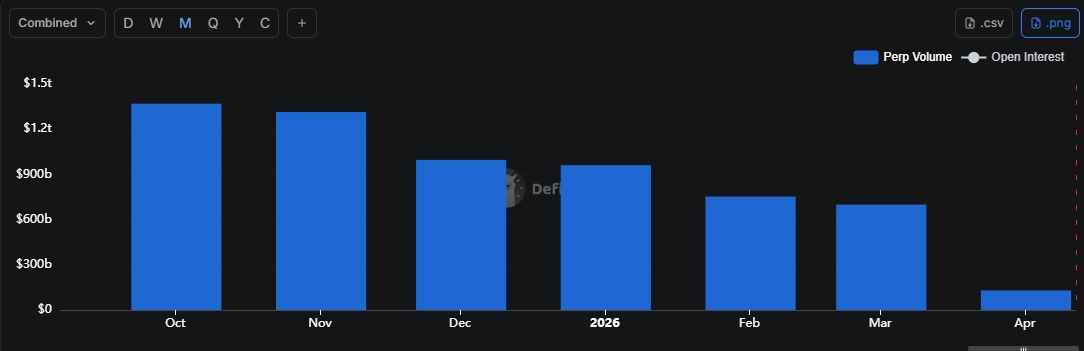
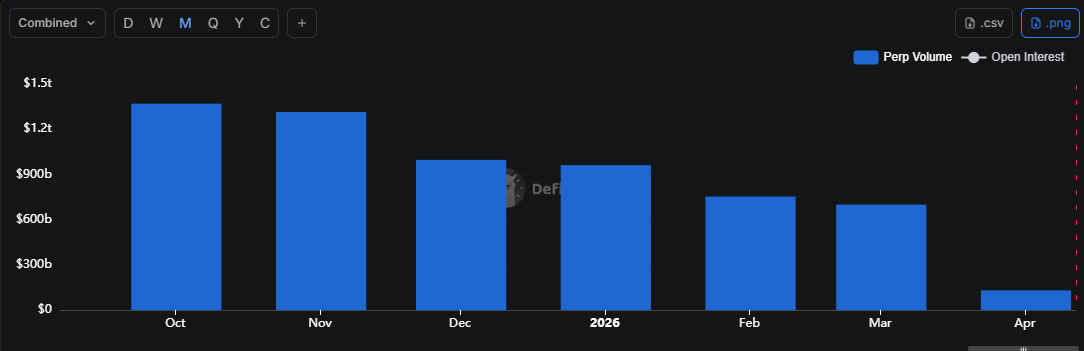
Fast forward to now, that wave of volatility hasn’t fully disappeared. Data from DeFiLlama shows that perpetual volumes across major DEX chains have been on a steady decline for five consecutive months. From a peak of $1.36 trillion in October 2025, volumes slid all the way down to $699 billion by March 2026.
Source: DeFiLlama

Technically speaking, traders wiped out nearly half of last quarter’s perp volume. For context, perp volume measures the total value of all perpetual contract trades happening on decentralized exchanges. It’s basically a snapshot of how actively traders are betting on short- and long-term price moves in crypto.

And let’s be real, anything involving “bets” is pure speculation. In a bull market, that speculative capital acts like rocket fuel, pushing rallies higher and giving momentum to the market. But since the October crash, crypto still sits about 40% below pre-crash levels, showing how much ground the market has yet to cover.

So what do we make of falling perp volume in a bear market? Could it be a healthy sign that traders are stepping back and markets are consolidating, or is it a warning that liquidity is drying up?

Falling perp volumes highlight lingering bear market pressure in crypto

Unlike spot trading, speculative trading is highly sensitive to macro conditions.

In other words, traders in perpetual markets don’t just react to crypto-specific news. Instead, they watch the broader financial landscape closely. Global market shifts, interest rate changes, and even geopolitical events can quickly influence their positions. In this context, that nearly 50% wipeout of perp volume really highlights the bearish setup the market is facing right now.

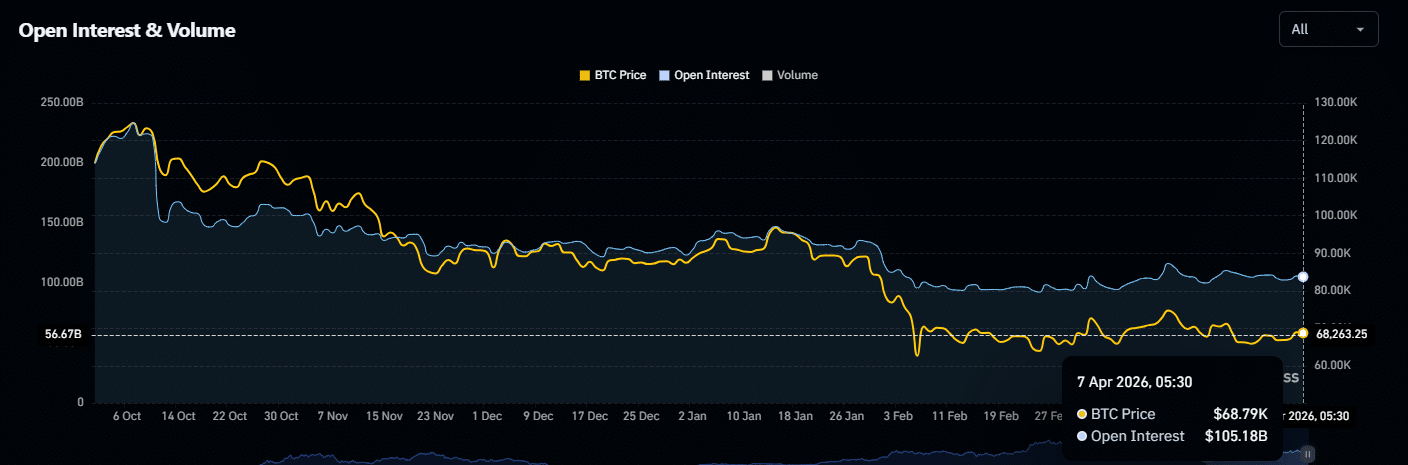
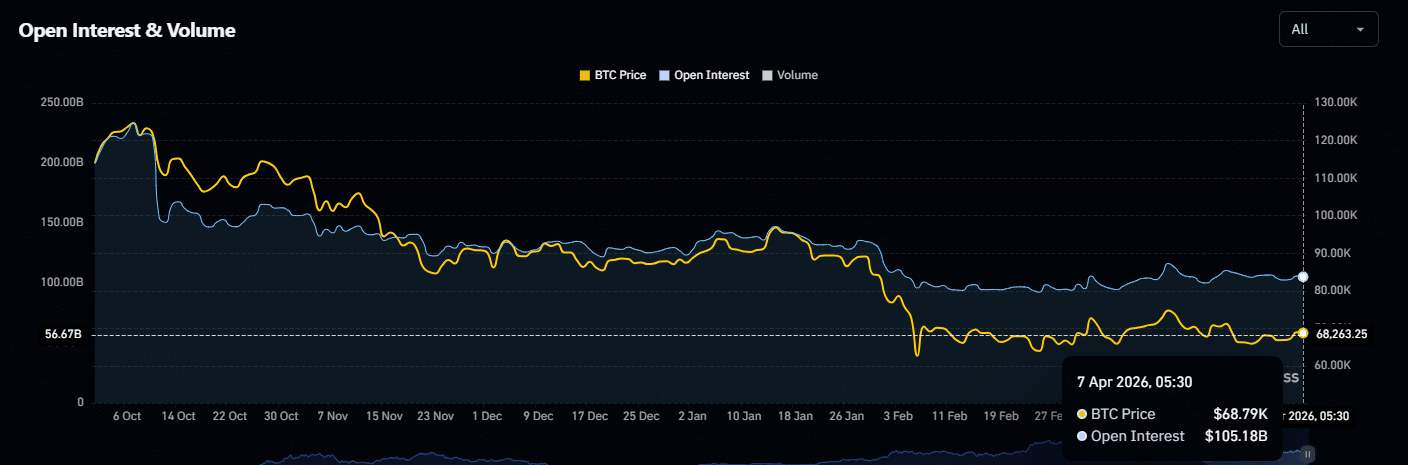
Adding to that, Coinglass data shows that open interest (OI) across all crypto assets combined has also dropped 50% from the $200 billion pre-October levels. For context, open interest is basically the total value of all “outstanding” contracts that haven’t been settled yet, showing how much capital traders have at risk.
Source: Coinglass

Taken together, the drop in perp volume and open interest tells a clear story: crypto traders are actively recalibrating risk and waiting for clearer signals before jumping back in. In a bear market, that’s actually a bullish sign. It indicates that traders aren’t blindly chasing moves. Instead, they’re letting the market settle, which helps reduce the risk of sudden swings and wild volatility.

At the same time, the scars from the October crash haven’t fully healed.

Still, traders are taking notes from past shocks, pulling back when risk is high, and redeploying capital more strategically. As a result, the market may look quiet on the surface, yet behind the scenes, this cautious behavior is quietly building a stronger foundation for crypto’s next move.


Final Summary

  • Perp volume and open interest are down nearly 50%, reflecting traders’ caution and a still-bearish market setup.
  • Measured trading behavior in a bear market helps stabilize liquidity, limit volatility, and lay the groundwork for the next crypto rally.


Preguntas relacionadas

QWhat has been the trend in monthly perpetual trading volumes on major DEX chains since October 2025, according to DeFiLlama data?

APerpetual trading volumes have been on a steady decline for five consecutive months, falling from a peak of $1.36 trillion in October 2025 to $699 billion by March 2026.

QWhat does the combined drop in perp volume and open interest indicate about current trader behavior?

AThe drop indicates that crypto traders are actively recalibrating risk and waiting for clearer signals before jumping back in, showing caution and a more strategic deployment of capital.

QHow does speculative trading in perpetual markets differ from spot trading in terms of market sensitivity?

ASpeculative trading is highly sensitive to macro conditions, meaning traders react to global market shifts, interest rate changes, and geopolitical events, not just crypto-specific news.

QWhat is the significance of falling perp volume in a bear market, according to the article?

AIn a bear market, falling perp volume can be a bullish sign as it indicates traders are not blindly chasing moves, which helps reduce the risk of sudden swings and builds a stronger foundation for the next market move.

QBy what percentage did the crypto market drop from its pre-crash levels following the October crash?

AThe crypto market still sits about 40% below pre-crash levels.

Lecturas Relacionadas

Se actualizan los datos sobre Bitcoin y altcoins en la cadena de bloques: mantente al día con la información más reciente

El mercado de criptomonedas ha experimentado un fuerte crecimiento en las últimas semanas, cambiando drásticamente el sentimiento de los inversores. El Índice de Miedo y Codicia ha alcanzado 81 puntos, su nivel más alto este año, entrando en la zona de "codicia extrema". Hace solo un mes, el índice estaba en la zona de "miedo", lo que subraya un rápido cambio en la aversión al riesgo. Bitcoin ($BTC) mantiene una tendencia alcista, cotizando alrededor de $79,252, con un aumento del 0,67% en la última hora. Sin embargo, el Índice de Miedo y Codicia de BitcoinSystem On-Chain muestra actualmente un nivel de "codicia" de 74 puntos. Los mercados de derivados muestran alta volatilidad. En las últimas 24 horas, se liquidaron posiciones apalancadas por un total de $424,5 millones, de los cuales $334,2 millones eran posiciones largas y $90,3 millones posiciones cortas. Los indicadores on-chain de Bitcoin ofrecen señales clave sobre la estructura del mercado. Con un precio actual muy por encima de su precio real estimado de unos $53,000, una parte significativa de los inversores está tomando ganancias. El ratio MVRV es de 1,49, indicando que la capitalización de mercado supera el valor real en un 49%, pero sigue estando por debajo de los niveles de sobrecalentamiento de mercados alcistas anteriores. La Ganancia/Pérdida Neta No Realizada (NUPL) está en 0,33, mostrando que los inversores en Bitcoin mantienen ganancias no realizadas. El SOPR en 1,0193 sugiere que los bitcoins gastados en la red se mueven con una ganancia promedio, señalando que continúa la toma de ganancias. El Múltiplo de Puell, en 0,93, indica que los ingresos de los mineros aún no han alcanzado niveles excesivamente altos en comparación con los promedios históricos. *Esto no es una recomendación de inversión.

cryptonews.ruHace 9 min(s)

Se actualizan los datos sobre Bitcoin y altcoins en la cadena de bloques: mantente al día con la información más reciente

cryptonews.ruHace 9 min(s)

FlyEdge lanza una plataforma de prueba para la tokenización de bonos de avión

FlyEdge, una plataforma B2B que se dedica a tokenizar programas de lealtad de aerolíneas, ha abierto el acceso público a su versión preliminar de infraestructura blockchain. Aerolíneas y pasajeros pueden probar el sistema y rastrear todo el proceso en la cadena de bloques: desde la emisión y conversión de tokens hasta su transferencia y canje. La plataforma funciona sobre StreamChain, una blockchain compatible con EVM especializada en soluciones para programas de fidelización aérea. Las aerolíneas mantienen el control total sobre sus tokens de lealtad. Mediante una herramienta específica de FlyEdge, pueden emitir, destruir y transferir tokens. Todas las operaciones se registran en la blockchain y son verificables. Este enfoque pretende dar a las aerolíneas más control sobre la emisión y uso de bonificaciones. FlyEdge también busca que la tecnología blockchain pase desapercibida para los pasajeros comunes. Los usuarios reciben billeteras inteligentes no custodiales protegidas con passkeys, y las comisiones de la red las paga la propia plataforma. Así, los pasajeros no necesitan guardar frases semilla, comprar tokens para pagar comisiones ni utilizar billeteras cripto típicas. La versión preliminar se lanzó el 20 de agosto en 12 idiomas. FlyEdge declaró que ya ha verificado 100 activos de prueba y operaciones de usuarios en la plataforma. La empresa subrayó que este lanzamiento no marca el inicio de operaciones comerciales con aerolíneas reales, sino que está destinado a pruebas por parte de aerolíneas, pasajeros y medios de comunicación.

cryptonews.ruHace 1 hora(s)

FlyEdge lanza una plataforma de prueba para la tokenización de bonos de avión

cryptonews.ruHace 1 hora(s)

Trading

Spot
活动图片