Nibbling Away at a Hundred-Billion-Dollar Gambling Cake, Prediction Markets Face Bans from Multiple States

比推Publicado a 2026-01-12Actualizado a 2026-01-12

Resumen

Prediction markets are facing regulatory crackdowns in multiple U.S. states, with Tennessee’s Sports Wagering Council (SWC) recently issuing cease-and-desist orders to platforms including Kalshi, Polymarket, and Crypto.com. These platforms, though registered with the CFTC as designated contract markets, are accused of offering illegal sports betting products without state licensing. They must halt operations in Tennessee by January 31 or face penalties. The conflict stems from the rapid growth of both the legal U.S. sports betting market—which reached $148.7 billion in handle in 2024—and prediction markets, which saw trading volume surge to $40 billion in 2025, up 400% year-over-year. Sports-related event contracts now dominate prediction market activity. While sports betting is regulated at the state level, prediction markets subject to federal oversight argue they offer “event contracts” rather than gambling, creating a regulatory loophole. This has led to legal battles in several states, including Nevada, New Jersey, and Maryland, with mixed court rulings so far. The outcome of ongoing appeals could set a national precedent, determining whether prediction markets must comply with state gambling regulations or can operate under federal rules alone.

Author: Azuma

Original Title: Eating Into the Hundred-Billion-Dollar Gambling Industry, Prediction Markets Are Being Chased Down by the Old Order


The booming prediction markets are now facing a real challenge.

On January 9, US local time, the Tennessee Sports Wagering Council (SWC) issued cease-and-desist orders to prediction market platforms such as Kalshi, Polymarket, and Crypto.com, demanding that these platforms stop offering sports event prediction contracts to residents of the state. The reason given was that these companies were engaged in illegal gambling operations without obtaining a license from the state government.

In the notice, the SWC accused these three companies of illegally offering sports betting products under the guise of "event contracts." Although these platforms are registered with the U.S. Commodity Futures Trading Commission (CFTC) as designated contract markets, according to Tennessee state law, any entity offering sports event betting services in the state must hold a license issued by the SWC.

The SWC demanded that Kalshi, Polymarket, and Crypto.com must cease all activities in the state by January 31, cancel open contracts, and refund resident deposits. Failure to comply by the deadline could result in civil penalties of up to $25,000 per violation and even criminal charges.

The Rapidly Growing Sports Betting Market

To understand why Tennessee is taking such a hard line against prediction market platforms, one must look at the current state of the U.S. sports betting market.

Since the U.S. Supreme Court overturned the federal law, the Professional and Amateur Sports Protection Act (PASPA), which had prohibited commercial sports betting, on May 14, 2018, individual states have gained the authority to decide whether to legalize sports betting within their jurisdictions. Currently, sports betting in the U.S. is regulated by state-level agencies responsible for licensing, compliance, and enforcement, with each state setting its own tax rates, market entry thresholds, and responsible gambling requirements.

According to a report by the sports betting media Legal Sports Report, as of now, 38 states (including Washington D.C. and Puerto Rico) have allowed the legal operation of sports betting services (both online and offline), with 30 states permitting online sports betting services — Tennessee is one of them and is the first state to allow only online sports betting while prohibiting physical betting venues.

Home to multiple popular leagues such as the NFL, MLB, NBA, and NHL, the United States is undoubtedly a sports powerhouse, and sports betting is a gambling service clearly defined and heavily taxed and regulated by state governments.

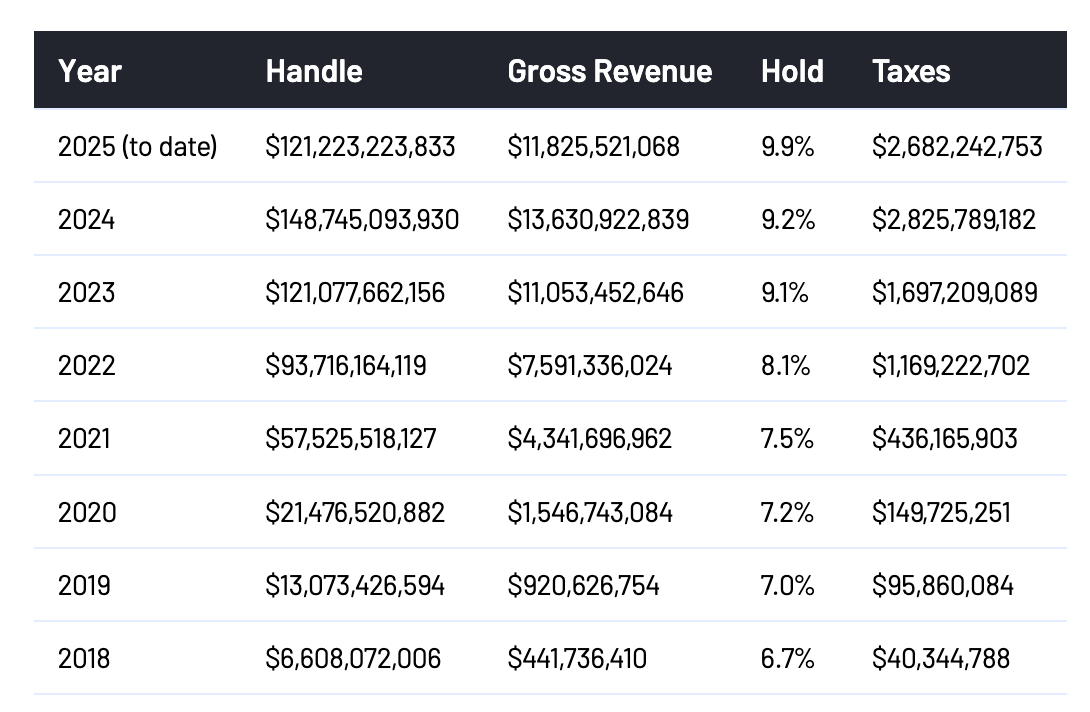
Statistics from another major sports betting media, Sports Book Review (chart below, data as of August 2025), show that since the regulatory relaxation in 2018, the total betting volume (Handle) and tax revenue (Taxes) of the U.S. sports betting market have shown a remarkably exaggerated growth trend over the past few years — the total market betting volume reached $148.74 billion in 2024, with tax contributions reaching $2.82 billion; in the first 8 months of 2025 alone, the total betting volume ($121.22 billion) and tax revenue ($2.68 billion) have nearly reached the full-year 2024 levels.
Focus on Tennessee: What Does Sports Betting Mean?

Now let's focus on Tennessee, the protagonist of this incident.

In 2019, Tennessee passed the Tennessee Sports Gaming Act, formally legalizing sports betting. Although the then-Governor Bill Lee had reservations about gambling, he still allowed the bill to pass without exercising his veto power. Between 2021 and 2022, the Tennessee state legislature passed laws establishing a dedicated regulatory council to be fully responsible for licensing and supervision. This council was initially called the Sports Wagering Advisory Council and was later renamed the Tennessee Sports Wagering Council, the SWC that issued the ban to Kalshi, Polymarket, and Crypto.com at the beginning of this article.
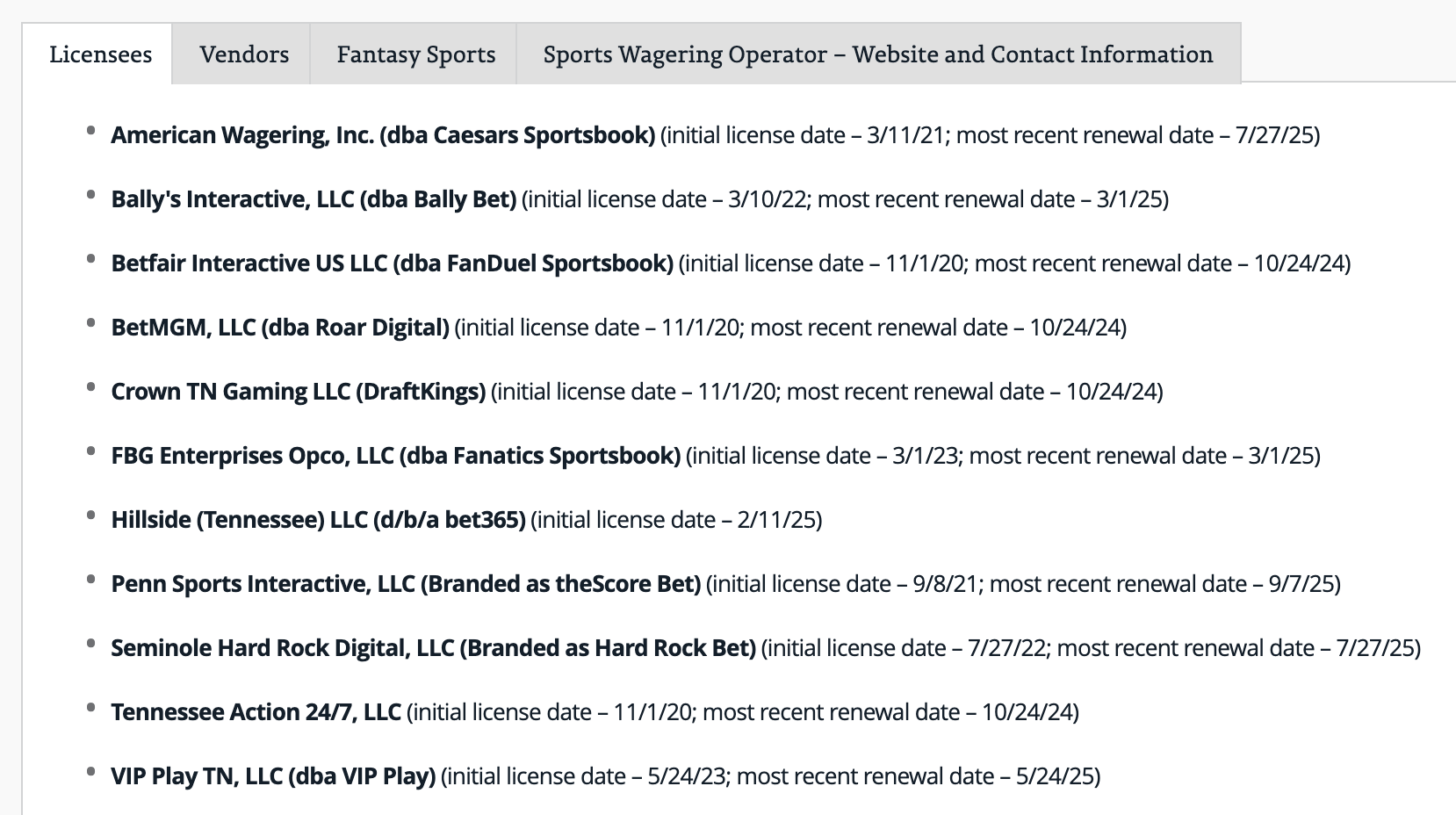
Currently, the SWC is Tennessee's sole sports betting regulatory body, responsible for operational licensing, compliance supervision, rule-making, and enforcement. The SWC stipulates that all sports betting providers must obtain a license from the SWC to offer services in the state. A total of 11 licenses have been issued so far (see chart above); only residents aged 21 and over can access related services, and they must pass geolocation verification to ensure bets are placed within the state. Regarding taxation, the state levies a 1.85% tax rate on the total betting handle — an income-based taxation scheme was used initially, but it was changed to taxation based on the total betting handle after 2023.

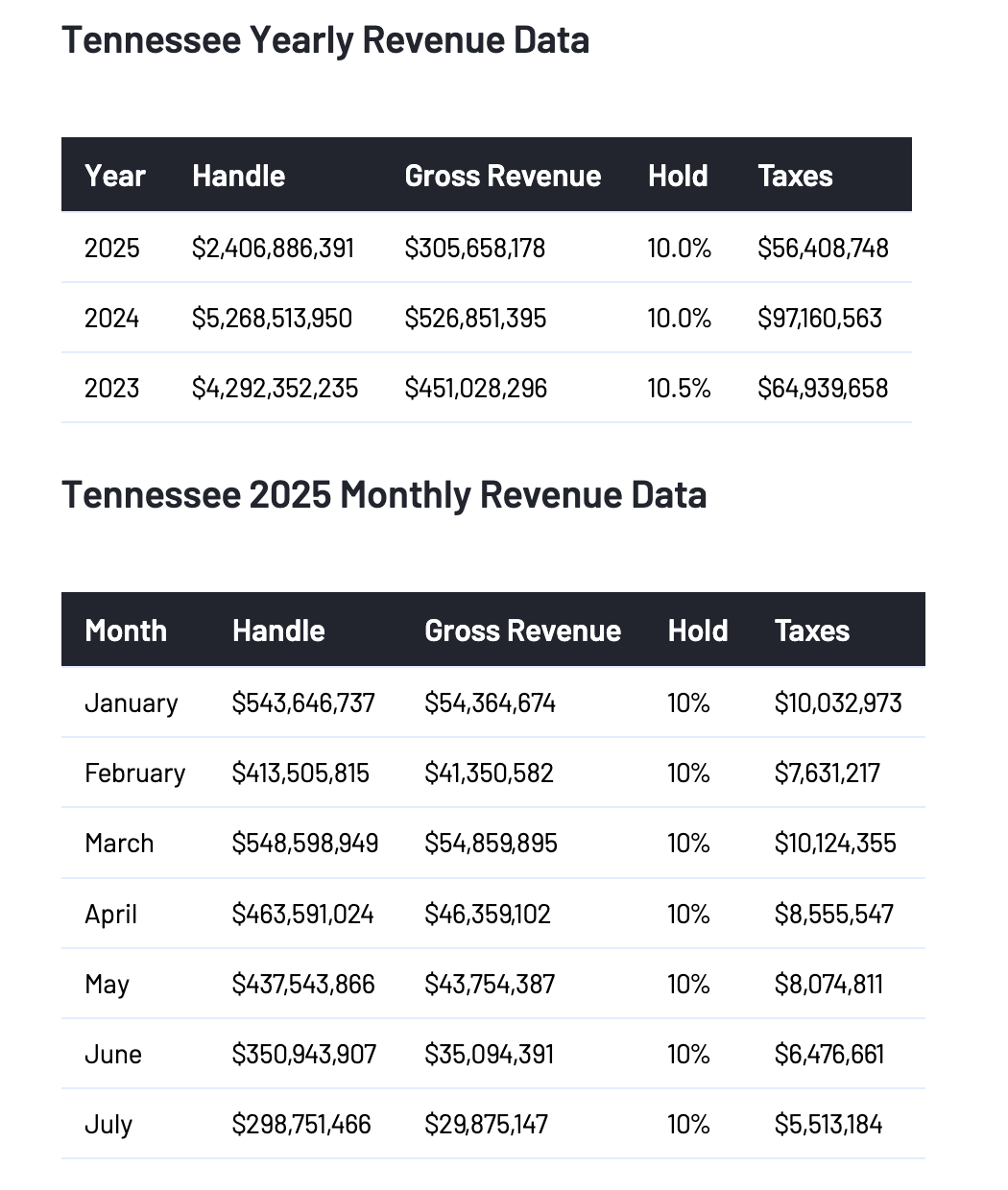
The sports betting market has contributed substantial tax revenue to Tennessee. Statistics from Sports Book Review (chart below, data as of July 2025) show that in 2024, the total sports betting handle in Tennessee reached $5.268 billion, with tax contributions reaching $97.16 million; the total betting handle for the first 7 months of 2025 has already reached $2.4 billion, with tax contributions reaching $56.4 million.
But this huge and still growing cake is now being gradually nibbled away by the likes of Polymarket.

How Are Prediction Markets Eating Into the Old World?

On December 3, 2025, Polymarket announced that it had obtained CFTC approval to return to the U.S. market after nearly four years; even earlier, Kalshi and Crypto.com's prediction market platform Truth Predict had already opened their doors to U.S. users under CFTC licensing.

The current regulatory situation is that sports betting is clearly classified as a gambling service, with regulatory authority belonging to the states. However, prediction market platforms like Polymarket are generally regarded as new entities providing "event contract" trading services, and "event contracts" are considered financial derivatives in terms of asset nature, falling under the regulatory purview of the CFTC. This allows prediction markets to bypass the stringent regulations of gambling services — no need for state-level licenses, no need to follow user protection regulations like addiction control, no need to pay high gambling taxes to the states; but at the same time, they can offer sports event outcome betting services similar to gambling,客观上 forming a certain "regulatory arbitrage."

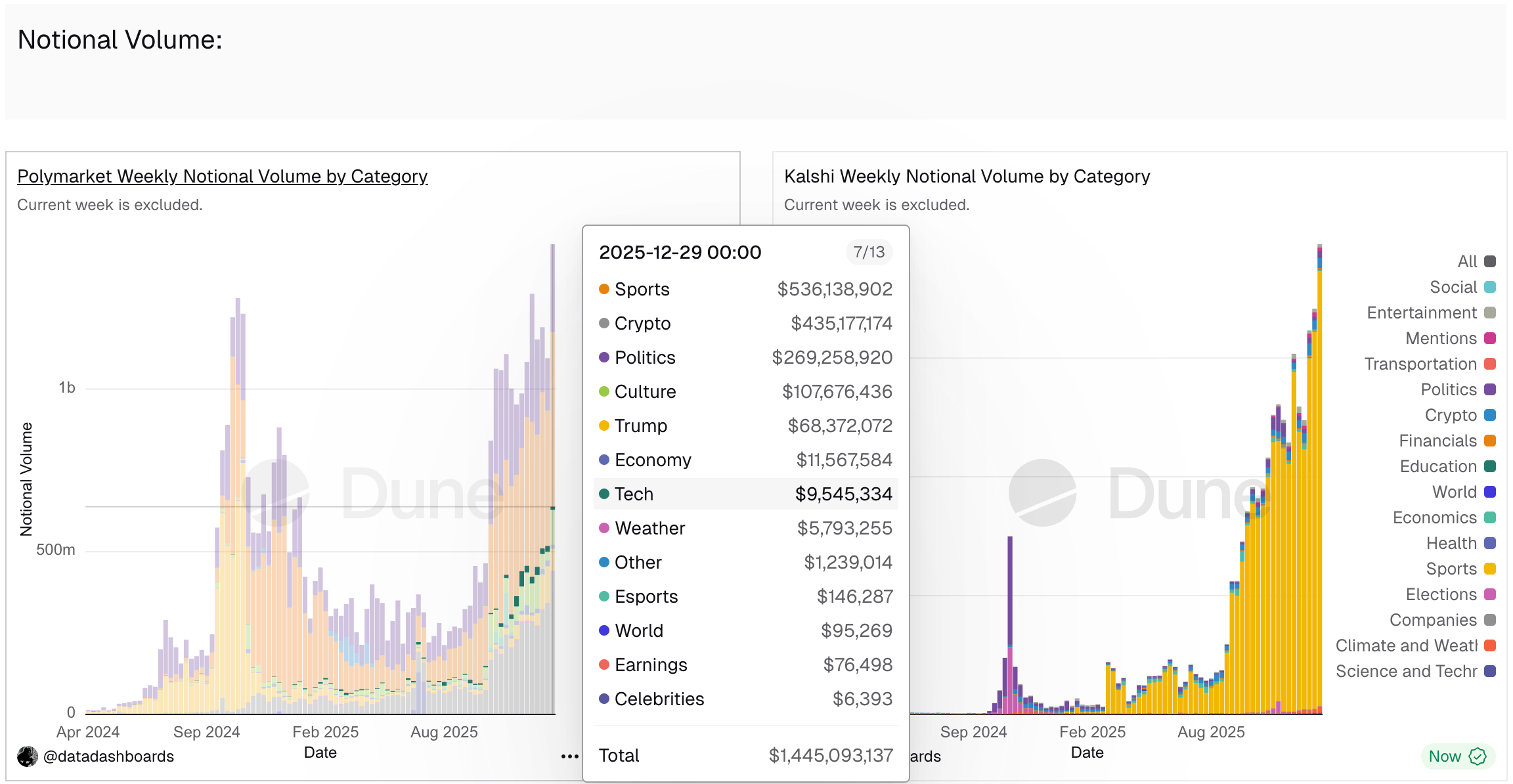
If prediction markets were still just small experimental fields, it might be one thing, but the fact is that the growth rate of prediction markets is even more outrageous than the already exaggerated sports betting market — in 2025, the total trading volume of prediction markets was approximately $40 billion, an increase of about 400% from $9 billion in 2024. A data dashboard compiled by Data Dashboards on Dune (chart below) shows that sports-related event contracts have long become the category with the highest trading volume share in the prediction market.
The capital market has long sensed the growing threat posed by Polymarket to traditional sports betting services. The two giants of the sports betting market, DraftKings and Flutter Entertainment, recorded declines of 11.7% and 16.1% respectively over the past year — during the same period, the US stock market was in a bull run, with the Dow Jones rising 12.97% for the year, the Nasdaq up 20.36%, and the S&P 500 up 16.39%; and the size of the sports betting market continued its eight-year upward trend.
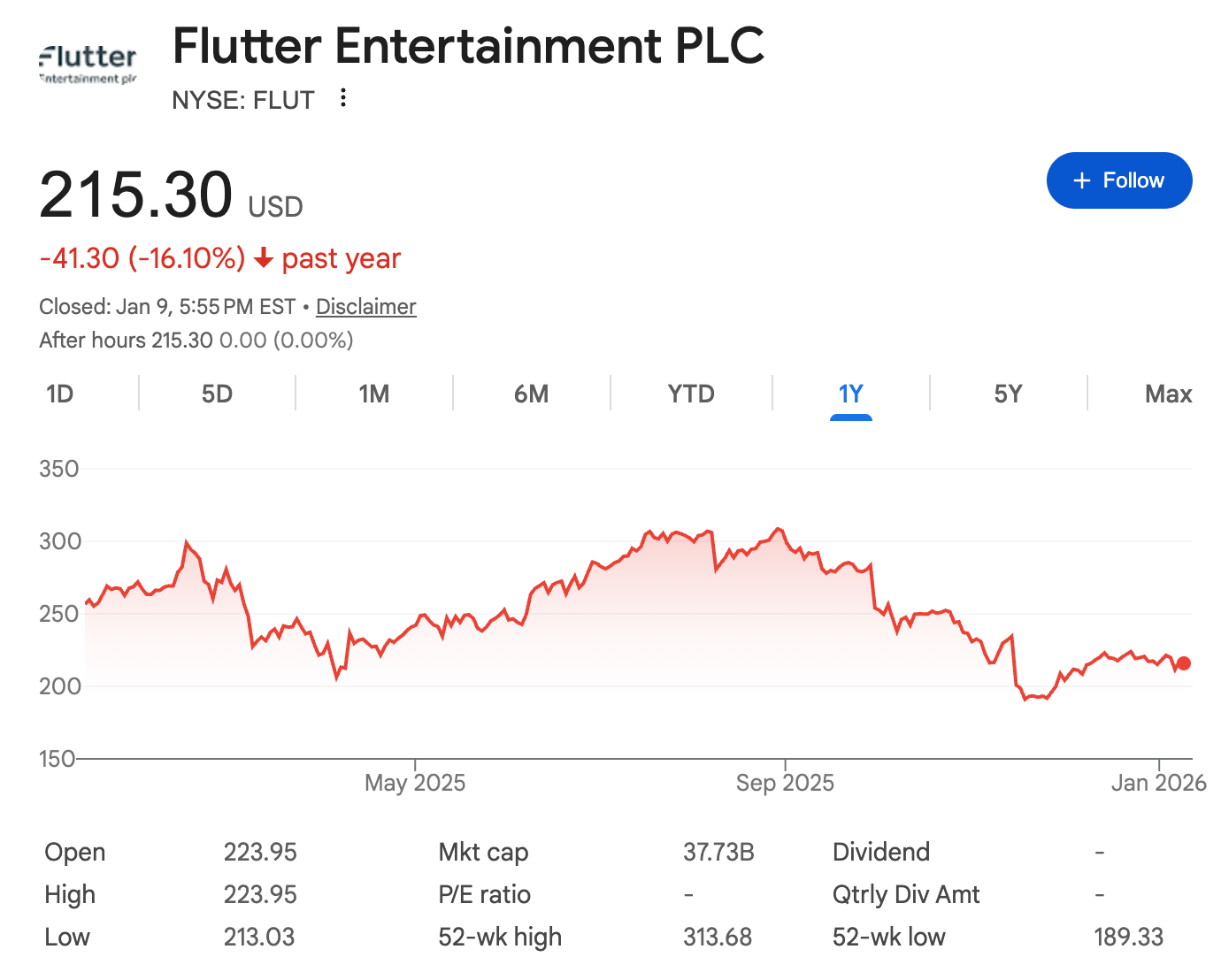
Whether it's Tennessee, which needs sports betting as a source of tax revenue, or the capital forces that actually control the sports betting market, it is difficult to agree to let prediction markets, this new player, come and share the pie.

Friction Is Not an Isolated Case, How Do Prediction Markets Fight Back?

In fact, Tennessee's ban on prediction markets is not an isolated incident. Maryland, Ohio, Illinois, New Jersey, Nevada, Montana, Michigan, and Connecticut have all cracked down on prediction markets for similar reasons. And since Polymarket only returned to the U.S. market last December, Kalshi has borne the brunt of more regulatory impacts.

In response, Kalshi has filed lawsuits against three states — Nevada, New Jersey, and Maryland — on the grounds that it "already complies with higher-priority federal regulations and does not need to comply with state-level regulations." But the results have not been ideal.

  • The lawsuit in Nevada was the first to proceed. The district court initially supported Kalshi, but then turned around and ruled against Kalshi last November. Judge Andrew Gordon determined that sports event contracts on Kalshi were very similar to sports betting wagers and therefore fell under the regulatory scope of Nevada's gambling laws. Kalshi has appealed to the U.S. Court of Appeals for the Ninth Circuit;

  • In New Jersey, the district court chose to support Kalshi, but the state's gambling regulatory agency has appealed to the U.S. Court of Appeals for the Third Circuit;

  • In Maryland, the district court sided with the gambling regulatory agency's demands. Judge Adam B. reasoned that Kalshi failed to prove that "Congress has clearly and manifestly intended to deprive states of their power to regulate gambling." Kalshi has appealed this to the U.S. Court of Appeals for the Fourth Circuit.

The law firm Benesch commented on this, stating that as the national debate continues, similar divisions are expected at the appellate court level, which will lay the groundwork for the Supreme Court to resolve this issue in the coming years...... If the appellate courts happen to consistently support Kalshi's position, other prediction markets might emulate its model and proceed with similar businesses before the Supreme Court hears the matter; but if the appellate courts reach different conclusions, companies in similar situations might wait for clearer legal signals before taking action. In any case, Kalshi's lawsuit will create a precedent with direct and profound implications for the national sports betting and gambling industry.

In summary, whether prediction markets need to follow state gambling regulations remains an unresolved question for now, and the fundamental contradiction of this issue lies in the similarity of products and services between prediction markets and sports betting and the differences in regulatory requirements.

This is a tug-of-war over institutional adaptation. Before the appellate courts or even the Supreme Court give a final verdict, the gray area between prediction markets and sports betting will persist for a long time, and regulatory conflicts will be hard to avoid. In the short term, states will likely continue to defend their regulatory authority and tax base through enforcement and litigation; while prediction market platforms will try to use federal compliance and innovation narratives as a shield to fight for more living space.


Twitter:https://twitter.com/BitpushNewsCN

Bitpush TG Discussion Group:https://t.me/BitPushCommunity

Bitpush TG Subscription: https://t.me/bitpush

Original article link:https://www.bitpush.news/articles/7601952

Preguntas relacionadas

QWhat is the main reason why the Sports Wagering Council (SWC) of Tennessee issued cease-and-desist orders to prediction market platforms like Kalshi, Polymarket, and Crypto.com?

AThe SWC issued the orders because these platforms were offering sports event prediction contracts to Tennessee residents without obtaining the required state license, which the state classifies as illegal gambling operations.

QHow has the legalization of sports betting in the United States since 2018 impacted the market's growth?

ASince the Supreme Court overturned the federal ban on commercial sports betting in 2018, the market has grown significantly, with the total handle reaching $148.74 billion in 2024 and tax contributions amounting to $2.82 billion that year.

QWhat regulatory advantage do prediction market platforms like Polymarket have over traditional sports betting services in the United States?

APrediction market platforms are regulated by the CFTC as 'event contracts,' which are classified as financial derivatives, allowing them to operate without needing state-level gambling licenses, adhering to strict user protection rules, or paying high state gambling taxes.

QWhich states, besides Tennessee, have taken regulatory action against prediction market platforms for similar reasons?

AOther states that have taken action include Maryland, Ohio, Illinois, New Jersey, Nevada, Montana, Michigan, and Connecticut, all citing similar concerns about unlicensed gambling operations.

QWhat was the outcome of Kalshi's legal challenges against state gambling regulators in Nevada, New Jersey, and Maryland?

AIn Nevada, Kalshi initially had some support but ultimately lost in district court and has appealed; in New Jersey, the district court supported Kalshi, but the state has appealed; in Maryland, the district court sided with the regulator, and Kalshi has appealed the decision.

Lecturas Relacionadas

Descifrando la verdad sobre los negocios, pagos e infraestructura de los Agentes

**Resumen: La realidad del comercio, los pagos y la infraestructura de los Agentes** El artículo, basado en un año de trabajo en la infraestructura para la economía de Agentes, sostiene que la demanda real actual es mínima y existen importantes obstáculos estructurales. Se examinan cuatro categorías: 1. **Agente-Comercio (B2C):** La experiencia de compra conversacional actualmente no supera al comercio electrónico tradicional para la mayoría de productos, especialmente los visuales. Existe demanda defensiva de comerciantes (optimización para Agentes), pero no es crítica. Las oportunidades están en compras de baja fricción (como pedir comida) o en navegar interfaces complejas, pero requieren una distribución masiva, dominio de grandes plataformas. 2. **Agente-API (B2B):** El uso actual de APIs es recurrente y se maneja con prepago y suscripciones. El mercado de nicho de servicios de cola larga es adecuado para nuevos protocolos de pago, pero es pequeño. Las grandes empresas SaaS prefieren contratos corporativos, y la distribución favorece a los gigantes existentes. 3. **Agente-Agente:** Es una visión a largo plazo, actualmente teórica y sin volumen comercial significativo. Cuando se materialice, requerirá una infraestructura de liquidación dedicada por su velocidad, escala y naturaleza multipartita. 4. **Agente-Finanzas:** Es la categoría con demanda existente, ya que se integra naturalmente en flujos de trabajo financieros actuales y crea nuevas capacidades. Sin embargo, el sector está altamente regulado y dominado por empresas establecidas. **Conclusión clave:** Los gigantes construyen de forma defensiva por su gran capital, pero las startups deben centrarse en dónde está el mercado real ahora. El verdadero reto no es el pago, sino la **coordinación** entre Agentes y humanos para verificar el trabajo y liquidar resultados. Quienes resuelvan la coordinación se llevarán la parte principal del pastel, no al revés. La autora señala que su trabajo las ha dirigido hacia un área de mercado activa y de rápido crecimiento fuera de estas cuatro categorías.

marsbitHace 3 min(s)

Descifrando la verdad sobre los negocios, pagos e infraestructura de los Agentes

marsbitHace 3 min(s)

El mercado de valores de EE.UU. sufre la caída más severa desde 2025: tres catalizadores desatan una revaluación de las valoraciones de las acciones tecnológicas

El 5 de junio, el mercado bursátil estadounidense sufrió su peor caída desde la crisis arancelaria de abril de 2025. El Nasdaq se desplomó un 4.18%, el S&P 500 un 2.64% y el Dow Jones 695 puntos. Tres factores clave impulsaron la brusca reevaluación de las valoraciones de las acciones tecnológicas. Primero, los resultados del segundo trimestre fiscal de 2026 de Broadcom, aunque mostraron fuertes ingresos por chips de IA, ofrecieron una guía para el próximo trimestre ligeramente inferior a las expectativas, sembrando dudas sobre la supuesta tasa de crecimiento ilimitada de la IA y desencadenando una venta masiva en todo el sector de semiconductores. Segundo, el informe de empleo de mayo superó ampliamente las previsiones, agregando 172,000 puestos. Esto reforzó los temores de que la Reserva Federal podría no solo posponer los recortes de tasas, sino incluso considerar un aumento, comprimiendo las valoraciones de las acciones de crecimiento sensibles a las tasas de interés. Tercero, la sombra inflacionaria de la guerra en Irán y el bloqueo persistente del Estrecho de Ormuz mantienen los precios del petróleo altos (WTI por encima de $90), complicando la política monetaria de la Fed. Juntos, estos eventos sacudieron los pilares narrativos del mercado: el crecimiento exponencial de la IA, las expectativas de liquidez de la Fed y el control de la inflación. La caída se propagó a los mercados globales y a las criptomonedas. Más que el estallido de una burbuja, esto parece una corrección y una reevaluación de las valoraciones extremas. La atención se centra ahora en la próxima reunión de la Fed, los próximos informes de empresas de IA y la evolución geopolítica para determinar la dirección del mercado.

marsbitHace 4 hora(s)

El mercado de valores de EE.UU. sufre la caída más severa desde 2025: tres catalizadores desatan una revaluación de las valoraciones de las acciones tecnológicas

marsbitHace 4 hora(s)

Desde el Madison Square Garden hasta Kalshi: Los mercados de predicción invaden las Finales de la NBA

Autor: Zen, PANews El 6 de junio, los New York Knicks vencieron 105-104 a San Antonio Spurs en el segundo partido de las Finales de la NBA, tomando una ventaja de 2-0. Esta inesperada racha ha desatado una gran euforia en Nueva York, donde los precios de las entradas para los próximos partidos en el Madison Square Garden superan los $10,000. Esta final no es solo un evento deportivo, sino también una plataforma para los mercados de predicción como Kalshi y Polymarket. El volumen de negocios en mercados relacionados con el campeón de la NBA supera los $400 millones. Kalshi, ahora socio oficial del Madison Square Garden, ha ganado una gran exposición. Estos mercados también se usan en estrategias comerciales. Por ejemplo, el bar The Jeffrey en Manhattan prometió bebidas gratis si los Knicks ganaban, cubriendo el riesgo potencial comprando contratos en Kalshi. Esto muestra cómo los mercados de predicción pueden actuar como herramientas de cobertura para negocios. Aunque similares a las apuestas deportivas tradicionales, estos mercados amplían los temas, permitiendo operar sobre eventos relacionados como la asistencia de celebridades. También tienen un alcance geográfico y de edad más amplio en EE.UU., lo que genera debates regulatorios sobre si son juegos de azar o productos financieros. La NBA aborda este fenómeno con cautela. El comisionado Adam Silver comparó estos mercados con las casas de apuestas. Si bien permite pequeñas inversiones de jugadores, como la de Giannis Antetokounmpo en Kalshi, la liga pide un marco regulatorio sólido para proteger la integridad del juego, reflejando la preocupación de algunos aficionados sobre posibles conflictos de interés. Las Finales de la NBA se han convertido en una prueba para la integración de los mercados de predicción en el deporte profesional.

marsbitHace 6 hora(s)

Desde el Madison Square Garden hasta Kalshi: Los mercados de predicción invaden las Finales de la NBA

marsbitHace 6 hora(s)

Trading

Spot
Futuros

Artículos destacados

Cómo comprar CAKE

¡Bienvenido a HTX.com! Hemos hecho que comprar PancakeSwap (CAKE) sea simple y conveniente. Sigue nuestra guía paso a paso para iniciar tu viaje de criptos.Paso 1: crea tu cuenta HTXUtiliza tu correo electrónico o número de teléfono para registrarte y obtener una cuenta gratuita en HTX. Experimenta un proceso de registro sin complicaciones y desbloquea todas las funciones.Obtener mi cuentaPaso 2: ve a Comprar cripto y elige tu método de pagoTarjeta de crédito/débito: usa tu Visa o Mastercard para comprar PancakeSwap (CAKE) al instante.Saldo: utiliza fondos del saldo de tu cuenta HTX para tradear sin problemas.Terceros: hemos agregado métodos de pago populares como Google Pay y Apple Pay para mejorar la comodidad.P2P: tradear directamente con otros usuarios en HTX.Over-the-Counter (OTC): ofrecemos servicios personalizados y tipos de cambio competitivos para los traders.Paso 3: guarda tu PancakeSwap (CAKE)Después de comprar tu PancakeSwap (CAKE), guárdalo en tu cuenta HTX. Alternativamente, puedes enviarlo a otro lugar mediante transferencia blockchain o utilizarlo para tradear otras criptomonedas.Paso 4: tradear PancakeSwap (CAKE)Tradear fácilmente con PancakeSwap (CAKE) en HTX's mercado spot. Simplemente accede a tu cuenta, selecciona tu par de trading, ejecuta tus trades y monitorea en tiempo real. Ofrecemos una experiencia fácil de usar tanto para principiantes como para traders experimentados.

388 Vistas totalesPublicado en 2024.12.11Actualizado en 2025.03.21

Cómo comprar CAKE

Discusiones

Bienvenido a la comunidad de HTX. Aquí puedes mantenerte informado sobre los últimos desarrollos de la plataforma y acceder a análisis profesionales del mercado. A continuación se presentan las opiniones de los usuarios sobre el precio de CAKE (CAKE).

活动图片













