$11 Million Crypto Vanishes In San Francisco Fake-Delivery Heist

bitcoinistPublicado a 2025-11-25Actualizado a 2025-11-25

Resumen

A staged fake-delivery encounter in San Francisco’s Mission Dolores district escalated into one of the city’s largest known individual crypto...

Trusted Editorial content, reviewed by leading industry experts and seasoned editors. Ad Disclosure

A staged fake-delivery encounter in San Francisco’s Mission Dolores district escalated into one of the city’s largest known individual crypto thefts, after a disguised assailant subdued a resident and escaped with assets worth $11 million, alongside the victim’s phone and laptop.

Mission Dolores Hit By $11M Crypto Robbery

According to a police report obtained by the San Francisco Chronicle, the Saturday evening robbery unfolded in broad daylight on the unit block of Dorland Street, only steps from Mission Dolores Park—a neighborhood where tech proximity and high-value assets have increasingly intersected with targeted crime.

Home-security footage posted by Y Combinator CEO Garry Tan captured the moments leading up to the heist. In the video, the suspect approaches the residence wearing dark clothing, a hooded sweatshirt, gloves and sunglasses, and holding a white package while deliberately turning his head away from the camera.

He rings the doorbell and asks for “Joshua,” claiming the box is addressed to him. The ruse continues when the resident opens the door and confirms his name. The man posing as a courier asks whether the victim can “sign for this,” pats his own pocket as though searching for a pen, and then asks the resident if he has one.

The moment the victim steps inside to retrieve a pen, the intruder follows him into the home and moves out of frame. A loud noise is heard. Police later confirmed that the suspect brandished a firearm and bound the victim with duct tape before fleeing with his belongings. Officers arrived at approximately 6:45 p.m. and found the victim with non-life-threatening injuries. No arrests had been made as of Monday morning, and authorities have not disclosed details about how the $11 million in cryptocurrency was accessed or transferred.

Tan publicly acknowledged the incident on X, describing the victim as a friend and community member. He urged anyone in the neighborhood with security footage from 4:30 to 6 p.m. to contact the San Francisco Police Department. “We have to find the perpetrator,” Tan wrote. “Time is of the essence.”

The Big Risk Of Self-Custody

In a follow-up post referencing the crypto theft, Tan added a pointed observation about crypto asset security: “Self custody of crypto seems like a good idea until it isn’t. Vault storage (at Coinbase or elsewhere) for long term holding is safest.” His comments drew immediate attention from both the tech and crypto communities, highlighting the tension between self-custody principles and the physical-security risks of storing large private-key access at home.

Thus, the incident has reignites a longstanding debate about personal-security practices among high-net-worth crypto holders in urban settings. While hacks, phishing attacks, SIM swaps and insider compromise have dominated crypto asset crime over the past decade, physical-world robberies—once rare—have become increasingly sophisticated.

The San Francisco case stands out due to the scale of assets stolen, the execution of the ruse and the direct commentary from one of Silicon Valley’s most visible figures.

At press time, the total crypto market cap stood at $2.98 trillion.
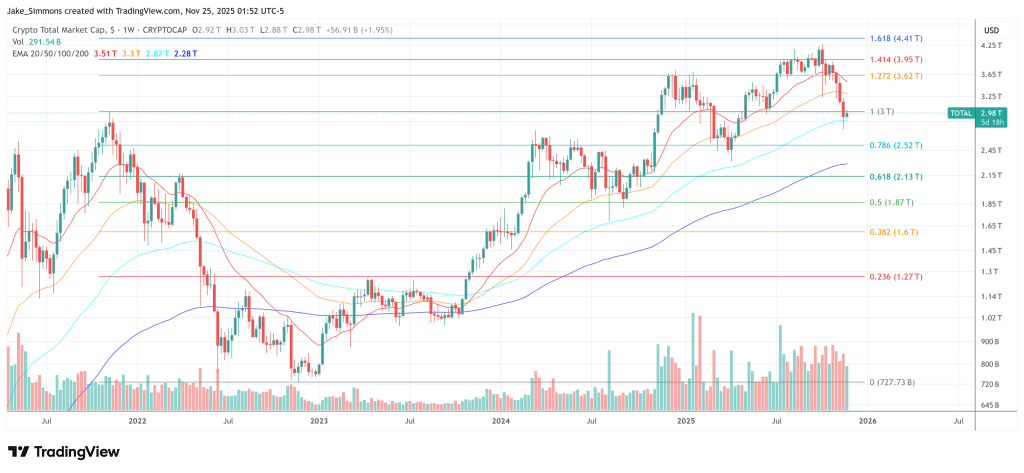
Total crypto market cap
Total crypto market holds above the 100-week EMA, 1-week chart | Source: TOTAL on TradingView.com
Featured image created with DALL.E, chart from TradingView.com
Editorial Process for bitcoinist is centered on delivering thoroughly researched, accurate, and unbiased content. We uphold strict sourcing standards, and each page undergoes diligent review by our team of top technology experts and seasoned editors. This process ensures the integrity, relevance, and value of our content for our readers.

Jake Simmons has been a Bitcoin enthusiast since 2016. Ever since he heard about Bitcoin, he has been studying the topic every day and trying to share his knowledge with others. His goal is to contribute to Bitcoin's financial revolution, which will replace the fiat money system. Besides BTC and crypto, Jake studied Business Informatics at a university. After graduation in 2017, he has been working in the blockchain and crypto sector. You can follow Jake on Twitter at @realJakeSimmons.

Lecturas Relacionadas

Un giro brusco tras ocho años de inversión: ¿Por qué Ethereum abandona repentinamente Poseidon?

Después de ocho años de investigación y millones de dólares invertidos, Ethereum abandona el algoritmo hash amigable con SNARK, Poseidon, en favor de funciones hash tradicionales como SHA2 o BLAKE2. Esta decisión, anunciada por el investigador Justin Drake, marca un cambio significativo en la hoja de ruta de la criptografía postcuántica de Ethereum. Poseidon, lanzado en 2019, era ideal para zkRollups y zkVMs por su eficiencia en circuitos SNARK. Sin embargo, su historial más corto y la creciente prioridad de la seguridad postcuántica revelaron sus limitaciones. Avances recientes en el diseño de SNARK, específicamente el uso de campos binarios, ahora permiten que las funciones hash tradicionales funcionen en circuitos SNARK con un rendimiento comparable, verificando millones de llamadas por segundo en un portátil. La urgencia viene dada por la amenaza cuántica. Informes predicen que las computadoras cuánticas podrían romper criptografía como ECDSA hacia 2030-2033, poniendo en riesgo billones de dólares en activos blockchain. Ethereum está acelerando su migración hacia esquemas postcuánticos basados en hash, considerados más resistentes. La hoja de ruta apunta a un leanVM de producción en 2027 y su despliegue completo en las capas de consenso, ejecución y datos en 2028. Otras blockchains como Solana y Starknet también están avanzando en sus propias transiciones postcuánticas, eligiendo esquemas como Falcon. Ethereum opta ahora por primitivas criptográficas más maduras y ampliamente analizadas, priorizando la seguridad a largo plazo sobre optimizaciones específicas.

marsbitHace 40 min(s)

Un giro brusco tras ocho años de inversión: ¿Por qué Ethereum abandona repentinamente Poseidon?

marsbitHace 40 min(s)

¡Programadores de todo el mundo le están regalando dinero a Anthropic! La empresa finalmente no puede soportarlo más

Anthropic acaba de publicar un blog revelando seis estrategias clave para que los desarrolladores ahorren costes significativos al usar Claude Code, ya que muchos están gastando innecesariamente en tokens. El costo proviene de los tokens de entrada (más baratos, procesados en paralelo) y salida (5 veces más caros, generados secuencialmente). La herramienta más poderosa es la **caché de prefijo**, que reduce el coste de releer el historial idéntico en un 90%. Sin embargo, acciones como cambiar de modelo (`/model`), ajustar el esfuerzo (`/effort`), comprimir (`/compact`) o dejar pasar el tiempo invalidan esta caché, disparando el coste. El historial de la conversación crece cuadráticamente (O(n²)) porque cada nuevo mensaje reenvía todo lo anterior. Para combatirlo, Anthropic recomienda: 1. **`/clear` al cambiar de tarea** para no arrastrar contexto irrelevante. 2. **Definir modelo y esfuerzo al inicio** y no cambiarlos. 3. **Usar `@` para adjuntar archivos** directamente, evitando búsquedas costosas. 4. **Usar flags `--quiet` en comandos ruidosos** (ej: tests) para minimizar la salida. 5. **Hacer `/compact` mientras la caché está activa** (coste reducido). 6. **Usar subagentes para tareas con mucha salida**, aislando el proceso en una ventana aparte. Dominar estas técnicas—elegir el modelo correcto, gestionar el contexto y preservar la caché—se está convirtiendo en una habilidad esencial para los desarrolladores, permitiendo hacer más con el mismo presupuesto en la era de la IA.

marsbitHace 2 hora(s)

¡Programadores de todo el mundo le están regalando dinero a Anthropic! La empresa finalmente no puede soportarlo más

marsbitHace 2 hora(s)

Pax Silica contra WAICO: EE.UU. quiere prohibir a Europa usar inteligencia artificial china

Estados Unidos exige a sus socios europeos y globales que abandonen las iniciativas chinas en inteligencia artificial, amenazando con expulsarlos de su alianza tecnológica Pax Silica, según un borrador filtrado del Departamento de Estado. La advertencia, dirigida a los 35 signatarios de la "Declaración sobre Oportunidades de IA" (junio 2026), establece una lealtad exclusiva y apunta claramente a China, aunque no la nombre. Esta presión obliga a los países, especialmente a los europeos que buscan autonomía estratégica, a elegir entre el ecosistema tecnológico occidental liderado por EE.UU. y las alternativas. Paralelamente, China, Rusia y otros 27 países fundaron en julio de 2026 la Organización Mundial para la Cooperación en Inteligencia Artificial (WAICO), con sede en Shanghái, presentándola como una plataforma de gobernanza global independiente. Este movimiento crea una arquitectura internacional rival, arriesgando la fragmentación del espacio tecnológico mundial en dos bloques con estándares potencialmente incompatibles. La situación marca una transición de la competencia de mercado a la confrontación geopolítica, donde la tecnología es el principal instrumento de influencia. La elección de los países entre Pax Silica y WAICO configurará la economía digital global durante décadas, priorizando la soberanía tecnológica sobre la eficiencia económica y forzando a las empresas a dividir sus cadenas de suministro según líneas políticas.

cryptonews.ruHace 4 hora(s)

Pax Silica contra WAICO: EE.UU. quiere prohibir a Europa usar inteligencia artificial china

cryptonews.ruHace 4 hora(s)

Trading

Spot
活动图片