Key Highlights
- Governor Miran said rising global demand for dollar-based stablecoins could pull more money into the U.S. Treasury. If that continues, borrowing costs may edge lower and the Fed may need to reassess what it considers a “normal” long-term interest rate.
- Stablecoins are being adopted in countries where banking access is limited or local currencies are unstable. Miran noted that this international use could become a key driver of dollar flows, rather than U.S. domestic demand.
- The stablecoin market has climbed back to over $300 billion after earlier contractions. Tether remains dominant, while usage continues in trading, DeFi, and cross-border payments.
A growing wave of demand for dollar-backed stablecoins could shape future U.S. interest rate decisions, according to U.S. Federal Reserve Governor Stephen Miran. He delivered the remarks at the BCVC Summit 2025 held at the Harvard Club in New York on November 7, 2025.
Miran explained that rising global use of stablecoins might increase demand for U.S. Treasury. Hence, borrowing costs could move lower. He linked this trend directly to the neutral rate, known as r*, which guides long-term monetary policy decisions. Miran argued that stablecoins “may become a multitrillion-dollar elephant in the room for central bankers” if current growth patterns continue.
Stablecoins function as digital tokens pegged to a specific asset, such as the U.S. dollar. They make it easier and less costly to send money across borders. Miran noted that this fits with the strong worldwide demand for using dollars.
Moreover, the passage of the GENIUS Act this year provided a regulated framework for U.S.-based stablecoin issuers. Hence, they must now maintain full reserves in safe and liquid dollar assets. This rule increases credibility, attracts broader users, and connects stablecoins further into mainstream finance.
Expanding dollar access through stablecoins
Miran highlighted how stablecoins help people in emerging and developing economies access dollars more easily. Unreliable financial systems and capital controls are problems in many nations. As a result, it is frequently difficult for people and companies to hold or deal in stable value currencies. Stablecoins move on blockchain networks, which operate across borders without traditional banking roadblocks. Besides, adoption could accelerate where local currencies suffer from inflation and volatility.
He explained that demand for these tokens could increasingly come from abroad rather than the U.S. market. Users in the U.S. already access insured deposits and yield-bearing assets. However, savers in countries with strict financial controls often cannot. Stablecoins provide a new channel for saving and transacting in dollars. Therefore, global demand may expand the amount of capital seeking U.S. Treasury bills and other short-term dollar assets.
Effects on the neutral rate and Treasury demand
Miran said stablecoin issuers will likely hold reserves in Treasurys, repos, or government money market funds. Consequently, demand for these assets increases. He compared the situation to the “global saving glut” that former Fed Chair Ben Bernanke talked about in the early 2000s.
Back then, a lot of money from overseas flowed into U.S. investments, which helped push long-term interest rates down. Miran said stablecoins could create a similar effect today, just on a smaller scale, by drawing more global money into U.S. Treasury markets.
Fed researchers think stablecoins could grow to between $1 trillion and $3 trillion by 2030, and some experts believe the number could go even higher. Miran pointed out that if stablecoins become widely used, they could push interest rates down by as much as 0.40%. That means the Fed may eventually need to rethink how it sets interest rates, because the “normal” level could end up being lower than it is today.
Current stablecoin market trends
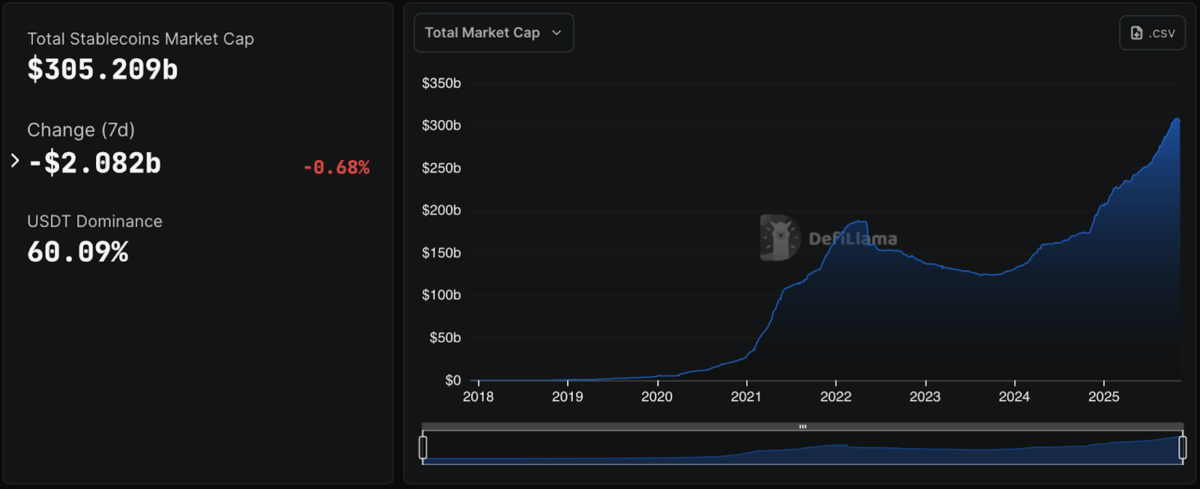
According to DefiLlama, the total stablecoin market currently stands near $305.2 billion. The market dipped slightly in the past week, but long-term expansion persists. Tether (USDT) controls around 60% of the total supply.
The stablecoin market grew sharply during the 2020–2021 crypto boom, contracted in 2022, and regained momentum from mid-2023 onward. The growth in this sector keeps rising as usage of stablecoins continues across trading markets, decentralized finance, and cross-border payments.

Stablecoins are no longer just a crypto trend. They’re starting to shape how money moves across countries. As more people around the world use dollar-backed stablecoins, it is more likely for the U.S. to consider key-policy updates favoring interest while managing the broader financial system.
Also Read: India’s Gujarat CID Busts ₹200 Cr Crypto Racket Linked to Pakistan