EU Plans Transfer Of Crypto, Stocks Oversight Power To Address Market Fragmentation – ESMA Chair

bitcoinistPublicado a 2025-10-07Actualizado a 2025-10-07

Resumen

The European Union (EU) is reportedly planning to shift oversight power of key financial market areas, including crypto, from national...

Trusted Editorial content, reviewed by leading industry experts and seasoned editors. Ad Disclosure

The European Union (EU) is reportedly planning to shift oversight power of key financial market areas, including crypto, from national authorities to a centralized supervisory authority to help boost the bloc’s capital markets and harmonize regulation.

EU Eyes Centralized Crypto Market Oversight

On Monday, Verena Ross, chair of the European Securities and Markets Authority (ESMA), affirmed that the regulation of stock exchanges, crypto companies, and clearing houses in the EU will likely be transferred to the bloc’s market watchdog.

Ross told the Financial Times that the European Commission is preparing new rules that would shift the supervision of several areas of EU financial markets from national authorities to ESMA, to push for “a capital market in Europe that is more integrated and globally competitive.”

Last month, the EU commissioner for financial services, Maria Luís Albuquerque, shared they were “considering a proposal to transfer supervisory powers to Esma for the most significant cross-border entities,” including crypto companies.

“All of this would imply changes to the governance and decision-making processes of Esma, and we have various models to consider based on other existing models of centralised supervision,” said Albuquerque.

The change aims to address the continued fragmentation in markets to “create more of a single market for capital in Europe,” the ESMA chair stated, arguing that “while we are doing a lot of work to try to make sure the implementation of MiCA is aligned, it clearly takes a lot of effort from us and the national supervisors to achieve that.”

“It also means that people had to build up specific new resources and expertise 27 times in different national supervisors, which could have been done more efficiently once at a European level,” she added.

Single Supervisor Proposal Faces Backlash

Notably, the EU first proposed making ESMA the main supervisory agency of Crypto Asset Service Providers (CASP) during the development of its Markets in Crypto-Assets Regulation (MiCA).

The plan received backlash from smaller EU nations, such as Luxembourg, Ireland, and Malta, which criticized the watchdog’s ability to oversee the fast-growing crypto market and feared it could undermine their flourishing financial sectors.

As a result, the supervision of these markets was left in the hands of the 27 national authorities, which Ross considers has created inefficiencies. She explained that the Paris-based authority has “tried for quite some time with the capital markets union and other initiatives to build a more effective capital market,” but “the reality has been that it is not easy to do given we have very different market structures.”

In July, ESMA raised concerns about Malta’s process for approving pan-EU licenses for crypto companies, arguing that “some risk areas were not adequately assessed during the authorisation process.”

As reported by Bitcoinist, the bloc watchdog’s Peer Review Committee (PRC) conducted a review of Malta’s Financial Services Authority (MFSA) CASP authorization process, finding the national regulator only “partially met expectations,” despite having adequate staffing and technical infrastructure.

At the time, ESMA stressed that the concerns extended beyond Malta and urged all EU competent authorities to align their oversight mechanisms to ensure consistency under MiCA’s regulatory regime.

Last year, former European Central Bank President Mario Draghi identified transforming ESMA into a single common regulator for all the bloc’s securities markets, similar to the US Securities and Exchange Commission (SEC), as a “key pillar” to boost European capital markets.

Since then, the European watchdog has been granted greater powers. The regulator will oversee new providers of consolidated tapes for equity and bond prices, and agencies that provide environmental, social, and governance ratings starting in 2026.

However, Claude Marx, Director General of Luxembourg’s financial watchdog, considers that a single financial regulator would turn into a “monster.” “It is a fantasy that the European Commission wants to push a single supervisor,” Marx stated in June.

“The European Commission has always stated they do not have an idée fixe to have a European SEC,” he argued, adding that there remain several barriers to providing financial services across European borders.
crypto, bitcoin, btc, btcusdt

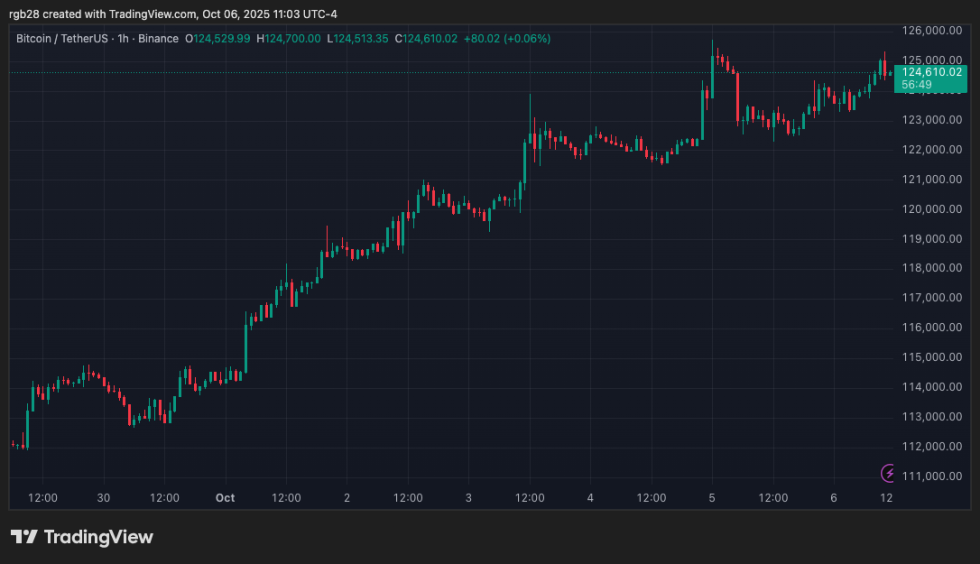
Bitcoin (BTC) trades at $124,610 in the one-week chart. Source: BTCUSDT on TradingView
Featured Image from Unsplash.com, Chart from TradingView.com
Editorial Process for bitcoinist is centered on delivering thoroughly researched, accurate, and unbiased content. We uphold strict sourcing standards, and each page undergoes diligent review by our team of top technology experts and seasoned editors. This process ensures the integrity, relevance, and value of our content for our readers.

Rubmar is a crypto enthusiast who likes learning and improving constantly. She enjoys reporting on the latest news and developments in the crypto industry. Rubmar also enjoys scrapbooking, crafting, simulation games, and watching football.

Lecturas Relacionadas

Hyperliquid, la tienda de conveniencia para operaciones de Wall Street las 24 horas

Hyperliquid, una plataforma de negociación descentralizada y de código abierto, opera las 24 horas del día, los 7 días de la semana, convirtiéndose en el destino preferido para los traders de Wall Street, especialmente durante los fines de semana cuando los mercados tradicionales están cerrados. Su fundador, Jeff Yan, ex trader cuantitativo, creó la plataforma tras el colapso de FTX, con el objetivo principal de que los usuarios custodien sus propios activos. La plataforma ofrece una amplia gama de contratos perpetuos con alto apalancamiento, que cubren desde criptomonedas como Bitcoin hasta índices bursátiles (S&P 500), materias primas (petróleo) e incluso empresas no cotizadas como SpaceX. Un ejemplo notable es el de un trader de fondos de cobertura que obtuvo un retorno del 243% operando derivados del petróleo durante una escalada de tensión geopolítica. A pesar de que los usuarios estadounidenses tienen prohibido oficialmente el acceso, muchos operan a través de VPN. La CFTC de EE. UU. ha comenzado a establecer un marco regulatorio para los contratos perpetuos, lo que podría cambiar el panorama. La plataforma, respaldada por una empresa de solo 11 empleados, generó unos 800 millones de dólares en ingresos el año pasado, y su token nativo, HYPE, tiene una capitalización de mercado de unos 160.000 millones. Su atractivo radica en su interfaz sencilla, su vibrante comunidad en línea (con memes como el gato Hypurr) y la transparencia de su sistema, que funcionó sin problemas durante una volatilidad extrema del mercado que provocó liquidaciones por valor de 100.000 millones de dólares solo en Hyperliquid. Los críticos advierten sobre los riesgos de los complejos contratos perpetuos para los inversores minoristas. Los planes futuros de Hyperliquid incluyen la expansión hacia mercados de predicción y opciones.

marsbitHace 5 min(s)

Hyperliquid, la tienda de conveniencia para operaciones de Wall Street las 24 horas

marsbitHace 5 min(s)

¿Quién financia a los agentes?

En marzo, OpenAI eliminó una función que permitía a los agentes de IA realizar compras por los usuarios, ya que en cinco meses solo 30 tiendas de Shopify la habían usado. El problema no era la infraestructura de pago, sino la falta de normas claras sobre qué podían comprar los agentes, impuestos, fraude o devoluciones. Esto abre una oportunidad en la economía de los agentes. Aunque en el último año los agentes de IA manejaron transacciones por 73 millones de dólares, McKinsey prevé que para 2030 podrían facilitar entre 3 y 5 billones en comercio global. El valor ya no está solo en procesar pagos (donde las comisiones tradicionales son inviables para transacciones promedio de 0,31$), sino en la capa de gobernanza: controles de gasto, verificación de identidad, políticas y auditoría. Empresas como Stripe y Coinbase están compitiendo por dominar esta capa. Stripe, por ejemplo, adquirió Privy para gestionar carteras y aplicar normas antes de que los fondos se muevan. Quien controle la gobernanza podrá establecer reglas, aprobar accesos y cobrar tarifas por ello. Se estima que, para un volumen de 3 billones, incluso una pequeña tarifa de gobernanza del 0,1% generaría unos 30.000 millones anuales. La integración vertical en varias capas (cartera, liquidación, gobernanza) será clave para competir, permitiendo ingresos por saldos inactivos, tarifas de transacción y por aplicar políticas.

marsbitHace 32 min(s)

¿Quién financia a los agentes?

marsbitHace 32 min(s)

Trading

Spot
Futuros
活动图片