Analyst Says XRP Price Remains Bullish As This Level Holds

bitcoinistPublicado a 2025-10-01Actualizado a 2025-10-02

Resumen

XRP’s price action in the final days of September was turbulent, with the cryptocurrency slipping below the $2.80 zone in...

Trusted Editorial content, reviewed by leading industry experts and seasoned editors. Ad Disclosure

XRP’s price action in the final days of September was turbulent, with the cryptocurrency slipping below the $2.80 zone in a market-wide pullback. Despite the sharp drop, XRP managed to defend a key support level near $2.72, bouncing from that mark on September 26. This recovery, though modest, has led to new analysis suggesting that as long as this support holds, XRP could be positioned to lead the next rally in the market.

$2.72 Support Is The Line In The Sand

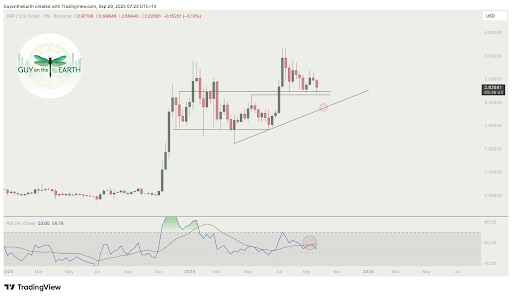
Technical analysis of XRP’s weekly candlestick timeframe chart shows that the cryptocurrency’s outlook is now bullish after holding up above an important level. This analysis, which was shared on the social media platform X, predicted that as long as this support holds, XRP could be positioned to lead the next rally for the entire crypto market.

The analyst noted the importance of the $2.72 level as an important support level that XRP has held up. This is in relation to how the XRP price broke below $2.8 last week. After crashing below $2.8, XRP managed to hold above $2.72, rebounding on it on September 26. Now, this move is what made XRP to be bullish. 
XRP
Source: Chart from Guyon on X

According to the analyst, the successful defense of this support, followed by a close back above $2.80, has created the conditions for a slight bullish divergence. The weekly chart supports this view, showing that XRP has consistently rebounded on higher lows while maintaining a broader ascending structure. Holding $2.72 prevents a breakdown of this pattern and keeps the longer-term uptrend intact.

XRP’s Strength Against The Market

Even in the face of the recent correction, the analysis pointed out that XRP is one of the stronger performers in the market. The chart comparison with XRP dominance (XRP.D) indicates that the token may have already bottomed in relative terms.

 According to the analyst, the XRP dominance bottoming means that the crypto can only start going up from here. This dominance means that XRP could play a leadership role if the broader crypto market begins to trend higher again.

Although the bullish case is worth noting, the analyst also warned against complacency among bullish traders. The start of a new week and month often brings volatility, and October could also start with some sort of volatility. 

As such, the XRP price could still experience a flush lower before any meaningful rally takes hold. However, this capitulation moment could be the final shakeout before XRP begins a stronger leg upward. 

The $2.72 support has become the line that separates the continuation of XRP’s bullish structure. As long as that level holds, the cryptocurrency’s outlook is bullish. At the time of writing, XRP is trading at $2.85, meaning that it has effectively registered a bullish close above $2.8.

XRP
XRP trading at $2.94 on the 1D chart | Source: XRPUSDT on Tradingview.com
Featured image from Getty Images, chart from Tradingview.com
Editorial Process for bitcoinist is centered on delivering thoroughly researched, accurate, and unbiased content. We uphold strict sourcing standards, and each page undergoes diligent review by our team of top technology experts and seasoned editors. This process ensures the integrity, relevance, and value of our content for our readers.

Scott Matherson is a leading crypto writer at Bitcoinist, who possesses a sharp analytical mind and a deep understanding of the digital currency landscape. Scott has earned a reputation for delivering thought-provoking and well-researched articles that resonate with both newcomers and seasoned crypto enthusiasts. Outside of his writing, Scott is passionate about promoting crypto literacy and often works to educate the public on the potential of blockchain.

Lecturas Relacionadas

Con la transición de los agentes de IA a gastos reales, XRP podría entrar en una nueva fase

Para XRP podría comenzar una nueva fase a medida que los agentes de IA pasan de comprar recursos digitales a realizar transacciones comerciales en el mundo real. Chandler Fang, cofundador de t54, explicó esta evolución, destacando que los agentes ya han procesado más de un millón de transacciones en XRP Ledger (XRPL) sin intervención humana. La primera etapa se centra en productos digitales, donde los agentes pueden pagar servicios en línea como API o recursos computacionales usando XRP o Ripple USD (RLUSD). La siguiente fase les dará límites de gasto controlados por los usuarios. Programas como "Agent Pay for Machines" de Mastercard, con socios como Ripple, Coinbase y Solana Foundation, amplían esto a facturas y transacciones automatizadas. El uso de XRP dependerá de las necesidades de liquidación: puede manejar pagos directos o liquidación final, mientras que RLUSD ofrece valor en dólares. Para transacciones recurrentes, se pueden usar canales de pago de XRP para agilizar el proceso. A largo plazo, la adopción de XRPL podría ser invisible: los agentes integrándose en plataformas empresariales y eligiendo infraestructuras blockchain en segundo plano. Las métricas clave no serán solo el volumen de transacciones, sino la actividad recurrente, los ingresos de los vendedores y la resolución eficiente de disputas. Fang compara este progreso con la llegada de ChatGPT: el trabajo en infraestructura se vuelve evidente solo cuando el producto alcanza una audiencia masiva.

cryptonews.ruHace 26 min(s)

Con la transición de los agentes de IA a gastos reales, XRP podría entrar en una nueva fase

cryptonews.ruHace 26 min(s)

Vitalik avanza hacia el 'mezclado local' conforme la serie de ofuscación alcanza su tercera fase

El viernes, Vitalik Buterin, cofundador de Ethereum, publicó la tercera parte de su serie sobre ofuscación criptográfica, explorando un método llamado "mezcla local" que descarta retículas y curvas elípticas, utilizando ideas del diseño de funciones hash. Buterin describió este enfoque como una forma radicalmente diferente de criptografía, sin curvas elípticas, factorización de números primos o retículas, y lo comparó con la criptografía simétrica que sustenta el cifrado y hashing diarios. El proceso comienza con un circuito lógico que pasa por un pipeline para garantizar una salida determinista mientras elimina cualquier rastro de lógica interna. Involucra pasos como hacer el circuito reversible, endurecerlo, mecanizarlo, mezclarlo y finalmente ofuscar su contenido, incluyendo agregar compuertas lógicas adicionales y reorganizar elementos. Buterin destacó que la reversibilidad es crucial, ya que permite reescribir compuertas lógicas de formas complejas. Aunque llamó a la mezcla local una "empresa salvaje y arriesgada", basada en intentos fallidos de criptografía de caja blanca, Buterin señaló que sus creadores argumentan que requiere más esfuerzo y tolerancia a mayores costos computacionales para ser viable. Sugirió que la inteligencia artificial podría acelerar su desarrollo, comprimiendo décadas de progreso en años. La ofuscación, descrita como el "último jefe" o "última frontera" de la criptografía, permite convertir un programa en una versión cifrada que oculta su código pero mantiene su funcionalidad. Combinada con blockchain, puede facilitar aplicaciones como votaciones privadas resistentes a colusiones sin depender de terceros de confianza.

cryptonews.ruHace 29 min(s)

Vitalik avanza hacia el 'mezclado local' conforme la serie de ofuscación alcanza su tercera fase

cryptonews.ruHace 29 min(s)

India ordena cerrar cientos de cuentas de Google Firebase utilizadas en fraudes bancarios

La agencia india de lucha contra el cibercrimen (I4C) ordenó a Google bloquear cientos de cuentas en su plataforma de desarrollo Firebase, tras rastrear numerosas aplicaciones bancarias falsas y sitios de phishing vinculados al servicio. En agosto, el I4C envió al menos tres notificaciones a Google identificando 57 sitios web y bases de datos en Firebase, utilizados para distribuir malware y robar datos financieros. Entre ellos, siete eran páginas de phishing que imitaban los portales de importantes bancos indios como State Bank of India, ICICI Bank y Axis Bank. El resto servían como puntos de recolección de información robada, como números de tarjetas de crédito y contraseñas de un solo uso. Los estafadores crearon malware para Android disfrazado de aplicaciones bancarias legítimas, atrayendo a las víctimas con ofertas de nuevas tarjetas de crédito, recompensas o aumentos de límite crediticio. Una vez instalada, la aplicación extraía datos del dispositivo y los enviaba a bases de datos controladas por los criminales en Firebase. Una estafa se centró en el programa de subsidios PM-KISAN para agricultores, prometiendo ayuda para recibir pagos. India, con un enorme volumen de transacciones digitales, es un objetivo lucrativo. Los criminales han migrado a Firebase por su accesibilidad y su nivel gratuito. Las nuevas medidas representan un cambio en la estrategia del gobierno, que ahora apunta a la infraestructura que sostiene estos fraudes, en lugar de solo bloquear sitios web individuales.

cryptonews.ruHace 31 min(s)

India ordena cerrar cientos de cuentas de Google Firebase utilizadas en fraudes bancarios

cryptonews.ruHace 31 min(s)

Trading

Spot
活动图片