DeepSeek Predicts SOL to Break $450 – $750 by Year-End, Snorter Token Stands to Benefit

bitcoinistPublicado a 2025-10-01Actualizado a 2025-10-01

Resumen

Chinese AI tool DeepSeek has high hopes for Solana’s next growth spurt, citing several bullish catalysts: technological upgrades, a favorable...

Trusted Editorial content, reviewed by leading industry experts and seasoned editors. Ad Disclosure

Chinese AI tool DeepSeek has high hopes for Solana’s next growth spurt, citing several bullish catalysts: technological upgrades, a favorable macro environment, and ETF approvals.

Suppose these factors work as planned, the chatbot believes that $SOL could exceed $450 by this year’s end – a 108%+ increase compared to its current $220 price tag.

It even goes as far as to suggest that a $750 price point might not be out of the equation.

And when $SOL rises, it’s not just a win for the asset itself. Solana-based projects often experience increased user activity and deeper liquidity – especially those pushing boundaries, like Snorter Token’s upcoming trading bot.

Solana’s Growth to Explode Under Compute Limit Upgrade

DeepSeek scouts the web in real time, ingesting and analyzing vast amounts of publicly available data – its findings aren’t to be sneezed at.

The chatbot found that a key driver of Solana’s future will likely be its expanding ecosystem. As applications like DeFi protocols and NFT marketplaces scale, demand for $SOL – which is required for transaction fees and staking – is expected to surge.

Another major catalyst includes technological advancements on the Solana network. Under Jump Crypto, Firedancer developers are working on SIMD-0370 to eliminate Solana’s fixed compute limit.

In turn, it should slash transaction finality from roughly 12.8 seconds to just 150 milliseconds. This would significantly boost Solana’s efficiency as a leading blockchain for real-time apps.
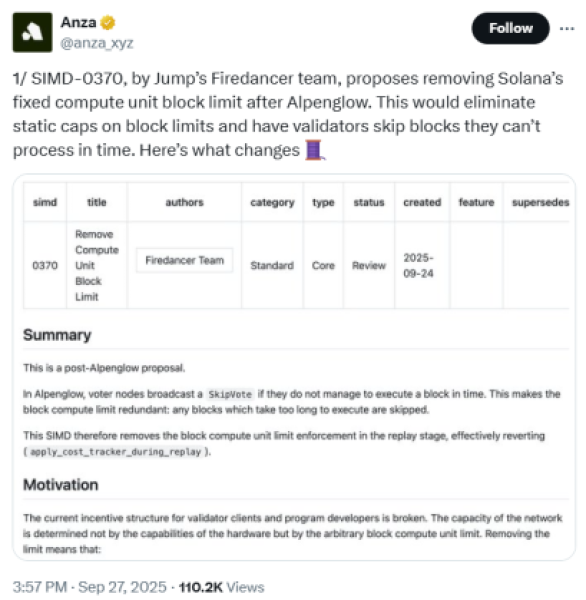
Anza announced Jump Crypto SIMD-0370 upgrade on X.
Source: X (Anza)

Macroeconomic conditions could also play a major role in $SOL’s success.

If 2025 brings lower interest rates and increased market liquidity, risk-on sentiment could return to financial markets. In such an environment, capital often flows into riskier assets like crypto, and which are better ones to invest in than the leaders: $BTC, $ETH, and $SOL?
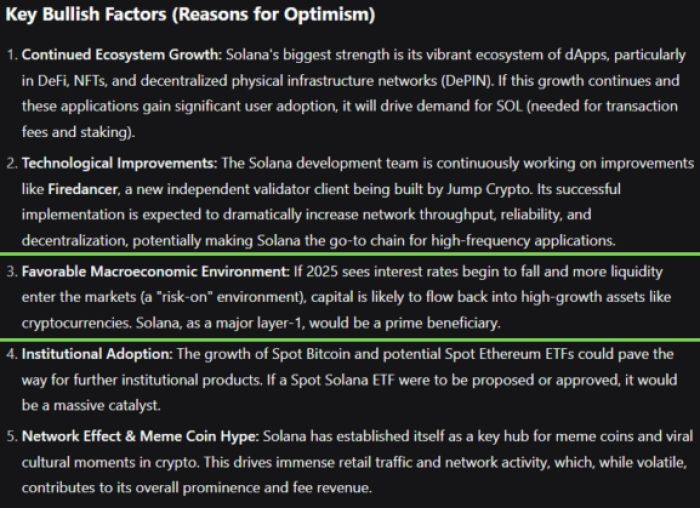
SOL bullish factors on DeepSeek.
Source: DeepSeek

Another area to watch? Solana ETFs, of course. The reason is that they’d unlock institutional capital, increase market liquidity, and cement $SOL’s status alongside $BTC and $ETH as a cornerstone asset in the digital economy.

Bloomberg analyst James Seyffart recently announced that significant movement is already underway on this front. Multiple issuers – Franklin, Fidelity, CoinShares, Direction, and Bitwise – have all submitted updated filings for $SOL ETFs.

With progress being made by the Securities and Exchange Commission (SEC), approvals may be just around the corner.
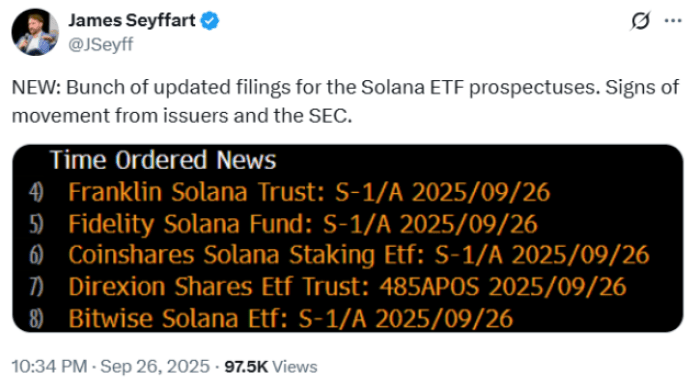
Bloomberg analyst announced SOL ETF filings on X.
Source: X (James Seyffart)

Finally, the network, driven by the best Solana meme coins and viral cultural moments like high-profile NFT mints (check out Mad Lads and Tensorians), continues to be a significant growth engine.

Together, these developments could propel not only $SOL but Solana-based projects like Snorter Token ($SNORT) to even rosier pursuits.

Snorter Bot to Go Live on Solana This Quarter

$SNORT would significantly benefit from a $SOL price rise as its flagship product – Snorter Bot – is set to go live on Solana this quarter.

The Telegram trading bot is designed to give traders a potent edge in the ultra-fast crypto market. By leveraging Solana’s high throughput, it promises to offer the lowest trading fees (at just 0.85%) and the fastest execution speeds.

When also taking into account Solana’s upcoming SIMD-0370 upgrade, its transaction fees might become even lower.

While it strategically picks Solana as its first network of choice, the bot’s also set to expand across Ethereum, BNB Chain, and other EVM-compatible chains. Doing so means that it’ll open the door to broader trading opportunities.

Whichever chain you favour, the bot will offer many ways to help you hunt down the next crypto to explode.

Take its copy trading tool, for instance. By copying the strategies of top-performing traders, you’ll be able to capitalize on market opportunities without deep crypto know-how.

To top it off, it promises to roll out automated sniping so that you can enter new token launches as soon as they go live.

Another boon is its upcoming set limit tool. You’ll be able to automatically buy and sell tokens at your preferred price tag, whether online or offline.
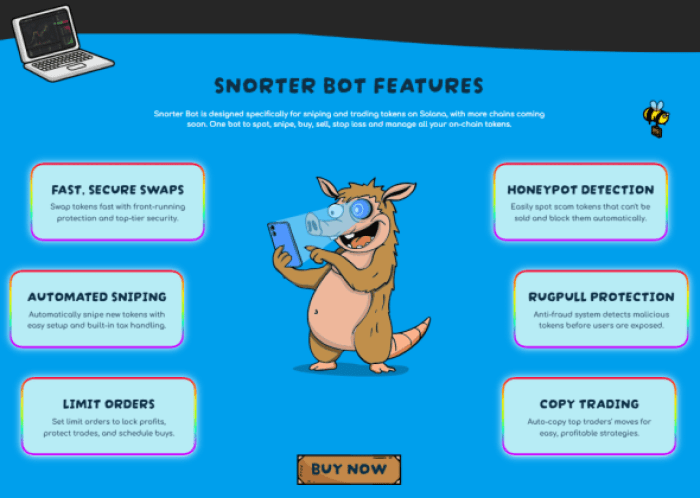
Top Snorter Token bot benefits.
Source: Snorter Token

And all will be achieved without compromising security. Snorter Bot will be MEV-protected and include built-in rug pull and honeypot detection alerts, so you don’t fall victim to scams.

Join the Snorter Token Presale for Possible 782% Returns

Behind it all is $SNORT, the ecosystem’s native token. It sets aside a substantial 25% of its total token supply for development, ensuring continuous innovation and growth.

By purchasing $SNORT, you not only contribute to its future trajectory, but are also granted perks. Think leaderboard rewards, staking yields up to 113% APY (if you join now), and DAO rights.

You can get involved by purchasing $SNORT on presale for as little as $0.1065, using either $SOL, $ETH, $USDT, $USDC, $BNB, or fiat.

Our Snorter Token price prediction anticipates it to close at around $0.94 this year. There might not be any better time to join the presale for potential returns exceeding 782%.

Join Snorter Token for possible 8x gains.

Disclaimer: This isn’t investment advice. DYOR and never invest more than you’re willing to lose. 

Authored by Leah Waters, Bitcoinist – https://bitcoinist.com/deepseek-sol-prediction-boosts-snorter-token

Editorial Process for bitcoinist is centered on delivering thoroughly researched, accurate, and unbiased content. We uphold strict sourcing standards, and each page undergoes diligent review by our team of top technology experts and seasoned editors. This process ensures the integrity, relevance, and value of our content for our readers.

Leah is a British journalist with a BA in Journalism, Media, and Communications and nearly a decade of content writing experience. Over the last four years, her focus has primarily been on Web3 technologies, driven by her genuine enthusiasm for decentralization and the latest technological advancements. She has contributed to leading crypto and NFT publications – Cointelegraph, Coinbound, Crypto News, NFT Plazas, Bitcolumnist, Techreport, and NFT Lately – which has elevated her to a senior role in crypto journalism. Whether crafting breaking news or in-depth reviews, she strives to engage her readers with the latest insights and information. Her articles often span the hottest cryptos, exchanges, and evolving regulations. As part of her ploy to attract crypto newbies into Web3, she explains even the most complex topics in an easily understandable and engaging way. Further underscoring her dynamic journalism background, she has written for various sectors, including software testing (TEST Magazine), travel (Travel Off Path), and music (Mixmag). When she's not deep into a crypto rabbit hole, she's probably island-hopping (with the Galapagos and Hainan being her go-to's). Or perhaps sketching chalk pencil drawings while listening to the Pixies, her all-time favorite band.

Lecturas Relacionadas

Anthropic lanza su OPI: ¿Milagro comercial o burbuja de valoración?

**Resumen:** Anthropic, la empresa de IA creadora de Claude, ha presentado en secreto su solicitud para una OPV (IPO), con el objetivo de cotizar en bolsa en octubre. Con una valoración actual cercana a los 965.000 millones de dólares tras una ronda de financiación de 650.000 millones, se espera que su valor supere el billón de dólares al debutar, pudiendo llegar incluso a 1,5 o 2 billones. Aunque algunos ven similitudes con la burbuja puntocom del año 2000, el artículo argumenta que existen diferencias fundamentales. A diferencia de las empresas de aquella época, que dependían de promesas sin ingresos, Anthropic presenta un crecimiento de ingresos sin precedentes (de 10.000 millones de dólares en ingresos anuales recurrentes a principios de 2025 a una proyección de 1 billón a finales de 2026), ya es rentable a nivel operativo y tiene una sólida cartera de clientes empresariales. Su alto valor se basa en métricas tangibles, como su ingreso por empleado (más de 10 millones de dólares), y un modelo de negocio SaaS predecible. El artículo concluye que este hito refleja una transición económica más profunda: el paso de una economía impulsada principalmente por el "carbono" (trabajo humano) a una economía dual "carbono-silicio", donde la inversión en capacidad de IA y potencia de cálculo se convierte en un motor clave de productividad y competitividad empresarial.

链捕手Hace 2 hora(s)

Anthropic lanza su OPI: ¿Milagro comercial o burbuja de valoración?

链捕手Hace 2 hora(s)

Senadores de EE.UU. presionan a los reguladores bancarios para obtener reglas de capital "justas" para las criptomonedas

Un grupo de senadores republicanos estadounidenses está presionando a los reguladores bancarios para que establezcan un marco de capital más claro y justo para las actividades con criptoactivos. En una carta dirigida a la Fed, la FDIC y la OCC, los legisladores, encabezados por la senadora Cynthia Lummis, criticaron los estrictos estándares de capital del Comité de Basilea, que asignan una ponderación de riesgo del 1250% a los criptoactivos, calificándola de "penalización general" que actúa como una prohibición efectiva. Los senadores elogiaron la guía interagencial reciente sobre valores tokenizados, que aclara que deben recibir el mismo tratamiento de capital que sus equivalentes no tokenizados, basándose en el riesgo del activo subyacente y no en la tecnología. Instaron a que este principio se aplique de manera consistente a otros activos digitales y a que se desarrolle un nuevo marco regulatorio, aprovechando también el progreso del proyecto de ley sobre estructura del mercado cripto. La solicitud coincide con el testimonio de los principales reguladores ante el Congreso, donde destacaron un cambio hacia una supervisión más "basada en el riesgo" y eficiente. El presidente de la FDIC, Travis Hill, y el interventor de la OCC, Jonathan Gould, subrayaron el papel del capital para la resiliencia del sistema y se comprometieron a facilitar la innovación responsable, revisando prácticas supervisoras pasadas e investigando denuncias de exclusión bancaria ("debanking").

bitcoinistHace 2 hora(s)

Senadores de EE.UU. presionan a los reguladores bancarios para obtener reglas de capital "justas" para las criptomonedas

bitcoinistHace 2 hora(s)

Near vuelve al escenario de la IA: la transformación en cadena pública por problemas para pagar salarios, y los agentes y la privacidad como nueva narrativa de crecimiento

**Resumen: Near regresa a la IA: De una cadena de bloques por problemas de pago a Agentes y privacidad como nueva narrativa** Near, fundada por Illia Polosukhin, coautor del influyente artículo "Transformer" de IA, nació de manera inesperada en 2017. La razón original fue pragmática: una startup de IA que Polosukhin cofundó tuvo que pausar su trabajo en "síntesis de programas" (enseñar a máquinas a escribir código) debido a la dificultad de pagar a desarrolladores remotos en todo el mundo. Ante sistemas de pago transfronterizos ineficientes, él y su cofundador decidieron construir su propia cadena de bloques escalable y de bajo costo: Near. Aunque Near ganó tracción como cadena de alto rendimiento, su momento crucial llegó con el auge actual de la IA. La participación de Polosukhin en eventos como el GTC de Nvidia volvió a poner el foco en su legado en IA. Near ha reposicionado su tecnología hacia dos áreas clave: 1. **Near Intents (Intenciones):** Este sistema abstrae la complejidad de las transacciones entre cadenas. Los usuarios (o futuros Agentes de IA) solo declaran su objetivo (ej. "intercambiar BTC por ETH"), y una red de "solvers" (solucionadores) encuentra y ejecuta la mejor ruta, manejando los costos de gas de fondo. Esta capa ha procesado más de **200.000 millones de dólares** en volumen y generado **más de 34 millones** en tarifas, integrada en 25 cadenas. 2. **Transacciones Privadas:** Near ha lanzado funciones de "Intenciones Confidenciales" e "Intercambios Confidenciales" que ocultan los detalles de las operaciones (monto, dirección) hasta su liquidación. Esto protege a los grandes traders del "MEV" y del deslizamiento. Sorprendentemente, este tipo de transacciones ya representa **más del 40%** del volumen reciente en Near, mostrando una fuerte demanda, pero también planteando posibles desafíos regulatorios en el futuro. En resumen, Near ha vuelto a sus raíces en IA, aprovechando su tecnología de cadena abstracta para facilitar la economía de los Agentes de IA y abordando la creciente demanda de privacidad en DeFi, mientras navega por las oportunidades y riesgos de este nuevo capítulo.

marsbitHace 5 hora(s)

Near vuelve al escenario de la IA: la transformación en cadena pública por problemas para pagar salarios, y los agentes y la privacidad como nueva narrativa de crecimiento

marsbitHace 5 hora(s)

Trading

Spot
Futuros
活动图片