Ripple Powers New Offramp For BlackRock, VanEck Tokenized Fund

bitcoinistPublicado a 2025-09-25Actualizado a 2025-09-25

Resumen

Ripple has added another institutional rail to its stablecoin strategy: through an integration with Securitize, holders of BlackRock’s USD Institutional...

Trusted Editorial content, reviewed by leading industry experts and seasoned editors. Ad Disclosure

Ripple has added another institutional rail to its stablecoin strategy: through an integration with Securitize, holders of BlackRock’s USD Institutional Digital Liquidity Fund (BUIDL) and VanEck’s VBILL tokenized US Treasuries can now redeem fund shares for Ripple USD (RLUSD) around the clock—initially on Ethereum, with support for the XRP Ledger (XRPL) in the pipeline.

BlackRock And VanEck Turn To Ripple’s RLUSD

In a press release dated September 23, Ripple and Securitize said a new smart-contract flow “would allow holders of BlackRock’s BUIDL and VanEck’s VBILL to exchange their shares … for Ripple USD (RLUSD),” describing the mechanism as “an additional stablecoin off ramp for BUIDL and VBILL tokenized short term treasury funds.” The companies emphasized continuous availability—“24/7”—and framed the upgrade as programmable liquidity for compliant, on-chain investment products. Securitize also confirmed it is integrating with the XRP Ledger “to expand access and bring new utility to the XRPL ecosystem.”

Jack McDonald, Ripple’s SVP of Stablecoins, positioned the move as a bridge between tokenized funds and transactional money: “RLUSD is for institutional use, offering regulatory clarity, stability, and real utility. As adoption grows, partnerships with trusted platforms like Securitize are key to unlocking new liquidity and enterprise-grade use cases.” On X, McDonald distilled the news for market participants: “RLUSD is now a key stablecoin offramp for BlackRock’s BUIDL and VanEck’s VBILL tokenized fund holders. The integration is starting with ETH, though Securitize is planning to integrate with the XRP Ledger.”

Ripple President Monica Long linked the Securitize integration to a broader RLUSD tokenization push announced the prior week with DBS and Franklin Templeton, where RLUSD serves as a “liquid, stable and compliant exchange mechanism for tokenized assets in lending and trading use cases.” “This week, Securitize added RLUSD as a new offramp for BlackRock and VanEck’s tokenized funds,” she noted.

Ripple CEO Brad Garlinghouse underscored the 24/7 redemption promise and the XRPL roadmap: “Very excited to share that BlackRock’s BUIDL and @VanEck_US’s VBILL tokenized fund holders can redeem shares for RLUSD/ETH 24/7 365 through Securitize, and soon to come RLUSD/XRPL. Enterprise-grade instant onchain liquidity at your fingertips. That’s real utility.”

The companies framed the design as explicitly regulatory-first. Ripple said RLUSD is issued under a New York Department of Financial Services (NYDFS) trust charter, with “1:1 USD backing by high-quality liquid assets, strict reserve management and asset segregation, third-party attestations and clear redemption rights.” Ripple added that since launch in late 2024, RLUSD has integrated into DeFi and cross-border payment flows and surpassed $700 million in market capitalization.

For tokenized funds, the off-ramp matters because it stitches together yield-bearing on-chain treasuries with settlement-grade stablecoin liquidity. BlackRock’s BUIDL and VanEck’s VBILL are tokenized short-term US Treasury strategies issued through Securitize on public blockchains; the new workflow lets qualified holders convert fund shares into RLUSD without banking hours friction, potentially improving collateral mobility for trading, lending, repo and treasury operations.

Ripple Puts New Focus On Tokenization

The development also follows Ripple’s tie-up with DBS and Franklin Templeton, which is listing Franklin’s sgBENJI token on the DBS Digital Exchange alongside RLUSD to enable swapping between the tokenized fund and the stablecoin, and to explore using tokenized fund units as repo collateral—an example of how banks envisage tokenization rails meeting institutional liquidity needs.

While the initial redemption path is live on Ethereum via Securitize, both firms signaled that XRPL integration is next, aligning with Ripple’s push to make RLUSD natively useful across multiple venues. If executed, XRPL support would extend the same institutional redemption mechanics to a different settlement environment—one that Ripple and parts of the treasury-tokenization market already touch via custody, payments, and prior Franklin Templeton XRPL issuance plans.

Notably, BlackRock will be represented at Ripple Swell 2025 in New York on November 4–5 at Convene Hudson Yards. Maxwell Stein, BlackRock’s Director of Digital Assets, is slated to speak in a session titled “The Impact of Tokenized Financial Assets on Capital Markets,” alongside Rory Callagy of Moody’s.

At press time, XRP traded at $2.88.
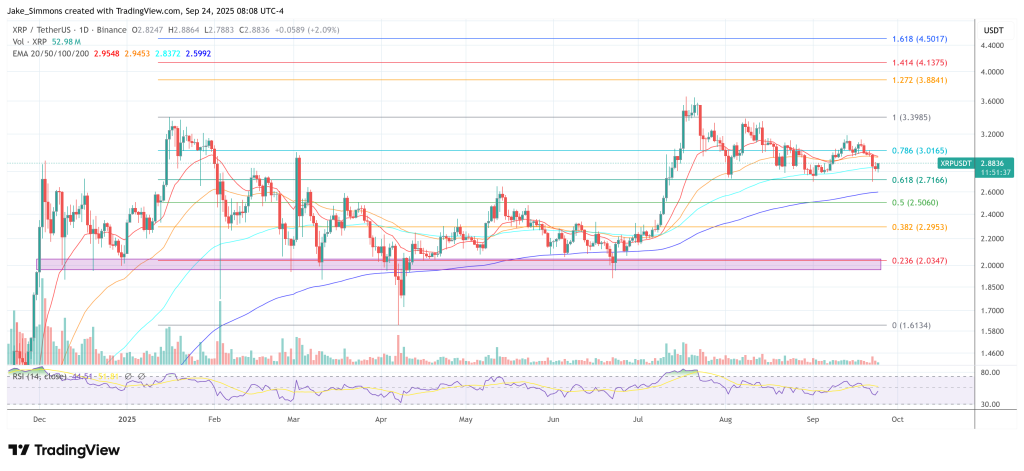
XRP price
XRP price, 1-day chart | Source: XRPUSDT on TradingView.com
Featured image created with DALL.E, chart from TradingView.com
Editorial Process for bitcoinist is centered on delivering thoroughly researched, accurate, and unbiased content. We uphold strict sourcing standards, and each page undergoes diligent review by our team of top technology experts and seasoned editors. This process ensures the integrity, relevance, and value of our content for our readers.

Jake Simmons has been a Bitcoin enthusiast since 2016. Ever since he heard about Bitcoin, he has been studying the topic every day and trying to share his knowledge with others. His goal is to contribute to Bitcoin's financial revolution, which will replace the fiat money system. Besides BTC and crypto, Jake studied Business Informatics at a university. After graduation in 2017, he has been working in the blockchain and crypto sector. You can follow Jake on Twitter at @realJakeSimmons.

Lecturas Relacionadas

El misterioso modelo de gran tamaño «Ox Alpha» causa sensación, gratuito por tiempo limitado

El misterioso modelo de IA "Ox Alpha", apodado "Llega el Buey", está causando revuelo al aparecer de forma anónima en OpenRouter, ofreciéndose de forma gratuita y limitada. Con un contexto de 1 millón de tokens y capacidades multimodales (texto, imagen, video), ha llamado la atención por su destacado rendimiento en tareas de programación. En pruebas iniciales del benchmark DeepSWE, que evalúa habilidades reales de ingeniería de software, logró una tasa de éxito del 80%, aproximándose a los principales modelos de código actuales, aunque resultados posteriores sugieren un 63%. Su identidad es un enigma. La evidencia más fuerte apunta a que podría ser una versión no lanzada de Zhipu AI, posiblemente GLM-5.3 Flash o una variante multimodal. Las pistas incluyen similitudes exactas en el tokenizador visual y de texto con modelos GLM, así como estilos de respuesta y comportamientos de agente similares. Mientras tanto, otro modelo anónimo llamado "korrine" aparece en Code Arena, con especulaciones que lo vinculan a Kimi, Qwen o MiMo. Este fenómeno de pruebas anónimas o "con identidad oculta" permite una evaluación más objetiva, libre de sesgos de marca, y sirve como una prueba de estrés pública para los desarrolladores antes del lanzamiento oficial. También se ha convertido en una efectiva herramienta de marketing que genera expectación. Si "Llega el Buey" es efectivamente un modelo "Flash" (optimizado en eficiencia), su alto rendimiento sugiere que las versiones completas podrían establecer nuevos estándares de capacidad.

marsbitHace 2 hora(s)

El misterioso modelo de gran tamaño «Ox Alpha» causa sensación, gratuito por tiempo limitado

marsbitHace 2 hora(s)

Hace un momento, se disputó el primer partido de tenis humano-máquina del mundo, el robot salvó la pelota al límite, dejando a Zheng Jie boquiabierta

El primer partido de tenis entre un humano y un robot humanoide del mundo se ha celebrado, protagonizado por la tenista profesional Zheng Jie y un robot desarrollado por Galaxy General. El evento, retransmitido en directo a nivel global, marcó un hito en el campo de la inteligencia encarnada, mostrando cómo la IA puede enfrentarse a desafíos físicos en tiempo real y bajo presión. Durante el partido, el robot demostró habilidades notables: movimientos ágiles, coordinación en dobles, golpes de derecha y revés, e incluso logró levantarse rápidamente tras una caída. Respondió a pelotas altas, efectos y cambios de ritmo, con reacciones en décimas de segundo ante saques de más de 100 km/h. Este logro supera las pruebas anteriores de IA, como AlphaGo, porque el tenis requiere integrar percepción, toma de decisiones y control motor en un entorno físico impredecible y en tiempo real. La clave es el modelo "AstraBrain" de Galaxy, que unifica en una sola arquitectura la planificación cognitiva y el control motor, evitando retrasos y desconexiones. El entrenamiento combinó datos de movimientos humanos (aunque imperfectos) con millones de partidas en simulaciones virtuales, donde el robot evolucionó mediante aprendizaje por refuerzo, desarrollando habilidades no programadas explícitamente, como rescates extremos o recuperarse de caídas. El momento "AstraTennis" simboliza el avance de la IA desde el dominio digital al físico, destacando el papel innovador de China en la creación de sistemas de inteligencia encarnada capaces de interactuar y competir en el mundo real.

marsbitHace 3 hora(s)

Hace un momento, se disputó el primer partido de tenis humano-máquina del mundo, el robot salvó la pelota al límite, dejando a Zheng Jie boquiabierta

marsbitHace 3 hora(s)

Trading

Spot
活动图片